

Billing for laboratory services is the process of turning an ordered, medically supported, and performed clinical test into a payer-compliant claim, then reconciling the payment or denial that comes back. From the outside it looks like ordinary medical billing. It is not. The specimen, the performing laboratory, the CLIA certificate, the date of service, the place of service, and the entity legally permitted to submit the claim each change the result.
This guide is for laboratory owners, administrators, directors, billing managers, revenue cycle leaders, and compliance teams in independent, reference, hospital outreach, and physician-office laboratories across the United States.
The most consequential errors often occur before coding begins. A laboratory claim can be flawlessly coded and still be wrong. If the wrong entity submits it, if the date of service was assigned under the wrong rule, if the performing site was not covered by the right CLIA certificate, or if the order never identified the specific test, the coding never gets a chance to matter.
What follows covers who may bill, the order-to-cash workflow, pre-submission validation, codes and modifiers, panels and repeats, Medicare payment and the Clinical Laboratory Fee Schedule in 2026, date of service and the 14-day rule, referred testing, CLIA and medical necessity, payer differences, denials, accounts receivable, and an audit you can run yourself. If you already outsource, measure your laboratory billing services against the same framework. Every rule below is scoped to a payer and a setting. Read them that way.
Use one practical checklist to review orders, CLIA information, coding, modifiers, billing authority, claim readiness, and date-of-service decisions before laboratory claims are released.
Table of Contents
1. What Is Billing for Laboratory Services?
Direct answer. Billing for laboratory services is the process of turning ordered and performed clinical tests into compliant claims for payment. It connects the ordering practitioner’s medical-necessity documentation with the performing laboratory, test codes, date and place of service, CLIA status, claim form, and payer rules. Billing is narrower than full revenue cycle management, and Medicare payment depends heavily on the setting and on who actually performed the test.
Definition. Billing for laboratory services is the controlled conversion of a clinical laboratory event – an order, a specimen, a performed test, and a result – into a claim a specific payer will adjudicate, followed by the posting, correction, appeal, or collection of whatever that payer returns.
What a Laboratory Claim Must Connect
Medical billing for laboratory services differs from general physician billing because the ordering, collecting, performing, and billing entities may all be different organizations. Payment may come from Medicare fee-for-service, a Medicare Advantage plan, a state Medicaid program, a Medicaid managed care organization, or a commercial plan – five separate rulebooks. A supportable claim ties together facts that live in different systems:
- The order or documented intent to order, and the ordering practitioner’s identity
- The clinical reason for the test, in the record and communicated through ICD-10-CM
- The specimen – source, collection date, collection time, accession
- The test actually performed, and the final report proving it
- The performing laboratory and its CLIA status for that test’s complexity
- The billing entity, its identifiers, and its authority to submit this claim
- Date of service, place of service, codes, units, and only supported modifiers
A diagnosis code that satisfies an automated edit is not documented medical necessity. The edit is a gate. The record is the evidence.
Billing vs. Coding vs. Revenue Cycle Management
Table 1. How laboratory coding, billing, and RCM differ
| Function | What it does | Main output |
| Coding | Translates the performed service and documented clinical reason into CPT, HCPCS, PLA, ICD-10-CM, units and modifiers | Coded service ready for claim build |
| Billing | Prepares, validates, submits and follows the claim – identifiers, CLIA data, claim form, transmission, rejection correction | Payer-compliant claim and a receivable |
| Laboratory RCM | Both of the above plus enrollment, eligibility, authorization, contracting, denials, A/R, reporting and compliance | Collected and reconciled revenue |
Who Orders, Who Performs, and Who Bills
This distinction causes the most avoidable damage in laboratory billing: the entity that orders a test, the entity that collects the specimen, the entity that performs it, and the entity permitted to bill for it can be four different organizations.
Table 2. Roles in a laboratory claim
| Role | Who fills it | Creates billing authority? |
| Ordering practitioner | Physician or qualified non-physician practitioner | No – ordering does not permit billing the technical service |
| Collecting site | Office, draw station, hospital, mobile phlebotomist | No – a collection fee is not authority to bill the test |
| Performing laboratory | The laboratory that analyzes the specimen | Generally yes under Medicare – the default biller |
| Billing entity | Whose identifiers appear on the claim | Yes, where the payer rule permits |
| Billing vendor or clearinghouse | Outsourced RCM company, EDI intermediary | No – preparing or transmitting does not make you the billing provider |

Why Setting and Payment System Change the Claim
The same assay follows a different financial path depending on where the specimen originated. Performed by an independent laboratory it commonly moves on a professional claim paid under the Clinical Laboratory Fee Schedule; performed on a hospital inpatient it is generally inside the hospital’s inpatient payment; in hospital outpatient, packaging rules apply. Services involving separately payable physician work may fall under the Physician Fee Schedule instead, which changes the payment amount, the modifier logic, and the patient’s cost-sharing exposure. And a code appearing on a Medicare fee schedule does not establish that Medicare covers the test – CMS states this directly on its CLFS files page.
2. Who Can Bill for Laboratory Services?
Direct answer. Under Medicare fee-for-service, the entity that performs a clinical laboratory test generally bills for it. A physician or group may bill tests performed inside its own appropriately CLIA-certified office laboratory, but not the technical service for tests sent outside. Narrow referred-test exceptions may let an eligible independent or hospital non-patient laboratory bill another laboratory’s work, and hospital or facility payment rules can override the default entirely.
The Performing Entity Is the Default Biller
Under Medicare fee-for-service, the performing laboratory is generally the default biller unless a facility-payment rule or a valid referred-test exception allows another eligible entity to submit the claim. Ordering does not create billing authority. Collecting a specimen does not create billing authority. Receiving the result does not create billing authority.
Contractors enforce this actively rather than theoretically. Novitas Solutions published findings from a review in which ordered or referred tests were being billed by both the physician and the laboratory for the same service, and refunds were requested from the ordering or referring physician. Its guidance is unambiguous: physicians who order or refer a laboratory test are not permitted to bill Medicare for a service they did not perform. Only one entity should submit the charge for a referred test – Novitas has described processing on a first-in approach and denying the second claim absent an appropriate modifier or narrative showing the service was separate and unique.
These physician billing guidelines for laboratory services apply to Medicare fee-for-service; commercial and Medicaid arrangements require separate review. One point also surprises laboratories using outsourced support: a billing company or clearinghouse never becomes the legal billing provider. It prepares and transmits on behalf of an entity that already holds the authority.
When a Physician-Office Laboratory Can Bill
A physician-office laboratory has real billing authority – it is simply narrower than most offices assume. Run this sequence rather than defaulting to habit. Field-level detail sits in the dedicated physician-office laboratory billing guidelines.
Table 3. Physician-office laboratory billing decision framework
| Question | If yes | If no |
| Test physically performed in the office laboratory? | Go to the CLIA question | The performing outside laboratory generally bills. Stop |
| Appropriate CLIA certificate for that complexity? | The physician or group may generally bill it | Do not perform or bill that test at that site |
| Separately reportable professional interpretation? | Evaluate professional-component rules separately | Bill only the laboratory service performed |
| Specimen sent to an outside laboratory? | The performing reference laboratory generally bills | Confirm whether a facility rule applies |
| Relying on a referred-test exception? | Do not assume eligibility – confirm conditions with your MAC first | Bill only what the office performed |
| Commercial rather than Medicare FFS? | Commercial only – not Medicare FFS. Check the contract and policy | Apply the Medicare framework |
Who Bills, by Setting
Patient status matters more than geography. A specimen drawn in the same building can follow three different billing routes depending on whether the patient was an inpatient, a registered outpatient, or a non-patient.
Table 4. Who-can-bill setting matrix (Medicare FFS)
| Setting | Generally bills | Route | Key limitation |
| Physician’s own office laboratory | Physician or group | CMS-1500 / 837P | Appropriate CLIA status; test performed on site |
| Ordered by physician, performed outside | Performing reference laboratory | CMS-1500 / 837P | Physician cannot bill the technical component |
| Independent laboratory, own test | Performing independent laboratory | CMS-1500 / 837P | Others cannot bill without a valid exception |
| Hospital inpatient | Hospital | UB-04 / 837I | Generally included in the inpatient payment |
| Hospital outpatient | Hospital | UB-04 / 837I | Packaging and separate-payment rules vary |
| Hospital non-patient / outreach | Hospital or permitted laboratory | UB-04 / 837I, TOB 14X where applicable | Non-patient is not the same as outpatient |
| Pathologist interpretation | Pathologist or physician group | CMS-1500 / 837P | Only where the code supports a professional component |
Independent laboratories carry the cleanest version of this rule and the highest exposure when entity mapping drifts; if you run one, see our billing support for independent laboratories. Skilled nursing facilities, critical access hospitals, rural health clinics, federally qualified health centers, and dialysis facilities operate under facility-specific payment rules that can replace the default pathway.
3. How the Laboratory Billing Process Works From Test Order to Collected Cash
Direct answer. The laboratory billing process starts with a documented test order and runs through registration, coverage review, specimen collection, testing, coding, claim submission, payer adjudication, payment posting, denial or underpayment resolution, and final A/R reconciliation. Each stage depends on data created upstream. Errors introduced early surface later as rejections, denials, delayed payment, or compliance exposure.
The Order-to-Cash Workflow
The following overview explains how to bill laboratory services from order through final account resolution.
- Order and medical-necessity documentation – a specific, authenticated order from an eligible practitioner
- Registration, eligibility, benefits, and authorization where the payer requires it
- Specimen collection and accessioning – source, date, time, collector, accession number
- Test performance and final report by a laboratory with appropriate CLIA authority
- Charge capture and coding – only work actually performed, mapped to current codes
- Claim validation – CLIA, NPI, TIN, DOS, POS, units, modifiers, performing and billing entity
- Scrubbing, submission, and correction of front-end rejections
- Payer adjudication against coverage, coding, contract, and pricing rules
- Remittance receipt and posting – allowed, paid, adjusted, patient responsibility
- Denials, corrected claims, appeals, and underpayment recovery
- A/R closure, reporting, and feedback into the front end
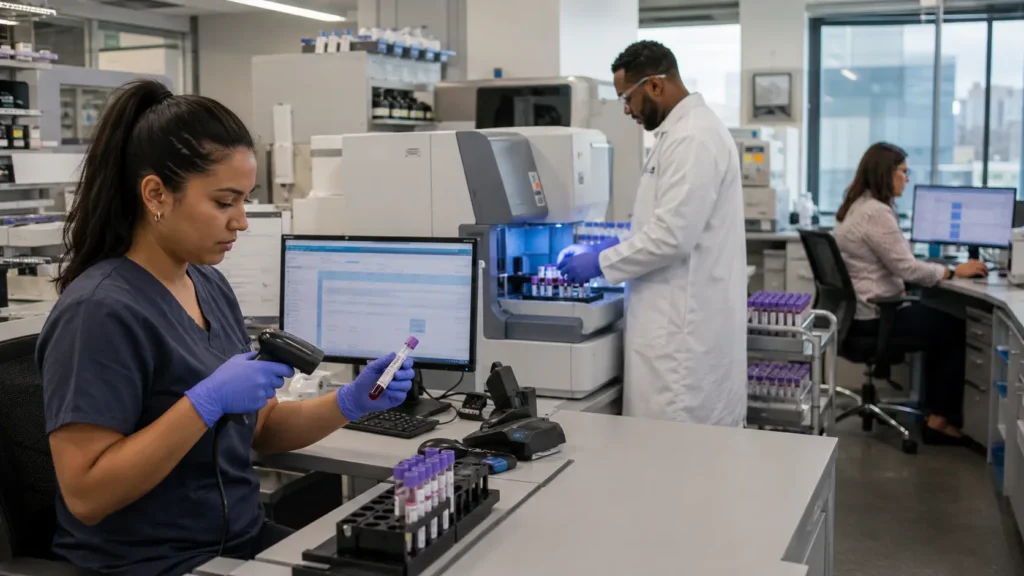
Note what stage one is. Billing begins before the specimen is tested. By the time a coder sees the account, most of the outcome has already been set by the order, the registration data, and the collection record.
Where the Handoffs Fail
- Practitioner to laboratory intake. A vague order, a missing ordering NPI, or a clinical indication that never reached the requisition. Nothing downstream repairs this.
- Collection to performing laboratory. Missing collection date or time, patient-specimen mismatch, or an accession that cannot be traced to the original request.
- Laboratory to coding. The report shows what was performed; the charge shows what was captured. When those diverge, the claim is understated or unsupported.
- Billing to payer. Wrong product, wrong claim route, wrong payer identifier – the claim never enters adjudication while the timely-filing clock runs.
A useful discipline: treat every denial as a question about which handoff failed, not about which coder erred. Claim-entry mechanics, field placement, and submission procedure are covered separately in our step-by-step laboratory claim process.
Rejection, Denial, Underpayment – Not the Same Thing
Table 5. Three failures, three workflows
| Event | When it happens | Correct response |
| Rejection | Before full adjudication, at clearinghouse or payer intake | Correct source data and resubmit – not a medical-necessity appeal |
| Denial | After the payer adjudicated the claim | Decide corrected claim versus formal appeal |
| Underpayment | Claim paid, but below the correct expected allowance | Compare to the service-date fee schedule or contract, then dispute |
4. What Must Be Correct Before a Laboratory Claim Is Submitted?
Direct answer. Before a laboratory claim is submitted, the patient, payer, order, medical necessity, specimen, test, performing laboratory, billing entity, codes, CLIA information, provider identifiers, date and place of service, units, modifiers, authorization, notice requirements, and claim route must all be accurate and supported. A claim that is technically complete but inconsistent with the documentation, setting, or payer rules can still be rejected, denied, underpaid, or recouped.
Complete Is Not the Same as Compliant
Five standards apply to one claim, and passing one does not mean passing the rest. Complete means required fields are populated. Accurate means the data reflect the real patient, test, and provider. Supported means retrievable documentation substantiates it. Eligible means the billing entity may submit it. Payable means coverage, necessity, coding, and authorization conditions are met. A scrubber tests the first standard well and the last two barely at all, and that gap is where apparently complete claims can still fail compliance or payment review.
Claim-Readiness Checklist
- Patient and coverage: identifiers match the payer record; subscriber and policy data correct; correct payer and product; coverage verified for the service date; coordination of benefits resolved.
- Order and necessity: ordering practitioner identified with a valid NPI; the specific test identified; requisition or authenticated documentation retained; test billed matches test ordered and reported; clinical indication documented; applicable NCD, LCD or payer policy reviewed.
- Laboratory and entity: performing laboratory identified; billing entity permitted to submit; CLIA certificate active and covering that complexity; billing NPI and TIN correct; service-facility information accurate where required.
- Coding: code valid for the date of service; diagnosis supported and pointed correctly; panel versus component reviewed; units correct; every modifier justified by facts rather than by a prior denial; current NCCI and MUE files loaded.
- Date and setting: DOS determined under the applicable rule; collection date and time documented; hospital patient status confirmed where relevant; POS correct for the service and payer; claim route consistent with the billing entity.
- Conditional items: authorization obtained where required and matching code, provider, site and dates; ABN evaluated for Original Medicare where noncoverage is expected; supporting records retained and retrievable.
Required Versus Conditional
Table 6. Required and conditional claim elements
| Element | Status | Main caution |
| Patient and subscriber identifiers | Required | Exact fields vary by claim type and payer |
| Eligibility verification | Operationally required | Active eligibility is not a coverage determination |
| Ordering practitioner | Required where an order is required | Field and loop placement vary by claim route |
| Medical-necessity documentation | Required | A diagnosis code alone may be insufficient |
| Performing and billing entity | Required | Billing authority exists independently of the claim form |
| CLIA status | Required | Certificate type must match test complexity |
| CLIA number on the claim | Conditional | Depends on claim type, service and current instructions |
| Units | Required | Code-specific – one unit is not universally one specimen |
| Modifiers 90, 91, 59, QW, 26, TC, GA | Conditional | Each has factual preconditions; presence never cures an invalid claim |
| Prior authorization | Conditional | Common commercially; not a universal Medicare FFS requirement |
| ABN | Conditional | Original Medicare notice process only |
Enrollment is a claim-readiness issue, not back-office housekeeping: an entity not correctly enrolled and mapped for the product being billed fails at intake regardless of coding quality, which is why laboratory payer enrollment and credentialing belongs upstream of the scrubber. Hold the claim when a material element cannot be validated – a held claim is a scheduling problem, a released claim with an unsupported element is a repayment problem. High-volume menus need this gate automated, which is the core of well-built diagnostic laboratory billing workflows.
5. Laboratory Billing Codes and Modifiers
Direct answer. Laboratory claims use CPT and HCPCS codes to identify services, including PLA and MAAA code types for certain proprietary or algorithmic tests, while ICD-10-CM communicates the supported clinical reason. Modifiers explain circumstances such as professional or technical components, outside-laboratory performance, medically necessary repeats, distinct services, CLIA-waived testing, or an advance beneficiary notice. Every code, unit, and modifier must match current documentation, payer policy, and effective-date rules.
The Code Systems on a Laboratory Claim
PLA and MAAA are categories inside CPT, not separate national code sets. The CLFS, the Physician Fee Schedule, OPPS, and IPPS are payment systems, not code systems. Mixing those two ideas produces claims that are internally inconsistent.
Table 7. Code systems and what each one carries
| Code set | Claim function | Main risk |
| CPT | Laboratory, pathology and physician services | A code not valid on the date of service |
| HCPCS Level II | Medicare-specific services not represented through CPT alone | Wrong code family for the payer |
| PLA | CPT category for specific proprietary laboratory analyses | Billing before the payer recognizes or prices the code |
| MAAA | CPT category for qualifying multianalyte algorithmic services | Treating every multianalyte test as a MAAA |
| ICD-10-CM | The documented diagnosis or reason for testing | A diagnosis chosen from a covered list, not the record |
Most qualifying clinical diagnostic tests without separately payable physician work are paid under the CLFS; services including physician work may fall under the Physician Fee Schedule; hospital settings can package the work into a facility payment. The practical question is never “what does this test pay?” It is “what does this test pay, for this payer, in this setting, on this date, billed by this entity?”
Modifier Decision Table
An unsupported modifier can turn an otherwise defensible claim into a coding and compliance problem. Each row states the factual precondition.
Table 8. Laboratory modifier logic
| Modifier | Communicates | Use only when | Never use when |
| 26 | Professional component only | PC/TC structure supports a separately reportable physician component and the interpretation is documented | Global-only or technical-only code, or a physician merely reviewed an automated result |
| TC | Technical component only | The technical portion is separately reportable and furnished by the billing entity | Professional-only code, or the concept does not apply |
| 90 | An outside laboratory performed the test | The billing entity already holds authority to report another laboratory’s work | The reporting entity lacks authority, or the test was performed in house |
| 91 | Medically necessary repeat of the same test | Repeated the same day for a genuine clinical reason | Damaged specimen, equipment failure, quality control, or duplicate submission |
| 59 | A distinct procedural service | Documentation establishes distinctness and no more specific modifier fits | Used to get past a bundling edit |
| XE, XP, XS, XU | Separate encounter, practitioner, structure or non-overlapping service | The named distinction is the actual fact and the edit recognizes it | A separate specimen is treated as a separate structure |
| QW | A qualifying CLIA-waived test | Current code-specific instructions require it | Waived status alone is treated as the trigger |
| GA | A required Medicare liability notice is on file | A valid ABN was obtained before the service | No valid advance notice exists, or it is added after a denial |
Modifier 90 does not create billing authority. It reports a circumstance for an entity that already holds the right to bill. Code maintenance is continuous – annual CPT and ICD-10-CM updates, quarterly HCPCS, CLFS, NCCI and MUE files, and payer revisions on their own schedule – which is why laboratories without that capacity outsource it as laboratory billing and coding services.
6. How to Bill Laboratory Panels, Repeat Tests, Units, and Distinct Services Correctly
Direct answer. Correct laboratory billing starts by matching the claim to the exact tests, specimens, encounters, and units documented. Complete panels follow current panel-coding rules, while incomplete testing requires component-level review. Modifier 91 is reserved for medically necessary same-day repeats, not technical reruns. Modifier 59 or an X modifier applies only where documentation proves a genuinely distinct service under the relevant NCCI or payer rule.
Complete Versus Incomplete Panels
Medicare’s instruction is direct. When billing organ or disease-oriented panels, laboratories bill the HCPCS panel test code and do not unbundle the individual components if all components were performed; claims can be returned as unprocessable when the panel code is not billed. The guidance sits in Chapter 16, Section 90.2 of the Medicare Claims Processing Manual. The reverse error is more dangerous: billing a complete panel when a required component was never performed.
Table 9. Panel versus component billing matrix
| Situation | Correct action | Incorrect action |
| All panel components performed | Report the panel code | Reporting every component separately |
| One or more components not performed | Report only the supported individual services | Billing the full panel anyway |
| Performed tests overlap two panels | Select an accurate combination after edit review | Reporting both panels so shared components pay twice |
| Panel plus a genuinely additional test | Report the panel and the additional service where allowed | Reporting a service already inside the panel |
Repeat Tests Versus Duplicates and Reruns
Table 10. Repeat, rerun, or duplicate
| Scenario | Classification | Handling |
| Same test repeated because the condition requires a later result | True clinical repeat | Report under current payer rules; modifier 91 may apply |
| Rerun after a damaged specimen | Technical rerun | Not a separately billable clinical repeat |
| Rerun after equipment failure or quality control | Technical rerun | Correct internally; do not bill as a repeat |
| The same claim resubmitted in error | Duplicate claim | Void or correct the claim; no repeat modifier |
Modifier 91 does not fix a duplicate denial. If the second line was never a clinically necessary repeat, appending 91 misrepresents the service. Medicare’s rules on tests performed more than once on the same day sit in Chapter 16, Section 100.5.1.
Units, Specimens, and MUEs
Units follow the code’s own definition of the service. One unit is not universally one specimen, one analyte, one container, or one claim line. Three separate controls also get merged constantly: Medically Unlikely Edits address units for an individual code, NCCI procedure-to-procedure edits address code pairs, and coverage frequency limits in an NCD, LCD or payer policy are a third control entirely. Collapsing all three into “the frequency edit” is how laboratories appeal the wrong thing. High-volume drug-testing menus are the sharpest version of this, which is why those laboratories usually need code-specific toxicology and drug-testing billing.
7. Medicare Laboratory Billing and the CLFS in 2026
Direct answer. Medicare pays for most clinical diagnostic laboratory tests based on the weighted median of private payor rates reported by applicable laboratories under the Clinical Laboratory Fee Schedule. Rates are typically updated every three years under the Protecting Access to Medicare Act. For the current cycle, CMS identifies a data collection period of January 1 to June 30, 2025, and a data reporting period of May 1 to July 31, 2026.
2026 CLFS and PAMA update. On February 3, 2026, Section 6226 of the Consolidated Appropriations Act, 2026 updated data reporting requirements for clinical diagnostic laboratory tests that are not ADLTs, and delayed the phase-in of payment reductions from private payor rate implementation. Under current CMS CLFS and PAMA reporting guidance: the data collection period is January 1 to June 30, 2025; the data reporting period is May 1 to July 31, 2026; there is no phase-in reduction in 2026; and beginning January 1, 2027 through 2029, payment may not be reduced by more than 15 percent per year compared with the amount established for that test the preceding year. Reported data are expected to update CLFS amounts effective January 1, 2027.
Which Medicare Payment System Applies
For Medicare lab billing, the CMS CLFS and CLFS reporting rules have to be reviewed separately from coverage policy. The CLFS is one pathway, not the only one. Hospital inpatient laboratory services are generally included in the inpatient payment. Hospital outpatient services follow outpatient rules, where some laboratory work is packaged. Services involving separately payable physician work may be paid under the Physician Fee Schedule. Covered services paid under the CLFS generally carry no beneficiary deductible or coinsurance. And CMS states on its CLFS files page that including a code or payment amount for a test does not imply Medicare will cover it. A rate is not a coverage decision.
Which Laboratories Must Report Private Payor Data
The entity types that report are independent laboratories, physician office laboratories, and hospital outreach laboratories. All four answers below must be yes.
- Does the entity meet the CLIA definition of a laboratory?
- Does it bill Medicare Part B under its own NPI, or – as a hospital outreach laboratory – on the Form CMS-1450 under type of bill 14X?
- Does more than 50 percent of its total Medicare revenue come from the CLFS, the PFS, or both combined?
- Did it receive at least $12,500 in Medicare CLFS revenue during the data collection period?
If any answer is no, the entity is not an applicable laboratory for that reporting period.
Table 11. Applicable-laboratory criteria under PAMA
| Criterion | Requirement | Common misreading |
| Billing pathway | Own NPI under Part B, or Form CMS-1450 under TOB 14X for hospital outreach | Assuming any enrolled laboratory qualifies |
| Majority of Medicare revenues | CLFS plus PFS revenues exceed 50% of total Medicare revenues on the same NPI or 14X basis | Comparing against total laboratory revenue instead of total Medicare revenue |
| Low expenditure threshold | At least $12,500 of Medicare CLFS revenues in the collection period | Treating the threshold as the only test |

CMS defines total Medicare revenues as all fee-for-service payments under Parts A and B, Part D prescription drug payment, and any associated beneficiary deductible or coinsurance for the collection period. One definition catches laboratories out every cycle: a private payor includes a health insurance issuer, a group health plan, a Medicare Advantage plan, and a Medicaid managed care organization. Medicare Advantage and managed Medicaid data are in scope.
CDLT Versus ADLT, Crosswalk Versus Gap-Fill
Table 12. Ordinary CDLT compared with ADLT
| Feature | Ordinary CDLT | ADLT |
| Category | Broad clinical diagnostic laboratory test | Specialized subcategory meeting specific statutory criteria |
| Availability | May be offered by many laboratories | Generally tied to a single laboratory |
| New-test pricing | Crosswalk or gap-fill | Actual list charge for an initial three full calendar quarters |
| Reporting cycle | Generally every three years | Generally annual |
Table 13. How new laboratory tests get priced
| Method | When CMS uses it | How the amount is developed |
| Crosswalking | The new or revised test is similar to an existing test, to multiple existing codes, or to a portion of one | The existing test or codes determine the payment |
| Gap-filling | No comparable existing test is available | MACs develop local amounts; CMS calculates the median across all MACs |
A test is not an ADLT because it is molecular, proprietary, or expensive. It is an ADLT when it satisfies the criteria and CMS has designated it – see billing for molecular and advanced diagnostic tests. For rate lookups, match the file to the date of service, not to today. CMS publishes CLFS files quarterly; confirm the effective date, locate the HCPCS code, check the amount and any pricing indicator, and check whether a later quarterly update changed it.
8. Date of Service, Place of Service, and Medicare’s 14-Day Rule
Direct answer. Medicare generally uses the specimen-collection date as the laboratory date of service. For specimens collected during a hospital encounter, special post-discharge rules may instead assign the test-performance date, which changes whether the service stays inside the hospital payment or can be billed separately. Qualifying hospital-outpatient molecular pathology tests, ADLTs, and certain designated services follow a separate performance-date exception.
The General Rule and the Post-Discharge Exception
The default date of service is the date the specimen was collected, and that single date determines whether the test lands inside a hospital stay – and therefore who bills. The 14-day rule is not a filing deadline; it is a date-of-service rule with billing consequences. The conditions sit in 42 CFR 414.510. For a test performed on a stored specimen, the date of service becomes the performance date when all of the following are true:
- The specimen was stored no more than 30 calendar days from collection – it was not archived
- The test was ordered by the patient’s physician at least 14 days following the date of discharge
- The specimen was collected while the patient was undergoing a hospital surgical procedure
- It would have been medically inappropriate to collect the sample other than during that procedure
- The results do not guide treatment provided during the hospital stay
- The test was reasonable and medically necessary for the treatment of an illness
Every condition has to hold. “Ordered more than 14 days after discharge” on its own does not move the date of service, and it does not authorize a performing laboratory to bill Medicare directly.
Date of Service by Setting
Table 14. Medicare laboratory DOS across three settings
| Rule element | Hospital inpatient | Hospital outpatient | Non-hospital |
| Default DOS | Collection date | Collection date | Collection date |
| Payment effect | Inside the inpatient payment | May be packaged into the outpatient payment | Evaluated for separate Part B payment |
| Who generally bills | Hospital | Hospital while tied to the encounter | Eligible performing laboratory |
| Outside-lab route | Reference lab bills the hospital | Reference lab bills the hospital | Performing lab bills Medicare |
| Post-discharge exception | May apply if every condition is met | May apply if every condition is met | Generally not applicable |
| Molecular exception | Do not apply the outpatient exception here | May apply to qualifying tests | Generally unnecessary |
Molecular DOS exception – hospital outpatient only. The categories are certain human molecular pathology tests analyzing human DNA or RNA, advanced diagnostic laboratory tests, certain cancer-related protein-based or multiprotein algorithmic analyses, and CPT 81490. The conditions are that the specimen was collected during a hospital outpatient encounter, the test was performed after discharge, collecting the specimen during that encounter was medically appropriate, the result did not guide treatment during the encounter, and the test was reasonable and medically necessary. For the molecular-pathology category, 42 CFR 414.510 limits the performance-date exception to tests performed by a laboratory other than a blood bank or center. The treatment of CPT 81490 and transfusion-related testing should be verified separately against the current regulation and CMS code list.
Check the current OPPS status indicator. Qualifying tests covered by the outpatient molecular DOS framework are generally identified with OPPS status indicator A, meaning they are not paid under OPPS and may be paid under another applicable fee schedule or payment system. Status indicator A does not by itself establish coverage, medical necessity, or eligibility for the DOS exception. Confirm the current code in OPPS Addendum B before billing.
The DOS Decision Tree
- Identify specimen origin – hospital inpatient, hospital outpatient, or non-hospital. If non-hospital, the collection date generally governs and the analysis stops here
- Record all five dates separately: encounter, collection, discharge, order, performance
- Confirm patient status from the registration record, not from location or the POS code
- Apply the default – collection-date DOS, service tied to the hospital encounter
- Test the post-discharge exception against every condition
- For hospital outpatients only, test the molecular exception against its own category list
- Check exclusions – blood bank or center status, a result that guided encounter treatment, a service outside the categories
- Only then determine billing entity, claim route and place of service
Use the one-page decision tree to review specimen origin, hospital patient status, collection and discharge dates, molecular DOS exceptions, place of service, and the entity permitted to submit the claim.
Place of Service Is a Separate Question
POS 11 is an office, POS 19 an off-campus outpatient hospital, POS 21 an inpatient hospital, POS 22 an on-campus outpatient hospital, and POS 81 an independent laboratory. Resist the shortcut that collection location determines place of service. The correct value depends on the service billed, the billing entity, whether the claim is professional or institutional, and whether a professional interpretation is involved. A specimen drawn in a physician office and analyzed by an independent laboratory does not make the office the place of service on the laboratory’s claim.
9. Reference, Referred, Purchased, and Pass-Through Laboratory Billing
Direct answer. Medicare reference lab billing begins with the performing-laboratory rule, followed by three limited referred-test exceptions. An eligible referring laboratory may bill another laboratory’s work only when a rural-hospital, common-ownership, or 30-percent condition applies. Physicians generally may not bill Medicare for tests performed entirely by an outside laboratory, and modifier 90 identifies an outside-laboratory service without creating billing authority.
Who Bills When Testing Is Referred
Separate four entities that everyday conversation collapses into one: the ordering practitioner, the referring laboratory that first received the request, the reference laboratory that performed the test, and the entity legally permitted to submit the claim.
Table 15. Reference laboratory – who bills?
| Scenario | Who generally bills Medicare | Key condition |
| Physician sends the entire test to an outside laboratory | Performing reference laboratory | The physician cannot bill the technical component |
| Physician performs one test, refers another | Each entity bills the test it performed | Claims may route to different MACs |
| Lab A refers a test to Lab B | Lab B, unless Lab A satisfies a valid exception | Only one laboratory submits the charge |
| Hospital inpatient or outpatient specimen sent out | Hospital | The reference laboratory bills the hospital; a valid DOS exception can change this |
| Hospital non-patient or outreach specimen | Hospital or a permitted laboratory | Distinct pathway, generally TOB 14X |
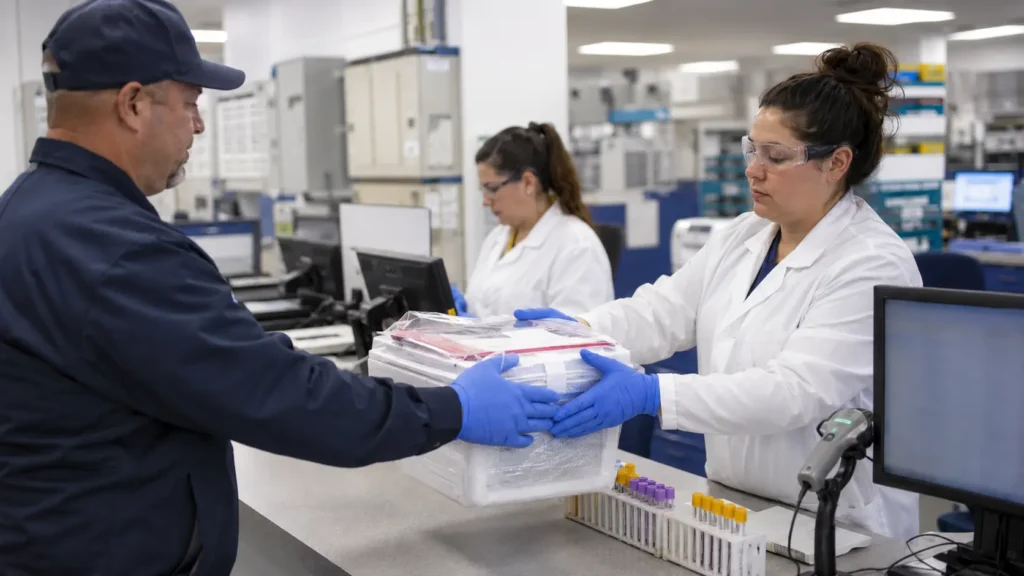
The CMS Medicare Claims Processing Manual, Chapter 16 is explicit for hospitals: when the hospital obtains laboratory tests for outpatients under arrangements with clinical laboratories or other hospital laboratories, only the hospital can bill for the arranged services.
The Three Referred-Test Exceptions
Section 1833(h)(5)(A) of the Social Security Act permits a referring laboratory to bill for tests performed by a reference laboratory only where specific conditions are met. Three are recognized:
Table 16. Referred-test exceptions
| Exception | Condition | Scope limit |
| Rural hospital | The referring laboratory is located in, or is part of, a rural hospital | Confirm the current definition of a rural hospital |
| Common ownership | The referring laboratory is wholly owned by the performing entity, wholly owns it, or both are wholly owned by a third entity | “Wholly owned” is the operative standard – affiliation is not enough |
| No more than 30 percent | No more than 30 percent of the tests for which it receives requests during the year are referred out, not counting wholly-owned referrals | Confirm numerator, denominator and period with your MAC |
Two boundaries matter as much as the conditions. These exceptions are built for laboratory entities – a physician office does not become an eligible referring laboratory by ordering a test and sending the specimen out. And they do not substitute for the hospital analysis. Contractors also expect eligibility to be established before claims flow; Noridian requires a referring laboratory to attest to which option applies prior to billing so the correct edit can be applied. Your ownership documentation or annual 30-percent calculation should exist as a retained record, which is what our reference laboratory billing services are built around, with the deeper walk-through in the reference laboratory billing guide.
Referred Testing Is Not a Purchased Diagnostic Service
Referred testing concerns one laboratory sending work to another. A purchased diagnostic service concerns a billing physician or supplier purchasing a diagnostic service from an outside supplier, where separate payment-limitation rules can apply. Identify what the service actually is – a clinical diagnostic laboratory test, an anatomic pathology technical service, a professional interpretation, or another diagnostic test – before applying either framework.
10. CLIA, Medical Necessity, Orders, Documentation, and Patient Liability
Direct answer. A laboratory claim should be released only when the performing location holds CLIA authority for that test, the record supports a specific order or authenticated intent to order, and the test performed, diagnosis, and documentation satisfy the applicable coverage rules. For Original Medicare, a valid advance beneficiary notice may be needed before furnishing a service expected to be denied under a liability-triggering rule.
Five Gates, Not One
Passing one of these does not mean passing the others, and each fails differently.
- CLIA. The performing site must hold a current certificate whose type matches the complexity of the test performed. Certificate status, certificate level, and the validated test menu are three separate checks. Whether a CLIA number must appear on a given claim depends on the claim type, the service, and current instructions – it is not a universal field on every laboratory claim.
- Order. Testing generally must be ordered by the treating practitioner. Medicare guidance is blunt on the consequence: tests not ordered by the physician are not considered reasonable and necessary. A signed requisition is one way to establish the order; authenticated medical-record documentation showing intent to order the specific test can be another.
- Performance. The test billed must match the test ordered and the test reported. Reconcile order, accession, result, and charge before release.
- Coverage. Medical necessity comes from the record, supported by an NCD, an LCD, a related billing article, or payer policy where one applies. Not every laboratory test has a directly applicable NCD or LCD, and a diagnosis code appearing on a covered list does not by itself prove necessity.
- Liability. Whether the patient can be billed is a separate legal question from whether the payer denied.
CMS publishes a Medicare Learning Network booklet on complying with documentation requirements for laboratory services that is worth circulating to ordering practices, not just to billing staff – most order defects originate outside the laboratory. The CLIA reporting side has its own field-level detail, covered in CLIA information on laboratory claims.
When the Patient Can Be Billed
Covered services paid under the CLFS generally carry no Medicare deductible or coinsurance, and a denial does not automatically create patient responsibility. For Original Medicare, where a laboratory expects a coverage-related denial, an Advance Beneficiary Notice of Non-coverage completed and signed by the patient before the service is furnished is what preserves the possibility of billing the patient. Obtained afterwards, it does not repair the situation – and modifier GA reports that a valid notice exists rather than creating one.
Commercial and Medicaid patient-liability rules are governed by the plan contract, state law, and program requirements. A commercial financial-responsibility form is not an ABN, and Medicaid beneficiary billing is heavily restricted and state-specific.
11. How Medicare Advantage, Medicaid, and Commercial Laboratory Billing Differ
Direct answer. Medicare fee-for-service provides a national baseline for laboratory payment and billing, but Medicare Advantage, Medicaid, managed Medicaid, and commercial plans add their own networks, authorization requirements, medical policies, fee schedules, edits, notices, and appeals. A rule valid for one payer – or even one product from the same payer – should not be applied to another claim without checking the current policy, contract, and effective date.
Table 17. Medicare FFS baseline against other payers
| Issue | Medicare FFS | Medicare Advantage | Medicaid and managed Medicaid | Commercial |
| Payment basis | CLFS, PFS, or facility payment system | Contracted plan rate | State fee schedule or MCO contract | Negotiated contract rate |
| Prior authorization | Not a universal requirement for routine laboratory work | May apply to selected tests | State- and MCO-specific | Common for molecular and genetic testing |
| Coverage source | NCD, LCD, billing articles | Medicare baseline plus plan criteria | State manual plus MCO policy | Proprietary medical policy |
| Network | Medicare enrollment | Plan network may apply | State enrollment plus MCO network | Product-specific network |
| Patient notice | ABN process | Plan notices and cost sharing | State rules, heavily restricted | Contract and state law |
| Appeals | Medicare appeals process | Plan organization determination and appeal | MCO appeal plus state hearing rights | Internal and any external review |
Two traps recur. First, “commercial payer” is not a category with shared rules – one national plan may require every panel component to be performed before the panel code is billed and may reprice overlapping panels to the code containing the highest number of tests, while another handles both differently. Commercial only – not Medicare FFS. Verify the exact policy, product, and effective date before you build an edit around it.
Second, prior authorization is not payment. An approval confirms the plan reviewed the request; coverage, coding, network status, documentation, and contract terms all still apply at adjudication. Equally, a missing authorization does not automatically make the balance the patient’s – that depends on the contract and applicable law.
The practical control is a maintained payer matrix: one row per payer and product, not per payer brand, recording network status, authorization list, coding and modifier rules, reference-lab policy, timely-filing limit, appeal deadline, policy effective date, contract date, and the date you last verified it. “Varies” is not an operational answer.
12. Common Laboratory Billing Denials, Rejections, and Compliance Errors
Direct answer. Laboratory claims commonly fail because patient, payer, provider, CLIA, order, diagnosis, code, modifier, unit, date, place-of-service, authorization, or billing-entity information is missing, inconsistent, or unsupported. The first step is deciding whether the event is a rejection, a denial, an underpayment, a recoupment, or a compliance risk – because that classification determines whether you resubmit, correct, appeal, refund, or remediate.
Denial Root-Cause Matrix
Table 18. What actually causes laboratory claims to fail
| Root cause | Usual classification | Preventive control |
| Demographics, member ID, or wrong payer product | Rejection | Date-specific eligibility check at registration |
| Invalid billing NPI or NPI/TIN mismatch | Rejection | Enrollment master-file validation |
| Missing or invalid CLIA data on the claim | Rejection or denial | CLIA scrub tied to performing location |
| CLIA certificate does not cover the test complexity | Denial, then recoupment risk | Certificate-to-test-menu validation |
| Missing, vague, or untraceable order | Denial and compliance risk | Order hard stop before accessioning |
| Diagnosis does not support the test | Medical-necessity denial | Diagnosis-to-test review against NCD, LCD or policy |
| Panel billed when a component was not performed | Denial or recoupment | Panel-integrity edit at charge capture |
| Components billed instead of the panel code | Rejection or bundling denial | Panel-to-component crosswalk |
| Unsupported modifier 91, 59, or X modifier | Denial and compliance risk | Modifier preconditions enforced at coding |
| Units exceed the code-specific edit | Denial | Unit and MUE validation |
| Wrong date of service on a hospital-origin specimen | Denial or packaging error | DOS decision logic before release |
| Wrong billing entity on a referred test | Denial, then recoupment | Billing-authority gate |
| Missing or mismatched authorization | Denial | Pre-service authorization matching code, provider, site, dates |
| Timely filing expired | Denial and permanent loss | Acceptance-report monitoring and filing alerts |
Corrected Claim, Appeal, Refund, or Write-Off?
Choosing the wrong route wastes the deadline as well as the effort.
- Rejected before adjudication? Correct the source data and resubmit. Do not file an appeal.
- Paid below the expected allowance? Treat it as an underpayment and compare against the service-date fee schedule or contract before disputing.
- Denied because of a factual claim-data error the record already supports? Submit a corrected claim where the payer permits that route.
- Denied because the payer disputes coverage, necessity, distinctness, or billing authority, and contemporaneous evidence exists? File the formal appeal with that evidence.
- Denied and no supporting evidence exists? Do not create documentation after the fact. Adjust or close it, and fix the upstream control.
- Previously paid but unsupported? This is a compliance and repayment question, not a billing question – escalate it internally.
Payment alone does not establish that a claim met every billing and documentation requirement, and a write-off does not resolve an underlying compliance issue. Deeper resolution playbooks by denial category sit in our laboratory denial-management guidance.
13. Payment Posting, Underpayments, Accounts Receivable, and Laboratory Billing KPIs
Direct answer. Laboratory payment posting should capture the allowed amount, payment, adjustment reason, valid patient responsibility, secondary-payer status, and remaining balance from the remittance. An underpayment exists when reimbursement falls below the correct fee schedule or contracted allowance – not merely below the billed charge. A/R and KPI reporting should then be segmented by payer, age, denial status, service line, and a documented methodology.
Post the Difference Correctly
The gap between billed charge and payment is not one number. Part of it is a valid contractual adjustment, part may be a denial that is still workable, part may be legitimate patient responsibility, and part may be an underpayment nobody has noticed. Posting all of it as “contractual” is the single most effective way to hide revenue loss from your own reporting.
Segment A/R by more than age. Payer and product, claim status, denial reason, authorization status, test category, location, performing laboratory, dollar value, and – critically – the filing and appeal deadlines. Aging alone does not establish collectibility; a 45-day claim with an expired appeal window is worth less than a 120-day claim with a documented, winnable dispute. Recovering older balances at scale is a distinct discipline, covered in recover aging laboratory A/R.
KPI Glossary
Table 19. Laboratory billing KPIs and how to define them
| Metric | Common formula | Must be defined before use |
| First-pass acceptance rate | Initial claims accepted without rejection / initial claims transmitted | Clearinghouse acceptance only, or payer acceptance too |
| Rejection rate | Claims rejected before adjudication / initial claims transmitted | Keep separate from denial rate |
| Initial denial rate | Initial adjudicated claims denied / initial adjudicated claims | Full versus partial denials; claim count versus dollars |
| Days in A/R | Ending A/R / average daily net revenue | Gross or net basis; whether credits and patient A/R are included |
| A/R over 90 days | A/R aged over 90 days / total positive A/R | The aging start date – service, bill, or submission |
| Net collection rate | Payments / (gross charges – valid contractual adjustments) | Cash period versus service cohort; what counts as a valid adjustment |
| Underpayment rate | Underpaid claims / paid claims evaluated against an expected allowance | The review population and the variance tolerance |
| Appeal overturn rate | Appeals producing additional payment / appeals decided | Fully versus partially overturned; pending appeals |
A caution on benchmarks. Published “healthy” targets circulate widely and rarely disclose the laboratory type, payer mix, test menu, or formula behind them. A molecular laboratory with heavy authorization requirements and a routine chemistry laboratory should not be measured against the same days-in-A/R figure. Build an internal baseline with a documented formula, hold the formula constant, and measure your own trend.
14. How to Audit and Improve a Laboratory Billing Workflow
Direct answer. A laboratory billing audit should follow each test from menu setup and CLIA authority through ordering, performance, coding, claim submission, payment, denial resolution, underpayment detection, and A/R. Findings should be supported by claim-level evidence, classified by compliance and financial risk, assigned to accountable owners, and converted into a phased improvement plan. Outsourcing should be evaluated only after the current workflow and its control gaps are understood.
Do Not Start With Denials
The instinct is to pull the denial report and work the top three reasons. That finds symptoms. A defensible audit samples paid claims as well, because payment alone does not establish that a claim met every billing and documentation requirement – and unsupported paid claims are where recoupment exposure accumulates quietly.
30-Point Laboratory Billing Audit Checklist
- Governance and inventory: 1. audit scope, period and owner defined; 2. active test menu inventoried; 3. test-to-code mapping validated; 4. payer matrix current by payer and product; 5. contracts and fee schedules inventoried with effective dates
- Entity and certification: 6. performing locations mapped; 7. CLIA certificates active; 8. certificate type matches test complexity; 9. NPI, TIN and enrollment mapping reconciled; 10. reference-lab and purchased-service relationships documented
- Sampling and intake: 11. stratified sample includes paid, denied, rejected and underpaid claims; 12. demographics, eligibility and COB verified; 13. orders reconciled to accession records; 14. accessions reconciled to final results; 15. results reconciled to billed claims
- Coding: 16. code valid for the date of service; 17. modifier preconditions evidenced; 18. panel and overlapping-panel logic reviewed; 19. repeats separated from reruns and duplicates; 20. current NCCI and MUE files applied
- Date, setting and coverage: 21. DOS determined under the correct rule; 22. POS validated for the service and billing entity; 23. medical necessity supported in the record; 24. authorization matched to code, provider, site and dates; 25. ABN and patient-liability process reviewed
- Financial and governance: 26. rejection and denial root causes categorized; 27. payment posting and adjustment reasons validated; 28. underpayments compared to service-date contracts; 29. A/R, credits, refunds and recoupments reviewed; 30. SOPs, training records and vendor oversight current
30/60/90-Day Improvement Roadmap
Table 20. Phased remediation
| Phase | Objective | Typical work |
| Days 1-30 | Stabilize and contain | Correct enrollment and CLIA exceptions; hold high-risk workflows; protect filing and appeal deadlines; establish baseline denial, rejection and A/R reporting |
| Days 31-60 | Redesign controls | Fix test-to-code crosswalks; build panel, modifier, unit and DOS edits; update the payer matrix; revise SOPs; deliver targeted training; launch underpayment detection |
| Days 61-90 | Test and decide | Re-sample claims after remediation; test control effectiveness against the baseline; review residual risk; decide in-house, hybrid or outsourced sourcing on evidence |

The roadmap is a sequence, not a guarantee. It does not promise a specific denial reduction, a clean-claim percentage, or a recovery figure, and any vendor offering those numbers before seeing your data is selling rather than assessing. When comparing vendors, use a documented evaluation framework rather than relying only on percentage fees; the guide to choosing a laboratory billing company covers the main operational and contractual criteria. Full end-to-end laboratory RCM is one option; a scoped audit against the standalone laboratory billing audit checklist is often the better first step.
15. Frequently Asked Questions and the 2026 Laboratory Billing Checklist
Direct answer. These answers cover the points laboratories search for most often, each scoped to a payer and a setting. The section closes with a working checklist that condenses the guide into a pre-bill review sheet.
Frequently Asked Questions
What is billing for laboratory services?
It is the process of turning an ordered, medically supported, and performed clinical test into a payer-compliant claim, then resolving the payment or denial. It connects the order, specimen, performing laboratory, CLIA status, codes, date and place of service, and the billing entity’s authority. It is narrower than full revenue cycle management, which also covers enrollment, contracting, and A/R.
How do you bill laboratory services?
Confirm eligibility and payer product, validate the order and medical necessity, collect and accession the specimen, perform and report the test, code the work actually performed, validate CLIA, entity, date, place, units and modifiers, submit on the correct claim route, then post, work denials, and reconcile A/R. Section 3 sets out all eleven stages.
Can a physician office bill for laboratory services?
Yes, for tests it actually performs in its own laboratory holding the appropriate CLIA certificate for that complexity, where enrollment, coding, coverage and documentation requirements are met. Ordering the test, collecting the specimen, or receiving the result does not create billing authority for work performed elsewhere.
Can a physician bill Medicare for a reference laboratory test?
Generally no. The laboratory that performed the test bills Medicare. MAC guidance is explicit that physicians who order or refer a laboratory test are not permitted to bill Medicare for a service they did not perform, and refunds have been requested where this occurred. Modifier 90 does not change that.
What are the three exceptions to Medicare direct billing for laboratory tests?
Under Section 1833(h)(5)(A) of the Social Security Act, a referring laboratory may bill for a reference laboratory’s work where it is located in or part of a rural hospital, where the two laboratories are wholly owned by each other or by a common third entity, or where it refers no more than 30 percent of the tests for which it receives requests annually. Confirm current conditions with your MAC.
What is the date of service for a laboratory test?
The default is the date the specimen was collected. That date determines whether a test falls inside a hospital stay, and therefore whether the hospital or the performing laboratory bills. Exceptions in 42 CFR 414.510 can move it to the performance date, but only when every attached condition is satisfied.
How does the 14-day rule work for hospital outpatient molecular tests?
Two separate rules can apply. Under the general stored-specimen rule, the date of service becomes the performance date when the specimen was stored no more than 30 days, the test was ordered at least 14 days after discharge, the specimen was collected during a hospital surgical procedure, collecting it otherwise would have been medically inappropriate, the result did not guide treatment during the stay, and the test was reasonable and necessary.
Separately, a hospital-outpatient molecular exception can assign the performance date to certain human molecular pathology tests analyzing DNA or RNA, ADLTs, certain cancer-related protein-based or multiprotein algorithmic analyses, and CPT 81490, where the specimen was collected during the outpatient encounter, the test was performed after discharge, collection during the encounter was medically appropriate, the result did not guide encounter treatment, and the test was reasonable and necessary. For the molecular-pathology category the regulation limits the exception to tests performed by a laboratory other than a blood bank or center. When a valid exception applies the service can fall outside the hospital payment and the eligible performing laboratory may bill separately – but neither the test category nor an OPPS status indicator establishes coverage or eligibility on its own.
What place of service is used for an independent laboratory?
POS 81 identifies an independent laboratory where the service and claim circumstances meet the current definition. It is not determined by where the specimen was drawn. The correct value depends on the service billed, the billing entity, the claim route, and whether a professional interpretation is involved.
What is the low-expenditure threshold for an applicable laboratory under PAMA?
At least $12,500 of Medicare revenues from the CLFS during the data collection period. It is one of three tests. The laboratory must also bill Part B under its own NPI – or, as a hospital outreach laboratory, on the Form CMS-1450 under type of bill 14X – and receive more than 50 percent of total Medicare revenues from the CLFS and Physician Fee Schedule combined.
Does Medicare allow coinsurance or a deductible on CLFS services?
Covered services paid under the CLFS generally carry no beneficiary deductible or coinsurance. That rule is specific to CLFS-paid services. Services paid under the Physician Fee Schedule, Medicare Advantage cost sharing, and noncovered services follow different rules, and a valid liability notice can still create patient responsibility.
What is the difference between the CLFS and the Physician Fee Schedule?
The CLFS pays most clinical diagnostic laboratory tests that do not involve separately payable physician work. The Physician Fee Schedule pays professional services and tests containing physician work, including qualifying pathology interpretations. Classify by the code’s payment status rather than by where the test was performed.
What is the difference between modifier 90 and modifier 91?
Modifier 90 reports that an outside or reference laboratory performed the test; it never creates the right to bill it. Modifier 91 reports a medically necessary repeat of the same test on the same day. Modifier 91 is not for reruns caused by damaged specimens, equipment failure or quality control, and it does not resolve a duplicate denial.
Can laboratory panels be unbundled?
Not when all components of the panel were performed. Medicare instructs laboratories to bill the HCPCS panel code rather than the individual components in that situation, and claims can be returned as unprocessable when the panel code is not billed. If a required component was not performed, report only the supported individual services.
When is an ABN required, and can a laboratory bill a Medicare patient after a denial?
For Original Medicare, an ABN is used where the laboratory expects a coverage-related denial and wants to preserve the option of billing the beneficiary. It must be completed and signed before the service is furnished. Without a valid advance notice a denial does not automatically become the patient’s responsibility, and a signed notice does not guarantee it either.
What causes laboratory claims to be denied?
Most failures trace to a small set of causes: eligibility and payer-product errors, enrollment or CLIA mismatches, missing or vague orders, diagnosis that does not support the test, panel and component errors, unsupported modifiers, unit edits, the wrong date of service on hospital-origin specimens, the wrong billing entity on referred tests, missing authorization, and expired filing limits.
When should a laboratory outsource billing, and what do laboratory billing services cost?
Outsource when an audit shows a capability gap you cannot close internally – specialty coding depth, payer-policy maintenance, authorization volume, or contract-variance detection. Pricing models include a percentage of collections, per-claim or per-accession fees, fixed monthly fees, and project-based audits. Compare included scope, legacy A/R, audit rights and exit terms before comparing rates. See laboratory billing services cost.
Quick Answers to Common Spoken Laboratory Billing Questions
Who actually gets paid when a doctor sends blood to another lab?
The laboratory that performs the test, in almost every Medicare scenario. The ordering physician does not bill it.
Does my lab need its CLIA number on every claim?
Not universally – it depends on the claim type, the service, and current instructions. The certificate itself must always cover the test performed.
Why did the hospital bill for a test my lab ran?
The specimen was probably collected during a hospital encounter, which keeps the service inside the hospital payment. Your laboratory bills the hospital, not Medicare.
Does active insurance mean the test is covered?
No. Eligibility confirms enrollment on a date. Coverage depends on medical necessity, policy criteria, and the claim itself.
Is a paid claim proof we billed it correctly?
No. Payment alone does not establish that a claim met every requirement. Unsupported paid claims are where recoupment exposure builds up unnoticed.
How often should we re-check payer policies?
On a risk basis rather than a calendar – after code updates, policy revisions, new test launches, denial spikes and system changes. Record the date you last verified each one.
The 2026 Laboratory Billing Checklist
The checklist walks a claim through the same gates this guide follows: orders and documentation, CLIA certificate and performing-location match, coding and modifier preconditions, date of service and place of service, reference-laboratory relationships and billing authority, claim readiness, denial controls, and A/R follow-up. It includes the DOS decision tree from Section 8 as a standalone reference. Use it as a short pre-bill pilot, document the issues identified, and compare them with your existing edits and SOPs.
Get the 2026 Laboratory Billing Checklist
Use this practical pre-bill review sheet to check individual claims or audit a representative sample of laboratory claims across:
- Orders and supporting documentation
- CLIA certificate, test complexity, and performing location
- CPT, HCPCS, PLA codes, units, and modifiers
- Date of service and place of service
- Reference-laboratory relationships and billing authority
- Claim-readiness controls before submission
- Denial and rejection prevention
- Payment posting and accounts receivable follow-up
Send Me the Checklist and DOS Decision Tree
Complete the form and we will send you the 2026 Laboratory Billing Checklist together with the one-page DOS decision tree.
Need a closer review of your current process? EliteMed Financials can assess a representative claim sample, denial patterns, aging A/R, payer mix, and workflow controls, then document the highest-priority corrective actions.
Where to Go From Here
Laboratory billing rewards teams who resolve questions in the right order. Who performed the test. Who is permitted to bill it. What date governs. What the record supports. What this payer requires. Get that sequence right and coding becomes the straightforward part.
A workflow review should identify where the claim process breaks, not simply rework denials after they appear. EliteMed Financials can review a representative claim sample, payer mix, denial categories, aging A/R, and current billing controls, then document the highest-priority corrective actions. You can request a laboratory billing workflow review and we will scope it to your payer mix and test menu.
References
- Centers for Medicare & Medicaid Services. Medicare Claims Processing Manual, Publication 100-04, Chapter 16 – Laboratory Services. https://www.cms.gov/regulations-and-guidance/guidance/manuals/downloads/clm104c16.pdf
- Centers for Medicare & Medicaid Services. Clinical Laboratory Fee Schedule, including CLFS and PAMA Reporting and Resources, CLFS Files, and Annual Public Meetings. Page last modified July 2026. https://www.cms.gov/medicare/payment/fee-schedules/clinical-laboratory-fee-schedule-clfs
- Centers for Medicare & Medicaid Services. Complying with Documentation Requirements for Laboratory Services, MLN909221. https://www.cms.gov/files/document/mln909221-complying-documentation-requirements-lab-services.pdf
- Consolidated Appropriations Act, 2026, Section 6226 – updated CLFS data reporting requirements and delayed the phase-in of payment reductions, as described by CMS.
- Social Security Act, Section 1833(h)(5)(A) – conditions under which a referring laboratory may bill for clinical diagnostic laboratory tests performed by a reference laboratory.
- Novitas Solutions, Proper billing of laboratory tests, Medicare Part B Jurisdiction H – duplicate billing of ordered and referred tests, panel billing, and Chapter 16 Sections 90.2 and 100.5.1.
- Noridian Healthcare Solutions, Laboratory – Part B specialty guidance, including laboratories billing for referred tests and the referring-laboratory attestation requirement.
- Medicare Payment Advisory Commission, Clinical Laboratory Services Payment System, November 2025 – payment-system context and setting distinctions.
Note on sources. Federal statute, regulation, and current CMS instructions control Medicare fee-for-service. Medicare Administrative Contractor guidance applies within that contractor’s jurisdiction. Commercial payer policies apply only to the payer, product, and effective period they cover and are labeled in the text where used. Verify every date-sensitive figure against the current CMS source before acting on it.
Disclaimer
This guide is provided for educational purposes and does not replace payer-specific billing instructions, legal advice, coding guidance, or review of current CMS, MAC, Medicaid, and commercial plan policies. Laboratory billing requirements vary by payer, plan, product, test, setting, contract, jurisdiction, performing entity, billing entity, documentation, and date of service. Dates, thresholds, reporting periods, and payment rules described here are time-sensitive and should be confirmed against the current primary source before they are relied on for a claim, a repayment decision, or a compliance determination.