
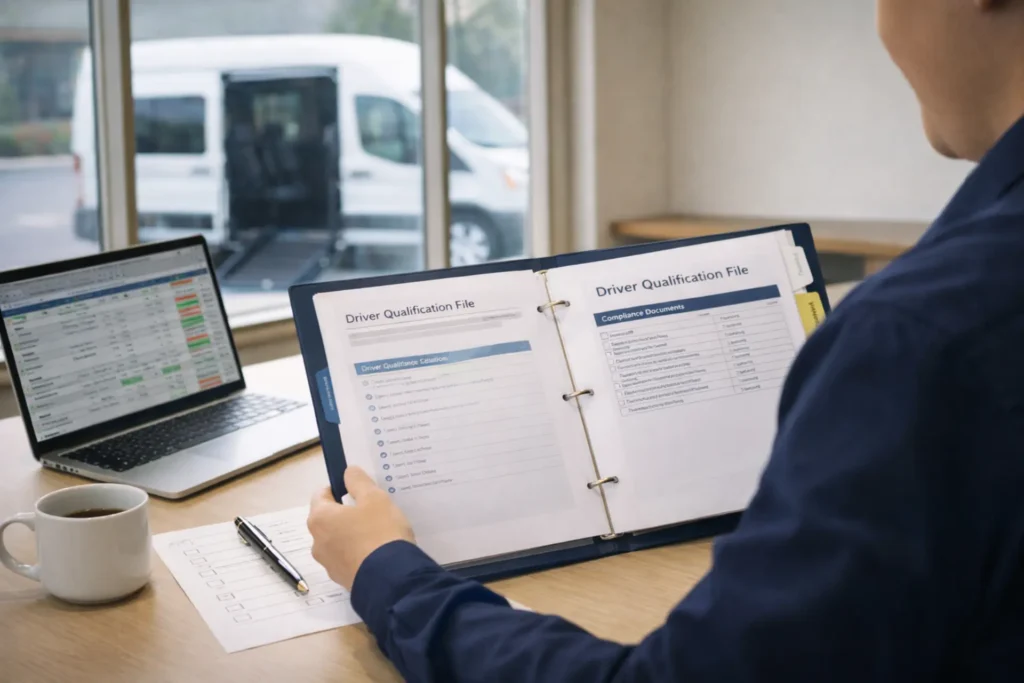
What Is a Driver Qualification File? A Driver Qualification (DQ) File is a mandatory records package that NEMT operators must maintain for every driver under 49 CFR §391.51 (FMCSA) and state Medicaid requirements. Each file must contain 12–16 specific documents covering employment history, driving record, medical certification, NEMT-specific training, and drug testing compliance. DQ files must be maintained for the entire employment period plus 3 years after termination. Incomplete DQ files are the leading cause of Medicaid billing recoupment and NEMT broker suspension.
Every trip your NEMT business completes depends on one document set most operators underestimate: the driver qualification file. A missing CPR certificate, an expired medical card, or a lapsed annual MVR review can unwind months of Medicaid billing in a single audit finding. Unlike general trucking operators, NEMT providers face three simultaneous compliance masters — FMCSA federal safety regulations, state Medicaid program integrity rules, and NEMT broker contractual requirements — and the strictest standard always applies. This complete driver qualification file guide covers every document required, how to build and maintain your system, what NEMT-specific certifications no competitor discusses, and how to keep your operation audit-ready from day one. If you are still learning how to start a NEMT business, understanding DQ files before your first driver starts is the single most important compliance step you will take.
What You Will Learn in This Guide
Table of Contents
What Is a Driver Qualification File and Why Does NEMT Require It?
A driver qualification file is the complete compliance record proving your driver was legally qualified and medically fit on the specific date each trip was billed. Medicaid auditors do not ask whether your driver is qualified today. They ask whether your driver was qualified on October 12th when you submitted a claim for that trip. That distinction is why 180 completed trips at $45 each can become an $8,100 recoupment demand overnight — because one expired medical card or missing annual MVR review converts every trip in that window from billable revenue into a liability.
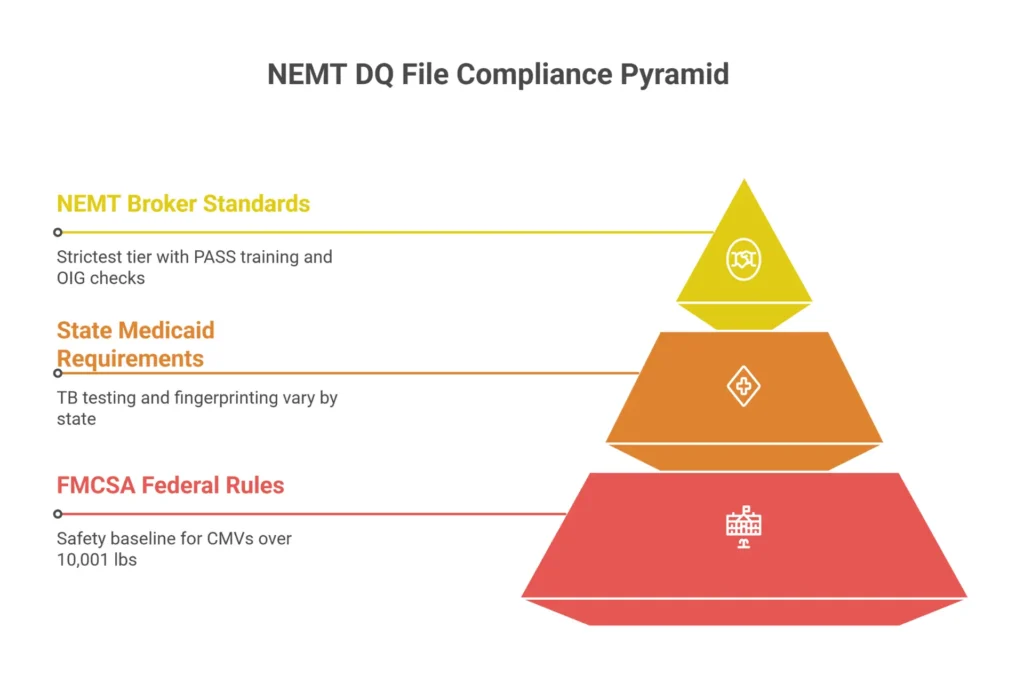
Pro Tip — The Triple Threat Framework: NEMT operators answer to three compliance masters simultaneously. FMCSA sets baseline safety rules. State Medicaid agencies add program integrity requirements. NEMT brokers impose their own contractual standards. The strictest requirement always governs. A driver can be federally compliant yet still fail broker credentialing or Medicaid provider enrollment.
FMCSA 49 CFR Part 391 — The Federal Requirement
Federal law under 49 CFR §391.51 requires every motor carrier to maintain a qualification file for each employed driver who operates a commercial motor vehicle. The regulation defines exactly which documents belong in the file, how long each must be retained, and what constitutes an acceptable annual review. NEMT operators whose vehicles have a Gross Vehicle Weight Rating (GVWR) of 10,001 lbs or more operating in interstate commerce fall squarely under FMCSA jurisdiction. Even operators using lighter vehicles must understand that the DQ file standard still applies through Medicaid and broker channels.
The regulation distinguishes between documents that must be retained for the full employment period plus 3 years, and periodic documents — annual MVRs, annual review notes, medical certificates — that may be removed after 3 years from their execution date. This distinction matters for file organization and audit defense. For a complete walkthrough of all compliance requirements beyond the DQ file, review our NEMT compliance guide.
How NEMT Broker Requirements Exceed Federal Standards
NEMT brokers — ModivCare, MTM Inc., MAS Transportation, and Access2Care — impose driver credentialing requirements that go significantly beyond what FMCSA mandates. ModivCare typically requires 10-panel drug screens rather than the DOT 5-panel standard. MTM often mandates 7-year multi-state criminal background checks rather than the 3-year lookback in federal rules. All major brokers require PASS training, CPR/BLS certification, and mobility device securement training — none of which appear anywhere in 49 CFR Part 391. These certifications belong in your DQ file even though FMCSA does not list them, because a missing PASS certificate means a broker suspends your trip assignments and your revenue stops immediately.
State Medicaid DQ File Requirements for NEMT Providers
State Medicaid agencies impose requirements parallel to — and often stricter than — FMCSA. California DHCS requires drivers to demonstrate physical capacity to lift 150 lbs and pass a tuberculosis screening. Texas HHSC mandates annual TB tests for patient-assist drivers. Florida AHCA requires Level 2 fingerprint-based background screening through its background screening clearinghouse under Florida Statute 435.03, not just a standard criminal check. Virginia DMAS added health and fitness documentation requirements effective April 1, 2025. Georgia DCH requires broker-driven TB and flu screening through Verida. Each state’s requirements add documents to your DQ file that no trucking-focused compliance guide will ever mention.
Consequences: Medicaid Recoupment, Broker Suspension, Civil Penalties
The financial consequences of incomplete DQ files are not theoretical. FMCSA recordkeeping violations carry penalties up to $1,584 per day the violation continues, with a maximum of $15,846 per occurrence. Medicaid auditors apply a date-alignment test: if your driver’s medical certificate expired October 10th and you billed trips on October 12th through 31st, every trip in that window becomes subject to 100% recoupment — no safe harbor, no retroactive correction. NEMT brokers typically freeze trip assignments the same business day they discover a missing or expired credential, creating immediate cash flow disruption. A 30-day broker suspension for a single-vehicle operation generating $9,000/month means $9,000 in lost revenue on top of any recoupment demand. The NEMT audit preparation guide covers exactly what auditors examine at each phase.
Complete NEMT Driver Qualification File Checklist
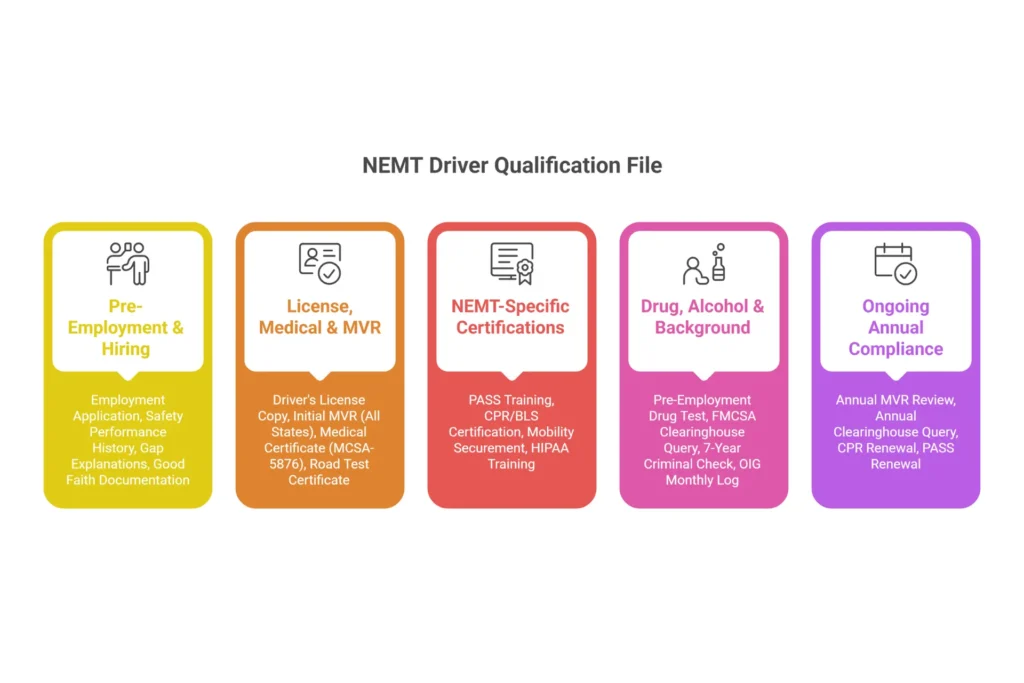
Your driver qualification file checklist covers five categories of documents. The first three categories align with FMCSA’s 49 CFR §391.51. Categories four and five cover the NEMT-specific certifications that no trucking compliance guide includes but that every NEMT broker and Medicaid auditor will inspect.
Pro Tip — The “Locked” Driver Standard: A driver is not “locked” and ready for dispatch until every document in Categories 1 through 4 is complete and current. Category 5 documents can follow within 30 days for safety history inquiries only. Never dispatch a driver whose file is missing a medical certificate, a negative drug test result, or a Clearinghouse full query.
Category 1 — Pre-Employment and Hiring Documents
The employment application under §391.21 must collect 10 years of commercial driving history for CDL drivers and 3 years for non-CDL drivers. All employment gaps of 30 days or more must be explained in writing on the application itself — this is a common audit flag that new NEMT operators miss. The safety performance history inquiry under §391.23 must go to all prior DOT-regulated employers for the 3 years preceding the application date. You have 30 days to complete this investigation; document every contact attempt with date, method, and response status. If a prior employer does not respond, file a certified mail receipt and phone log as proof of good faith effort.
Category 2 — License, Medical, and Driving Record Documents
The motor vehicle record at hire must cover the previous 3 years and be pulled from every state where the driver has held a license during that period. The medical examiner’s certificate (MCSA-5876) is valid for up to 24 months for drivers meeting all physical qualification standards; conditions like controlled hypertension shorten validity to 12 months. For non-CDL drivers, you must print and file a National Registry verification showing the examining physician’s active status on the date of examination. Since June 23, 2025, CDL drivers’ medical certification status transmits automatically to the CDLIS MVR system, eliminating the need for manual paper certificate verification — but non-CDL drivers still require paper MECs in the file. The road test certificate under §391.31 is required unless the driver holds a valid CDL, which serves as the equivalent under §391.33.
Category 3 — NEMT-Specific Certifications (Not in Standard Trucking DQ Files)
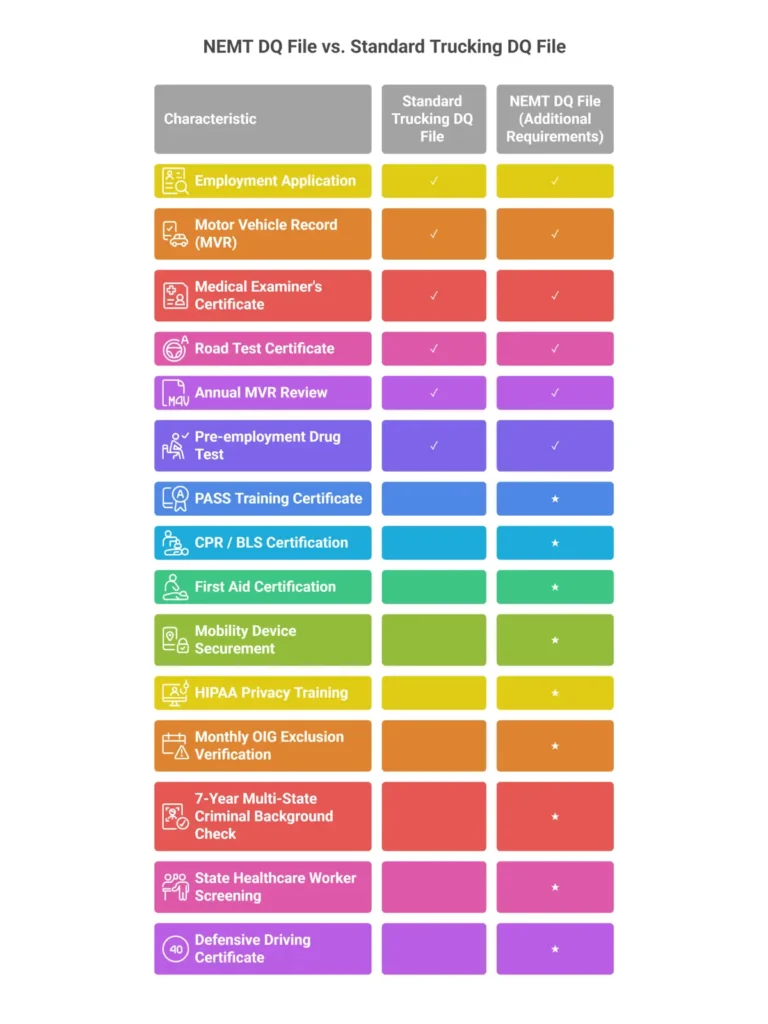
This is the category that separates an NEMT-compliant driver file from a trucking-compliant one. Every major NEMT broker requires all five of these certifications as a condition of driver approval, yet none appear in FMCSA’s standard DQ file requirements.
| Certification | Issuing Authority | Validity Period | Required By | Notes |
|---|---|---|---|---|
| PASS Training | CTAA-approved provider | Annually (per most brokers) | All major brokers | Covers wheelchair securement, passenger safety, disability awareness; ~$75–$150/driver |
| CPR/BLS Certification | AHA or Red Cross | Every 2 years | All major brokers; most state Medicaid programs | BLS level required; online-only certifications typically not accepted |
| First Aid Certification | AHA or Red Cross | Every 2–3 years | All major brokers | Often bundled with CPR/BLS course |
| Mobility Device Securement Training | Q’Straint, Sure-Lok, or equivalent | At hire; re-train on equipment change | MTM, ModivCare, MAS | Manufacturer-specific certificate for WAV operators |
| HIPAA Privacy Training | Online course; employer provides | Annually | State Medicaid programs; all brokers | Document signed acknowledgment in DQ file |
| OIG Exclusion Verification | OIG List of Excluded Individuals and Entities | Monthly (print and file) | All Medicaid programs; brokers | Billing for trips by excluded individuals creates False Claims Act exposure of $11,000–$22,000 per claim |
Category 4 — Drug, Alcohol, and Background Compliance Documents
The pre-employment drug test under 49 CFR §382.301 must return a negative result before the driver performs any safety-sensitive duty. The FMCSA Drug and Alcohol Clearinghouse full query must be completed before hire, separate from the drug test itself — the Clearinghouse checks for prior violations across all DOT-regulated employers, while the drug test verifies current status. Background check documentation must go beyond a national criminal database search. NEMT brokers typically require 7-year multi-state criminal checks with county court searches, sex offender registry verification through the national NSOPW portal, and where applicable, state healthcare worker registries like Florida’s AHCA Background Screening Clearinghouse or Texas’s Employee Misconduct Registry.
Category 5 — Ongoing Annual Compliance Documents
The annual MVR review under §391.25 must be completed within 12 months of the previous review. You pull a current MVR from every state where the driver holds or has recently held a license, review it for disqualifying violations, and document the review with a signed note in the file. Note that the driver certification of violations (formerly §391.27) was eliminated on May 9, 2022 — do not collect this form from drivers. The annual Clearinghouse limited query under §382.413 must be run once every 12 months for all drivers. Monthly OIG exclusion list checks must be documented with a search printout or screenshot saved in the driver’s file on the first of each month.
How to Create and Maintain a DQ File System
Building a compliant DQ file system for a new NEMT operation does not require enterprise software. It requires a consistent structure, a reliable expiration tracking method, and a clear rule about when a driver is “locked” for dispatch. The cost of setup runs $25–$100 per driver for the administrative components alone, not counting certifications — far less than the exposure created by missing documents.
Pro Tip — The Pre-First-Trip Lock Rule: Before a driver’s first trip, four documents must be physically or digitally in your system: a negative pre-employment drug test result, a completed Clearinghouse full query, a valid medical examiner’s certificate, and a signed employment application. Nothing else can substitute for these four items. Safety performance history can follow within 30 days.
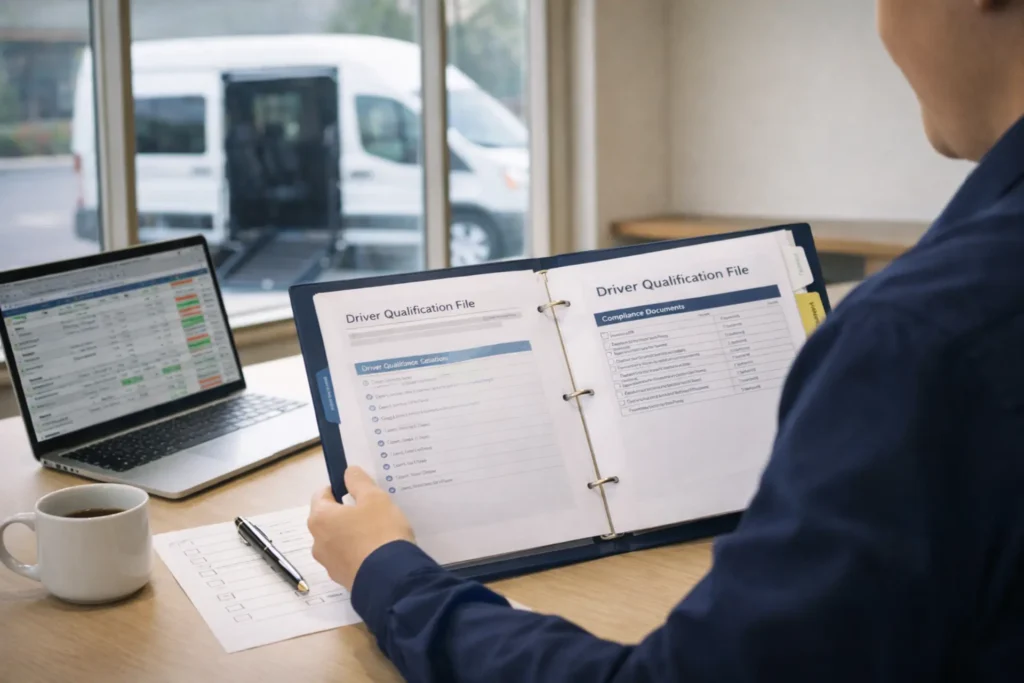
Setting Up Your First DQ File Step by Step
Day 1 of a new hire: collect the signed employment application, run an OIG exclusion check, and initiate the criminal background check and MVR pulls. Days 1–5: schedule the pre-employment drug test, run the FMCSA Clearinghouse full query, complete the road test, and verify the medical examiner’s National Registry status. Days 5–7: assemble the medical certificate, CPR/BLS cards, PASS certificate, HIPAA acknowledgment, and mobility securement training record. Within 30 days: receive and file all prior employer safety performance history responses, documenting every contact attempt for non-responsive former employers. This sequence ensures your driver is legally dispatchable from day one while the 30-day administrative window closes behind them.
Digital vs. Physical DQ File Storage (What FMCSA Allows)
FMCSA permits electronic DQ file storage under §391.51(b)(2) provided the files are immediately producible upon request, tamper-proof with a verifiable audit trail, legible, and retained for the full required period. For NEMT operators, electronic storage adds a HIPAA security overlay — medical certificates and health screenings are protected health information requiring AES-256 encryption, role-based access controls, and documented breach notification procedures. A well-organized Google Drive or Dropbox folder with restricted access, consistent naming conventions (YYYY-MM-DD_DocumentType_DriverLastName.pdf), and a shared Google Sheets expiration tracker gives small NEMT operators a functional, audit-ready system at near-zero cost. Physical binders work for single-vehicle operators but create retrieval delays during audits and no automated expiration alerts.
Expiration Date Tracking Calendar
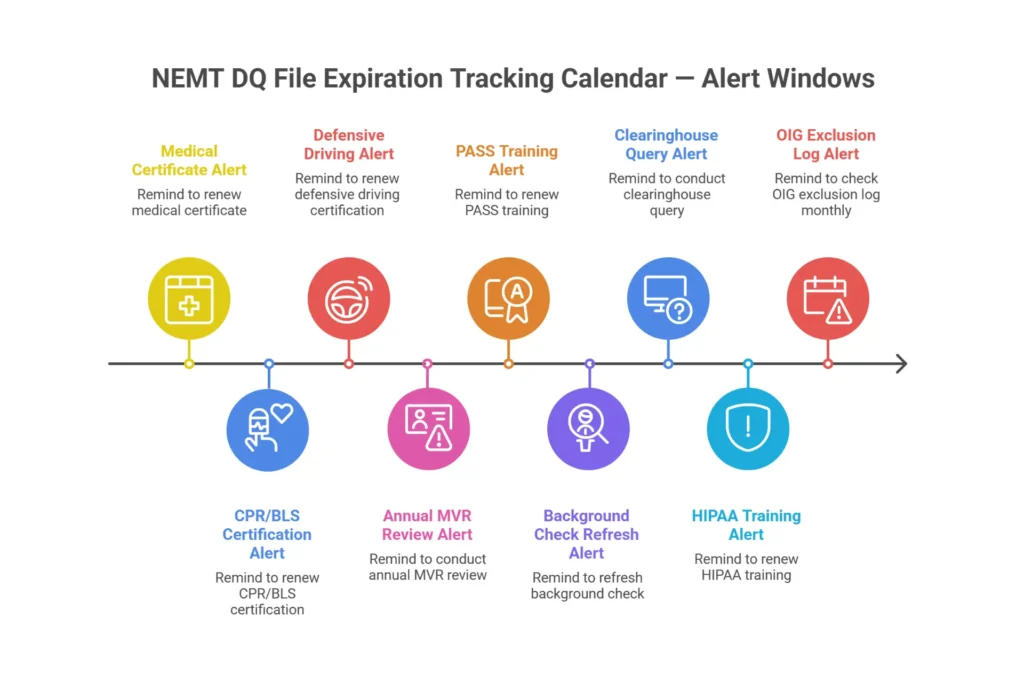
| Document | Validity Period | Renewal Frequency | Recommended Alert Window | Risk if Expired |
|---|---|---|---|---|
| Medical Examiner’s Certificate | Up to 24 months | Per certificate date | 90 / 60 / 30 days | Driver immediately disqualified; trips unbillable |
| Annual MVR Review | 12 months from last review | Annually | 45 days | $1,584/day FMCSA penalty; audit finding |
| Annual Clearinghouse Limited Query | 12 months | Annually | 30 days | Broker suspension; compliance violation |
| CPR/BLS Certification | 2 years (AHA/Red Cross) | Every 2 years | 60 days | Broker trip freeze; Medicaid recoupment |
| PASS Training Certificate | Annual (per most brokers) | Annually | 45 days | Broker enrollment suspension |
| HIPAA Privacy Training | Annual | Annually | 30 days | Medicaid audit finding; HIPAA exposure |
| OIG Exclusion Verification | Monthly log | Monthly | 1st of each month | $11,000+ False Claims Act per claim |
| Background Check Refresh | Annual (broker-dependent) | Annually | 45 days | Broker credentialing failure |
| Defensive Driving Certificate | 3 years (NSC or equivalent) | Every 3 years | 60 days | Broker renewal requirement failure |
DQ File Management Software for Small NEMT Fleets
For operators managing 1–5 drivers, a Google Sheets tracker with conditional formatting (color the cell red when days-to-expiration drops below 30) costs nothing and works reliably. For fleets of 5–20 drivers, purpose-built platforms like Samsara, JJ Keller Encompass, or EHS Momentum MyMomentum add automated MVR pulls, expiration alerts, and audit export capabilities at $15–$50 per driver per month. The hidden cost comparison makes the choice clear: manual file management for 5 drivers consumes roughly 5–10 hours per week in administrative labor, worth $3,000–$6,000 annually at a modest hourly rate. Software at $50/month per driver — $250/month total — eliminates that cost and adds real-time violation alerts. Review our NEMT dispatch and compliance software guide for a full platform comparison.
Pre-Employment Requirements Before the First Trip
Pre-employment compliance for NEMT drivers is more rigorous than for trucking drivers because NEMT drivers are patient-facing healthcare workers, not just commercial operators. Your drivers handle vulnerable Medicaid beneficiaries — dialysis patients, behavioral health patients, elderly individuals — which means the screening standard reflects both driving safety and patient safety simultaneously.
Pro Tip — The FMCSA Clearinghouse Query Comes First: Run the full Clearinghouse query before administering the pre-employment drug test. If the Clearinghouse shows a prohibitive violation, you cannot hire the driver for safety-sensitive duties regardless of the drug test result. Register as an employer at clearinghouse.fmcsa.dot.gov; each full query costs $1.25.
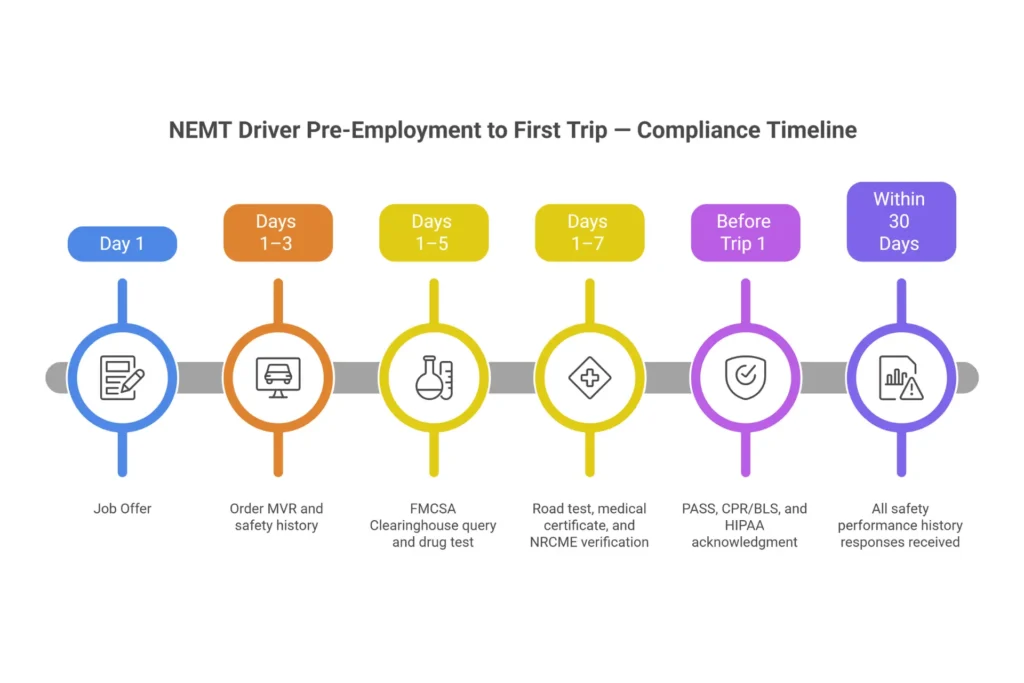
Employment Application and 10-Year History Requirements
Your DOT-compliant employment application under §391.21 must collect the driver’s complete commercial driving history. For CDL drivers, that covers 10 years. For non-CDL NEMT drivers, the lookback period is 3 years. The application must ask specifically about: all licenses and permits held in any state, all accidents in the past 3 years, all traffic convictions and forfeitures in the past 3 years, and any denial, revocation, or suspension of any operating privilege. Employment gaps of 30 days or more must be explained in writing on the application itself — auditors routinely flag unsigned applications and unexplained gaps as automatic deficiencies. Once you have the application, contact every prior DOT-regulated employer in the covered period for a safety performance history inquiry under §391.23. You have 30 days to receive responses; document every contact attempt with date, method used, and the response received.
Background Check Standards for Patient-Facing NEMT Drivers
The background check standard for a NEMT driver serving Medicaid patients exceeds what FMCSA requires for trucking. Most NEMT brokers require a 7-year multi-state criminal check with county court searches — not just a national database query. Sex offender registry verification through NSOPW.gov is required and must be documented in the file. In Florida, Level 2 fingerprint screening through the AHCA Background Screening Clearinghouse is mandatory for all drivers with patient contact. Texas requires checks against the Employee Misconduct Registry (EMR) for patient-facing healthcare workers. Georgia enrollment through Verida includes background screening as part of the provider credentialing process. Automatic disqualifiers for NEMT specifically include: violent felony convictions, sex offenses (typically lifetime ban), human trafficking, child or elder abuse findings, and Medicaid fraud exclusions under Social Security Act §1128. Check the OIG List of Excluded Individuals and Entities at hire and every month thereafter without exception.
Pre-Employment Drug Testing and FMCSA Clearinghouse Query
The pre-employment drug test under 49 CFR §382.301 must be a DOT 5-panel test conducted at a certified laboratory through a chain of custody form. The driver cannot perform any safety-sensitive function until a negative result is confirmed by the Medical Review Officer. NEMT brokers frequently require a 10-panel test in addition to or instead of the DOT 5-panel — confirm your broker’s specific requirement before ordering the test. The Clearinghouse full query verifies the driver has no unresolved drug or alcohol violations across all DOT-regulated employers in the system. If the query returns a “prohibited” status, do not hire the driver for safety-sensitive duties — the driver must complete a return-to-duty process with a Substance Abuse Professional before eligibility is restored. For guidance on how compliance intersects with billing, see our NEMT billing guide.
Medical Examination Requirements for NEMT Drivers
The question new NEMT operators ask most often about medical exams is: “Do my drivers actually need a DOT physical?” The answer depends on your vehicle and your broker, and the two answers are frequently different.
Pro Tip — Modified GVWR After Wheelchair Conversion: Wheelchair lifts and ADA conversion equipment add weight to a vehicle’s original GVWR. Always check the door-jamb certification label on a converted van — not just the manufacturer’s base GVWR — to determine if the conversion has pushed the vehicle above the 10,001 lb threshold. Many operators discover their converted van is technically a FMCSA-regulated CMV only during a broker vehicle inspection.
When DOT Medical Certificates Are Required (GVWR Threshold)
Under 49 CFR §390.5, any vehicle with a GVWR of 10,001 lbs or more operating in interstate commerce is a commercial motor vehicle requiring a full DOT medical examination under §391.41. Most standard NEMT vans fall below this threshold: a Chrysler Pacifica WAV has a GVWR of approximately 5,500–6,050 lbs, and a Toyota Sienna WAV runs 5,500–6,000 lbs. However, the Ford Transit 350 high-roof has a GVWR of 10,360 lbs — above the threshold. A full-size Chevy Express 3500 with a wheelchair lift conversion can run 9,600–9,900 lbs, close enough to the threshold that operators must verify the converted GVWR specifically. Stretcher vans often reach 10,500–11,500 lbs and clearly require DOT physicals.
National Registry of Certified Medical Examiners Verification
For non-CDL drivers who do require DOT physicals, you must verify that the examining physician is actively listed on the National Registry of Certified Medical Examiners (NRCME) at the time of examination. Print the verification page showing the examiner’s name, registry number, and active status on the examination date — file this printout in the DQ file alongside the MCSA-5876 medical examiner’s certificate. As of June 23, 2025, CDL drivers’ medical certification status now transmits automatically to the CDLIS MVR system, meaning paper NRCME verification is no longer required for CDL holders whose MVR shows an up-to-date medical certification status. Non-CDL NEMT drivers still require manual verification and paper certificate filing.
Common NEMT Vehicles and DOT Medical Exam Applicability
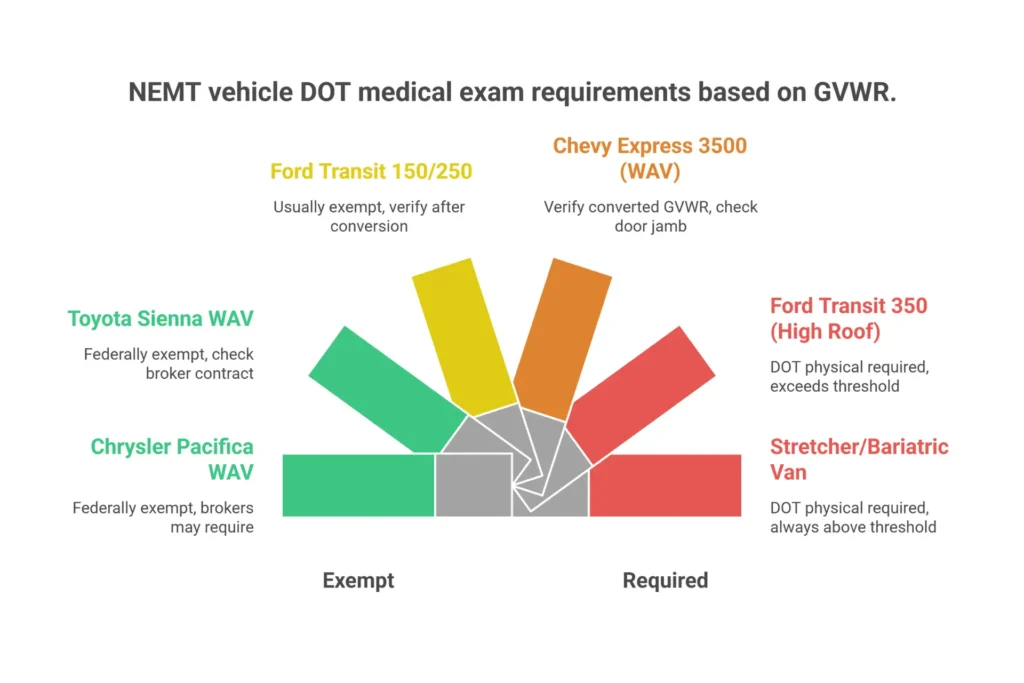
Even when your vehicle falls below the 10,001 lb federal threshold, your broker contract may require a DOT-equivalent physical for all drivers. ModivCare and MTM both typically require DOT physicals for all WAV drivers regardless of vehicle GVWR. This broker mandate reflects the physical demands of NEMT — operating wheelchair lifts, securing power wheelchairs, and assisting passengers who may weigh 250 lbs or more. Additionally, California requires drivers to pass a physical capacity test demonstrating ability to lift 150 lbs as part of Medi-Cal driver qualification. Texas and Virginia require annual TB screening for patient-contact NEMT drivers. Document all state-required health certifications in the medical section of your DQ file alongside the standard MCSA-5876.
Motor Vehicle Record Requirements
The motor vehicle record is both a hiring document and an annual maintenance requirement. Missing an annual MVR review is the most common DQ file deficiency auditors find — and it is entirely preventable with a basic expiration tracking system.
Pro Tip — The 30-Day Rule: Initial MVRs at hire must be ordered and received within 30 days of the driver’s start date under §391.23. An MVR pulled 6 months before hire does not satisfy this requirement. Order the MVR on the same day the driver’s application is received, not after a verbal offer is made.
Initial MVR at Hire — What States and What Time Period
The initial MVR must cover the 3 years prior to the application date and must be pulled from every state where the driver has held a license or permit during that period. If a driver moved from Ohio to Texas 2 years ago, you need MVRs from both states. Most states allow employer MVR requests through online portals: California’s DMV e-Services portal processes instantly at $2.00 per record; Texas DPS provides instant online access at $6.50–$7.50; Florida DHSMV returns instant results; New York DMV can take 3–10 days by mail at $7–$10. For multi-state hires, third-party MVR services from providers like HireRight, Sterling, or Checkr bundle all state records with turnaround times of 24–48 hours, typically at $30–$50 per bundle.
Annual MVR Review Process and Documentation
Every 12 months from the previous review, you must pull a current MVR for each active driver under §391.25. The review itself requires two steps: ordering the MVR and actually reviewing it for disqualifying violations. Document the review with a signed note that identifies the driver, the date of review, the states where records were pulled, any violations found, and your certification that the driver remains qualified. File this note in the DQ file with the MVR printout. Note that the annual driver certification of violations (formerly required under §391.27) was permanently eliminated on May 9, 2022 — do not collect this form, as it creates unnecessary paperwork without any compliance benefit.
MVR Violations That Disqualify a NEMT Driver
Federal major offenses under 49 CFR §383.51(b) — DUI, hit and run, using a vehicle to commit a felony, vehicular manslaughter — result in disqualification. Serious traffic violations including reckless driving, excessive speeding (15+ mph over limit), improper lane changes, and texting while driving accumulate toward disqualification when two offenses occur within 3 years. NEMT brokers impose stricter standards: ModivCare and MTM commonly disqualify drivers with 3 or more moving violations in a 3-year period regardless of FMCSA thresholds. A DUI conviction carries a lifetime ban from most NEMT broker networks even though FMCSA requires only a 1-year disqualification for a first offense. License suspension for any reason — including non-driving issues like unpaid child support — triggers immediate broker removal from the active provider list. Review our resource on NEMT denial codes to understand how driver compliance failures create downstream billing denials.
DQ File Retention Schedule and Audit Preparation
Retention rules answer one question: how long must you keep each document? Audit preparation answers a different question: how quickly can you produce every document in that file when an auditor sends a request letter? Both questions have the same financial consequence if you get the answer wrong.
Pro Tip — The “No Safe Harbor” Rule: Medicaid auditors apply a date-of-service compliance test. Retroactively correcting a document after an audit notice arrives does not cure the historic non-compliance. The only correction that protects past claims is having the document in your file on the date each trip was billed. There are no exceptions to this rule in any state Medicaid program.
Active Employee Retention Requirements
During active employment, the core DQ file documents — employment application, initial MVR, safety performance history, road test certificate — must be retained continuously under §391.51(c). Periodic documents — annual MVRs, annual review notes, medical certificates — must be kept for 3 years from their execution date, after which they may be removed from the active file. Many operators choose to retain all documents for the full employment period plus 3 years rather than tracking individual removal dates, which simplifies audit response and eliminates the risk of accidentally purging a document that is still within its required retention window.
Post-Termination Retention — 3-Year Federal Minimum
When a driver leaves your company, the complete DQ file must be retained for an additional 3 years under §391.51(c). The Driver Investigation History File — the safety performance history responses kept separately under §391.53 — also requires 3-year post-employment retention in its own folder. Create a dedicated archive folder for terminated drivers using the naming convention YYYY-MM-DD_Terminated_LastName_FirstName so records are immediately sortable by termination date during future audits. State Medicaid programs often extend this retention: California DHCS requires 7 years for all Medi-Cal billing records, Virginia DMAS requires 6 years from service date, Texas HHSC requires 5 years, and Florida AHCA requires 5–7 years depending on record type. Always apply the longer period.
Drug Testing Records — 5-Year Requirement
Drug and alcohol testing records operate on a separate retention schedule under §382.401(a). Positive test results, refusals to test, return-to-duty documentation, follow-up testing plans, and substance abuse professional evaluations must all be retained for 5 years — regardless of whether the driver remains employed. A driver who tested positive and was not hired still requires a 5-year retention of that test result. Negative pre-employment test results must be retained for 1 year under the regulation, though most compliance professionals recommend retaining them for 3 years for consistency with the rest of the DQ file. For guidance on how billing and compliance documentation intersect in an audit, see our NEMT billing outsourcing vs. in-house analysis.
How to Prepare for a Medicaid DQ File Audit

| Document | CFR Section | During Employment | Post-Termination | State Medicaid Override |
|---|---|---|---|---|
| Employment Application | §391.21 / §391.51(c) | Full employment | 3 years | CA: 7 years; VA: 6 years |
| Initial MVR at Hire | §391.23 / §391.51(c) | Full employment | 3 years | Apply state maximum |
| Safety Performance History | §391.23 / §391.53 | Separate file; full employment | 3 years | Apply state maximum |
| Road Test Certificate | §391.31 / §391.51(c) | Full employment | 3 years | Apply state maximum |
| Annual MVR Reviews | §391.25 / §391.51(d)(1) | 3 years from execution | 3 years | Apply state maximum |
| Medical Certificate (non-CDL) | §391.43 / §391.51(d)(5) | 3 years from execution | 3 years | Apply state maximum |
| Clearinghouse Queries + Consent | §382.413(f) | Full employment | 3 years | Apply state maximum |
| Drug/Alcohol Testing Records (positive) | §382.401(a) | 5 years | 5 years | 5 years minimum |
| Background Check Reports | FCRA + State Law | Full employment | 3–7 years by state | FL: up to 7 years for criminal |
| NEMT Certifications (PASS/CPR/HIPAA) | Broker/Medicaid contract | Full employment | 3 years minimum | Apply state/broker maximum |
Audit readiness means producing any requested document within 48 hours of an audit notice. When an audit notice arrives, immediately freeze all document purging, identify every driver in the audit sample period, and verify each file contains a complete set of documents with no expiration gaps for the audit lookback period. Conduct quarterly internal audits using the same DQ file checklist your brokers and Medicaid auditors use — catch deficiencies internally before they become external findings. For billing-specific audit defense strategies, review our comprehensive NEMT audit preparation guide.
Free NEMT Driver Qualification File Checklist (Download)
The checklist below covers every document required for a fully compliant NEMT driver qualification file in 2026 — combining FMCSA core requirements with the NEMT-specific broker and Medicaid additions that no trucking compliance guide includes. Download, customize with your company name and driver information, and use it as your front-page index for every physical or digital DQ file you create.
Pro Tip — State Customization Required: Before using this checklist in California, Texas, Florida, Virginia, or Georgia, add the state-specific requirements from your Medicaid provider manual. California operators must add the TB test and 150-lb physical capacity documentation. Florida operators must add the AHCA Level 2 fingerprint clearance. Texas operators must add the Employee Misconduct Registry check. Generic checklists that skip these state additions will fail a Medicaid audit in high-enforcement states.
How to Use This Checklist
Print one checklist per driver and place it as the cover page of the driver’s physical folder, or use it as the first tab in their digital folder. Check off each item as it is collected, initial and date each checkbox to create an audit trail. Set calendar alerts based on the expiration tracking table above. Assign one staff member as the DQ file owner responsible for monthly OIG checks, quarterly mock audits, and annual renewal coordination. When a broker sends a credentialing request or a Medicaid auditor issues a document request, this index page allows you to locate and produce every required document within minutes, not hours.
6 DQ File Mistakes That Trigger NEMT Audits
- Missing the annual MVR review entirely. This is the most common audit finding. Set a calendar reminder 45 days before each driver’s annual review date — not the date the current MVR was pulled, but the anniversary of the previous review. A missed annual review creates a $1,584 per day FMCSA violation and triggers Medicaid recoupment for the entire gap period.
- Expired medical certificate with no gap detection. A medical certificate that expires on October 10th and is not renewed until November 1st creates a 21-day window of unbillable trips. Auditors cross-reference service dates against certificate expiration dates trip by trip. The 90/60/30 day alert system prevents this from happening — but only if you build it into your tracking system before the first certificate is issued.
- OIG exclusion verification gaps. Monthly OIG checks are not optional in any Medicaid transportation program. A driver who appears on the exclusion list after hire and is not caught for 3 months because you are running quarterly checks creates a 90-day False Claims Act exposure window. Every undocumented month is its own compliance failure.
- PASS training listed as “completed” without certificate in file. Verbal confirmation from a driver that they completed PASS training is not documentation. The CTAA-issued certificate must be physically present in the DQ file — not described in a note, not referenced in an email, not promised for later. Brokers disqualify drivers during enrollment audits specifically for missing PASS certificates.
- Employment application missing gap explanations. §391.21 requires written explanation for all employment gaps of 30 days or more. Auditors treat unexplained gaps as incomplete applications, which converts the entire DQ file into a deficient file and creates recoupment exposure for all trips during that driver’s tenure.
- Using the wrong GVWR to determine medical exam applicability. Operators who check the manufacturer’s base GVWR without accounting for the weight added by a wheelchair lift conversion, heavy-duty suspension upgrade, or stretcher mounting system sometimes conclude their vehicle is below the 10,001 lb threshold when the converted vehicle is above it. Verify the door-jamb certification label — not the VIN lookup — before concluding your driver does not need a DOT physical.
Frequently Asked Questions About NEMT Driver Qualification Files
What is included in a driver qualification file?
A complete NEMT driver qualification file includes the FMCSA-required documents under 49 CFR §391.51 — employment application, initial MVR, safety performance history, road test certificate, medical examiner’s certificate, annual MVR reviews, and drug testing records — plus NEMT-specific items: PASS training certificate, CPR/BLS certification, First Aid, HIPAA training, mobility securement training, monthly OIG exclusion verification logs, and 7-year criminal background check results required by brokers like ModivCare and MTM.
Is a driver qualification file required for NEMT?
Yes. Under 49 CFR §391.51, a DQ file is federally required for drivers operating commercial motor vehicles with a GVWR of 10,001 lbs or more in interstate commerce. Even for lighter NEMT vehicles, state Medicaid programs and NEMT brokers require a functionally equivalent compliance file as a condition of enrollment and reimbursement. Incomplete files are the leading cause of Medicaid billing recoupment and broker suspension for NEMT operators.
How long must NEMT driver qualification files be kept?
NEMT driver qualification files must be retained for the full employment period plus 3 years after termination under 49 CFR §391.51(c). Drug and alcohol testing records require 5 years under §382.401(a). State Medicaid programs impose longer requirements in many cases: California requires 7 years, Virginia 6 years, Texas and Georgia 5 years. Always apply the longest applicable retention period.
How often should driver qualification files be updated?
DQ files require updates at multiple intervals: annually for MVR reviews (§391.25) and Clearinghouse limited queries (§382.413); every 24 months for medical certificates and CPR/BLS recertification; annually for HIPAA training and PASS training (per most brokers); monthly for OIG exclusion verification. Defensive driving certificates renew every 3 years and mobility securement training renews when equipment changes.
What happens if NEMT driver files are incomplete during an audit?
Medicaid auditors apply a date-of-service test: any trip billed during a period when the driver’s DQ file was non-compliant is subject to 100% recoupment. FMCSA recordkeeping violations carry penalties up to $1,584 per day. NEMT brokers typically suspend trip assignments the same day a missing credential is discovered. There is no retroactive fix — a document corrected after the audit notice does not cure past non-compliance.
Do non-CDL NEMT drivers need a DQ file?
Federal FMCSA rules require a DQ file for non-CDL drivers who operate CMVs with a GVWR of 10,001 lbs or more in interstate commerce. For lighter vehicles operating intrastate, federal requirements may not apply. However, every major NEMT broker and state Medicaid program requires a full DQ-equivalent compliance file for all drivers regardless of vehicle weight or CDL status, as a condition of enrollment and reimbursement.
Can driver qualification files be kept electronically?
Yes. FMCSA permits electronic DQ file storage under §391.51(b)(2) provided files are immediately producible upon request, tamper-proof with an audit trail, and legible. For NEMT operators, electronic files must also comply with HIPAA security requirements under §164.308 because medical certificates and health screening records are protected health information. Role-based access controls, AES-256 encryption, and documented backup procedures are required.
What certifications must NEMT drivers have that trucking drivers do not?
NEMT drivers must carry certifications not required in trucking: PASS training (Passenger Assistance Safety and Sensitivity, CTAA-approved), CPR/BLS (AHA or Red Cross, every 2 years), First Aid, mobility device securement training (Q’Straint or Sure-Lok), and HIPAA privacy training. Additionally, monthly OIG exclusion verification is required for Medicaid billing eligibility — trucking operators have no equivalent healthcare program integrity requirement.
Quick Answer Reference: Driver Qualification File Questions
Short, direct answers for common DQ file questions.
What is in a driver qualification file?
A driver qualification file contains employment application, 3-year motor vehicle records, safety performance history from prior employers, road test certificate, medical examiner’s certificate, pre-employment drug test results, Clearinghouse query, and annual review documents. For NEMT operators, the file also includes PASS training, CPR/BLS, HIPAA training, and monthly OIG exclusion verification logs.
How long do you keep driver qualification files?
Keep driver qualification files for the driver’s entire employment period plus 3 years after their last day. Drug and alcohol testing records require a longer 5-year retention. State Medicaid programs in California, Virginia, Texas, and Florida require up to 7 years for billing-related records. Always apply the longest period that applies to your state and payer mix.
Do NEMT drivers need a DOT physical?
NEMT drivers need a DOT physical if their vehicle has a GVWR of 10,001 lbs or more — this applies to Ford Transit 350 and stretcher vans but typically not standard Chrysler Pacifica or Toyota Sienna WAVs. Even for lighter vehicles, brokers like ModivCare and MTM require DOT-equivalent physicals for all WAV drivers as a contractual condition regardless of the federal weight threshold.
What is PASS training for NEMT drivers?
PASS stands for Passenger Assistance Safety and Sensitivity. It is a certification course from a CTAA-approved provider that teaches NEMT drivers how to safely assist wheelchair users, elderly passengers, and individuals with disabilities. All major NEMT brokers require current PASS certification as a condition of driver approval. The training typically costs $75–$150 per driver and renews annually per broker requirements.
Can driver qualification files be kept electronically?
Yes. FMCSA permits electronic DQ files under 49 CFR §391.51 provided they are immediately accessible, legible, and tamper-proof. NEMT operators must also meet HIPAA security requirements because medical certificates are protected health information. A secure, access-controlled cloud folder with consistent naming conventions satisfies both FMCSA and HIPAA requirements for small fleets.
Who needs a driver qualification file?
Every driver your NEMT company dispatches needs a complete DQ file — including owner-operators who also drive their own vehicle. If you are both the carrier and the driver, you must maintain your own file with every required document. Brokers audit provider files regardless of whether the driver is an employee, contractor, or owner, and missing documentation suspends trip assignments for all categories equally.
Keep Your NEMT Operation Audit-Ready from Day One
Your driver qualification file is not administrative overhead. It is the document set that determines whether your driver is legally dispatchable, whether your Medicaid claims are billable, and whether your operation survives a broker or state audit. The three-layer compliance framework — FMCSA, state Medicaid, and broker standards — means you cannot rely on any single checklist built for trucking to protect a NEMT operation. Build your system before your first driver’s first trip, track every expiration date, and run quarterly internal audits to catch problems before an auditor does. The EliteMed Financials team works exclusively with NEMT operators and medical transportation providers. Whether you need expert NEMT billing and compliance services that keep your denial rate below 5% and your documentation audit-ready, or guidance on building the digital infrastructure your operation needs from the ground up, every service we provide is built around one goal: making your operation as compliant as your patients depend on you to be.
and Your Claims Denial-Free