
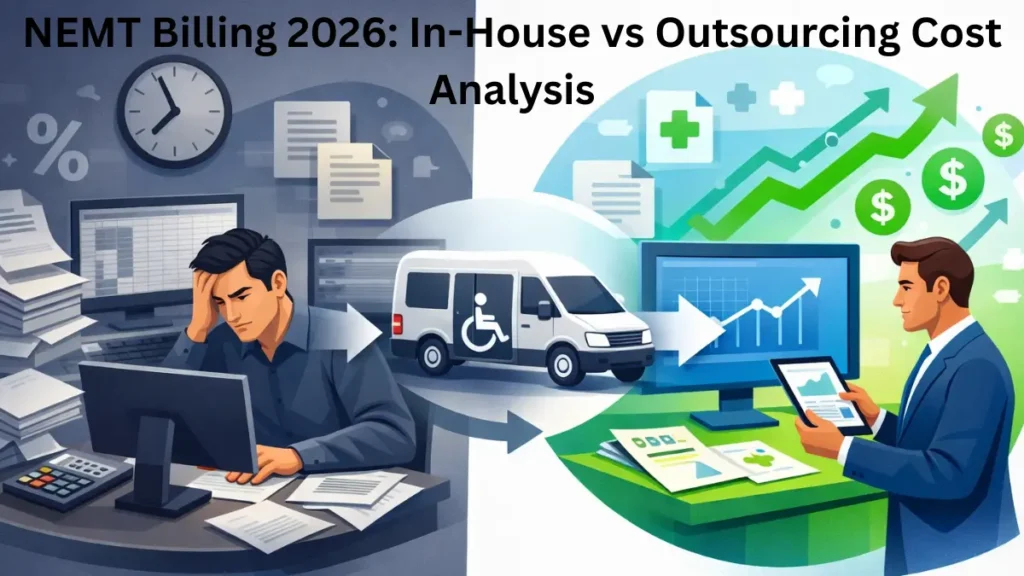
The $150,000 Wake-Up Call That Changed Everything
NEMT billing outsourcing vs in-house—it’s the decision that separates profitable medical transportation companies from those bleeding money every single month. If you’re wrestling with this choice in 2026, you’re not alone. This comprehensive guide breaks down every cost, reveals 15 revenue-draining mistakes, and gives you the exact ROI framework to make the right decision for your fleet. Picture this scenario: You’re reviewing your quarterly financials for your 15-vehicle NEMT fleet, and something doesn’t add up. According to your dispatch logs, you completed 12,000 trips last year. But your collections only account for 10,800. That’s 1,200 trips—roughly $72,000 at $60 per trip—that simply vanished into thin air. Now add in the $57.23 rework cost for each of your 1,440 denied claims, and suddenly you’re staring at over $150,000 in lost revenue and unnecessary expenses.
This isn’t some worst-case hypothetical. It’s the reality for countless NEMT providers operating right now in 2026.
Here’s what most owners don’t realize: billing has evolved from a back-office clerical task into a strategic revenue engine that directly determines whether your business thrives or barely survives. With Electronic Visit Verification mandates now fully enforced across all states, AI-driven payer audits becoming standard practice, and broker requirements growing more complex by the month, your billing approach isn’t just an operational choice anymore—it’s a survival decision.
And you’re not alone in this struggle. Industry statistics show that the NEMT market continues expanding, yet profit margins are getting squeezed tighter every year. Our data shows that 60-70% of NEMT providers have outsourced their billing since 2021, and those who haven’t are facing denial rates of 10-15% compared to 3-5% for their outsourced competitors. The gap isn’t just widening—it’s becoming a chasm that swallows profit margins whole.
What You’ll Learn in This Guide:
Whether you’re evaluating NEMT billing outsourcing vs in-house for the first time or reconsidering your current approach, this guide provides the data-driven answers you need.
- The true cost breakdown of in-house vs. outsourced billing with 2026-specific numbers
- 15 costly billing mistakes that drain 2-5% of your revenue annually (and exactly how to fix them)
- A step-by-step ROI calculator to determine your optimal approach
- Real-world case studies showing 25-40% cost reductions
- The decision framework used by top-performing NEMT companies
- Technology solutions that can reduce denials by 65% or more
At Elite Med Financials, we’ve analyzed over $500M in NEMT claims and helped hundreds of providers navigate this exact decision. The patterns are clear, the data is undeniable, and the opportunity to transform your billing from a cost center to a profit center has never been more accessible.
Let’s start by understanding what billing really costs in today’s compliance-heavy environment.
Table of Contents
Understanding the True Cost of NEMT Billing in 2026
What is NEMT Billing and Why Does Cost Matter?
What is the average cost of NEMT billing? NEMT billing costs in 2026 typically range from $3-5 per claim when outsourced to specialized providers, compared to $8-12 per claim for in-house operations. However, the true cost extends far beyond simple per-claim processing fees to include compliance overhead, technology investments, staff turnover, and revenue leakage—often totaling 5-10% of net revenue for in-house departments versus 3-8% for outsourced arrangements.
The NEMT billing outsourcing vs in-house debate ultimately comes down to one question: what’s your true cost to collect each dollar of revenue?
If you’re operating a 20-vehicle NEMT fleet completing 2,000 trips monthly at $60 average reimbursement, you’re probably looking at billing as a line item expense. But here’s the reality most owners miss: billing is not an expense—it’s an investment in revenue capture. And like any investment, its true cost is measured by what you’re leaving on the table.
The Hidden Economics Behind Every NEMT Claim
The NEMT billing landscape has undergone a fundamental transformation over the past three years. What was once primarily about submitting claims and posting payments has evolved into a complex, compliance-driven operation that requires specialized expertise. Consider these 2026 realities:
EVV Mandates Are Now Table Stakes. Every single Medicaid NEMT claim requires Electronic Visit Verification with GPS timestamp validation. Non-compliance doesn’t just mean denials—it triggers automatic audits with potential recoupments that can devastate your cash flow.
AI-Powered Payer Scrutiny Has Intensified. Major brokers like Modivcare and MTM now use artificial intelligence to flag “suspicious” claims before human review even begins. A single documentation inconsistency can trigger a cascade of denials across your entire claim batch.
The Specialization Gap Keeps Widening. General medical billers simply lack the specific knowledge required for NEMT—HCPCS coding variations, mileage calculations, state-specific PCS forms, and broker portal requirements create a steep learning curve that takes 4-12 weeks to climb.
Revenue Leakage Remains Invisible. Unlike denied claims that show up on reports, unbilled trips and undercoded services represent silent profit erosion that often goes undetected for months or even years.
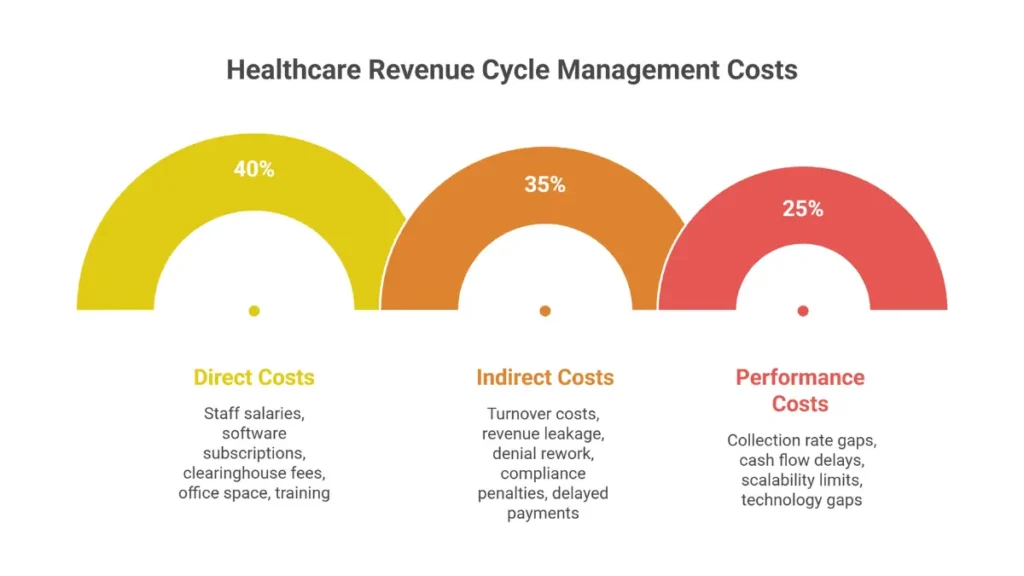
Key Cost Factors Most Providers Overlook
When evaluating your billing costs, you need to look beyond the obvious. Here’s the comprehensive framework we use when helping providers understand their complete billing operations:
Direct Costs (What Shows Up on Your P&L):
- Staff salaries and benefits
- Software subscriptions and licensing
- Clearinghouse fees per claim
- Office space and equipment allocation
- Training and certification programs
Indirect Costs (The Hidden Profit Drains):
- Turnover and retraining expenses (29-40% annual turnover rate in billing)
- Revenue leakage from unbilled services (2-5% of completed trips)
- Denial rework labor ($57.23 average per error)
- Compliance penalties and audit defense costs
- Opportunity cost of delayed payments (8% cost of capital)
Performance Costs (What You’re Leaving on the Table):
- Collection rate gaps (85-90% in-house vs. 95-98% outsourced)
- Days Sales Outstanding differences (40-60 days vs. 30-45 days)
- Scalability constraints during growth periods
- Technology access limitations
2026 Industry Benchmarks
Let’s examine the hard numbers from current industry analysis:
| Cost Category | In-House Average | Outsourced Average | Financial Impact |
|---|---|---|---|
| Per-Claim Processing | $8-12 | $3-5 | 60%+ savings potential |
| Collection Rate | 85-90% | 95-98% | 5-13% revenue lift |
| Denial Rate | 10-15% | 3-5% | 7-12% reduction |
| Annual Staff Costs | $55,000-$85,000 per biller | 3-8% of collections | 25-40% cost reduction |
| Technology Investment | $600-$1,800/vehicle/year | Included in service fee | Eliminated capital outlay |
The most revealing metric? True cost to collect $1 in revenue. Our data shows in-house operations spend 13.7% of every collected dollar on billing operations, while outsourced arrangements average just 5.4%. That’s a 60% efficiency gap that compounds with every claim you process.
Actionable Takeaway: Before reading further, ask yourself these questions: Have you audited your unbilled trip ratio in the last quarter? Do you know your true cost per claim including rework and overhead? Can you quantify your revenue leakage as a percentage of total revenue? If you answered “no” to any of these, you’re operating with incomplete cost data—and that’s costing you money every single day.
In-House NEMT Billing: Complete Cost Breakdown
How Much Does It Cost to Hire an In-House NEMT Biller?
Hiring an in-house NEMT biller costs $46,000-$75,000 annually in base salary, plus 29-31% in benefits, totaling $59,340-$98,250 per biller. However, the true cost includes $5,000-$15,000 in recruitment expenses, $2,000-$2,500 in training investment, and 20% of salary in turnover costs—bringing the actual first-year cost to $78,000-$138,000 per billing specialist.
Let’s dismantle the myth of “fixed cost control” that many providers believe they have with in-house billing. When you build an internal billing team, you’re not just hiring employees—you’re building an entire operational department with layers of hidden expenses that most providers dramatically underestimate.
Direct Costs of In-House Billing Staff
The Visible Costs (What You See on Paper):
- Base Salary: $46,000-$75,000 depending on experience and location
- Benefits Package (29-31% of salary): $13,340-$23,250 annually
- Payroll Taxes and Insurance: $3,500-$5,700 per year
The Hidden Costs (What’s Actually Draining Your Budget):
- Recruitment fees and job posting costs: $5,000-$15,000 per hire
- Training period (4-12 weeks at reduced productivity): $2,000-$2,500 plus opportunity loss
- Turnover replacement (20% of annual salary): $9,200-$15,000 per departure
- Management oversight allocation: 10-15% of supervisor time
- Quality control and error correction: 5-10% additional labor hours
The NEMT billing specialist salary market has become increasingly competitive due to the specialized knowledge requirements. A certified biller with genuine NEMT-specific experience now commands $65,000-$85,000 in most metropolitan markets—that’s a 25% premium over general medical billers who lack transportation-specific expertise.
Indirect Costs You’re Already Paying
Your technology stack represents far more than just software subscriptions. Here’s the complete picture of what running billing operations actually requires:
Required Technology Systems and Their Costs:
| System Component | Annual Cost Range | Notes |
|---|---|---|
| Billing Platform | $6,000-$18,000 (10 vehicles) | $50-$150/vehicle/month |
| Clearinghouse Services | $2,500-$5,000 | $0.25-$0.50 per claim |
| EVV Compliance System | $3,600-$9,000 | $30-$75/vehicle/month |
| EDI Integration | $2,000-$10,000 setup + $500-$2,000/month | One-time plus ongoing |
| Document Management | $1,000-$3,000 | Annual subscription |
| Security & HIPAA Compliance | $5,000-$15,000 | Audit preparation included |
| Backup/Disaster Recovery | $2,000-$5,000 | Data protection essential |
Total Annual Technology Cost Range: $19,600-$57,000 for a 10-vehicle fleet—and this scales upward as you grow.
Here’s the painful truth most providers discover too late: most in-house teams use only 40-60% of their software’s capabilities due to training gaps and time constraints. You’re paying for premium features that never get activated because your staff is too busy putting out fires to learn advanced functionality.
The Turnover Tax: What Staff Changes Really Cost
The billing staff turnover rate in NEMT averages 29-40% annually—nearly double the healthcare industry average. Every single departure costs you:
- Direct Replacement Costs: $5,000-$15,000 in recruitment, advertising, and interviewing time
- Training Investment Loss: $2,000-$2,500 in completed training that walks out the door
- Productivity Dip: New hires operate at 50% efficiency for 4-8 weeks during ramp-up
- Quality Erosion: New employees make 2-3x more errors in their first 90 days
- Morale Impact: Remaining staff absorb extra work, increasing their burnout risk and potential departure
A single turnover event can cost $15,000-$20,000 in hard expenses and $30,000-$50,000 in lost productivity and errors. For a billing department with 3 billers experiencing industry-average turnover, that’s $135,000-$210,000 annually in turnover-related costs alone.
In-House Cost Calculator: Real-World Scenario
Let’s construct a realistic scenario for a 20-vehicle fleet completing 24,000 annual trips:
Complete Annual In-House Billing Costs:
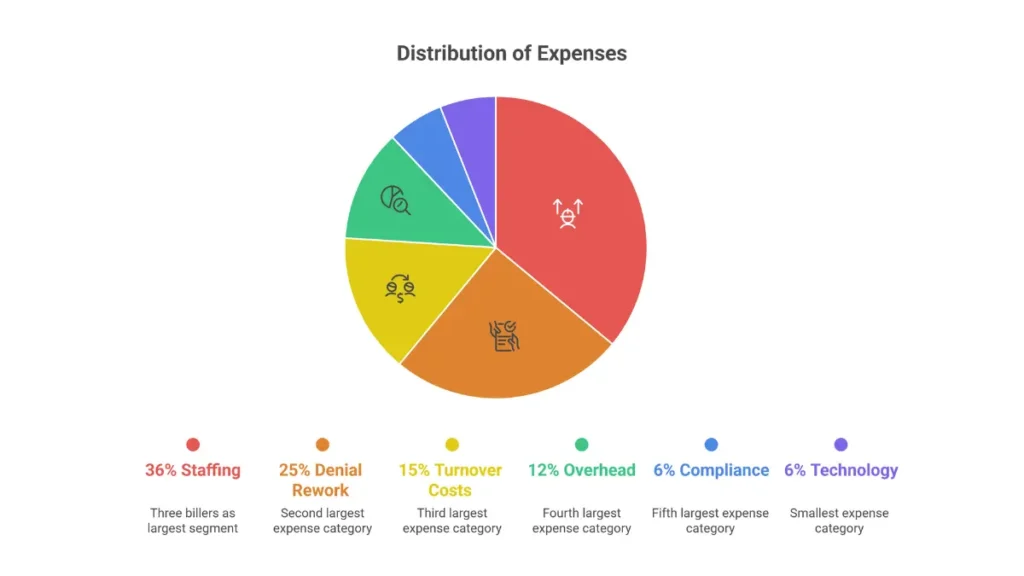
| Cost Category | Annual Amount |
|---|---|
| Staffing (3 billers at $79,000 fully loaded) | $237,000 |
| Technology Stack | $38,000 |
| Overhead ($25,000 per FTE) | $75,000 |
| Compliance and Training | $42,000 |
| Turnover Costs (40% rate) | $94,800 |
| Denial Rework (12% rate × 2,880 denials × $57.23) | $164,880 |
| TOTAL ANNUAL COST | $651,680 |
| Cost Per Claim | $27.15 |
Now consider the opportunity cost: If this operation achieves only 87% collection rate versus the outsourced benchmark of 96%, they’re leaving 9% of revenue on the table. At $1.44M annual revenue, that’s $129,600 in lost collections on top of the operational costs.
Effective Total Cost: $781,280 when accounting for suboptimal performance.
Actionable Takeaway: Before dismissing outsourcing as “too expensive,” complete this exercise for your own operation: Calculate fully loaded staff costs (Salary × 1.6), quantify every technology expense, track your turnover impact over the past two years, and measure denial rework hours. Most providers discover their actual in-house costs are 40-60% higher than their initial estimates.
Outsourced NEMT Billing: Complete Cost Breakdown
How Much Does It Cost to Outsource NEMT Billing?
Outsourcing NEMT billing typically costs 3-10% of net collections, with competitive rates of 4-8% being standard in 2026. Alternative pricing models include $3-10 per claim or $500-$2,000 monthly flat rates for small fleets, with setup fees ranging from $0-$5,000 that are often waived for volume commitments.
If the in-house cost breakdown felt overwhelming, here’s the good news: outsourcing transforms those complex, fixed costs into simple, variable expenses directly tied to your success. But not all outsourcing arrangements are created equal, and understanding the true cost—and value—requires looking beyond the headline percentage rate.
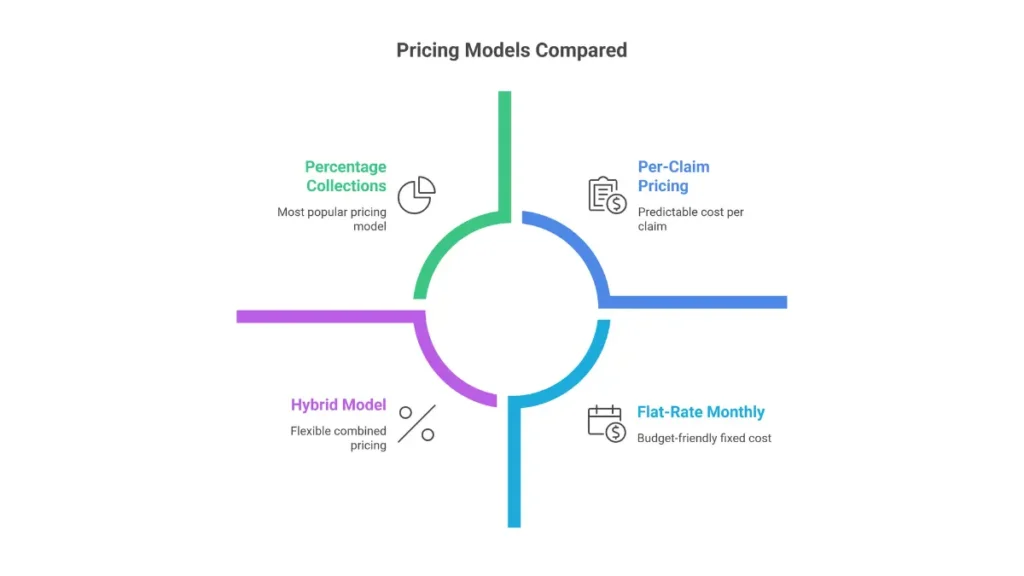
Common Pricing Models Explained
Percentage of Collections (Most Common):
- Standard Range: 3-10% of net collections
- Competitive Market Rate: 4-8%
- What’s Included: Full-service RCM—claim submission, denial management, payment posting, A/R follow-up
- Best For: Most providers seeking aligned incentives where your billing partner only wins when you win
Per-Claim Pricing:
- Rate Range: $3-$10 per clean claim
- Typical Structure: $3-$5 for basic processing, $6-$10 with comprehensive denial management
- Volume Discounts: Usually available above 1,000 claims monthly
- Best For: High-volume, consistent operations with historically stable denial rates
Flat-Rate Monthly:
- Small Fleets (1-10 vehicles): $500-$1,500 monthly
- Mid-Size Operations: $1,500-$3,000 monthly
- What’s Included: Predetermined claim volume with basic services
- Best For: Budget predictability, though watch carefully for overage fees
Hybrid Models:
- Base + Percentage: $1,000/month plus 2-4% of collections
- Per-Vehicle + Per-Claim: $50/vehicle plus $2/claim
- Best For: Providers wanting some fixed cost control with performance incentives
What’s Actually Included in Service Fees
Not all NEMT billing services deliver the same value. Here’s what you should expect at different price points:
At 3-4% (Basic Service):
- Claim creation and electronic submission
- Basic eligibility verification
- Payment posting and reconciliation
- Monthly standard reporting
At 5-6% (Standard Market Rate):
- Everything in Basic PLUS:
- Comprehensive denial management and appeals
- A/R follow-up on aging claims (60-90 day focus)
- EVV compliance monitoring and validation
- Quarterly performance reviews with recommendations
- Broker portal management for multiple payers
At 7-8% (Premium Service):
- Everything in Standard PLUS:
- Predictive denial prevention using AI tools
- Real-time eligibility verification before dispatch
- Custom reporting dashboards and KPI tracking
- Audit defense support and documentation review
- Strategic revenue cycle consulting
At 9-10% (Enterprise/High-Touch):
- Everything in Premium PLUS:
- Dedicated account management team
- Custom integration development for your systems
- Advanced analytics and industry benchmarking
- Compliance certification management
- Board-level reporting and executive summaries
Hidden Costs to Watch For
Even outsourcing has potential hidden expenses that can surprise you. Watch for these items in contracts and ask about them upfront:
- Setup/Implementation Fees: $0-$5,000 (often negotiable or waived entirely for volume commitments)
- Clearinghouse Pass-Throughs: $0.15-$0.50 per claim (should be clearly disclosed in your agreement)
- Statement Fees: $0.50-$0.90 per patient statement if paper statements are required
- Custom Report Fees: $100-$500 per custom report request beyond standard packages
- Integration Fees: $500-$5,000 for custom software connections to your dispatch system
- Termination/Tail Fees: 2-4% for A/R work-down if you end the relationship
Pro Tip: Reputable providers offer all-inclusive pricing with no hidden fees. Always request a complete “total cost of service” breakdown before signing any agreement, and get everything in writing.
Outsourcing Cost Calculator: Annual Cost Scenarios by Fleet Size
Small Fleet (10 vehicles, $600K annual revenue):
- Projected Collections at 90%: $540,000
- Outsourcing at 6% Rate: $32,400 annually ($2,700 monthly)
- Effective Per-Claim Cost: $4.05 (8,000 claims annually)
- Compared to In-House Equivalent: $200,000+ in savings
Mid-Size Fleet (25 vehicles, $1.5M annual revenue):
- Projected Collections at 96%: $1,440,000
- Outsourcing at 5.5% Rate: $79,200 annually ($6,600 monthly)
- Effective Per-Claim Cost: $3.96 (20,000 claims)
- Compared to In-House Equivalent: $400,000+ in savings
Large Fleet (50 vehicles, $3M annual revenue):
- Projected Collections at 96%: $2,880,000
- Outsourcing at 5% Negotiated Rate: $144,000 annually ($12,000 monthly)
- Effective Per-Claim Cost: $3.60 (40,000 claims)
- Compared to In-House: Marginal direct savings but significant risk reduction
The Performance Premium: Why Percentage Pricing Often Wins
The beauty of percentage-based billing cost structures is the aligned incentives between you and your billing partner. Consider this comparison:
| Performance Factor | In-House (Fixed Cost) | Outsourced (% of Collections) |
|---|---|---|
| Denial Goal | Minimize staff workload | Achieve zero denials (directly impacts their revenue) |
| Collection Speed | Eventually get to it | Immediate priority (faster payment = faster fees) |
| Revenue Leakage | Often unmeasured | Actively hunted (increases collection base) |
| Compliance Investment | Seen as cost center | Revenue protection strategy |
| Technology Upgrades | Budget constraint | Competitive advantage investment |
When your billing partner earns more only when you earn more, every aspect of the relationship changes fundamentally. Denials become shared problems to solve together. Revenue leakage becomes mutual opportunity. Technology upgrades happen proactively because they benefit both parties.
Actionable Takeaway: When comparing billing providers, use this framework: Calculate effective rate (Annual fee ÷ Net collections), quantify projected performance lift, value technology access separately, factor risk reduction benefits, and consider scalability for your growth plans. The provider with the lowest percentage isn’t always the best value.
NEMT Billing Outsourcing vs In-House: Head-to-Head Cost Comparison
Side-by-Side Annual Cost Analysis by Fleet Size
Now let’s put everything together in a direct comparison that accounts for all the factors we’ve discussed:
| Fleet Size | Monthly Claims | In-House Annual Cost | Outsourced Annual Cost | Annual Savings | Recommended Approach |
|---|---|---|---|---|---|
| 1-10 vehicles | 300-800 | $150,000-$250,000 | $24,000-$48,000 | $126,000-$202,000 | Outsource immediately |
| 11-25 vehicles | 800-2,000 | $300,000-$450,000 | $60,000-$120,000 | $240,000-$330,000 | Outsource (strong case) |
| 26-50 vehicles | 2,000-4,000 | $450,000-$700,000 | $120,000-$240,000 | $330,000-$460,000 | Evaluate both options |
| 50+ vehicles | 4,000+ | $700,000+ | $240,000+ | Variable | Consider hybrid model |
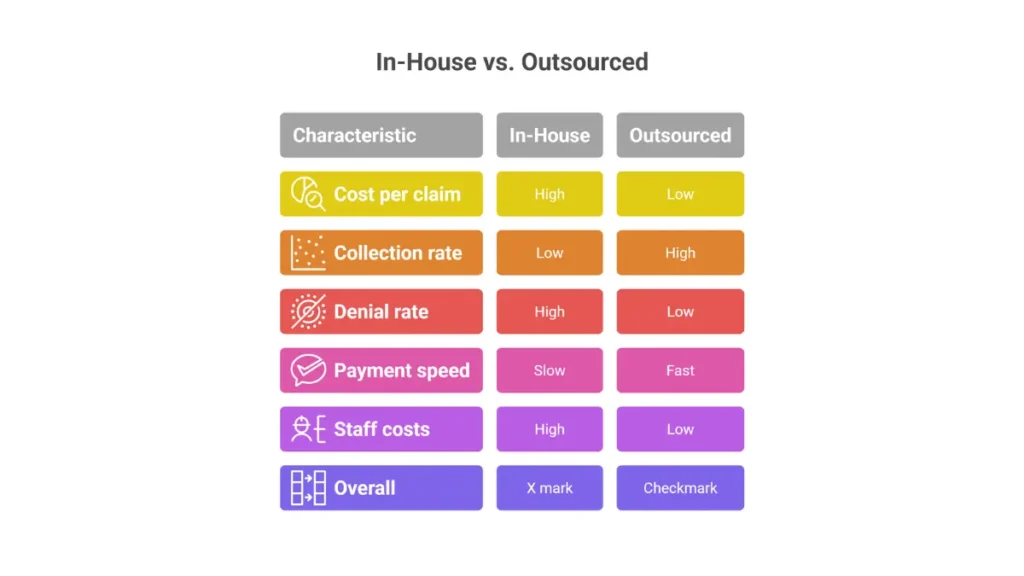
When analyzing NEMT billing outsourcing vs in-house on a pure numbers basis, the math consistently favors outsourcing for operations under 50 vehicles. These numbers include all direct costs, indirect costs, and performance differentials. The savings column represents the combined impact of lower operational costs AND improved collection rates.
Collection Rate Comparison: Where the Real Money Is
Cost savings are compelling, but the collection rate differential is where outsourcing really shines:
In-House Collection Rate Reality:
- Average: 85-90% of billable services collected
- First-pass acceptance: 80-85%
- Denial rate: 10-15%
- Denial appeal success: 40-50%
- Revenue left on table: $10-$15 per $100 billed
Outsourced Collection Rate Reality:
- Average: 95-98% of billable services collected
- First-pass acceptance: 92-96%
- Denial rate: 3-5%
- Denial appeal success: 65-75%
- Revenue left on table: $2-$5 per $100 billed
For a fleet billing $1.5M annually, this 8-13% collection rate improvement translates to $120,000-$195,000 in additional revenue—often exceeding the entire cost of outsourced billing services.
Time-to-Payment: The Cash Flow Impact
Cash flow is the lifeblood of any NEMT operation. Days Sales Outstanding (DSO) measures how quickly you convert completed trips into actual cash:
| Metric | In-House Average | Outsourced Average | Impact |
|---|---|---|---|
| DSO | 40-60 days | 30-45 days | 15-30 days faster cash |
| Clean Claim Rate | 80-85% | 92-96% | Fewer resubmissions |
| First-Pass Acceptance | 80-85% | 90-95% | Faster initial payment |
| Appeal Turnaround | 45-90 days | 21-45 days | Quicker denial resolution |
At an 8% annual cost of capital, collecting $100,000 even 30 days faster saves $657 in financing costs. Across your entire revenue stream, this adds up to thousands in annual savings that most providers never calculate.
5-Year Total Cost of Ownership Analysis
Looking beyond year one reveals even more dramatic differences:
20-Vehicle Fleet, $1.2M Annual Revenue:
| Year | In-House Cumulative Cost | Outsourced Cumulative Cost | Cumulative Difference |
|---|---|---|---|
| Year 1 | $651,680 | $79,200 | $572,480 |
| Year 2 | $1,336,000 | $162,800 | $1,173,200 |
| Year 3 | $2,055,600 | $251,100 | $1,804,500 |
| Year 4 | $2,812,800 | $344,400 | $2,468,400 |
| Year 5 | $3,610,000 | $443,000 | $3,167,000 |
Assumes 3% annual cost inflation for in-house, 2% for outsourced due to efficiency gains
The five-year difference: Over $3 million that could be invested in fleet expansion, driver retention, technology upgrades, or owner distribution.
Fleet Size Decision Matrix
Use this framework to determine your optimal approach:
| Decision Factor | Points Toward In-House | Points Toward Outsourcing |
|---|---|---|
| Fleet Size | 50+ vehicles | Under 50 vehicles |
| Annual Revenue | Over $5M | Under $5M |
| Current Denial Rate | Under 5% | Over 8% |
| Staff Turnover | Under 15% | Over 20% |
| IT Capabilities | Strong in-house team | Limited technical resources |
| Growth Plans | Stable, predictable | Rapid expansion planned |
| Multi-State Operations | Single state | Multiple states |
| Payer Mix | Simple, few payers | Complex, many brokers |
Scoring: Award 1 point for each factor that applies to your situation. If you score 5+ points toward outsourcing, it’s almost certainly your better option. Scores of 3-4 require deeper analysis of your specific circumstances.
Actionable Takeaway: Run your own numbers using the frameworks above. Most providers who complete this analysis discover that outsourcing delivers 25-40% cost savings while simultaneously improving cash flow and reducing operational stress. The math rarely lies.
The 15 Costliest NEMT Billing Mistakes (And How to Avoid Them)
Every denied claim, every unbilled trip, every coding error chips away at your profitability. Here are the 15 most expensive mistakes we see NEMT providers making—and exactly how to prevent each one.
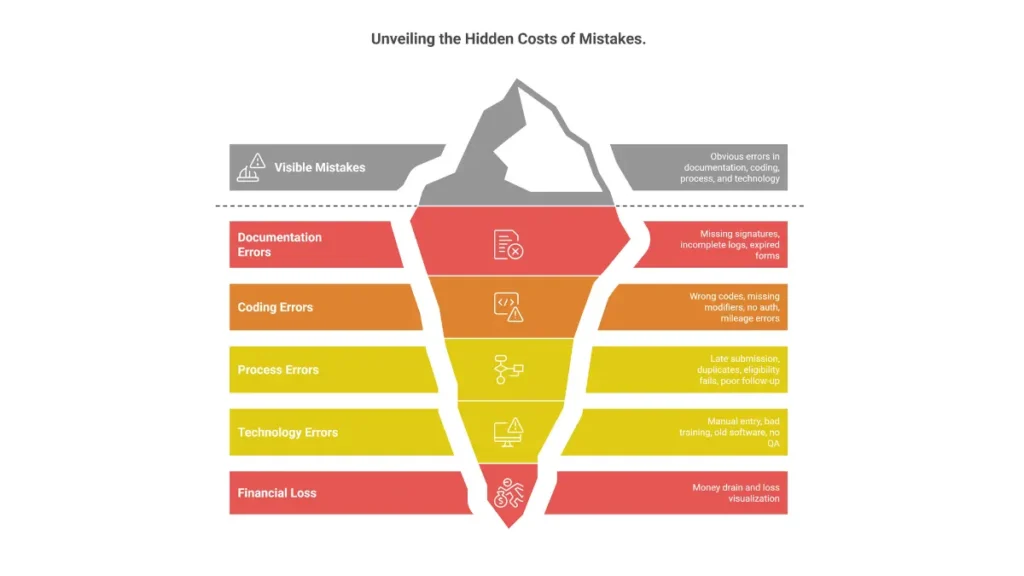
Documentation Errors (Mistakes 1-3)
Mistake #1: Missing or Incomplete Patient Signatures
The Problem: 55% of audit findings cite signature issues. Missing signatures on trip logs, consent forms, or attestation documents trigger automatic denials.
The Cost: $25-$125 per claim in rework and potential revenue loss.
The Fix: Implement mandatory digital signature capture through driver apps. No signature = no trip completion in the system.
Mistake #2: Inadequate Trip Documentation
The Problem: 48% of denied claims result from incomplete trip logs—missing times, locations, or service details.
The Cost: Average $60 per undocumented trip in lost revenue.
The Fix: Use GPS-enabled documentation that auto-populates pickup/dropoff times and locations. Require photo verification at key points.
Mistake #3: Expired or Missing PCS Forms
The Problem: Physician Certification Statements expire (typically 90 days in states like California and New York), and providers forget to renew.
The Cost: All trips without valid PCS become unbillable—potentially thousands per patient.
The Fix: Implement automated PCS expiration alerts 30, 14, and 7 days before expiration. Never let a form lapse. For detailed requirements, review our NEMT compliance guide.
Coding and Compliance Errors (Mistakes 4-7)
Mistake #4: Incorrect HCPCS Level Coding
The Problem: Billing ambulatory transport codes (A0425) for wheelchair trips, or vice versa. This represents 25% of coding errors.
The Cost: Undercoding loses $5-$15 per trip; upcoding triggers audits with 3x penalties.
The Fix: Implement automated service level validation that matches dispatch service type to billing codes. Review our complete billing guide for proper coding procedures.
Mistake #5: Missing or Incorrect Modifiers
The Problem: Origin/destination modifiers (like HE for residential, SH for skilled nursing) are required but frequently omitted or misapplied.
The Cost: 15-20% of claims rejected for modifier issues.
The Fix: Build modifier logic into your billing software based on facility type. Automate wherever possible.
Mistake #6: Prior Authorization Gaps
The Problem: Services provided without required prior authorization are automatically denied. This affects 20-30% of denied claims.
The Cost: 100% revenue loss on non-authorized trips.
The Fix: Implement real-time authorization verification before dispatch. Never transport without confirmed authorization. Understand prior authorization requirements for your payers.
Mistake #7: Mileage Calculation Errors
The Problem: Billing for more miles than GPS validates, or failing to capture all loaded miles. 68% of audits flag mileage discrepancies.
The Cost: Underbilling loses $3-$12 per trip; overbilling triggers recoupment.
The Fix: Use GPS-integrated mileage calculation that automatically populates from actual trip data. Verify against state-specific Medicaid rates.
Process and Timing Errors (Mistakes 8-11)
Mistake #8: Late Claim Submission
The Problem: Missing timely filing deadlines (typically 90-365 days depending on payer) means automatic denial with no appeal rights.
The Cost: 100% revenue loss on late claims—potentially thousands monthly.
The Fix: Implement rolling claim submission within 48 hours of service. Never let claims age.
Mistake #9: Duplicate Billing
The Problem: Submitting the same claim twice triggers fraud alerts and damages payer relationships.
The Cost: Immediate denial plus potential audit triggering.
The Fix: Implement claim tracking systems that prevent duplicate submission. Automate duplicate detection.
Mistake #10: Eligibility Verification Failures
The Problem: Providing service to ineligible patients or during coverage gaps represents 10-20% of rejections.
The Cost: Complete trip revenue loss plus wasted operational resources.
The Fix: Verify eligibility in real-time before every pickup, not just at scheduling.
Mistake #11: Poor Denial Follow-Up
The Problem: Denied claims sitting in A/R without timely appeal or correction. Many providers simply write off small denials.
The Cost: 40-60% of denials are recoverable if appealed properly.
The Fix: Implement same-day denial triage with 72-hour correction/appeal deadlines. Never let a denial age without action. Understand common denial codes and their solutions.
Technology and Training Errors (Mistakes 12-15)
Mistake #12: Manual Data Entry Dependence
The Problem: Manually re-keying information between dispatch and billing introduces errors at every step.
The Cost: 30-40% of initial denials stem from manual entry errors.
The Fix: Integrate dispatch and billing systems with automatic data flow. Eliminate re-keying entirely.
Mistake #13: Inadequate Staff Training
The Problem: Billers without NEMT-specific training make costly coding and documentation errors consistently.
The Cost: New/untrained staff have 2-3x higher error rates.
The Fix: Require NEMT-specific certification and ongoing education. Budget for training as an investment, not an expense. Consider whether your team would benefit from specialized NEMT billing expertise.
Mistake #14: Ignoring Software Updates
The Problem: Outdated billing software misses compliance changes, new payer requirements, and security vulnerabilities.
The Cost: Systematic denials from outdated processes; potential HIPAA violations.
The Fix: Stay current on all software updates. Budget for annual technology reviews.
Mistake #15: No Quality Assurance Process
The Problem: Claims submitted without review catch errors only after denial—the most expensive time to fix them.
The Cost: Each post-submission correction costs $57.23 average.
The Fix: Implement pre-submission claim scrubbing with AI-assisted error detection.
15 Billing Mistakes Summary Table
| # | Mistake | Category | Prevalence | Cost Impact | Prevention Priority |
|---|---|---|---|---|---|
| 1 | Missing signatures | Documentation | 55% of audits | $25-$125/claim | Critical |
| 2 | Incomplete trip logs | Documentation | 48% of denials | $60/trip | Critical |
| 3 | Expired PCS forms | Documentation | 42% of issues | Total trip loss | High |
| 4 | Wrong HCPCS codes | Coding | 25% of errors | $5-$15/trip | High |
| 5 | Missing modifiers | Coding | 15-20% rejections | Full claim denial | High |
| 6 | No prior auth | Compliance | 20-30% denials | 100% trip loss | Critical |
| 7 | Mileage errors | Coding | 68% of audits | $3-$12/trip | High |
| 8 | Late submission | Process | 10-15% of claims | 100% loss | Critical |
| 9 | Duplicate billing | Process | 10% of issues | Audit trigger | Medium |
| 10 | Eligibility failures | Process | 10-20% rejections | Total trip loss | Critical |
| 11 | Poor denial follow-up | Process | 40% of denials | Recoverable revenue | High |
| 12 | Manual data entry | Technology | 30-40% of denials | $57.23/error | High |
| 13 | Inadequate training | Training | Varies | 2-3x error rate | Medium |
| 14 | Outdated software | Technology | Varies | Systematic issues | Medium |
| 15 | No QA process | Process | Varies | $57.23/error | High |
Actionable Takeaway: Audit your operation against this list. Identify your top three problem areas and address them immediately. Most providers can recover 2-5% of annual revenue just by fixing their most common errors.
NEMT Claim Denials: The True Cost of Rejection
Industry Denial Rates: Where Do You Stand?
What causes NEMT claim denials? The most common reasons for NEMT claim denials are documentation errors (40-55% of denials), eligibility issues (20-30%), coding mistakes (15-25%), prior authorization gaps (15-20%), and EVV compliance failures. Up to 70% of these denials are entirely preventable with proper processes and technology.
Here’s the uncomfortable truth: if your denial rate exceeds 8%, you’re hemorrhaging money every single month. Let’s examine the actual financial impact.
NEMT Denial Rates by Billing Approach:
| Billing Type | Average Denial Rate | Best-in-Class Rate | Industry Range |
|---|---|---|---|
| In-House (Small Fleet) | 12-18% | 8-10% | 8-25% |
| In-House (Large Fleet) | 10-15% | 6-8% | 6-20% |
| Outsourced (Standard) | 5-8% | 3-5% | 3-12% |
| Outsourced (Premium) | 3-5% | Under 3% | 2-8% |
Top 10 Reasons Claims Get Denied
Based on our analysis of thousands of denied claims, here are the primary culprits:
- Missing/Invalid Patient Information (20-30% of denials): Incorrect Medicaid ID, DOB mismatches, name spelling errors
- Documentation Deficiencies (15-25%): Incomplete trip logs, missing signatures, inadequate service notes
- Eligibility Issues (10-20%): Patient not covered on service date, coverage gaps, wrong plan
- Authorization Problems (10-15%): No prior auth, expired auth, service outside auth scope
- Coding Errors (10-15%): Wrong HCPCS codes, missing modifiers, level mismatch
- EVV Discrepancies (8-12%): GPS/time mismatches, signature bypass, data sync failures
- Timely Filing Violations (5-10%): Claim submitted after deadline
- Duplicate Claims (5-8%): Same service billed twice
- Coordination of Benefits (3-5%): Primary payer not billed first
- Medical Necessity (2-5%): PCS expired or service not medically justified
The Compounding Cost of Denials
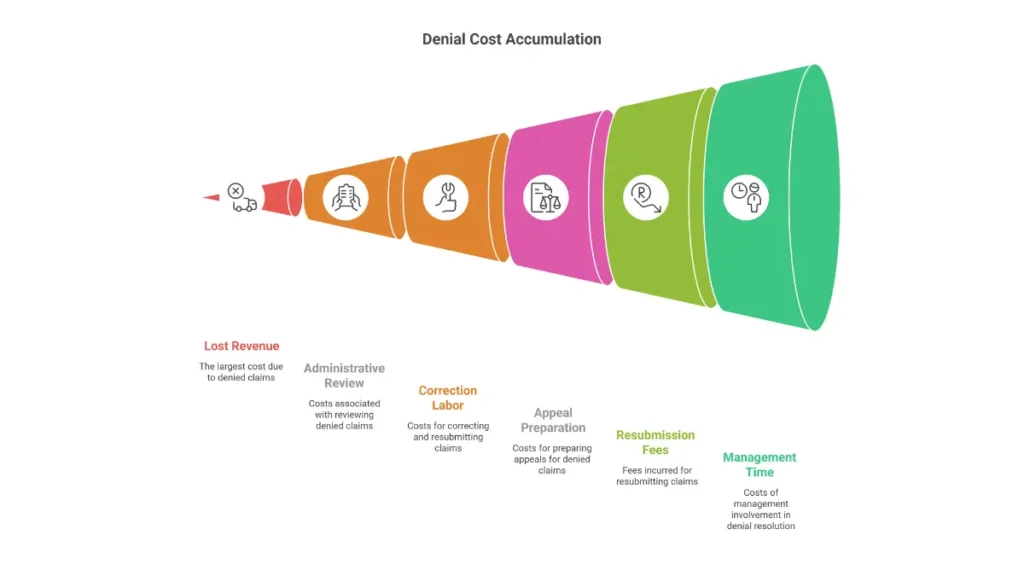
Each denied claim costs far more than the lost trip revenue. Here’s the complete picture:
Single Denial Cost Breakdown:
- Lost trip revenue: $30-$80 (average $60)
- Administrative review time: $15-$25
- Correction/resubmission labor: $20-$40
- Appeal preparation (if needed): $18.50 average
- Clearinghouse resubmission: $1.25
- Management oversight: $10-$15
- Total cost per denial: $94-$180 (average $124)
Annual Denial Impact for 20-Vehicle Fleet:
At 24,000 annual trips and 12% denial rate:
- Denied claims: 2,880
- Direct revenue at risk: $172,800 (at $60/trip)
- Rework costs: $164,880 (at $57.23 average)
- Ultimately unrecovered: $51,840 (30% write-off rate)
- Total annual denial impact: $216,720
Prevention Strategies That Actually Work
For Documentation Errors:
- Implement mandatory field completion in driver apps
- Use GPS auto-population for times and locations
- Require photo verification at pickup/dropoff
For Eligibility Issues:
- Real-time eligibility verification before every trip
- Daily eligibility batch checks for scheduled patients
- Automated alerts for coverage changes
For Coding Errors:
- Automated service level validation against dispatch data
- Built-in modifier logic based on facility types
- Pre-submission claim scrubbing with AI tools
For EVV Compliance:
- GPS-enabled devices for all drivers
- Automatic timestamp capture
- Signature capture verification before trip completion
Actionable Takeaway: Calculate your current denial cost using the formula above. If you’re losing more than $50,000 annually to denials, the ROI on prevention technology and/or outsourcing is almost certainly positive. The math is clear: prevention costs less than cure.
Revenue Leakage: The Silent Profit Killer
What is Revenue Leakage in NEMT Billing?
Revenue leakage refers to money you’ve earned through completed services that never reaches your bank account. Unlike denied claims that appear on reports, revenue leakage represents silent profit erosion that often goes undetected for months. In NEMT operations, leakage typically ranges from 5-10% of gross revenue—potentially $50,000-$300,000 annually for mid-size providers.
The scariest part? Most providers don’t even know it’s happening until a detailed audit reveals the gap between trips completed and revenue collected.
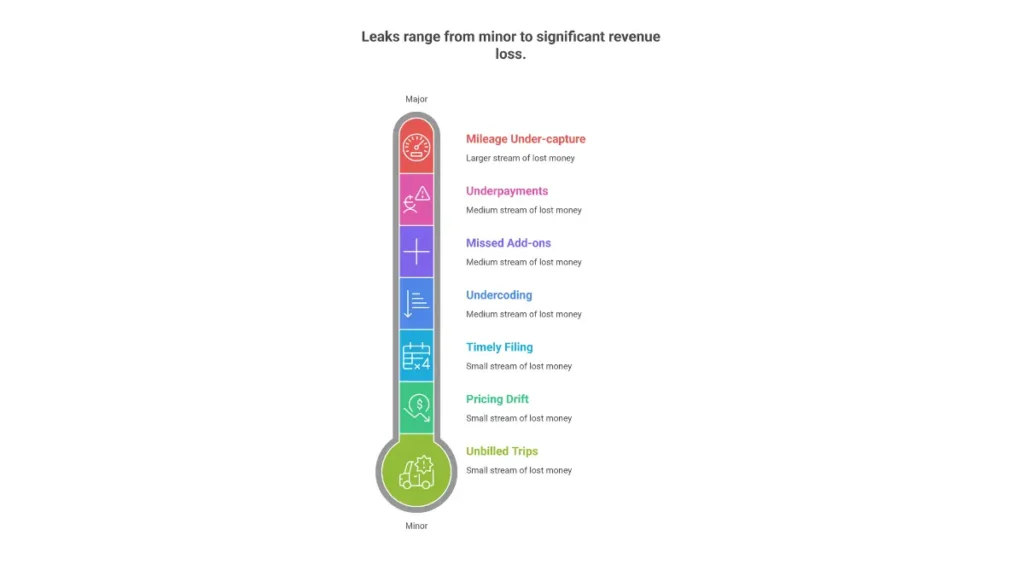
7 Common Sources of Revenue Leakage
Source #1: Unbilled Trips (2-5% of trips) Completed trips that never enter the billing system due to dispatch-to-billing disconnects, driver paperwork failures, or system integration gaps. Every unbilled trip is 100% revenue loss.
Source #2: Undercoding (10-15% of claims) Billing for basic ambulatory transport when wheelchair or stretcher service was actually provided. This systematically undercharges by $5-$15 per trip across your entire operation.
Source #3: Mileage Under-Capture (25%+ of trips) Failing to bill all loaded miles due to manual entry errors, GPS gaps, or misunderstanding of billing rules. Costs $3-$12 per trip in lost mileage revenue.
Source #4: Missed Add-On Services (12% of trips) Wait time charges, extra attendants, oxygen support, and other add-on services that were provided but never billed. Ranges from $10-$30 per missed service.
Source #5: Pricing Drift (5% of claims) Continuing to bill at outdated rates after fee schedule updates, effectively discounting your services without intention.
Source #6: Contractual Underpayments (8% of payments) Accepting payer payments without verifying they match contracted rates. Many providers are systematically underpaid and never notice.
Source #7: Timely Filing Leakage (3% of claims) Claims that miss filing deadlines due to processing backlogs, representing complete revenue loss with no recovery option.
Detection Methods: Finding Your Hidden Losses
Monthly KPI Monitoring:
- Compare dispatched trips to billed claims (should be 98%+)
- Track collection ratio versus billed amounts
- Monitor average revenue per trip trends
- Review A/R aging weekly
Quarterly Audit Procedures:
- Random sample 10% of trips for documentation review
- Compare contracted rates to actual payments received
- Analyze coding patterns for systematic underbilling
- Review add-on service billing rates
Technology-Assisted Detection:
- AI-powered variance reporting
- Automated trip-to-claim reconciliation
- Real-time eligibility and authorization verification
- Predictive analytics for payment shortfalls
Technology Solutions for Leakage Prevention
The right NEMT software can prevent most revenue leakage automatically:
Essential Features:
- Dispatch-to-billing integration with automatic trip population
- GPS-verified mileage calculation
- Service level validation against dispatch records
- Real-time eligibility verification
- Automated add-on service detection
- Contract rate compliance checking
ROI of Leakage Prevention: Investing $15,000-$30,000 annually in prevention technology typically recovers $75,000-$150,000 in previously leaked revenue—a 3-5x return on investment within the first year.
Actionable Takeaway: Conduct a leakage audit immediately. Compare your dispatched trip count to billed claims for the past quarter. If the gap exceeds 2%, you have a leakage problem worth solving. The money is already earned—you just need to collect it.
Why NEMT Providers Are Replacing In-House Billing Staff
The Staffing Crisis Hitting NEMT Billing
Something fundamental shifted in the NEMT billing workforce starting in 2021, and the trends have only accelerated. Here’s what we’re seeing across the industry:
The Turnover Tsunami:
- Annual billing staff turnover: 29-40% (up from 18-22% pre-2020)
- Average tenure before departure: 18 months
- Time to full productivity for replacements: 4-8 weeks
- Vacancy rates in billing departments: 20-30%
The Specialization Gap:
- NEMT billing requires knowledge that general medical billers don’t have
- Training period for NEMT-specific competency: 4-12 weeks
- Certified billers with NEMT experience command 25% salary premiums
- The talent pool keeps shrinking as demand grows
The Real Cost of “Key Person” Risk: When your one experienced biller leaves, you’re not just losing an employee—you’re losing institutional knowledge, payer relationships, and operational continuity. We’ve seen providers lose $50,000-$100,000 in the three months following a key billing person’s departure.
Technology Disruption: AI Changes Everything
The technology revolution in billing has created a stark divide:
What AI-Powered Billing Can Now Do:
- Predict denials before submission with 85%+ accuracy
- Auto-populate claims from dispatch data
- Verify eligibility in real-time
- Identify coding errors instantly
- Appeal denials automatically using optimal language
- Generate compliance documentation
What This Means for In-House Teams: A single AI-enhanced billing platform can now process what previously required 3-5 human billers. The providers who adopt this technology gain massive competitive advantages. Those who don’t fall further behind every month.
Compliance Pressure Intensifies
The regulatory environment has become increasingly demanding:
2024-2026 Compliance Changes:
- EVV mandate enforcement reached 100% across all states
- Broker prior authorization requirements expanded
- Documentation standards tightened
- Audit frequency increased for providers with elevated denial rates
The Expertise Required: Staying compliant now requires deep knowledge of federal regulations, state-specific rules, individual broker requirements, and constantly changing payer policies. Most in-house teams simply cannot keep pace.
Case Studies: Real Providers Making the Switch
Case Study 1: 15-Vehicle Florida Provider
- Before: 2 in-house billers, 14% denial rate, 87% collection rate
- Challenge: Key biller resigned, replacement took 8 weeks to hire and train
- Solution: Outsourced to specialized NEMT billing provider
- After: 4% denial rate, 96% collection rate, $85,000 annual savings
- Timeline: Full transition in 6 weeks
Case Study 2: 30-Vehicle Texas Operation
- Before: 4 in-house billers, struggling with EVV compliance
- Challenge: 2 failed audits in 12 months, 68% of issues were documentation-related
- Solution: Hybrid model—kept 1 internal coordinator, outsourced processing
- After: Zero audit findings in subsequent review, 98% compliance rate
- Timeline: 8-week transition with parallel processing
Actionable Takeaway: If you’re experiencing billing staff turnover above 20%, denial rates above 10%, or failed compliance audits, the operational risk of maintaining in-house billing likely exceeds the perceived control benefits. The industry is moving toward specialized outsourcing for good reason—the economics and compliance demands both point the same direction.
How to Calculate Your NEMT Billing ROI
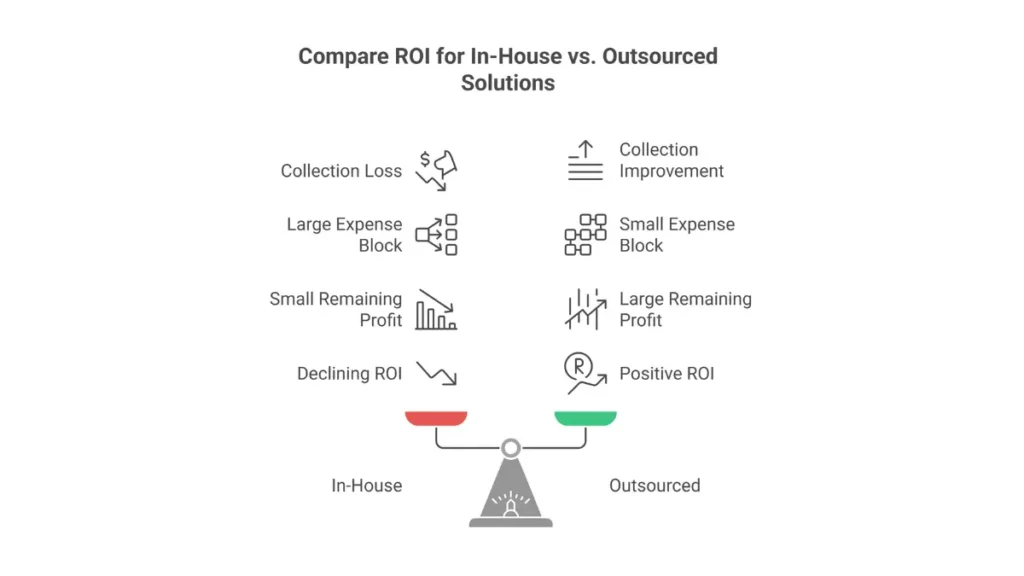
The ROI Formula for Billing Decisions
Making the NEMT billing outsourcing vs in-house decision requires objective financial analysis, not gut feelings or assumptions. Making the in-house vs. outsourcing decision requires objective financial analysis. Here’s the ROI framework we use with providers:
Basic ROI Formula:
ROI = [(Net Revenue Gain - Total Billing Costs) / Total Billing Costs] × 100For Comparing Options:
Comparative ROI = [(Outsourced Net Collections - In-House Net Collections) - (Outsourced Cost - In-House Cost)] / In-House Cost × 100Measuring In-House ROI
Step 1: Calculate Total In-House Costs
- Staff costs (salary × 1.6 for fully loaded)
- Technology costs (all software, hardware, support)
- Overhead allocation (space, utilities, management)
- Turnover costs (annual turnover % × replacement cost)
- Denial rework (denial rate × claims × $57.23)
Step 2: Calculate Net Revenue
- Gross billable amount
- × Collection rate
- = Net collections
Step 3: Calculate ROI
- (Net collections – Total costs) / Total costs × 100
Example Calculation (20 Vehicles, In-House):
- Gross billable: $1,440,000
- Collection rate: 87%
- Net collections: $1,252,800
- Total billing costs: $651,680
- Net after billing: $601,120
- ROI: -7.8% (costs exceed optimal performance)
Measuring Outsourced ROI
Step 1: Calculate Total Outsourced Costs
- Service fee (% of collections or per-claim)
- Any setup/integration fees (usually year 1 only)
- Internal coordination time (minimal)
Step 2: Calculate Net Revenue
- Gross billable amount
- × Projected collection rate (typically 95-98%)
- = Net collections
Step 3: Calculate ROI
- (Net collections – Total costs) / Total costs × 100
Example Calculation (20 Vehicles, Outsourced):
- Gross billable: $1,440,000
- Collection rate: 96%
- Net collections: $1,382,400
- Outsourcing cost (5.5%): $76,032
- Net after billing: $1,306,368
- ROI: 1618% (massive return on billing investment)
Break-Even Analysis
The Key Question: At what point does in-house billing become financially viable?
Break-Even Thresholds:
- Claims volume: 400+ claims/month typically favors outsourcing
- Annual revenue: Under $1.2M almost always better outsourced
- Fleet size: Under 50 vehicles generally outsource
- Denial rate: Over 8% indicates outsourcing needed regardless of size
ROI Calculation Summary Table
| Scenario | 10-Vehicle Fleet | 20-Vehicle Fleet | 50-Vehicle Fleet |
|---|---|---|---|
| Annual Revenue | $600,000 | $1,200,000 | $3,000,000 |
| In-House Cost | $250,000 | $450,000 | $800,000 |
| In-House Collections (87%) | $522,000 | $1,044,000 | $2,610,000 |
| In-House Net | $272,000 | $594,000 | $1,810,000 |
| Outsourced Cost (5.5%) | $31,350 | $62,700 | $156,750 |
| Outsourced Collections (96%) | $576,000 | $1,152,000 | $2,880,000 |
| Outsourced Net | $544,650 | $1,089,300 | $2,723,250 |
| Annual Advantage | $272,650 | $495,300 | $913,250 |
Actionable Takeaway: Run these calculations with your actual numbers. Most providers discover that outsourcing delivers 25-40% improvement in net billing results. The math doesn’t lie—and it usually points clearly toward specialization.
Choosing the Right Billing Solution for Your Business
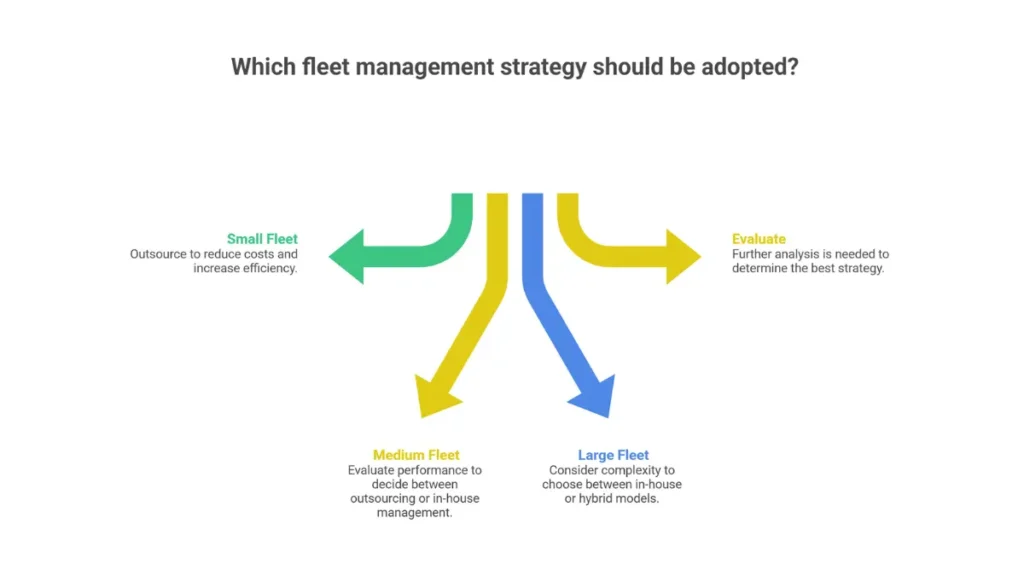
The NEMT billing outsourcing vs in-house question doesn’t have a one-size-fits-all answer—but clear decision criteria exist.
Key Questions to Ask Before Deciding
Before making any billing decisions, answer these critical questions honestly:
About Your Current Operation:
- What is your actual denial rate over the past 12 months?
- What is your collection rate as a percentage of billable services?
- What is your Days Sales Outstanding (average time to payment)?
- How much did billing staff turnover cost you last year?
- Have you failed any compliance audits recently?
About Your Future Needs: 6. Are you planning fleet expansion in the next 2-3 years? 7. Do you operate (or plan to operate) in multiple states? 8. How complex is your payer mix (Medicaid, Medicare Advantage, brokers)? 9. Do you have the capital for technology investments? 10. Is billing expertise a core competency you want to develop?
When In-House Billing Makes Sense
In-house billing may be the right choice if:
- Fleet size exceeds 50 vehicles with stable operations
- Annual revenue exceeds $5M providing economy of scale
- Current denial rate is under 5% demonstrating existing competency
- Staff turnover is under 15% indicating stable workforce
- Strong IT infrastructure already in place
- Single-state operation with simple compliance
- Long-term strategic goal to build billing as core competency
Even then, most large operations benefit from hybrid models where routine processing is outsourced while strategy and oversight remain internal.
When Outsourcing Wins
Outsourcing almost certainly makes sense if:
- Fleet size is under 50 vehicles
- Denial rate exceeds 8%
- Collection rate is under 92%
- Staff turnover exceeds 20%
- Limited IT resources for technology investment
- Multi-state operations requiring diverse compliance knowledge
- Growth plans requiring scalable solutions
- Recent audit failures indicating compliance gaps
For providers in this category, the question isn’t whether to outsource—it’s how to find the right partner.
The Hybrid Approach: Best of Both Worlds?
Some providers find success with hybrid models:
Option A: 70/30 Split
- Outsource routine claim processing (70%)
- Keep strategic oversight and exception handling in-house (30%)
- Works for mid-size operations wanting control without full staffing burden
Option B: Payer-Based Split
- In-house for straightforward Medicaid direct
- Outsource complex broker billing and appeals
- Works when one segment drives most complexity
Option C: Function-Based Split
- In-house for eligibility and authorization
- Outsource for claim submission and follow-up
- Works when you have strong front-office but weak back-office
Actionable Takeaway: Use the questions above to create a clear picture of your current state and future needs. For 80%+ of providers under 50 vehicles, full outsourcing delivers the best financial and operational outcome. Don’t let ego about “control” override the math.
Final Verdict: NEMT Billing Outsourcing vs In-House
So what’s the bottom line on NEMT billing outsourcing vs in-house? For 80% of providers, outsourcing delivers superior results. The combination of lower costs, higher collection rates, reduced compliance risk, and eliminated staffing headaches makes the choice clear for most operations. The exceptions are large, stable operations with existing billing expertise and the resources to maintain it. Even then, hybrid models often outperform pure in-house approaches.
Transitioning from In-House to Outsourced Billing
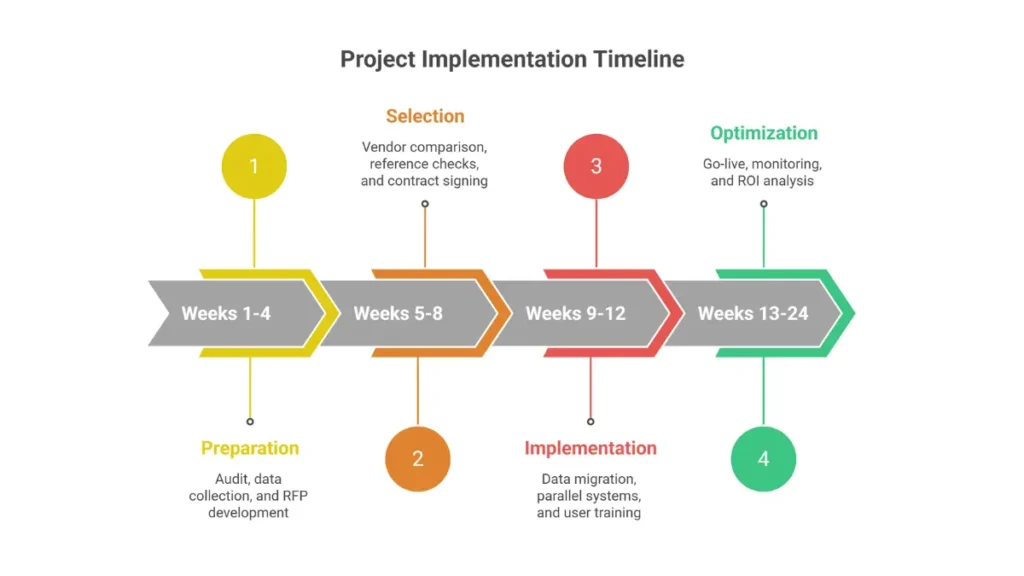
Step-by-Step Transition Guide
If you’ve decided to outsource, here’s how to make the transition smooth:
Phase 1: Preparation (Weeks 1-4)
- Audit current KPIs and document baseline performance
- Create complete data inventory (patient records, claim history, payer contracts)
- Develop RFP with specific requirements
- Solicit proposals from 3-5 specialized NEMT billing providers
- Check references and verify NEMT-specific experience
Phase 2: Selection and Contracting (Weeks 5-8) 6. Evaluate proposals against your specific needs 7. Conduct discovery calls with top 2-3 candidates 8. Negotiate terms, SLAs, and performance guarantees 9. Execute contract with clear transition timeline 10. Assign internal transition coordinator
Phase 3: Implementation (Weeks 9-12) 11. Complete data migration and system integration 12. Conduct parallel processing test (run both systems simultaneously) 13. Train internal staff on new workflows 14. Establish communication protocols and escalation procedures 15. Define KPI reporting requirements and review schedule
Phase 4: Go-Live and Optimization (Weeks 13-24) 16. Full cutover to outsourced processing 17. Intensive monitoring for first 30 days 18. Weekly performance reviews initially, then monthly 19. Address any integration issues promptly 20. Full ROI assessment at 90 days
What to Look For in a Billing Partner
Essential Qualifications:
- NEMT-specific experience (not just general medical billing)
- Demonstrated results with similar-sized operations
- References you can actually contact
- Technology integration capabilities
- Transparent pricing with no hidden fees
- Clear SLAs with performance guarantees
Red Flags to Avoid:
- No NEMT-specific experience or references
- Unwillingness to share performance data
- Complex pricing with many add-on fees
- Long-term contracts without performance exits
- Poor communication during sales process
- Promises that sound too good to be true (100% collection rates, etc.)
Red Flags to Watch During Transition
Warning Signs Something’s Wrong:
- Data migration delays beyond two weeks
- Integration issues not resolved promptly
- Poor communication or unresponsive account management
- KPIs declining during transition period
- Hidden fees appearing after contract signing
- Resistance to providing regular reporting
How to Protect Yourself:
- Include performance benchmarks in contract
- Require 30-day reporting during transition
- Maintain parallel processing until confident in new system
- Keep clear documentation of all issues
- Have exit clause ready if performance doesn’t meet standards
Actionable Takeaway: A well-planned transition takes 8-12 weeks. Don’t rush it—the parallel processing period is essential for catching issues before they impact revenue. But don’t delay unnecessarily either; every month you wait costs you money.
The Golden Rule of Medical Billing and NEMT Compliance
Understanding the Most Important Rule
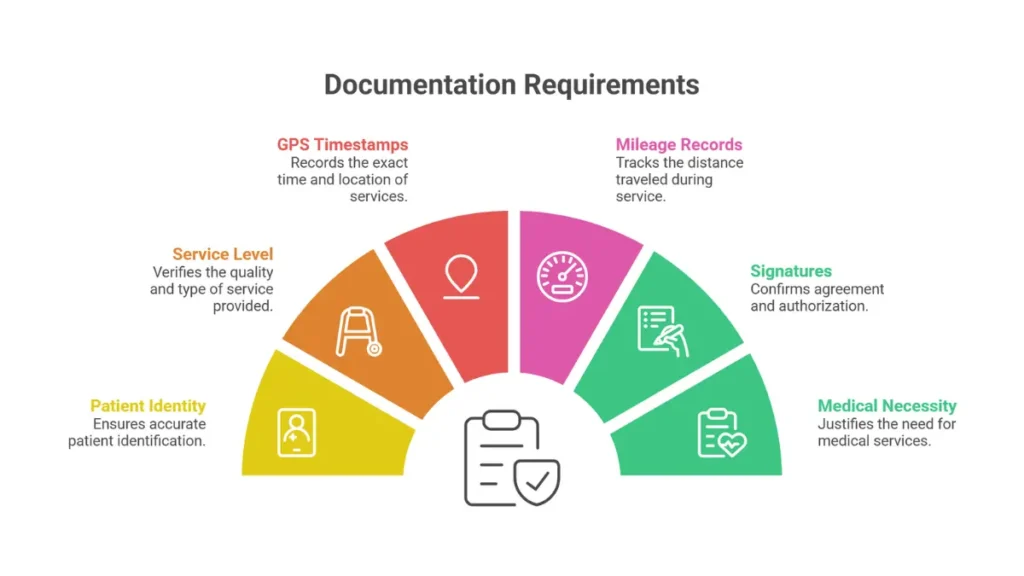
What is the golden rule in medical billing? The golden rule is: “If it wasn’t documented, it wasn’t done.” This foundational principle requires that all billed services must be thoroughly, accurately, and contemporaneously recorded to prove medical necessity and justify reimbursement. In NEMT billing, this means every trip must have complete documentation including patient information, service details, times, locations, signatures, and medical justification.
This isn’t just best practice—it’s the legal standard that protects both providers and payers from fraud and abuse. Understanding and implementing this rule is essential for sustainable billing operations.
Documentation Requirements for NEMT
Minimum Required Documentation per Trip:
| Element | Requirement | Purpose |
|---|---|---|
| Patient Identity | Full name, DOB, Medicaid/Insurance ID | Eligibility verification |
| Service Level | Ambulatory/Wheelchair/Stretcher/Bariatric | Proper coding |
| Trip Timestamps | Arrival, pickup, dropoff times (GPS-validated) | EVV compliance |
| Mileage | Loaded miles from odometer or GPS | Mileage billing |
| Locations | Full addresses for pickup and destination | Trip verification |
| Medical Link | Facility/provider name, appointment type | Medical necessity |
| Attestation | Driver and patient signatures | Service confirmation |
| Vehicle/Driver ID | Vehicle number, driver credentials | Audit trail |
Compliance Best Practices
Daily Operations:
- Verify documentation completeness before trip completion
- Capture signatures digitally with timestamps
- Use GPS-enabled systems for automatic data population
- Review trips same-day for documentation gaps
Weekly Procedures:
- Audit random sample of completed trips (5-10%)
- Review any documentation exceptions or overrides
- Check for PCS expirations approaching
- Verify eligibility for upcoming scheduled patients
Monthly Reviews:
- Analyze denial patterns for documentation issues
- Review coding accuracy statistics
- Update staff on any compliance changes
- Prepare for potential audit requests
Quarterly Activities:
- Conduct mock audit using 10% random sample
- Review all compliance policies and procedures
- Retrain staff on documentation requirements
- Update software and forms as regulations change
For comprehensive compliance guidance, review our NEMT compliance guide and audit preparation resources.
Audit-Proofing Your Operation
Preparation is Protection:
- Maintain records for minimum 7 years (10 in some states)
- Use digital storage with backup systems
- Document all policies and procedures
- Train staff on audit response protocols
- Keep compliance certificates current
When Auditors Come Calling:
- Have designated audit response team
- Know your rights and deadlines
- Provide exactly what’s requested—nothing more
- Document all auditor interactions
- Engage legal counsel for significant audits
Actionable Takeaway: The golden rule isn’t just about avoiding denials—it’s about building a sustainable, audit-proof operation. Every shortcut in documentation creates downstream risk. The providers who internalize this principle sleep better at night.
NEMT Billing Technology: Software and Automation Options
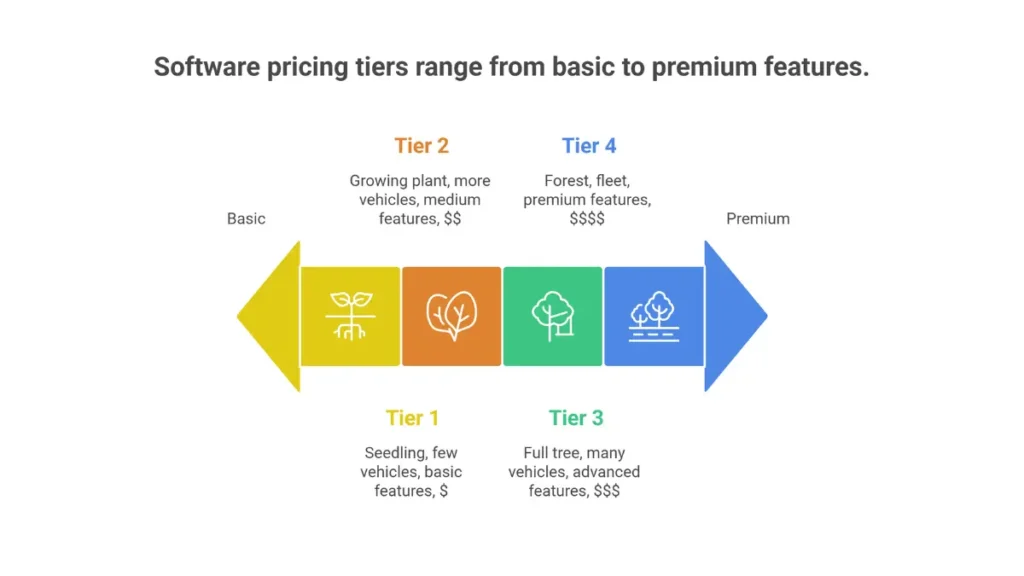
Top Software Solutions for 2026
The technology landscape for NEMT billing has evolved dramatically. Here are the primary options by provider size:
For Startup/Small Fleets (1-10 Vehicles):
- Entry-level platforms with basic claim creation
- Focus on ease of use over advanced features
- Price range: $99-$299/month flat rate
- Examples: NEMT Cloud, Basic tier of major platforms
For Growth Operations (11-25 Vehicles):
- AI-enhanced claim scrubbing
- Broker portal integrations
- Denial management workflows
- Price range: $500-$2,000/month or $50-$75/vehicle
- Examples: RouteGenie, TobiCloud, CareTap
For Mid-Size Operations (26-50 Vehicles):
- Full automation capabilities
- Predictive analytics
- Custom reporting dashboards
- Price range: $2,000-$5,000/month
- Examples: TripMaster, MediRoutes, advanced tier platforms
For Enterprise Operations (50+ Vehicles):
- API-first architecture for custom integration
- Multi-state compliance management
- Advanced AI and machine learning
- Price range: Custom negotiated
- Examples: TripSpark, Momentm (NovusMED)
Key Features That Actually Matter
Must-Have Features (Any Size):
- Dispatch-to-billing integration
- EVV compliance tracking
- Eligibility verification
- Basic denial management
- Standard reporting
Should-Have Features (Growth Stage):
- AI claim scrubbing
- Broker API integration
- Automated payment posting
- Custom reporting
- Mobile driver apps
Nice-to-Have Features (Scale Operations):
- Predictive denial prevention
- Advanced analytics
- Custom integration development
- Multi-location management
- Real-time dashboards
Software Comparison Table
| Feature | Budget ($99-299) | Growth ($500-2K) | Enterprise (Custom) |
|---|---|---|---|
| Claim Creation | ✓ | ✓ | ✓ |
| Eligibility Check | Basic | Real-time | Automated |
| Denial Management | Manual | Workflow | AI-Assisted |
| Broker Integration | Limited | Multiple | Full API |
| EVV Compliance | Basic | Full | Advanced |
| Reporting | Standard | Custom | Advanced Analytics |
| Support | Phone/Chat | Dedicated Team |
Cost vs. Value Analysis
Calculating Technology ROI:
- Denial reduction value: (Current denial rate – 3%) × Annual claims × $124
- Time savings value: Hours saved × Biller hourly rate
- Leakage prevention: 2-5% of revenue recovered
- Collection improvement: Additional % collected × Revenue
Example Calculation: A $15,000/year software investment for a 20-vehicle fleet that:
- Reduces denials from 12% to 5% (7% × 24,000 claims × $124 = $208,320 saved)
- Prevents 3% revenue leakage (3% × $1.2M = $36,000 recovered)
- Improves collection rate 5% (5% × $1.2M = $60,000 additional)
Total annual value: $304,320 vs. $15,000 cost = 20x ROI
Actionable Takeaway: Technology is an investment, not an expense. The right platform pays for itself many times over through denial reduction, leakage prevention, and collection improvement. Don’t make technology decisions based solely on price—make them based on value.
Frequently Asked Questions About NEMT Billing
How much does NEMT billing cost per claim?
In-house NEMT billing costs $8-12 per claim when accounting for all expenses including staff, technology, overhead, and rework. Outsourced billing typically costs $3-5 per claim with competitive providers. The difference becomes even more significant when considering that outsourced providers typically achieve higher collection rates.
What is the average cost of running a NEMT billing department?
Running an in-house billing department costs $150,000-$250,000 annually for small fleets (1-10 vehicles), $300,000-$450,000 for mid-size operations (11-25 vehicles), and $450,000-$700,000 for larger fleets (26-50 vehicles). These figures include staffing, technology, overhead, and turnover costs.
How much does outsourced NEMT billing typically cost?
Outsourced NEMT billing typically costs 3-10% of net collections, with competitive rates ranging from 4-8%. Alternative pricing includes per-claim fees of $3-$10 or flat monthly rates of $500-$2,000 for small operations. Most providers find 5-6% rates offer the best value-for-service balance.
What are typical setup fees for outsourced billing?
Setup fees for outsourced billing range from $0-$5,000 depending on complexity and provider. Many billing companies waive setup fees for volume commitments or longer contract terms. Always negotiate this as part of your overall agreement.
How much does billing software cost for NEMT operations?
NEMT billing software costs vary by tier: startup solutions run $99-$299/month, growth platforms cost $500-$2,000/month or $50-$150 per vehicle, and enterprise solutions are custom-priced typically starting at $2,000+/month.
What percentage of revenue should go to billing operations?
Efficient billing operations should cost 3-8% of collected revenue. In-house operations often run 10-15% when all costs are counted, while well-managed outsourced arrangements typically achieve 4-6%. Anything above 10% indicates significant inefficiency.
How much does a denied NEMT claim actually cost?
A denied NEMT claim costs $94-$180 total, including lost trip revenue ($30-$80), administrative review ($15-$25), correction labor ($20-$40), appeal preparation ($18.50), and management overhead ($10-$15). The average total cost is approximately $124 per denial.
What’s the ROI on investing in billing technology?
Billing technology typically delivers 10-20x ROI through denial reduction, leakage prevention, and collection rate improvement. A $15,000 annual investment commonly generates $150,000-$300,000 in recovered revenue and cost savings.
Is in-house or outsourced NEMT billing better?
Outsourcing is almost always better for operations under 50 vehicles, delivering 95-98% collection rates versus 85-90% in-house, with 25-40% lower total costs. In-house may be viable for larger operations with stable staffing and strong existing competency.
When should I switch from in-house to outsourced billing?
Consider switching when denial rates exceed 8%, collection rates fall below 92%, billing staff turnover exceeds 20%, you’ve failed compliance audits, or you’re planning growth that will strain current capacity. Any of these triggers indicates outsourcing would likely improve results.
What are the pros and cons of in-house billing?
In-house pros include direct control, institutional knowledge retention, and immediate access to staff. In-house cons include higher costs, turnover risk, technology investment requirements, and difficulty maintaining expertise. For most small-medium providers, the cons significantly outweigh the pros.
What collection rates can I expect from outsourced billing?
Outsourced billing typically achieves 95-98% collection rates compared to 85-90% for in-house operations. This 5-13% improvement often exceeds the cost of outsourcing, making it effectively free or even profitable.
How do denial rates compare between in-house and outsourced?
In-house operations average 10-15% denial rates while outsourced providers typically achieve 3-5%. This 7-12% reduction represents significant revenue recovery and eliminated rework costs.
Can a billing company handle multiple states and payers?
Yes, specialized NEMT billing companies routinely handle multi-state operations with diverse payer mixes. This is actually a key advantage of outsourcing, as maintaining compliance expertise across multiple jurisdictions is extremely difficult in-house.
How does the NEMT billing process work?
The NEMT billing process includes: trip completion and documentation, eligibility verification, claim creation with proper coding, pre-submission scrubbing, electronic submission, payment posting, denial management, and accounts receivable follow-up. Each step requires specialized knowledge.
What documentation is required for NEMT billing?
Required documentation includes patient identity (name, DOB, insurance ID), service level, GPS-validated timestamps, mileage records, pickup/dropoff locations, medical necessity documentation (PCS forms), and driver/patient signatures. Missing any element risks denial.
How long does NEMT billing take from trip to payment?
Efficient billing operations achieve payment in 30-45 days. In-house operations often run 40-60 days. The difference comes from claim accuracy (fewer rejections requiring resubmission) and systematic follow-up on pending claims.
What are the most common reasons for claim denials?
The most common denial reasons are missing/invalid patient information (20-30%), documentation deficiencies (15-25%), eligibility issues (10-20%), authorization problems (10-15%), and coding errors (10-15%). Most are preventable with proper processes.
How should I handle a denied NEMT claim?
Immediately categorize the denial (technical vs. clinical), gather required documentation, correct any errors, resubmit within 72 hours if possible, and track the appeal. Technical denials have 85% appeal success rates when handled promptly.
What is the golden rule in NEMT billing?
The golden rule is “If it wasn’t documented, it wasn’t done.” All billed services must be thoroughly documented with patient information, service details, times, locations, and signatures. This documentation must exist at the time of service, not created retroactively.
What are EVV requirements for NEMT billing?
Electronic Visit Verification requires GPS-validated timestamps for pickup and dropoff, electronic signature capture, automatic mileage calculation, and integration with state EVV aggregator systems. All Medicaid NEMT claims require EVV compliance.
How long must I keep NEMT billing records?
NEMT billing records must be retained for minimum 7 years under federal guidelines, with some states requiring 10 years. Digital records with proper backup are acceptable and recommended. Never destroy records that might be needed for audits.
What happens if I fail a NEMT billing audit?
Failed audits can result in recoupment demands (paying back previous claims), enhanced scrutiny of future claims, civil penalties for fraud findings, and potential exclusion from Medicaid programs. Prevention through proper documentation is essential.
What are common compliance violations in NEMT billing?
Common violations include missing patient signatures, incomplete trip documentation, expired PCS forms, EVV discrepancies, coding errors, unauthorized services, and inadequate medical necessity documentation. All are preventable.
What software is best for NEMT billing?
The best NEMT billing software depends on your fleet size. Small fleets (1-10 vehicles) do well with entry-level platforms like NEMT Cloud at $99-$299/month. Growing operations (11-25 vehicles) benefit from RouteGenie or TobiCloud at $500-$2,000/month. Enterprise operations need platforms like TripMaster with custom pricing.
How does AI help with NEMT billing?
AI-powered billing tools predict denials before submission with 85%+ accuracy, auto-populate claims from dispatch data, verify eligibility in real-time, identify coding errors instantly, and can even generate appeal language automatically. These capabilities reduce denial rates by 50-70% compared to manual processing.
Should I integrate my dispatch and billing software?
Absolutely. Integrated dispatch-to-billing systems eliminate manual data re-entry, which causes 30-40% of initial denials. Automatic data flow ensures trip information, times, locations, and mileage transfer accurately without human error. This integration typically pays for itself within 3-6 months.
What EVV systems work best for billing compliance?
EVV systems must capture GPS-validated timestamps, electronic signatures, and automatic mileage calculation. Look for systems that integrate directly with your billing platform and your state’s EVV aggregator. Popular compliant options include those built into major NEMT platforms like RouteGenie and TripMaster.
How much training is needed for billing software?
New billing software typically requires 2-4 weeks for basic proficiency and 8-12 weeks for advanced features. However, most providers only use 40-60% of their software capabilities due to inadequate training. Budget for ongoing education, not just initial training.
What ROI can I expect from outsourcing billing?
Most providers see 25-40% improvement in net billing results within 90 days of outsourcing. The combination of lower direct costs and higher collection rates often delivers 10-20x return on investment. A typical 20-vehicle fleet saves $400,000-$500,000 over five years.
How quickly does outsourced billing pay for itself?
Outsourced billing typically achieves break-even within 30-60 days through improved collection rates and denied claim recovery. Many providers see positive ROI in the first month when comparing total costs including in-house overhead, turnover, and technology expenses.
What’s the break-even point for in-house vs. outsourced billing?
The break-even point generally favors outsourcing until operations reach 50+ vehicles, $5M+ annual revenue, and have achieved denial rates under 5% with existing processes. Below these thresholds, outsourcing almost always delivers better financial results.
How do I measure billing department performance?
Track these key metrics monthly: collection rate (should be 95%+), denial rate (should be under 5%), Days Sales Outstanding (should be under 45 days), unbilled trip ratio (should be under 2%), and cost per claim processed (should be declining over time).
What hidden costs should I watch for in billing agreements?
Watch for clearinghouse pass-through fees, custom report charges, integration fees, statement mailing costs, termination fees for A/R work-down, and annual price escalation clauses. Request complete “all-in” pricing before signing any agreement.
What trends are affecting NEMT billing in 2026?
Key 2026 trends include AI-powered claim scrubbing becoming standard, EVV enforcement reaching 100% compliance requirements, broker consolidation increasing complexity, payer audits becoming more frequent and sophisticated, and staffing shortages driving outsourcing adoption to 70%+ of providers.
How is Medicare Advantage affecting NEMT billing?
Medicare Advantage plans increasingly offer NEMT benefits, creating new revenue opportunities but also new billing complexity. Each MA plan has different requirements, authorization processes, and payment schedules. Understanding Medicare Advantage NEMT benefits is becoming essential for diversified revenue.
What impact does dialysis transportation have on billing?
Dialysis patients represent high-frequency, consistent revenue but require specialized billing knowledge. Multiple trips per week, medical necessity documentation, and coordination with dialysis facility scheduling create unique billing challenges and opportunities.
How are broker relationships changing billing requirements?
Major brokers like Modivcare, MTM, and LogistiCare continue expanding prior authorization requirements and documentation standards. Understanding broker billing requirements is essential as broker-mediated trips represent an increasing share of total NEMT volume.
What factors determine the NEMT billing outsourcing vs in-house decision?
The primary factors include fleet size (under 50 vehicles favors outsourcing), current denial rates (over 8% indicates outsourcing needed), staff turnover (over 20% signals in-house isn’t working), collection rates (under 92% needs improvement), and growth plans (rapid expansion requires scalable solutions).
How much does it cost to outsource medical transportation billing? Outsourcing NEMT billing costs 3-10% of what you collect, with most providers paying 4-8%. For a company collecting $500,000 annually, that’s $20,000-$40,000 per year for complete billing services including claim submission, denial management, and compliance support.
Should I outsource my NEMT billing or keep it in-house? Most NEMT providers under 50 vehicles should outsource. Outsourcing typically costs 50-75% less than in-house while delivering 5-13% higher collection rates. The math almost always favors outsourcing unless you have over 50 vehicles and existing billing expertise.
What percentage do medical billing companies charge? Medical billing companies typically charge 3-10% of collections, with NEMT specialists averaging 4-8%. Some offer per-claim pricing of $3-$10 per claim or flat monthly rates. The best pricing depends on your volume and complexity.
How do I reduce claim denials for my transportation company? Reduce denials by verifying eligibility before every trip, capturing complete documentation including GPS timestamps and signatures, using proper coding for service levels, obtaining prior authorization when required, and submitting claims within 48 hours of service.
What is the profit margin for NEMT billing services? NEMT billing services typically cost 4-8% of collections while generating 5-13% improvement in collection rates. This means outsourcing often pays for itself through improved performance. Net profit to your business typically improves by 3-8% after outsourcing.
How long does it take to switch billing companies? Switching billing companies takes 8-12 weeks for a well-planned transition including data migration, parallel processing, and full cutover. Most of this time is validation and testing to ensure continuity. Don’t rush the transition.
What makes NEMT billing different from regular medical billing? NEMT billing requires specialized knowledge of transportation HCPCS codes, mileage calculations, EVV compliance, state-specific PCS requirements, and broker portal systems. General medical billers typically lack this specialized expertise.
How can I tell if my billing company is doing a good job? Evaluate billing performance by collection rate (should be 95%+), denial rate (should be under 5%), Days Sales Outstanding (should be under 45 days), and unbilled trip ratio (should be under 2%). Request monthly reporting on all metrics.
What makes NEMT billing different from regular medical billing? NEMT billing requires specialized knowledge of transportation HCPCS codes, mileage calculations, EVV compliance, state-specific PCS requirements, and broker portal systems. General medical billers typically lack this specialized expertise.
How can I tell if my billing company is doing a good job? Evaluate billing performance by collection rate (should be 95%+), denial rate (should be under 5%), Days Sales Outstanding (should be under 45 days), and unbilled trip ratio (should be under 2%). Request monthly reporting on all metrics.
What is the best way to reduce billing costs for my medical transportation company? The most effective ways to reduce billing costs are outsourcing to specialized providers who achieve economies of scale, implementing technology that automates manual processes, preventing denials through proper documentation, and eliminating revenue leakage through regular audits.
How do I know if my in-house billing team is underperforming? Signs of underperforming in-house billing include denial rates above 8%, collection rates below 92%, Days Sales Outstanding exceeding 50 days, frequent staff turnover, recurring compliance issues, and inability to scale with business growth.
What questions should I ask when interviewing billing service providers? Ask about their NEMT-specific experience, current client denial rates and collection rates, technology capabilities and integrations, pricing structure including all fees, contract terms and exit provisions, and request references from similar-sized operations you can contact directly.
How do I prepare my company for a billing audit? Prepare for audits by maintaining complete documentation for every trip, keeping records for 7+ years, conducting quarterly self-audits on 10% of claims, training staff on documentation requirements, and having clear policies and procedures in writing.
What is the biggest mistake new NEMT companies make with billing? The biggest mistake is underestimating billing complexity and trying to handle it with general medical billing knowledge or untrained staff. NEMT billing requires specialized expertise that takes months to develop. Starting with an experienced billing partner saves significant revenue loss during the learning curve.
How do I calculate if outsourcing billing is right for my company? Calculate your true in-house costs including salary times 1.6 for benefits and overhead, add technology costs, turnover expenses, and denial rework time. Compare to outsourcing at 5-6% of projected collections with 96% collection rate. If outsourcing costs less with better collections, the math is clear.
Conclusion: Making the Right Billing Decision for 2026
Key Takeaways from This Guide
After examining NEMT billing outsourcing vs in-house from every angle, the patterns are unmistakable. Let’s recap the critical insights that should guide your billing decisions:
The Cost Reality:
- In-house billing costs $8-12 per claim; outsourcing costs $3-5
- True in-house costs are typically 40-60% higher than salary figures suggest
- The 5-year total cost difference can exceed $3 million for mid-size operations
The Performance Gap:
- Outsourced billing achieves 95-98% collection rates vs. 85-90% in-house
- Denial rates of 3-5% outsourced vs. 10-15% in-house
- Cash flow improves by 15-30 days through faster claim processing
The Risk Factors:
- 29-40% annual turnover devastates in-house billing departments
- Compliance demands continue intensifying every year
- Technology advantages increasingly favor specialized providers
The Decision Framework:
- Under 50 vehicles: Outsource almost always wins
- Over 50 vehicles: Hybrid models often optimal
- Any size with denial rates over 8%: Outsourcing likely needed
- Any size planning growth: Outsourcing scales more easily
Your Action Steps
This Week:
- Calculate your true cost per claim using the frameworks in this guide
- Audit your denial rate and collection rate for the past 12 months
- Quantify your revenue leakage by comparing dispatched trips to billed claims
- Assess your staff turnover and its financial impact
This Month: 5. Score yourself against the decision matrix in Section 10 6. If outsourcing scores higher, develop an RFP for billing providers 7. Request references and verify NEMT-specific experience 8. Evaluate 3-5 providers against your specific needs
This Quarter: 9. Make a decision and commit to implementation 10. Plan your transition with clear milestones 11. Monitor results intensively for first 90 days 12. Conduct full ROI assessment at 6 months
How Elite Med Financials Can Help
At Elite Med Financials, we specialize exclusively in healthcare revenue cycle management with deep expertise in NEMT billing operations. We’ve helped hundreds of providers transform their billing from a cost center to a profit driver.
What Sets Us Apart:
- NEMT-specific expertise (not general medical billing)
- Proven results: 96%+ collection rates, under 5% denial rates
- Technology-enabled processing with AI claim scrubbing
- Transparent pricing with no hidden fees
- Dedicated account management for every client
- Compliance expertise across all 50 states
Our Services Include:
- Complete NEMT billing services with denial management
- Medical billing for healthcare practices of all sizes
- NEMT website development and technology solutions
- Compliance consulting and audit preparation
- Revenue cycle optimization
Ready to Stop Leaving Money on the Table?
Every month you wait costs you money. Whether it’s 2% revenue leakage, 10% denial rates, or $50,000 in turnover costs, the financial drain of suboptimal billing compounds over time.
Take the first step: Contact Elite Med Financials for a free billing analysis. We’ll calculate your exact costs, identify your improvement opportunities, and show you the path to better results.
The providers who act on this information transform their operations. The ones who don’t keep struggling with the same problems year after year. Which will you choose?
External Resources:
- Centers for Medicare & Medicaid Services (CMS) – NEMT Coverage Guidelines
- Community Transportation Association of America (CTAA) – Industry Resources
Article Last Updated: February 2026
Elite Med Financials is a leading healthcare revenue cycle management company specializing in NEMT billing services. For more information about starting a profitable NEMT business or understanding industry trends, explore our comprehensive resource library.