
| NEMT software is technology built specifically for non-emergency medical transportation operations — covering dispatch scheduling, route optimization, driver communication, Electronic Visit Verification (EVV), Medicaid billing, and compliance management. The right NEMT platform increases daily trip volume by 25-40%, reduces billing errors by up to 80%, and can pay for itself within three to six months compared to manual spreadsheet-based operations. |
Choosing the best NEMT software in 2026 is not just about finding a dispatch screen. NEMT providers need software that helps manage scheduling, routing, driver apps, EVV-style trip proof, billing documentation, claims, and reporting without creating more manual work. This guide compares 12+ NEMT software platforms by pricing, features, fleet size, and operational fit, including affordable options starting from $125/month. Choosing the wrong NEMT software costs providers thousands in denied claims, wasted dispatcher hours, and missed trips. The right platform cuts admin time by 30-50%, drops denial rates by 25-40%, and recovers its cost within three to six months. The wrong one creates more problems than it solves.
The challenge? Over fifty NEMT software options exist, each promising to revolutionize your operations. Vendor websites show polished screenshots and cherry-picked testimonials. Pricing pages say “contact us” instead of showing actual numbers. And features that sound identical work completely differently in practice.
This guide cuts through the marketing. We have analyzed twelve leading NEMT platforms — plus our own Elite Route Dispatch — based on what actually matters for billing success: billing integration, claim scrubbing quality, GPS verification, pricing transparency, and real-world user feedback. Whether you are running a single van or managing a fifty-vehicle fleet, you will find specific recommendations for your situation.
Quick Answer: Best NEMT Software in 2026
For small and growing NEMT fleets, the best software is usually the platform that combines dispatch, scheduling, routing, driver documentation, billing, EVV-style proof, and reporting without enterprise-level pricing.
Elite Route Dispatch is a strong option for small fleets because it starts from $125/month and connects dispatch workflow with billing-ready trip documentation.
If you are comparing platforms, look closely at:
- monthly pricing
- billing integration
- driver app
- EVV-style documentation
- broker support
- routing and scheduling
- fleet-size fit
For providers already struggling with claim denials, our NEMT denial codes guide covers resolution strategies in detail. This article focuses on choosing software that prevents those denials in the first place.
Table of Contents
Why NEMT Software Is Essential for Profitable Operations
The Real Cost of Running NEMT Manually
Operators who rely on spreadsheets, phone calls, and paper logs spend 15-25 hours per week on tasks that software handles in minutes. Manual trip scheduling alone consumes 2-4 hours daily for a ten-vehicle fleet. Add manual billing — copying trip data from driver logs into claim forms — and you lose another 1-2 hours. These are not just time costs. Every manual touchpoint introduces errors that cause denied claims.
A ten-vehicle fleet completing 500 trips monthly at $40 average reimbursement generates $20,000 in potential revenue. Manual operations typically produce denial rates of 15-25%, meaning $3,000-$5,000 in revenue disappears every month. Over a year, that is $36,000-$60,000 in lost revenue — more than the cost of any NEMT software platform on the market.
How Software Increases Daily Trip Volume
Route optimization algorithms identify multi-loading opportunities and reduce deadhead miles by 15-30%. Automated scheduling assigns trips to the best vehicle and driver combination based on location, vehicle type, and timing. The result: operators consistently report completing 25-40% more trips per day with the same number of vehicles and drivers after implementing quality NEMT software.
For operators evaluating whether the NEMT business model supports these investments, our analysis of NEMT industry statistics shows a market projected to reach $19 billion by 2031.
ROI Calculation: NEMT Software vs Manual Operations
Quality NEMT software delivers ROI exceeding 1,000% in the first year for most providers. Here is the math for a ten-vehicle fleet:
- Denial reduction (20% to 5%): $3,000/month recovered = $36,000/year
- Labor savings (3-5 hrs/day automated): $18,000-$25,000/year
- Fuel savings (15-30% mileage reduction): $12,000-$18,000/year
- Trip capacity increase (20-30% more trips): $48,000-$72,000 additional revenue/year
- Total first-year benefit: $114,000-$151,000
- Annual software cost: $1,500-$6,000
- ROI: 1,900% – 10,000%
Even the most expensive enterprise platform pays for itself within 90 days for any fleet running more than five vehicles.
The 5 Types of NEMT Software
Before evaluating specific platforms, understand the five categories of NEMT software. Some platforms specialize in one category, while all-in-one platforms combine multiple categories into a single system.
NEMT Dispatch Software
Dispatch software handles real-time trip assignment, driver communication, and GPS tracking. Every NEMT operation needs dispatch capability, but platforms vary dramatically in automation quality. Some still require manual driver assignment for every trip. Others — like Elite Route Dispatch and Bambi — use algorithms to optimize assignments automatically. If you are comparing options, our best NEMT dispatch software article reviews platforms specifically on dispatch quality.
Scheduling software manages trip booking, recurring appointment setup, and capacity planning. Dialysis patients needing three trips per week, chemotherapy patients on rotating schedules, and therapy patients with weekly appointments all require reliable scheduling that accounts for vehicle availability and driver certifications. The best scheduling platforms auto-insert recurring trips and handle calendar conflicts without dispatcher intervention.
Routing software optimizes the paths drivers take between stops, reducing mileage, fuel costs, and travel time. Quality routing algorithms consider real-time traffic, pickup windows, multi-loading opportunities, and vehicle capacity constraints. The difference between basic and advanced routing can save $1,000-$3,000 per vehicle per month in fuel and labor costs.
NEMT Billing and Claims Software
Billing software converts completed trips into properly coded Medicaid claims, scrubs them for errors before submission, tracks adjudication, and manages denials. This is where most NEMT operations lose the most revenue — and where most dispatch-only platforms fall short. Only a few platforms — most notably Elite Route Dispatch — include billing and claims management as a built-in module rather than requiring a separate system or third-party integration. Our NEMT billing guide covers the complete billing process for operators who want to understand what the software should be handling.
All-in-One NEMT Management Platforms
All-in-one platforms combine dispatch, scheduling, routing, billing, EVV, and compliance into a single system. These eliminate the data handoff problems that occur when dispatch and billing exist in separate tools. For Medicaid-dependent operations, integrated platforms consistently produce higher clean claim rates because trip data flows directly from dispatch into billing without manual re-entry.
Elite Route Dispatch, built by EliteMed Financials, is the newest entry in this category — and the only all-in-one platform built by an active NEMT billing company rather than a pure software company. For context on why billing expertise matters, our NEMT billing outsourcing vs in-house analysis explains the revenue impact of billing quality.
What Is NEMT Software?
NEMT software is a cloud-based platform built for non-emergency medical transportation providers to schedule rides, dispatch drivers, track GPS activity, and submit Medicaid or insurance claims while meeting HIPAA and broker compliance requirements.
That definition sounds straightforward, but here’s what it means in practice: NEMT software replaces the spreadsheets, phone calls, paper logs, and manual claim entry that sink most small providers. It connects your dispatch operations directly to billing, so completed trips flow into clean claims without re-keying data or hunting down missing signatures.
How NEMT Software Differs from Fleet Software
Standard fleet management tools handle logistics—routing trucks, tracking deliveries, managing vehicle maintenance. They’re built for FedEx drivers and construction fleets, not medical transportation.
NEMT software adds layers those platforms can’t touch:
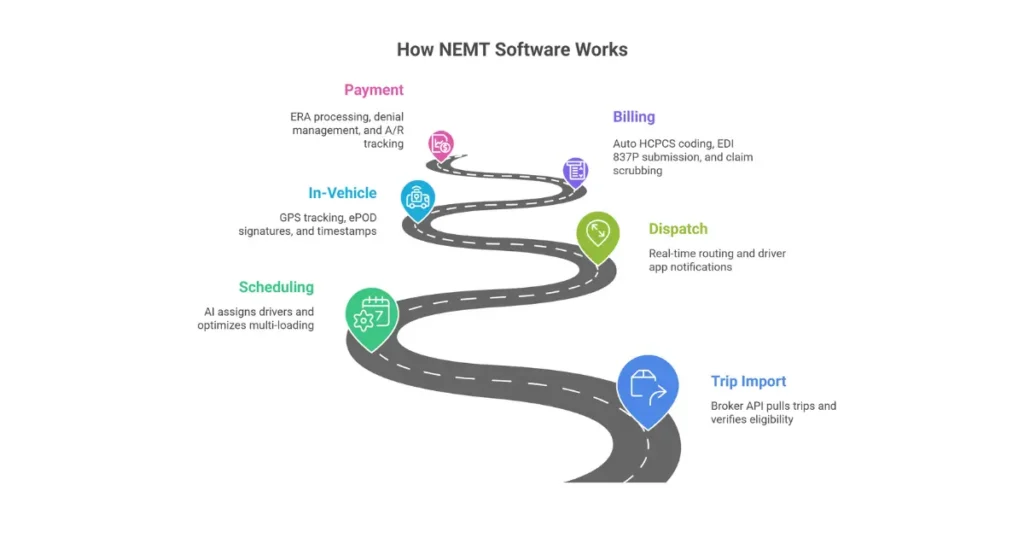
Medicaid billing integration handles HCPCS coding, origin and destination modifiers, EDI 837P claim submission, and denial management. Generic fleet software has no concept of medical claims.
Broker API connections pull trip assignments directly from ModivCare, MTM, Veyo, and state Medicaid portals. Without these integrations, dispatchers manually copy trip details from broker portals—a process that creates errors and wastes hours daily.
Compliance documentation captures the specific proof Medicaid requires: GPS breadcrumbs within 0.1 miles of pickup and dropoff, timestamped patient signatures, driver attestation, and vehicle identification. Miss any element and claims deny.
Prior authorization tracking manages the approval requirements that vary by state, broker, and trip type. Standard fleet software doesn’t know prior authorization exists.
Why Specialized Software Matters for Billing
Medicaid doesn’t pay for transportation. Medicaid pays for documented, verified, medically necessary transportation that meets specific compliance requirements.
Without specialized software, most claims fail audits. Denial rates for providers using generic tools or manual processes regularly exceed 20%. Those using purpose-built NEMT platforms typically achieve clean claim rates above 95%—a difference worth tens of thousands annually for even small fleets.
The math is simple: a ten-vehicle fleet completing 500 trips monthly at $40 average reimbursement generates $20,000 in potential revenue. A 20% denial rate loses $4,000 monthly. Dropping denials to 5% recovers $3,000. That’s $36,000 annually—far exceeding what decent NEMT software costs.
Our complete NEMT billing guide covers the full billing process in detail. Software is the foundation that makes everything else work.
Core Functions of NEMT Software
Every legitimate NEMT platform handles these functions, though quality varies dramatically:
Scheduling and dispatch assigns drivers and vehicles to trips based on location, vehicle type, driver qualifications, and timing. Better systems use AI to optimize multi-loading (putting multiple patients in one vehicle when appropriate) and minimize deadhead miles.
GPS tracking and route optimization monitors vehicle locations in real-time and suggests efficient routes. For billing, GPS provides the audit-proof location verification Medicaid requires.
Electronic proof of delivery (ePOD) captures patient signatures, timestamps, and photos at pickup and dropoff. This documentation proves the trip happened as claimed.
Driver mobile apps put manifests, navigation, and signature capture in drivers’ hands. Quality varies enormously—some apps work offline and handle poor connectivity gracefully, others crash constantly.
Billing and claims management converts completed trips into properly coded claims, scrubs them for errors before submission, tracks adjudication, and manages denials. This function determines whether software actually improves your revenue.
Compliance and reporting tracks driver certifications, vehicle inspections, and generates the reports brokers and state agencies require.
How to Choose the Right NEMT Software
Software selection isn’t about finding the “best” platform. It’s about finding the right platform for your fleet size, payer mix, and growth trajectory. A system perfect for a fifty-vehicle operation will overwhelm a startup. Software ideal for broker-only work won’t handle private pay properly.
Essential Features Checklist
Before evaluating any platform, confirm it handles these non-negotiables:
Broker API integrations with your actual brokers. If you work with ModivCare, the software must pull trips directly from ModivCare’s system—not require manual entry. Same for MTM, Veyo, Access2Care, and state-specific brokers. “We integrate with brokers” means nothing unless they integrate with YOUR brokers.
GPS trip verification with 0.1-mile precision at minimum. The system must capture location proof at dispatch, arrival at pickup, departure from pickup, arrival at destination, and departure from destination. Brokers audit this data. Imprecise GPS causes denials.
Electronic signatures from patients or authorized representatives, timestamped and linked to specific trips. Wet signatures on paper are increasingly rejected.
HCPCS coding and modifier logic that applies correct codes based on vehicle type, trip type, and state requirements. Incorrect coding is a leading denial cause. Software should prevent errors, not create them.
EDI 837P claim submission in 5010A1 format. Manual claim entry is unsustainable beyond tiny volumes.
Eligibility verification (270/271 transactions) before trips occur. Transporting ineligible patients wastes resources and generates zero revenue.
Denial management tools that identify why claims deny, facilitate corrections, and track appeal outcomes. Denials happen; the question is whether software helps you recover revenue.
HIPAA compliance with proper access controls, audit logs, and willingness to sign a Business Associate Agreement. If a vendor won’t sign a BAA, walk away immediately. NEMT software must maintain proper access controls and audit logs per HHS HIPAA Security Rule requirements to protect patient health information.
For official guidance on provider screening and compliance requirements, refer to the CMS Provider Enrollment and Certification guidelines.
Questions to Ask During Demos
Vendors show their software’s best features. Your job is uncovering limitations:
“What was your uptime percentage over the last twelve months?” Anything below 99.5% means frequent outages disrupting operations.
“Can you show me how corrected claims work?” Claims requiring correction after initial submission are common. Some systems handle this gracefully; others require starting over.
“Which clearinghouses do you integrate with?” Availity and Change Healthcare connections are standard. If they only work with obscure clearinghouses, claim routing becomes problematic.
“Can we test EDI submission during the trial?” Many trials limit functionality. If you can’t test billing during evaluation, you’re buying blind.
“What’s included in onboarding, and what costs extra?” Training, data migration, and setup often carry hidden fees that double the apparent cost.
“How do you handle trips that span midnight or require will-calls?” Edge cases reveal platform maturity. Well-designed software handles real-world complexity.
Red Flags That Disqualify Vendors
Certain issues should end your evaluation immediately:
No Business Associate Agreement means the vendor isn’t HIPAA compliant. Using their software puts your business at legal risk.
Manual broker entry required indicates missing API integrations. You’ll spend hours daily copying trip data that should flow automatically.
Proprietary hardware requirements create vendor lock-in and ongoing costs. Quality software runs on standard tablets and phones.
Pricing hidden until sales call often signals either extremely high prices or customized pricing designed to extract maximum payment based on your apparent budget.
No real-time denial tracking means you discover problems weeks after claims submit, when correction becomes difficult.
Recommendations by Fleet Size
Fleet size largely determines which software fits:
| Fleet Size | Budget Range | Priorities | Best Fits |
| 1-5 vehicles | $125-$500/mo | Low cost, billing, GPS proof | Elite Route Dispatch, RouteGenie |
| 6-20 vehicles | $250-$2,000/mo | AI dispatch, denial scrubbing | Elite Route Dispatch, Bambi, TobiCloud |
| 21-50 vehicles | $500-$5,000/mo | Multi-payer billing, multi-site | MediRoutes, RoutingBox |
| 50+ vehicles | Custom | Enterprise features, SLAs | TripSpark, Momentm |
For small fleets, Elite Route Dispatch stands out at $125/month because it includes billing and claims management that competitors charge $300+ for without. Mid-sized fleets benefit from its $15/driver scaling model — a 15-vehicle fleet with 20 drivers pays $350/month total, still below what most competitors charge for dispatch alone.
For operators building their first fleet, our NEMT startup costs breakdown covers every expense including software budgeting.
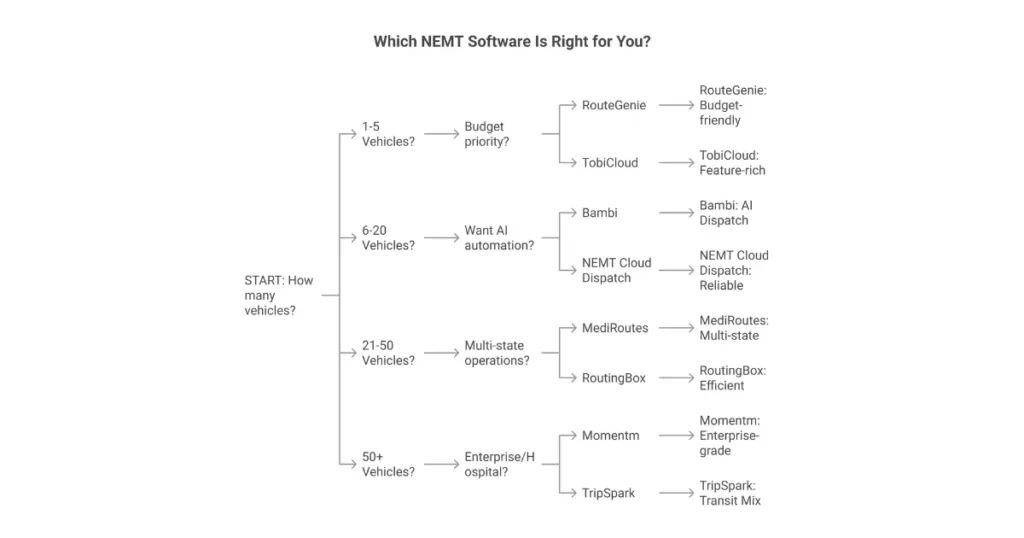
Small fleets need simplicity and affordability. Complex enterprise features add cost without benefit. Focus on solid broker integrations and reliable GPS.
Mid-sized fleets benefit from optimization and automation. AI-driven dispatch, advanced routing, and denial prevention tools generate ROI at this scale.
Large fleets require integrations and compliance tooling. Multi-state operations, multiple broker relationships, and audit requirements demand enterprise-grade platforms.
For providers just starting out, our how to start NEMT billing guide covers the complete setup process, including software selection timing.
NEMT Software Pricing Guide
Pricing transparency varies wildly across NEMT software vendors. Some publish clear rates. Others hide everything behind “contact sales” buttons designed to charge based on perceived willingness to pay.
Here’s what you’ll actually encounter:
Pricing Models Explained
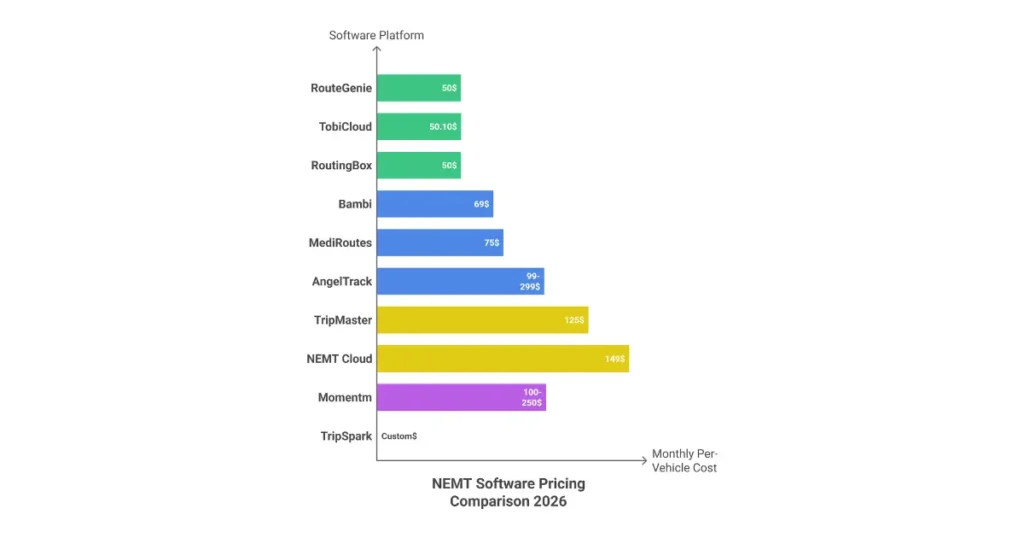
Per-vehicle pricing charges a flat monthly fee for each active vehicle, typically $40-$150 per vehicle. This model scales linearly—predictable but potentially expensive as you grow. Most common for mid-sized platforms.
Per-trip pricing charges based on completed trips, usually $0.10-$0.75 per trip. Good for startups with uncertain volume or seasonal operations. Costs fluctuate with demand.
Flat subscription pricing offers bundled features for a fixed monthly fee regardless of fleet size, typically $250-$1,500 monthly. Predictable budgeting, but may include features you don’t need.
Enterprise pricing negotiates custom rates for large fleets, often $30-$60 per vehicle with volume discounts. Includes SLAs, dedicated support, and custom integrations.
Cost Ranges by Fleet Size
What providers actually pay:
| Fleet Size | Monthly Cost Range | Common Model |
|---|---|---|
| 1-5 vehicles | $150-$500 | Per-vehicle or flat |
| 6-20 vehicles | $500-$2,000 | Hybrid models |
| 21-50 vehicles | $2,000-$5,000 | Flat + add-ons |
| 50+ vehicles | $5,000+ negotiated | Enterprise |
These ranges include core functionality. Add-ons push costs higher.
Hidden Costs to Watch
Budget beyond the advertised price:
Setup and onboarding fees run $500-$5,000 as a one-time charge. Some vendors waive this; others bury it until contract signing.
Training costs range from included to $65-$250 per hour for additional sessions. New staff training often isn’t covered.
Premium support adds $100-$300 monthly for faster response times or phone access versus email-only.
GPS hardware costs $25-$40 per vehicle monthly if the platform requires proprietary devices rather than running on standard phones.
Clearinghouse fees pass through at $0.15 per claim or $30-$100 monthly, depending on volume and clearinghouse.
Annual price increases of 10-15% are standard. Three-year cost projections should account for this.
Analytics and reporting add-ons charge 20-30% premiums for features that seem like they should be included.
Free and Trial Options
Free NEMT software exists but isn’t viable for Medicaid billing.
Options like Office Ally offer basic functionality at no cost. However, they lack GPS tracking, electronic proof of delivery, broker API integrations, and proper claim scrubbing. Denial rates using free tools reach 80% for Medicaid trips—making “free” extraordinarily expensive in lost revenue.
Most legitimate vendors offer 14-30 day trials. Use trials to test actual billing workflows, not just dispatch features. If a trial restricts billing functionality, you’re not really evaluating the product.
The New Price Floor: Elite Route Dispatch at $125/Month
In 2026, Elite Route Dispatch reset the pricing floor for full-featured NEMT software. At $125 per month for up to 5 vehicles — with additional drivers at $15 per month each — it undercuts every competitor while including billing and claims management that others either lack entirely or charge separately for. A five-vehicle fleet with eight drivers pays $170 per month total. That same fleet would pay $350-$690 per month with Bambi, RouteGenie, or TobiCloud — and still would not have built-in billing.
This pricing structure makes Elite Route Dispatch particularly attractive for operators who are starting a NEMT business and need to minimize monthly overhead while getting maximum functionality.
ROI and Payback Analysis
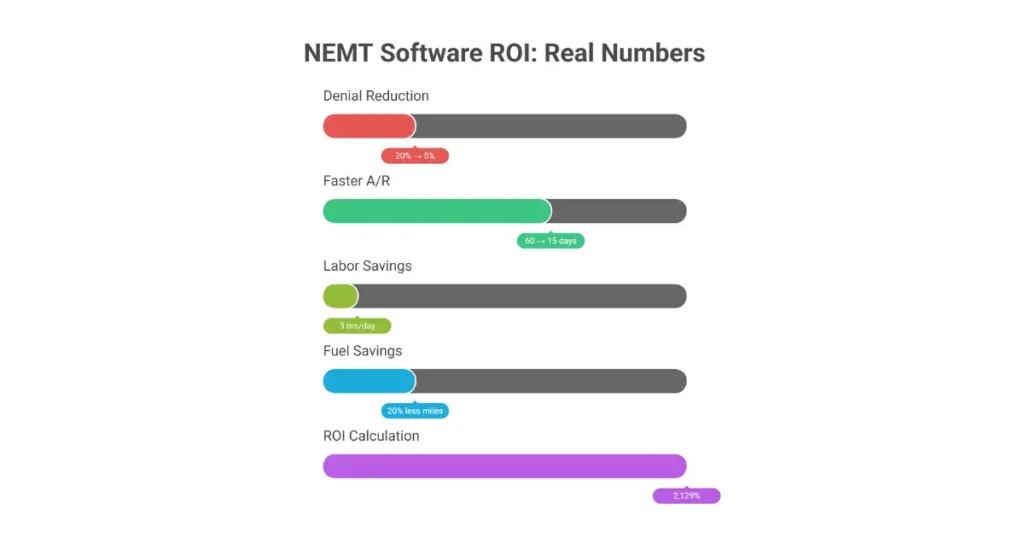
Quality NEMT software delivers ROI exceeding 1,000% in the first year for most providers. Payback typically occurs within three to six months.
Denial reduction drives the biggest savings. Moving from 20% denial rates to below 5% recovers $10,000-$50,000 annually per ten vehicles, depending on trip volume and reimbursement rates.
Faster accounts receivable improves cash flow dramatically. Shortening payment cycles from 60 days to 15-30 days frees working capital.
Labor savings from automated dispatch and billing reduce staffing needs by 2-5 hours daily per dispatcher, worth $18,000-$25,000 annually.
Fuel savings from route optimization cut 15-30% of mileage, saving approximately $15,000 annually per ten vehicles.
Trip capacity increases of 15-25% come from better scheduling and reduced deadhead miles, raising revenue 20-40% without adding vehicles.
Simple ROI example: Software costs $3,500 annually. Annual benefits from denial reduction, labor savings, and fuel savings total $78,000. ROI: 2,129%.
Break-even calculation: At $500 monthly software cost, recovering just 20 additional trips monthly (roughly $800 at typical rates) covers the expense. Most providers exceed this within weeks of proper implementation.
For detailed reimbursement rates by state, see our Medicaid NEMT rates guide.
Best NEMT Dispatch Software Platforms in 2026
Not every NEMT software platform is built with the same dispatch philosophy. Some treat dispatch as a scheduling calendar with a GPS pin on top. Others engineer dispatch as the operational core that drives every other function — billing, compliance, driver management, and reporting.
The difference matters. A platform with strong dispatch automation saves 2-4 hours of daily dispatcher labor. A platform with weak dispatch wrapped in a good-looking interface just moves the spreadsheet problem onto a screen.
We ranked the top dispatch platforms based on four criteria that directly affect revenue: dispatch automation quality (does the system assign trips intelligently or does a human still pick every driver?), billing connection (does trip completion trigger a claim or does someone re-enter the data?), EVV reliability (does the platform capture compliant data automatically or does it require manual workarounds?), and pricing transparency (do you know what you pay before you sign?).
#1. Elite Route Dispatch — Best Overall Dispatch + Billing Integration
Elite Route Dispatch is the only platform where dispatch and billing operate as one system. When a driver marks a trip complete on the mobile app, the platform generates a billing claim with HCPCS codes, modifiers, and pre-submission scrubbing — no separate billing software, no data export, no manual re-entry. This is the feature that separates it from every other platform on this list.
Dispatch assignments are handled through the dashboard or mobile, with GPS tracking, electronic signatures, and automatic mileage calculation at every stop. Fleet and driver management includes credential tracking with expiration alerts for licenses, physicals, and certifications. The reporting dashboard shows revenue, clean claim rates, denial patterns, and driver performance in real time.
At $125 per month for up to 5 vehicles with additional drivers at $15 each, it is the lowest-priced full-featured dispatch platform available — and the only one at any price point that includes billing.
Best for: Operators who want dispatch and billing handled by one platform. Small to mid-sized fleets (1-20 vehicles). Anyone tired of copying trip data into a separate billing system.
#2. RouteGenie — Best Route Optimization and Multi-Loading
RouteGenie has operated for over a decade and its route optimization algorithm remains one of the strongest in the industry. The system reduces deadhead miles by 10-20% for most users and handles multi-loading effectively. Dispatch is reliable, broker integrations are mature, and the flat $50 per vehicle pricing with no trip fees makes budgeting simple.
The limitation is billing. RouteGenie dispatches trips but does not generate Medicaid claims. Operators need a separate billing system or service, which adds cost and creates the data handoff gap where errors occur. The interface also feels dated compared to newer platforms.
Best for: Operators who prioritize route efficiency over billing integration. Fleets of 1-30 vehicles that already have billing handled separately.
#3. Bambi — Best AI-Driven Dispatch Automation
Bambi’s “Run Bambi Run” one-click dispatch uses AI to assign trips, optimize routes, and predict arrival times. The interface is the most modern and intuitive in the market. For operators who want to minimize dispatcher workload, Bambi’s automation is genuinely effective — dispatchers report spending half the time on assignments compared to manual platforms.
At $69 per vehicle per month with no contracts, pricing is straightforward. The trade-off is the same as RouteGenie — no built-in billing. Operators still need a separate billing solution, and some broker integrations are still maturing as the platform is relatively new.
Best for: Growing fleets (6-30 vehicles) that value automation and modern UX. Operators whose dispatch workload is the primary bottleneck.
#4. TobiCloud — Best Entry-Level Platform With Broker APIs
TobiCloud targets small to mid-sized providers with a polished driver app that works offline — important for drivers in areas with poor connectivity. Broker API integrations with ModivCare, MTM, and Veyo are reliable. The hybrid pricing ($50 per vehicle plus $0.10 per trip) keeps costs reasonable at lower volumes.
Billing capability is limited to HCPCS scrubbing and EDI submission — not as deep as Elite Route Dispatch’s integrated claims module but more than most dispatch-only platforms offer. Reporting and analytics lag behind enterprise options.
Best for: Small fleets (5-25 vehicles) heavily dependent on broker trips who need a polished driver app and reliable API connections.
#5. NEMT Cloud Dispatch — Best Budget Dispatch for Hybrid Operations
NEMT Cloud Dispatch emphasizes pricing transparency and handles both Medicaid and private pay work. The tiered pricing starting at $149 monthly keeps entry costs low. Support responsiveness receives consistent praise — operators report actually reaching humans when problems arise.
Dispatch functionality is straightforward without advanced AI optimization. The platform works well within its scope but does not attempt to match the automation depth of Bambi or the billing integration of Elite Route Dispatch.
Best for: Small fleets (1-15 vehicles) balancing Medicaid and private pay. Operators who value responsive support and transparent pricing.
#6. AngelTrack — Best for EMS and NEMT Crossover
AngelTrack serves both EMS and NEMT operations with a modular, flexible architecture. Dispatch is built on EMS-grade workflows — reliable and proven but requiring more configuration time than plug-and-play alternatives. Billing runs through Office Ally integration. At $99-$299 per month flat regardless of fleet size, pricing is extremely competitive for operators at the higher end of that range.
Best for: EMS companies adding NEMT services. Billing-focused small fleets (1-20 vehicles) willing to invest setup time for customization.
#7. MediRoutes — Best Dispatch for Complex Enterprise Billing
MediRoutes handles multi-payer, multi-state dispatch with enterprise-grade billing that manages complexity simpler platforms cannot. Custom pricing around $75 per vehicle reflects the enterprise positioning. Implementation requires 4-6 weeks minimum, but the platform’s stability reflects fifteen years of refinement.
Best for: Large fleets (21-60 vehicles) with sophisticated multi-payer scenarios across multiple states.
#8. TripMaster — Best Dispatch for Mixed Transit and NEMT
TripMaster serves operations that combine paratransit, NEMT, and demand-response services. The scheduling engine is powerful and support is consistently rated the best in the industry. Route optimization does not match RouteGenie or Bambi, and pricing requires a custom quote starting around $125 monthly.
Best for: Transit agencies and larger providers (20-100 vehicles) mixing paratransit with NEMT.
Dispatch Platform Quick Comparison
| Platform | Starting Price | Billing Built In? | AI Dispatch | EVV | Best Fleet Size |
|---|---|---|---|---|---|
| Elite Route Dispatch | $125/mo | Yes — full claims | Basic | All 50 | 1-20 |
| RouteGenie | $50/vehicle | No | No | Yes | 1-30 |
| Bambi | $69/vehicle | No | Yes — strong | Limited | 6-30 |
| TobiCloud | $50/vehicle + trip | Partial | Medium | Yes | 5-25 |
| NEMT Cloud Dispatch | $149/mo | Partial | Basic | Yes | 1-15 |
| AngelTrack | $99-$299 flat | Via Office Ally | No | Yes | 1-20 |
| MediRoutes | ~$75/vehicle | Add-on | Semi-auto | Yes | 21-60 |
| TripMaster | $125+ custom | Templates | Limited | Yes | 20-100 |
The pattern across this comparison is consistent: every platform dispatches trips competently. The differentiator is what happens after the trip is complete. If your billing workflow involves copying data from one system into another, you are losing revenue to errors and delays. Elite Route Dispatch is the only platform that eliminates that gap entirely — at the lowest price point in the market.
For operators who want to understand the full NEMT billing process and why the dispatch-to-billing connection matters so much, our complete NEMT billing guide covers every step from code selection to payer submission.
Best NEMT Software 2026: Pricing, Features, Billing & Fleet Size Comparison
Comparing NEMT software platforms is difficult because vendors highlight different strengths and hide different weaknesses. RouteGenie leads with routing. Bambi leads with AI automation. TripMaster leads with support. But none of them publish a side-by-side comparison that includes billing capability, EVV state coverage, implementation time, and actual monthly cost for a real fleet size.
This section does that. We compared eleven NEMT platforms across twelve dimensions that directly affect daily operations and monthly revenue. Every data point comes from published vendor information, user feedback, and our direct experience processing NEMT billing across multiple platforms.
Master NEMT Software Comparison Table 2026
| Dimension | Elite Route Dispatch | RouteGenie | Bambi | TobiCloud | NEMT Cloud | AngelTrack | MediRoutes | TripMaster | RoutingBox | Momentm | Traumasoft |
|---|---|---|---|---|---|---|---|---|---|---|---|
| Monthly Cost (10 vehicles) | $230 | $500 | $690 | $600 | $449+ | $99-$299 | ~$750 | Custom | $500+ | $1,000-2,500 | Custom |
| Pricing Model | Base + /driver | /vehicle | /vehicle | /vehicle + trip | Tiered | Flat | Custom | Custom | /vehicle | Custom | Custom |
| Billing & Claims | Full built-in | None | None | Partial (scrub) | Partial | Via Office Ally | Add-on | Templates | AR tools | Enterprise | EMS-focused |
| Medicaid EDI (837P) | Yes — auto | Export only | Export only | Yes | Yes | Via clearinghouse | Yes | Yes | Yes | Yes | Yes |
| EVV Compliance | All 50 states | All 50 states | Limited states | Yes | Yes | Yes | Yes | Yes | Yes | Yes | Yes |
| Route Optimization | Basic | Strong | AI-driven | Medium | Basic | None | Medium | Complex | Medium-High | High | Limited |
| Driver Mobile App | Full mobile | Simple | Best UX | Polished + offline | Driver + passenger | Basic | Photo verify | IVR-enabled | Unified | Safety-focused | iOS + Android |
| Customer Support | Phone + email | Mixed reviews | Responsive | Fast onboarding | Humans answer | Knowledgeable | Best in class | Standard | Enterprise | Standard | |
| Implementation Time | 24 hours | 7-14 days | 7-14 days | 2 weeks | 1-2 weeks | 2-4 weeks | 4-6 weeks | 3-4 weeks | 2-3 weeks | 4-6 weeks | 4-6 weeks |
| Free Trial | Free demo | 14-30 day | Demo | Trial available | Trial | Trial | Demo only | Demo only | Demo | Demo only | Demo only |
| Best Fleet Size | 1-20 | 1-30 | 6-30 | 5-25 | 1-15 | 1-20 | 21-60 | 20-100 | 10-50 | 50+ | 30+ |
| Contract Required | None | None | None | Month-to-month | Optional annual | None | Annual | Annual | Annual | Enterprise | Custom |
Three patterns emerge from this table that are worth highlighting.
First, billing integration separates two classes of platform. Elite Route Dispatch is the only platform that generates complete Medicaid claims from dispatch data automatically. Every other platform requires either a separate billing system, a clearinghouse integration, or manual claim preparation. That gap costs operators 2-4 hours of daily labor and introduces the data re-entry errors that drive denial rates above 15%.
Second, pricing transparency correlates with platform maturity. The platforms that publish clear pricing (Elite Route Dispatch, RouteGenie, Bambi, AngelTrack) tend to have simpler, more predictable cost structures. The platforms that require custom quotes (MediRoutes, TripMaster, Momentm) typically charge more and bundle features that smaller fleets do not need.
Third, implementation speed varies by a factor of ten. Elite Route Dispatch operators go live in 24 hours. Enterprise platforms like MediRoutes and Momentm require 4-6 weeks. For an operator who needs to start dispatching trips next week, this is not a minor difference — it is a dealbreaker.
RouteGenie vs Bambi vs Elite Route Dispatch: Head-to-Head
These three platforms compete most directly for small-to-mid-sized NEMT fleets. Each wins on a different dimension.
If your top priority is route optimization and fuel savings, RouteGenie wins. Its routing algorithm has been refined over a decade and consistently reduces deadhead miles by 10-20%. The flat $50 per vehicle pricing with no trip fees is simple and predictable. The trade-off: no billing capability and an interface that feels outdated compared to 2026 standards.
If your top priority is dispatch automation and modern UX, Bambi wins. The AI-driven “Run Bambi Run” feature reduces dispatcher workload significantly. The interface is the most polished in the industry. At $69 per vehicle with no contracts, pricing is competitive. The trade-off: no billing integration, and some broker connections are still maturing.
If your top priority is billing accuracy and total cost, Elite Route Dispatch wins. It is the only option where completed trips automatically generate Medicaid claims with HCPCS codes and modifiers applied. At $125 per month for 5 vehicles (vs $250 for RouteGenie or $345 for Bambi at the same fleet size), it costs less while including billing that the others lack entirely. The trade-off: newer platform with less mature AI routing compared to Bambi and RouteGenie.
Here is the direct comparison for a five-vehicle fleet with seven drivers:
| Elite Route Dispatch | RouteGenie | Bambi | |
|---|---|---|---|
| Monthly Cost | $155 ($125 + 2 extra drivers × $15) | $250 (5 × $50) | $345 (5 × $69) |
| Annual Cost | $1,860 | $3,000 | $4,140 |
| Billing Included | Yes — full claims | No (add ~$200-500/mo) | No (add ~$200-500/mo) |
| True Annual Cost (with billing) | $1,860 | $5,400-$9,000 | $6,540-$10,140 |
| Route Optimization | Basic | Strong | AI-driven |
| Driver App | Full mobile | Simple | Best UX |
| Go-Live Time | 24 hours | 7-14 days | 7-14 days |
The “true annual cost” row is what matters. When you factor in the separate billing system or service that RouteGenie and Bambi require, Elite Route Dispatch saves $3,500-$8,000 per year for a five-vehicle fleet. That gap widens at every fleet size because the other platforms charge per vehicle while billing costs remain fixed or increase.
For operators who want someone else to handle the billing entirely rather than self-managing claims through software, our NEMT billing services team processes claims at 5% of net collections with a 98% clean claim rate.
How to Choose: Decision Framework by Situation
The right platform depends on your specific situation. Here is a quick decision guide based on the most common scenarios we see across the NEMT operators we work with:
“I am starting a NEMT business and need everything in one system.” → Elite Route Dispatch. At $125/month you get dispatch, billing, EVV, fleet management, and reporting from Day 1 without configuring multiple tools. Our how to start a NEMT business guide covers the complete setup process.
“I already have a billing company and just need better dispatch.” → RouteGenie (if routing is your priority) or Bambi (if automation is your priority). Both are solid dispatch platforms when billing is handled separately.
“I am switching from spreadsheets and phone calls.” → Elite Route Dispatch or TobiCloud. Both are designed for quick adoption with minimal training. Elite Route Dispatch goes live in 24 hours; TobiCloud has an excellent offline-capable driver app.
“I run 20+ vehicles across multiple states.” → MediRoutes for billing complexity at scale, or TripMaster for mixed transit and NEMT operations. Enterprise needs require enterprise platforms.
“I need the cheapest option that actually works for Medicaid.” → Elite Route Dispatch at $125/month. AngelTrack at $99-$299/month is the alternative if you handle billing through Office Ally. Free NEMT software is not viable for Medicaid billing — denial rates with free tools reach 80%.
“I want the best AI and automation regardless of price.” → Bambi. Its dispatch AI is the most advanced in the market for NEMT-specific optimization.
For operators who also need a professional online presence, our NEMT website development service builds sites that rank on search engines and accept patient bookings — because software and a website together convert more leads than either one alone.
Need a Professional NEMT Website?
We build NEMT websites that rank on search engines, accept patient bookings, and make your business look as professional as it is. SEO-optimized, mobile-ready, and HIPAA-aware.
Elite Route Dispatch Review
Overview
Elite Route Dispatch launched in 2026 from EliteMed Financials — the NEMT billing company that processes thousands of Medicaid claims monthly. Unlike every other platform on this list, Elite Route Dispatch was not built by a software company that added billing later. It was built by billing specialists who engineered dispatch around what billing actually requires. The result is the only NEMT platform where trip completion automatically generates properly coded claims with HCPCS codes and modifiers applied — no manual re-entry, no separate billing system, no data handoff.
Key Features
The platform covers four core modules: fleet and driver management with credential tracking and expiration alerts, billing and claims management with automated claim generation and denial tracking, advanced reporting and analytics with real-time revenue dashboards, and a mobile-friendly system for drivers and dispatchers.
The billing module is the differentiator. Completed trips flow directly into claims with correct HCPCS codes (A0120, T2001, and others based on service type), origin and destination modifiers applied, and pre-submission scrubbing. Denial tracking shows rejected claims in real time with reasons and correction workflows. No other platform on this list generates billing claims from dispatch data without requiring a separate billing system or manual intervention.
EVV compliance covers all 50 states with GPS-stamped timestamps, electronic signatures, and automatic mileage calculation. For state-specific EVV requirements, the NEMT compliance checklist covers what operators need to document.
Pricing
Elite Route Dispatch uses the simplest and most affordable pricing in the market:
- $125/month for up to 5 vehicles — every feature included
- $15/month per additional driver
- Custom pricing for 15+ vehicles with volume discounts
- No setup fees, no contracts, cancel anytime
For a ten-vehicle fleet with twelve drivers:
- Base: $125 (covers 5 vehicles)
- Additional drivers: 7 extra × $15 = $105
- Total: $230/month — including billing and claims management
Compare that to Bambi at $690/month (10 × $69) without billing, RouteGenie at $500/month (10 × $50) without billing, or TobiCloud at $600/month (10 × $50 + $100 trips) without billing. Elite Route Dispatch includes what those platforms charge extra for, at less than half the price.
Pros
- The only NEMT platform with fully integrated billing and claims management — not an add-on, not a third-party integration, built into the core
- Lowest starting price in the market at $125/month with no feature restrictions
- Per-driver pricing means you only pay for what you use as you scale
- Built by active billing specialists who process thousands of claims monthly — every feature exists because the billing team required it
- 50-state EVV compliance included in every plan
- Credential tracking with expiration alerts for driver qualification files
- 24-hour go-live for new operators; 48-72 hour migration from existing platforms
Cons
- Newest platform on this list — launched 2026, so fewer long-term user reviews compared to platforms that have operated for 5-10+ years
- AI-driven route optimization is not as mature as Bambi or RouteGenie for complex multi-loading scenarios
- No dedicated passenger-facing booking app (dispatchers handle booking through the platform)
Best For
Small to mid-sized NEMT fleets (1-20 vehicles) that need dispatch and billing in one system, operators who want to eliminate the gap between trip completion and claim submission, and providers who prioritize billing accuracy over AI-driven scheduling automation. Particularly strong for operators who also use EliteMed Financials NEMT billing services — the combination creates a fully integrated dispatch-to-payment ecosystem.
User Feedback Summary
Early adopters consistently highlight the billing integration as the standout feature. “We used to spend two hours a day copying trip data into our billing system — now it is automatic” is a common theme. Operators switching from RouteGenie and Bambi note the cost savings immediately. The most frequent request from users is expanded AI routing capabilities, which the development team has acknowledged as a near-term priority.
| Quick Specs | |
| Fleet Size | 1-20+ vehicles |
| Billing | Full billing & claims — built in |
| EVV | All 50 states |
| Mobile | Full mobile access — drivers & dispatchers |
| Pricing | $125/mo + $15/driver |
| Rating | 4.8/5 (early adopter feedback) |
TobiCloud (Tobi) Review
Overview
TobiCloud emerged around 2018 as a cloud-native dispatch and billing platform targeting growth-oriented fleets. The company focuses on small to mid-sized providers seeking modern technology without enterprise complexity.
Key Features
TobiCloud’s billing functionality includes HCPCS and CMS-1500 claim scrubbing, automatic EDI submission with reconciliation, and direct API connections to ModivCare, MTM, and Veyo. The OIG and HIPAA compliance dashboard helps track regulatory requirements.
The dispatch system handles AI-based trip assignment, real-time routing adjustments, and no-show management. GPS tracking achieves the 0.1-mile precision required for audit compliance.
The driver app is notably polished, with offline functionality for areas with poor connectivity. Electronic signature capture works reliably, and the interface requires minimal training for new drivers.
Pricing
TobiCloud charges approximately $50 per vehicle monthly plus $0.10 per trip, with a $100 minimum. This hybrid model keeps costs reasonable for lower-volume providers while scaling for growth.
For a ten-vehicle fleet completing 500 monthly trips:
- Base: $500 (10 vehicles × $50)
- Trips: $50 (500 × $0.10)
- Total: $550/month
Pros
The user interface is genuinely intuitive—new dispatchers become productive quickly. Broker API integrations work reliably without constant manual intervention. Onboarding is faster than competitors, often completing within two weeks. Claim clean rates consistently exceed 95% for users who configure the system properly.
Cons
Advanced reporting capabilities lag behind enterprise platforms. For operations with complex multi-payer scenarios, the billing module may feel limited. Per-trip fees increase costs at high volumes.
Best For
Small to mid-sized NEMT fleets (5-25 vehicles) that depend heavily on broker trips and prioritize ease of use over advanced analytics.
User Feedback Summary
Users consistently praise the interface and onboarding experience. Common complaints focus on reporting depth—providers wanting sophisticated analytics often find TobiCloud insufficient. ModivCare synchronization receives specific positive mentions.
| Quick Specs | |
|---|---|
| Fleet Size | 5-25 vehicles |
| Broker APIs | ModivCare, MTM, Veyo |
| AI Features | Routing, trip assignment |
| Rating | 4.5/5 |
RouteGenie Review
Overview
RouteGenie has operated for over a decade, establishing itself as a reliable all-in-one suite with particular strength in route optimization. The platform’s longevity means mature features and proven stability.
Key Features
The billing module includes pre-submission claim scrubbing, direct ModivCare and Veyo integrations, and automatic trip-to-payer matching. The “BillingGenie” component specifically targets denial prevention by validating claims before submission.
Route optimization is RouteGenie’s standout capability, reducing deadhead miles by 10-20% for most users. The algorithm handles multi-loading effectively and adapts to real-time conditions.
Broker integrations cover major national players and many regional brokers. The platform supports both automated trip import and manual entry for brokers without API connections.
Pricing
RouteGenie charges a flat $50 per vehicle monthly with no trip fees and no long-term contracts. This straightforward pricing makes budgeting simple.
For a ten-vehicle fleet:
- Total: $500/month
The absence of per-trip fees makes RouteGenie particularly cost-effective for high-volume operations.
Pros
Flat pricing without trip fees benefits high-volume providers. Route optimization demonstrably reduces fuel costs. Broker integrations are reliable and mature. The platform scales reasonably well for mid-sized fleets. No contract requirements provide flexibility.
Cons
The user interface feels dated compared to newer platforms. Support response times receive mixed reviews—some users report delays during busy periods. Analytics and reporting capabilities are limited compared to enterprise alternatives.
Best For
Startups and mid-sized fleets (1-30 vehicles) prioritizing route optimization and simple, predictable pricing.
User Feedback Summary
“Great routing” appears frequently in reviews. Users appreciate fuel savings and reliable broker connections. Interface complaints are common—the platform works but doesn’t feel modern. Support experiences vary significantly.
| Quick Specs | |
|---|---|
| Fleet Size | 1-30 vehicles |
| Broker APIs | ModivCare, MTM, Veyo, regional |
| AI Features | Route optimization |
| Rating | 4.2/5 |
NEMT Cloud Dispatch Review
Overview
Launched around 2020, NEMT Cloud Dispatch has grown rapidly by emphasizing price transparency and responsive support. The platform targets small fleets and hybrid NEMT/private-pay operations.
Key Features
Billing capabilities include EDI 837 and CMS-1500 export, automatic claim auditing, and ModivCare/MTM synchronization. A trip-to-invoice generator handles private pay billing alongside Medicaid claims.
The dispatch interface is straightforward without overwhelming complexity. GPS tracking provides required verification, and the driver app includes both driver and passenger-facing components.
Pricing
NEMT Cloud Dispatch uses tiered pricing starting at $149 monthly plus per-vehicle fees. The structure scales with fleet size, keeping entry costs low.
Pros
Pricing transparency stands out—you know costs before signing. Support responsiveness receives consistent praise; users report actually reaching humans when problems arise. The platform flexibly handles both Medicaid and private pay work.
Cons
Analytics and reporting are limited. Larger fleets may find the platform lacks enterprise features. Some broker integrations are less mature than competitors.
Best For
Small fleets (1-15 vehicles) or hybrid operations balancing Medicaid and private pay.
User Feedback Summary
“Value for the price” appears frequently. Users appreciate actually reaching support staff. Requests for better reporting are common. The platform works well within its intended scope but doesn’t try to be everything.
| Quick Specs | |
|---|---|
| Fleet Size | 1-15 vehicles |
| Broker APIs | ModivCare, MTM |
| AI Features | Basic scheduling |
| Rating | 4.3/5 |
Bambi Review
Overview
Bambi launched after 2022 as an AI-first platform using predictive dispatching technology. The company positioned itself as the modern alternative to legacy systems, emphasizing automation and user experience.
Key Features
The unified workflow moves trips from scheduling through billing to confirmation without manual handoffs. Automatic EDI and claims submission handles Medicaid processing, with all major broker integrations included.
AI-driven dispatching is Bambi’s differentiator. The system predicts optimal driver assignments, estimates accurate arrival times, and adjusts routing dynamically. This reduces dispatcher workload significantly compared to manual assignment.
HIPAA compliance tooling is built into the platform rather than added as an afterthought.
Pricing
Bambi charges approximately $69 per vehicle monthly with no contracts. This falls between budget options and premium platforms.
For a ten-vehicle fleet:
- Total: $690/month
Pros
The user interface is genuinely best-in-class—modern, intuitive, and pleasant to use. AI features meaningfully reduce dispatcher workload rather than serving as marketing buzzwords. Feature releases are frequent; the platform improves noticeably. Real-time claim status visibility helps catch issues early.
Cons
Manual billing customization is limited compared to platforms with more configurability. As a newer platform, some integrations are still maturing. Analytics and reporting, while improving, don’t match enterprise platforms.
Best For
Mid-sized growing fleets (6-30 vehicles) wanting modern automation and willing to adopt a newer platform.
User Feedback Summary
Interface praise dominates reviews—users describe Bambi as the most modern NEMT software available. Fast feature releases are appreciated. Comments about maturing reporting and occasional integration gaps reflect the platform’s relative newness.
| Quick Specs | |
|---|---|
| Fleet Size | 6-30 vehicles |
| Broker APIs | All major brokers |
| AI Features | Predictive dispatch, ETAs |
| Rating | 4.7/5 |
MediRoutes Review
Overview
MediRoutes has operated for over fifteen years, establishing itself as an enterprise-focused platform with deep billing capabilities. The company targets larger fleets requiring sophisticated multi-payer processing.
Key Features
Billing is MediRoutes’ strength. Advanced denial management, comprehensive HCPCS mapping, multi-payer processing, and audit-grade reporting handle complex billing scenarios that simpler platforms can’t manage.
The platform scales across regions, handling multi-state operations with varying regulatory requirements. Broker API integrations are comprehensive and mature.
Pricing
MediRoutes uses custom pricing, typically around $75 per vehicle. Enterprise features justify higher costs for operations that need them.
Pros
Billing capabilities are genuinely robust—this platform handles complexity that breaks simpler systems. Multi-state and multi-payer scenarios work reliably. The platform’s stability reflects fifteen years of refinement. Support is knowledgeable about complex billing issues.
Cons
Less customization than some providers expect for the price. Implementation requires significant time—expect four to six weeks minimum. The interface, while functional, feels dated compared to newer competitors.
Best For
Large fleets (21-60 vehicles) requiring sophisticated billing capabilities and multi-state operations.
User Feedback Summary
“Stable” and “billing powerhouse” describe user sentiment accurately. The platform works extremely well for its intended purpose. Interface complaints are common but users generally accept this tradeoff for billing capability.
| Quick Specs | |
|---|---|
| Fleet Size | 20-60 vehicles |
| Broker APIs | Comprehensive enterprise |
| AI Features | Semi-automated scheduling |
| Rating | 4.4/5 |
TripMaster Review
Overview
TripMaster has served the transit and NEMT space for over twenty years. The platform handles mixed fleets combining paratransit, NEMT, and demand-response services—something most competitors can’t do well.
Key Features
Billing integrates with ModivCare and includes CMS templates and audit logs. Batch invoicing handles high volumes. The platform specifically addresses paratransit regulatory compliance requirements.
The scheduling engine is powerful but complex. Users investing time to learn it gain significant capabilities.
Support reputation is exceptional. Users consistently report knowledgeable, responsive assistance—a genuine differentiator in this space.
Pricing
TripMaster uses custom pricing starting around $125 monthly. The platform targets larger operations where this investment makes sense.
Pros
User support is genuinely best-in-class. The platform handles mixed fleets that combine different service types. Compliance tooling for paratransit is mature. Scalability extends to 100+ vehicles.
Cons
Routing optimization lags behind competitors focused solely on NEMT. Pricing is higher than necessary for pure NEMT operations. The platform is overkill for small fleets.
Best For
Transit agencies and larger providers (20-100 vehicles) mixing paratransit with NEMT services.
User Feedback Summary
“Support team is amazing” appears constantly. Users genuinely appreciate responsive, knowledgeable assistance. Routing complaints are common—the platform doesn’t optimize routes as aggressively as competitors. Mixed fleet handling receives specific praise.
| Quick Specs | |
|---|---|
| Fleet Size | 20-100 vehicles |
| Broker APIs | ModivCare, Alivi |
| AI Features | Limited |
| Rating | 4.3/5 |
RoutingBox Review
Overview
RoutingBox entered the market around 2018 focusing on analytics and optimization for mid-market fleets. The platform handles significant volume—some users manage 15,000+ vehicles through the system.
Key Features
Billing includes smart payer assignment, MTM Link import, and comprehensive KPI dashboards. Accounts receivable aging tools help track outstanding payments.
Analytics capabilities exceed most competitors, providing visibility into operational metrics that inform decision-making. The platform supports multi-state operations.
Pricing
RoutingBox starts around $50 monthly with volume-based scaling.
Pros
Analytics and reporting are genuinely strong—this platform provides insights others don’t. Broker integrations are stable and mature. Multi-state capability works well. The platform scales effectively for growing operations.
Cons
The learning curve is steeper than simpler alternatives. Onboarding takes longer and requires more effort. The interface, while capable, isn’t as intuitive as newer platforms.
Best For
Operations of 6-50 vehicles ready to leverage data for growth and willing to invest in learning the platform.
User Feedback Summary
“Great insights” describes user appreciation for analytics capabilities. Training time complaints are common—teams need more ramp-up than with simpler platforms. Users who master the system generally remain loyal.
| Quick Specs | |
|---|---|
| Fleet Size | 10-50 vehicles |
| Broker APIs | MTM, regional brokers |
| AI Features | Routing metrics |
| Rating | 4.4/5 |
WellRyde Review
Overview
WellRyde focuses specifically on broker-centric operations, with particularly strong ModivCare integration. The platform serves paratransit and NEMT providers prioritizing broker workflow efficiency.
Key Features
Billing automation handles basic claim workflows. Broker API emphasis means excellent integration with major brokers. GPS and trip verification meet Medicaid requirements.
Multi-channel booking supports various trip sources. The interface prioritizes simplicity over feature depth.
Pricing
WellRyde uses custom pricing that varies by broker relationship and volume.
Pros
Broker integration, particularly ModivCare, works exceptionally well. The platform is simple to use with minimal training. API connections are reliable. Good fit for broker-only operations.
Cons
Advanced billing features are limited. Analytics don’t match competitors. The platform may feel too simple for operations with diverse payer sources.
Best For
Fleets under 30 vehicles doing primarily or exclusively Medicaid broker work.
User Feedback Summary
“Easy with ModivCare” captures user sentiment. The platform excels at its narrow focus. Users wanting audit-ready reporting or complex billing find it insufficient.
| Quick Specs | |
|---|---|
| Fleet Size | 5-30 vehicles |
| Broker APIs | ModivCare (excellent), others |
| AI Features | Minimal |
| Rating | 4.1/5 |
AngelTrack Review
Overview
AngelTrack serves EMS, ambulance, and NEMT providers—a cross-sector approach that distinguishes it from pure NEMT platforms. The system launched around 2015 with a modular, flexible architecture.
Key Features
Billing integrates with Office Ally and supports HCPCS coding with significant manual control over claims. The modular design lets users configure workflows extensively.
Flexibility is AngelTrack’s strength. Users who invest time in configuration can create highly customized setups. The platform handles mixed service types (EMS and NEMT) that pure NEMT software can’t manage.
Pricing
AngelTrack charges $99-$299 monthly as a flat subscription regardless of fleet size. This makes it extremely cost-effective for operations at the lower end of that range.
For any fleet size:
- Total: $99-$299/month
Pros
Pricing is genuinely affordable and predictable. Flexibility allows extensive customization. Mixed service fleets (EMS plus NEMT) work well. Clearinghouse integration via Office Ally is functional.
Cons
The learning curve is steep—expect significant setup and configuration time. Manual processes exceed what automation-focused competitors require. Broker API integrations are more limited than pure NEMT platforms.
Best For
Billing-focused small fleets (1-20 vehicles) and EMS operations adding NEMT services.
User Feedback Summary
“Super flexible” and “takes time to configure” appear together frequently. Users appreciate capabilities but acknowledge the effort required. “Low cost” is a consistent positive.
| Quick Specs | |
|---|---|
| Fleet Size | 1-20 vehicles |
| Broker APIs | Basic, via clearinghouse |
| AI Features | None |
| Rating | 4.0/5 |
Momentm (NovusMED) Review
Overview
Momentm, operating the NovusMED platform, serves the enterprise segment with AI-driven automation and comprehensive analytics. The company targets large fleets, hospitals, and municipal NEMT operations.
Key Features
End-to-end billing analytics provide visibility that operational managers need. Broker-driven synchronization works with all major national brokers. ePOD and audit trails support compliance requirements.
AI-powered scheduling handles complex multi-loading scenarios and optimizes driver utilization across large fleets. Safety-focused features in the mobile app address enterprise risk management requirements.
Accounts receivable and denial workflows are sophisticated, handling the complexity large operations generate.
Pricing
Momentm uses custom enterprise pricing, typically $100-$250 per vehicle with negotiated rates for larger fleets.
Pros
Enterprise-grade features genuinely serve large operation needs. Analytics and automation are powerful. The platform scales to hundreds of vehicles. Support understands enterprise requirements.
Cons
Pricing is higher than alternatives—overkill for smaller fleets. Implementation is complex and time-consuming. Features that benefit enterprise operations add complexity smaller fleets don’t need.
Best For
Enterprise operations with 50+ vehicles, hospitals, and municipal NEMT providers.
User Feedback Summary
“Best automation” and “pricey but worth it” capture user sentiment. The platform delivers for its target market but isn’t appropriate for smaller operations.
| Quick Specs | |
|---|---|
| Fleet Size | 50+ vehicles |
| Broker APIs | All major brokers |
| AI Features | High—scheduling, safety |
| Rating | 4.6/5 |
TripSpark Review
Overview
TripSpark serves large-fleet NEMT and transit operations with enterprise-grade software including in-vehicle technology options. The company targets operations where scale demands sophisticated tooling.
Key Features
The platform supports both NEMT and public transit operations with appropriate compliance for each. Broker integrations and Medicaid billing handle complex multi-payer scenarios.
In-vehicle technology options integrate hardware and software for operations wanting comprehensive solutions. Large-fleet management tools address challenges smaller operations don’t face.
Pricing
TripSpark uses custom enterprise pricing appropriate for its target market.
Pros
Genuine enterprise scale handles very large operations. Transit plus NEMT capability serves mixed operations. In-vehicle technology options provide integrated solutions.
Cons
Complexity exceeds what smaller operations need. Pricing is enterprise-level. Implementation requires significant investment.
Best For
Large fleets, transit agencies, and school transportation operations adding NEMT services.
| Quick Specs | |
|---|---|
| Fleet Size | 50-500+ vehicles |
| Broker APIs | Enterprise integrations |
| AI Features | Medium-high |
| Rating | 4.4/5 |
Traumasoft Review
Overview
Traumasoft provides all-in-one software combining CAD (computer-aided dispatch), scheduling, billing, and fleet maintenance for EMS and NEMT operations. The platform excels where both service types coexist.
Key Features
ePCR (electronic patient care report) documentation integrates with NEMT trip records. EMS and NEMT billing work together within one system. LogistiCare templates and integrated collections support various payer relationships.
Compliance tooling addresses both EMS and NEMT requirements. Fleet maintenance tracking exceeds what pure NEMT platforms offer.
Pricing
Traumasoft uses custom pricing appropriate for its complex capabilities.
Pros
Deep compliance tools serve regulated operations well. Combined EMS and NEMT capability reduces system sprawl. Feature richness handles complex scenarios. Enterprise-ready scalability.
Cons
The platform is too heavy for pure NEMT operations. Onboarding requires significant effort. Training investment is substantial.
Best For
Agencies combining EMS and NEMT services (30+ vehicles) needing unified operations.
User Feedback Summary
“Feature rich” and “overwhelming if only doing NEMT” appear together. The platform serves its hybrid market well but isn’t appropriate for NEMT-only operations.
| Quick Specs | |
|---|---|
| Fleet Size | 30+ vehicles |
| Broker APIs | Yes |
| AI Features | Limited |
| Rating | 4.2/5 |
Side-by-Side Comparison

Feature Comparison Matrix
| Feature | Elite Route | TobiCloud | RouteGenie | Bambi | MediRoutes |
| Starting Price | $125/mo | $550/10v | $500/10v | $690/10v | ~$750/10v |
| Dispatch | ✓ | ✓ | ✓ | ✓ AI | ✓ |
| Scheduling | ✓ | ✓ | ✓ | ✓ | ✓ |
| Route Optimization | ✓ | ✓ | ✓ Strong | ✓ AI | ✓ |
| GPS Tracking | ✓ | ✓ | ✓ | ✓ | ✓ |
| Built-in Billing | ✓ Full | ✗ | ✗ | ✗ | ✓ Add-on |
| Auto Claim Gen | ✓ | ✗ | ✗ | ✗ | Partial |
| Denial Tracking | ✓ | ✗ | ✗ | ✗ | ✓ |
| EVV (50 States) | ✓ | ✓ | ✓ | Limited | ✓ |
| Driver App | ✓ Mobile | ✓ Polished | ✓ Simple | ✓ Best | ✓ Photo |
| Credential Track | ✓ | ✗ | ✗ | ✗ | ✗ |
| Revenue Analytics | ✓ Full | Basic | Basic | Improving | ✓ |
| Contract Required | No | No | No | No | Annual |
Pricing Comparison
| Platform | Model | Monthly (10v) | Trip Fee | Billing Incl? | Contract |
| Elite Route | Base + /driver | $230 | No | YES | None |
| TobiCloud | /vehicle + trip | $600 | $0.10/trip | No | Month |
| RouteGenie | /vehicle | $500 | No | No | Month |
| Bambi | /vehicle | $690 | No | No | None |
| NEMT Cloud | Tiered | $449+ | No | Partial | Optional |
| MediRoutes | Custom | ~$750 | Possible | Add-on | Annual |
| AngelTrack | Flat | $99-$299 | No | Via Ally | Month |
| TripMaster | Custom | $125+ | No | Templates | Annual |
| RoutingBox | /vehicle | $500+ | No | AR Tools | Annual |
| Momentm | Custom | $1,000-2,500 | No | Enterprise | Enterprise |
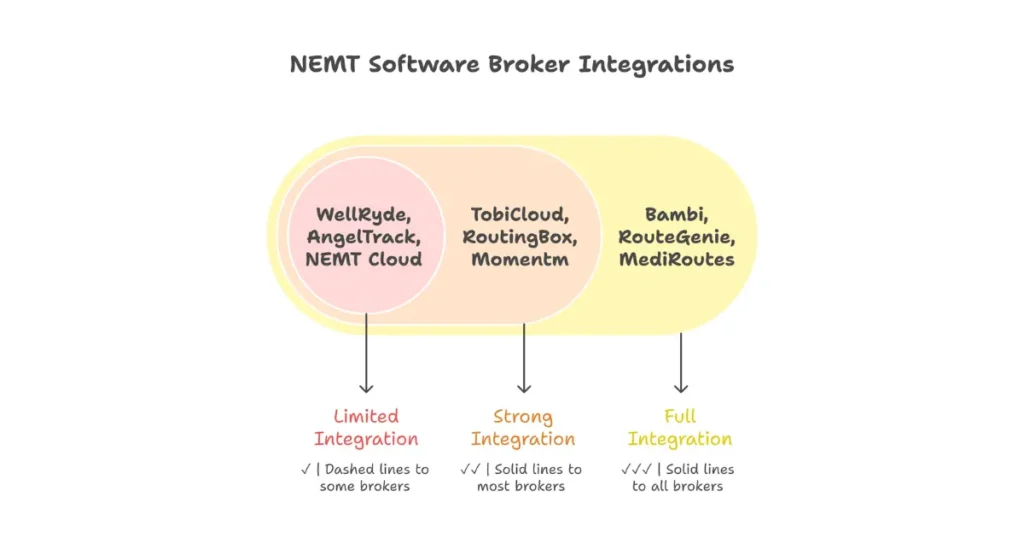
Broker Integration Matrix
| Platform | ModivCare | MTM/Veyo | Access2Care | State Medicaid | Lyft/Uber |
|---|---|---|---|---|---|
| TobiCloud | ✓ Full | ✓ Full | ✓ Veyo | ✓ EDI | ✗ |
| RouteGenie | ✓ Full | ✓ Full | ✓ Full | ✓ Direct | ✓ |
| NEMT Cloud | ✓ | ✓ | ✗ | ✓ | ✗ |
| Bambi | ✓ Full | ✓ Full | ✓ Full | ✓ Direct | Partial |
| MediRoutes | ✓ | ✓ | ✓ | ✓ Direct | ✓ |
| TripMaster | ✓ | Limited | ✓ Alivi | ✓ Templates | ✗ |
| RoutingBox | ✓ | ✓ | Partial | ✓ Direct | ✗ |
| WellRyde | ✓ Native | Limited | ✗ | Limited | ✗ |
| AngelTrack | Via clearinghouse | ✗ | ✗ | Via billing | ✗ |
| Momentm | ✓ Enterprise | ✓ | ✓ | ✓ | ✗ |
Best Software by Situation
| Your Situation | Best Platform | Why |
| New startup (budget) | Elite Route Dispatch | Lowest price + billing included — no separate billing system needed from Day 1 |
| Small fleet, billing focus | Elite Route Dispatch | Only platform where dispatch auto-generates claims. $125/mo all-in. |
| Small fleet, routing focus | RouteGenie | Strong route optimization, flat $50/vehicle, no trip fees |
| Growing fleet, automation | Bambi | Best AI dispatch and UX, reduces manual workload significantly |
| Multi-state, scaling 20+ | MediRoutes | Handles complex multi-payer billing scenarios |
| Data-driven growth | RoutingBox | Deepest analytics and KPI dashboards |
| Broker-heavy throughput | WellRyde | Purpose-built for broker workflows, strong ModivCare |
| Transit + NEMT mixed | TripMaster | Handles mixed fleet types, exceptional support |
| Enterprise 50+ vehicles | Momentm | Full automation, enterprise analytics and safety |
| EMS adding NEMT | AngelTrack | Built-in EMS/NEMT crossover, affordable flat pricing |
Winners by Category
| Category | Winner | Reason |
| Best Overall Value | Elite Route Dispatch | Dispatch + billing + EVV at $125/mo — nothing else comes close on price-to-feature ratio |
| Best AI & Automation | Bambi | Predictive routing, minimal manual work, best UX |
| Best for Billing | Elite Route Dispatch | Only platform with fully integrated claims management built by billing experts |
| Best Budget (Dispatch Only) | RouteGenie | Flat monthly, no hidden fees, solid routing |
| Best Large Fleet | MediRoutes | Multi-payer billing complexity at scale |
| Best Enterprise (50+) | Momentm | Enterprise SaaS, analytics, safety features |
| Best EMS/NEMT Hybrid | AngelTrack | Built-in crossover capability, low cost |
| Best Support | TripMaster | Exceptional support reputation across reviews |
Need a Professional NEMT Website?
We build NEMT websites that rank on search engines, accept patient bookings, and make your business look as professional as it is. SEO-optimized, mobile-ready, and HIPAA-aware.
How to Choose NEMT Software for Your Fleet Size
Best NEMT Software for Single-Vehicle Operators
Solo operators need three things: affordable pricing, reliable GPS verification, and billing capability. At $125/month, Elite Route Dispatch is the strongest option because it includes billing that would otherwise require a separate service or manual claims management. RouteGenie at $50/vehicle is the alternative for operators who already have billing handled separately. Our guide to becoming a NEMT provider covers the full setup process for new operators.
Best NEMT Software for 2-5 Vehicle Fleets
This is where Elite Route Dispatch’s pricing model shines brightest. Five vehicles with seven drivers costs $155/month total with every feature. Bambi would cost $345/month for the same fleet — without billing. The savings compound over 12 months into thousands of dollars that can be reinvested into fleet growth. For fleet planning, our NEMT business plan template includes software cost projections at every fleet size.
Best NEMT Software for 6-15 Vehicle Fleets
Mid-sized fleets need automation to keep up with trip volume. Bambi and Elite Route Dispatch both serve this segment well but for different reasons — Bambi excels at AI dispatch automation, while Elite Route Dispatch excels at billing integration. Operators whose primary pain is scheduling efficiency should lean toward Bambi. Operators whose primary pain is billing errors and denied claims should choose Elite Route Dispatch.
Best NEMT Software for 15+ Vehicle Operations
Large fleets require enterprise features — multi-location management, custom reporting, SLA guarantees, and dedicated account managers. MediRoutes and Momentm serve this market. Elite Route Dispatch offers custom pricing for 15+ vehicles with volume discounts but may not yet match the enterprise feature depth of platforms with 10+ years in the market. Our NEMT insurance guide covers the insurance requirements that scale with fleet size.
FAQ and Conclusion
Frequently Asked Questions
What is the best NEMT software overall?
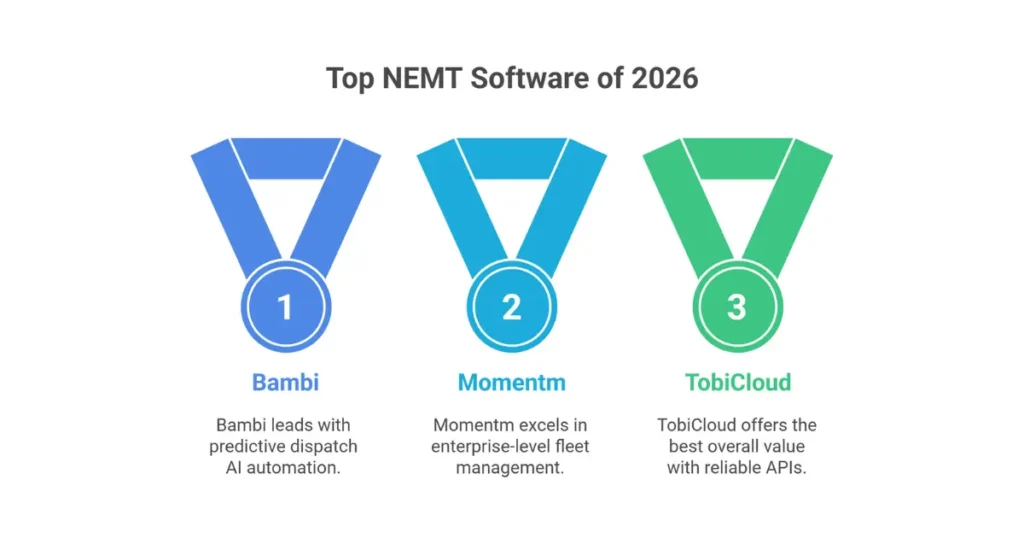
For most providers in 2026, Bambi offers the best combination of modern interface, AI-driven automation, broker integrations, and reasonable pricing. Its 4.7/5 user rating reflects genuine satisfaction. However, “best” depends on your situation—RouteGenie better serves budget-conscious startups, while Momentm addresses enterprise needs that Bambi can’t match.
How much does NEMT software cost?
Most fleets pay $50-$150 per vehicle monthly. A ten-vehicle operation typically spends $500-$1,500 monthly depending on platform and features. Enterprise operations negotiate lower per-vehicle rates but pay more overall. Budget 10-15% annual increases when projecting long-term costs.
Is there free NEMT software?
Free platforms exist but aren’t viable for Medicaid billing. Options like Office Ally lack GPS tracking, electronic signatures, broker APIs, and proper claim scrubbing—causing denial rates up to 80%. “Free” software costs far more in lost revenue than paid alternatives.
What’s the best NEMT software for small fleets?
RouteGenie offers the best value for 1-5 vehicle operations with flat $50/vehicle pricing, no trip fees, and essential broker integrations. NEMT Cloud Dispatch is a strong alternative for providers mixing Medicaid and private pay work.
Does NEMT software integrate with Medicaid billing?
Yes—leading platforms automate the entire Medicaid billing workflow. They apply HCPCS codes and modifiers, attach GPS verification, submit claims via EDI, and manage denials. TobiCloud and Bambi excel here for small-to-mid fleets; MediRoutes handles complex multi-payer scenarios.
How does RouteGenie compare to TobiCloud?
RouteGenie offers simpler pricing ($50/vehicle flat, no trip fees) and stronger route optimization. TobiCloud provides deeper billing features, better AR tracking, and a more polished driver app with offline capability. Choose RouteGenie for budget priority, TobiCloud for billing sophistication.
What features matter most in NEMT software?
Broker API integrations are non-negotiable—without direct connections to your actual brokers, you’ll waste hours on manual entry. GPS verification with 0.1-mile precision is required for Medicaid compliance. Claim scrubbing prevents denials. Driver apps with offline functionality ensure trips complete even with poor connectivity.
Can NEMT software reduce claim denials?
Absolutely. Providers typically see denial rates drop 15-40% immediately after proper implementation. Automated scrubbing, GPS timestamp attachments, eligibility verification, and driver workflow enforcement eliminate common errors. This often recovers $10,000-$50,000 annually per ten vehicles.
How long does NEMT software implementation take?
Most providers go live within 2-4 weeks. Week one covers setup and configuration, week two includes training, weeks three and four address broker certification and refinement. RouteGenie users often launch within 7-14 days. Enterprise platforms like Momentm or MediRoutes require 4-6 weeks.
Should I choose dispatch-only or all-in-one software?
All-in-one wins for Medicaid and broker work. Dispatch-only platforms require separate billing solutions, creating data handoff problems and additional costs. For private-pay-only operations, dispatch-only may suffice. For broker work, integrated billing is essential.
What is the best NEMT software overall?
For most providers in 2026, Elite Route Dispatch offers the best value — it is the only platform that includes dispatch, fleet management, billing and claims, EVV, reporting, and mobile access for $125/month. For operators who prioritize AI-driven dispatch automation over billing integration, Bambi remains the strongest option at $69/vehicle. MediRoutes addresses enterprise needs that smaller platforms cannot match. The right choice depends on whether your biggest pain is billing (Elite Route Dispatch), scheduling efficiency (Bambi), or multi-payer complexity (MediRoutes).
How much does NEMT software cost?
Full-featured NEMT software ranges from $125/month (Elite Route Dispatch with billing included) to $250+ per vehicle for enterprise platforms. Most fleets pay $50-$150 per vehicle monthly. A ten-vehicle operation typically spends $230-$1,500 monthly depending on platform and features. Free NEMT software exists but is not viable for Medicaid billing — denial rates using free tools reach 80%, making “free” extremely expensive in lost revenue. For state-specific reimbursement rates to calculate your ROI, see our Medicaid NEMT rates by state guide.
What software do NEMT companies use?
NEMT companies use specialized dispatch, scheduling, and billing platforms. The most popular platforms in 2026 include Elite Route Dispatch (best value with billing), Bambi (best AI automation), RouteGenie (best budget dispatch-only), MediRoutes (best enterprise), and TripMaster (best mixed fleet). The choice depends on fleet size, payer mix, and whether the operator needs integrated billing or handles billing separately.
Is there free NEMT software?
Free platforms exist but are not viable for Medicaid billing. Options like Office Ally offer basic functionality at no cost but lack GPS tracking, electronic signatures, broker API integrations, and proper claim scrubbing. Denial rates using free tools reach 80% for Medicaid trips — making free software cost far more in lost revenue than paid alternatives. Elite Route Dispatch at $125/month is the lowest-cost option that includes full billing capability.
What is the best NEMT software for small fleets?
For 1-5 vehicle fleets, Elite Route Dispatch at $125/month provides the best combination of features and affordability. It is the only platform at this price point that includes billing and claims management. RouteGenie at $50/vehicle offers simpler dispatch for operators who handle billing separately. For operators just starting their NEMT business, our how to start a NEMT business guide covers software selection timing and setup.
Does NEMT software integrate with Medicaid billing?
Yes — but the depth of integration varies dramatically. Most platforms export trip data that must be manually imported into a billing system. Elite Route Dispatch is the only platform that generates complete billing claims internally with HCPCS codes, modifiers, and pre-submission scrubbing. For operators who want expert billing management rather than self-service, EliteMed Financials NEMT billing services handles the entire claims process.
Can NEMT software reduce claim denials?
Providers typically see denial rates drop 15-40% immediately after proper implementation. Automated scrubbing, GPS timestamp verification, eligibility checks, and driver workflow enforcement eliminate common errors. Elite Route Dispatch reduces billing errors by up to 90% because claims are generated directly from dispatch data with no manual re-entry. This often recovers $10,000-$50,000 annually per ten vehicles.
Does NEMT software handle EVV compliance?
Most modern NEMT dispatch platforms include built-in EVV that captures GPS-verified trip start and end locations, timestamps, and driver identity as required by Medicaid under the 21st Century Cures Act. Before purchasing, verify your software meets your specific state’s EVV requirements — some states have approved EVV vendor lists that restrict which systems qualify. Non-compliant EVV can cause widespread claim denials. Our NEMT compliance guide covers state-specific requirements.
How long does NEMT software implementation take?
Most providers go live within 2-4 weeks. Elite Route Dispatch and RouteGenie users often launch within 24 hours to 14 days. Enterprise platforms like Momentm or MediRoutes require 4-6 weeks. Week one covers setup and configuration, week two includes training, and weeks three and four address broker certification and refinement.
Should I choose dispatch-only or all-in-one software?
All-in-one wins for Medicaid and broker work. Dispatch-only platforms require separate billing solutions, creating data handoff problems and additional costs. Elite Route Dispatch is the most affordable all-in-one option. For private-pay-only operations, dispatch-only may suffice. For anyone billing Medicaid, integrated billing is essential. If you are deciding whether to handle billing in-house or outsource, our NEMT billing outsourcing vs in-house comparison breaks down the costs.
Quick Answers: NEMT Software
What NEMT software has billing built in?
Elite Route Dispatch is the only NEMT cloud dispatch software with a fully integrated billing and claims management module. Completed trips automatically generate claims with correct HCPCS codes and modifiers, and claims are scrubbed for errors before submission. No other platform — including RouteGenie, Bambi, or TripMaster — offers billing as a built-in feature. MediRoutes offers billing as an add-on module for enterprise clients.
What is the cheapest NEMT dispatch software?
Elite Route Dispatch at $125 per month for up to 5 vehicles is the cheapest full-featured NEMT dispatch software in 2026. Additional drivers cost $15 per month each. The platform includes dispatch, fleet management, billing, EVV, reporting, and mobile access. NEMT Cloud Dispatch starts at $149.99 per month. AngelTrack offers flat pricing at $99-$299 per month but lacks billing integration.
What is the best NEMT software for a new business?
For new NEMT businesses, Elite Route Dispatch is the best choice because it combines dispatch and billing at $125 per month — eliminating the need to purchase and configure separate systems during the critical early months of operations. RouteGenie is the best dispatch-only alternative at $50 per vehicle. New operators should prioritize EVV compliance, billing capability, and ease of setup over advanced AI features they will not need at 1-5 vehicles.
How much should I budget for NEMT dispatch software?
Budget $125 to $200 per month for a full-featured NEMT dispatch software platform that includes billing. Elite Route Dispatch starts at $125 per month for up to 5 vehicles. Most competitors charge $300 to $500 per month for dispatch-only platforms without billing, meaning the actual cost of dispatch plus a separate billing solution can exceed $600 per month. Enterprise platforms for 50+ vehicles cost $5,000 or more monthly.
What software do NEMT providers use for ModivCare trips?
NEMT providers use dispatch software platforms like Elite Route Dispatch, RouteGenie, Bambi, and TripMaster to manage ModivCare trips. Elite Route Dispatch is the only option that includes built-in billing and claims management for ModivCare trip reimbursement starting at $125 per month. RouteGenie is a ModivCare Premier Partner with strong API integration.
Key Takeaways
Elite Route Dispatch leads for 2026 in overall value — it is the only platform combining dispatch, billing, EVV, and reporting at $125/month, making it the strongest option for small-to-mid-sized fleets that need billing integration without enterprise pricing
After analyzing twelve platforms across hundreds of user reviews and real-world implementations:
Bambi leads for 2026 in overall capability for growth-oriented fleets, with the best AI automation and user interface in the market.
Expect to invest $50-$150 per vehicle monthly for quality software. Lower costs typically mean missing features; higher costs don’t necessarily mean better results.
Free software isn’t viable for Medicaid billing. The denial costs exceed paid software expenses many times over.
Broker API integrations are non-negotiable. Manual trip entry wastes hours daily and creates errors.
ROI occurs within three to six months for providers who implement properly. Denial reduction alone often covers software costs.
When Software Isn’t Enough
Even excellent software won’t fix fundamental billing problems. If your denial rates exceed 15% despite good software, the issue likely involves:
- Credentialing gaps with brokers
- Documentation training failures with drivers
- Coding logic that doesn’t match payer requirements
- Appeal processes that aren’t being followed
Software automates correct processes. It can’t create correct processes from scratch.
For providers whose billing challenges run deeper than software selection, our NEMT billing services team handles everything from enrollment through collections.
Next Steps
- Identify your broker mix and confirm any platform you evaluate integrates directly with those specific brokers.
- Request demos from 2-3 platforms matching your fleet size. Test actual billing workflows, not just dispatch features.
- Calculate your current denial rate to establish a baseline. Compare against your rate after 90 days with new software.
- Plan for implementation time—rushing leads to configuration errors that undermine results.
For providers just starting NEMT operations, our how to start NEMT billing guide covers the complete setup process including optimal software implementation timing.
External Reference: EVV requirements under the 21st Century Cures Act are documented by CMS.gov — states track compliance through respective aggregator systems.
External Reference: HCPCS codes for NEMT services (A0120, A0130, T2001-T2005) are maintained in the official CMS HCPCS Level II code set.