What Are NEMT Vehicle Requirements?
NEMT vehicle requirements are the federal and state-mandated safety, accessibility, and equipment standards that vehicles must meet to legally transport Medicaid patients. All NEMT vehicles must comply with ADA standards (49 CFR §38), pass state safety inspections, carry proof of commercial insurance, and maintain required onboard safety equipment at all times.
Every year, an estimated 3.7 million Americans miss or delay medical appointments because they cannot get a ride. Non-emergency medical transportation bridges that gap. But before you can transport a single patient, your vehicles must meet strict NEMT vehicle requirements set by federal law, your state Medicaid program, and your broker network.
Get this wrong and you face failed inspections, suspended contracts, and lost revenue. Get it right and you build a compliant fleet that brokers trust, patients rely on, and regulators approve.
If you are just starting out, our guide on how to start a NEMT business covers the full launch roadmap. This article focuses specifically on your vehicles — the types you need, the federal ADA specs you must meet, the equipment every van must carry, how inspections work, age and mileage limits by state, and what to look for when buying new or used.
Here are the five areas this guide covers in full: vehicle types, ADA compliance, required equipment, inspection rules, and state-specific requirements.
Table of Contents
NEMT Vehicle Types and When to Use Each
Choosing the right vehicle for each trip type directly affects your reimbursement rates, broker contract bids, and operational efficiency. There are four main non emergency medical transportation vehicles categories, and each serves a different level of patient need.
Ambulatory Transport Vehicles
Ambulatory vehicles carry patients who walk independently. Sedans like the Toyota Camry and Honda Accord, standard SUVs, and non-converted minivans all qualify. These are your lowest-cost options and account for roughly 40 to 50 percent of all NEMT trips. They do not require ADA modifications, but they still need GPS, a first aid kit, fire extinguisher, and commercial insurance.
Wheelchair-Accessible Vans (WAV)
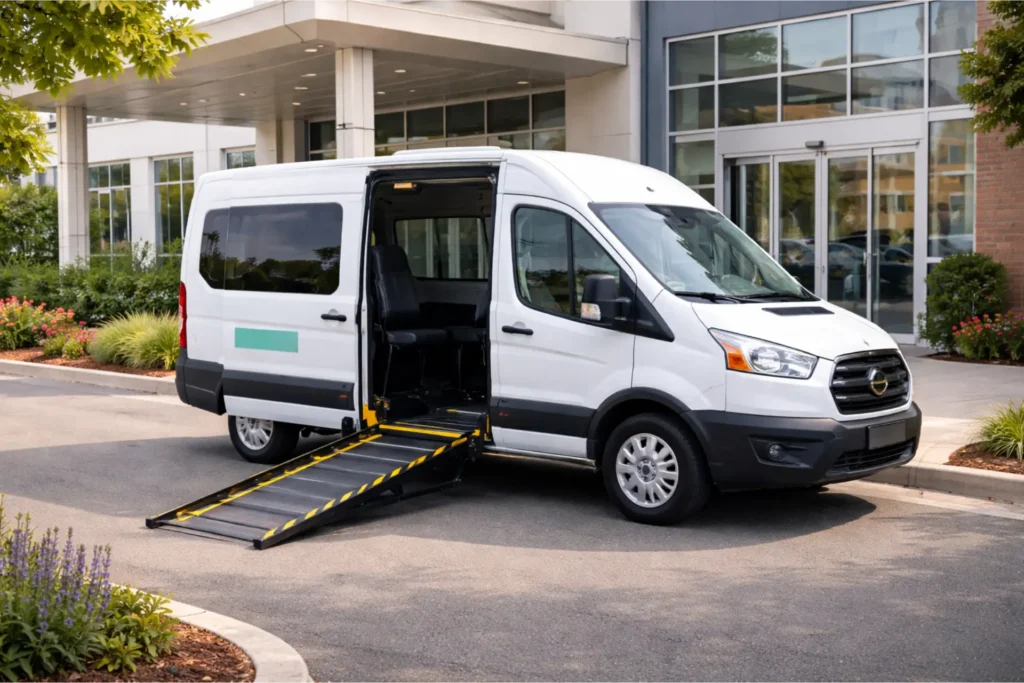
Wheelchair-accessible vans are the cornerstone of most NEMT fleets. They must be modified with a ramp or lift, four-point securement systems, and occupant restraints. The most popular models for NEMT operators in 2026 are listed below.
| Model | Entry Type | WAV Positions | GVWR | New Price (Converted) | Used Price |
|---|---|---|---|---|---|
| Ford Transit 350 High Roof | Rear or Side | 1 WC + 4–6 seats | 9,500 lbs | $60,000–$96,000 | $40,000–$70,000 |
| Ram ProMaster 2500 High Roof | Rear | 1 WC + 5–7 seats | 8,550–9,350 lbs | $55,000–$92,000 | $35,000–$65,000 |
| Toyota Sienna 2025 Hybrid | Rear | 1 WC + 4–6 seats | 6,170 lbs | $55,000–$88,000 | $40,000–$60,000 |
| Chrysler Pacifica WAV | Side or Rear | 1 WC + 5–7 seats | 6,500 lbs | $55,000–$98,000 | $40,000–$65,000 |
| Honda Odyssey WAV | Side | 1 WC + 4–6 seats | 6,000 lbs | $50,000–$70,000 | $35,000–$55,000 |
| Mercedes-Benz Sprinter | Rear | 1 WC + 5–8 seats | 9,000–12,000 lbs | $70,000–$115,000 | $50,000–$80,000 |
| Dodge Grand Caravan (Used) | Side | 1 WC + 4 seats | 6,050 lbs | Discontinued | $25,000–$45,000 |
Stretcher and Gurney Transport Vans
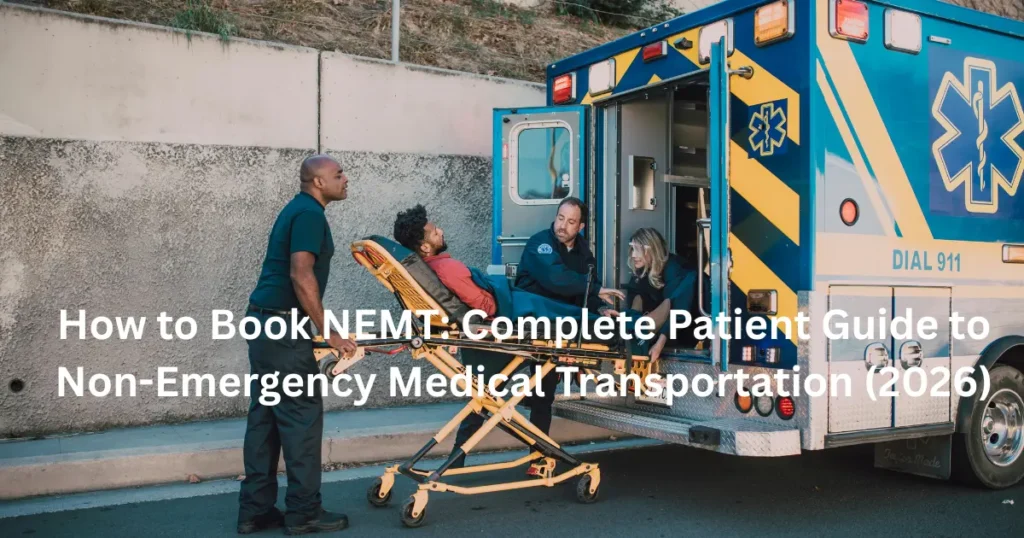
Stretcher vans transport medically stable patients who cannot sit upright. About 5 to 10 percent of NEMT orders require this level of service. Per Virginia DMAS and federal GSA specifications, stretchers must meet KKK-A-1822E standards — minimum 75 inches long and 22 inches wide — and be secured with crash-stable fasteners rated at 2,200 pounds. Two crew members are required: a driver and an attendant seated in the passenger compartment at all times.
Multi-Purpose and Bariatric Vehicles
Bariatric NEMT vehicles feature heavy-duty lifts rated at 800 to 1,600 pounds, reinforced flooring, and extra-wide gurneys. Cutaway vans and minibuses handle group transport to dialysis centers, senior facilities, and hospital discharge runs. Vehicles designed to carry 16 or more passengers including the driver require a Commercial Driver’s License (CDL).
| Vehicle Type | Best Patient Type | WC Capacity | Est. New Cost | Est. Used Cost |
|---|---|---|---|---|
| Ambulatory (Sedan/SUV) | Independent walkers | 0 | $25,000–$40,000 | $5,000–$20,000 |
| Minivan WAV (Sienna, Pacifica) | Single wheelchair user | 1 | $45,000–$90,000 | $25,000–$55,000 |
| Full-Size WAV (Transit, ProMaster) | Wheelchair + multi-passenger | 1 | $60,000–$115,000 | $35,000–$80,000 |
| Stretcher Van / Ambulette | Supine, non-ambulatory | 0 (gurney) | $70,000–$110,000 | $50,000–$80,000 |
| Bariatric / Cutaway Bus | Bariatric or group | 1–2+ | $80,000–$150,000+ | $60,000+ |
Federal ADA Requirements for NEMT Vehicles
ADA compliance is non-negotiable for any NEMT vehicle transporting wheelchair users. The ada requirements for nemt vehicles are governed by the Americans with Disabilities Act of 1990 and its 2008 amendments, with specific technical standards found in 49 CFR Part 38, Subparts A and B. For full compliance context, the ADA Title II regulations from ADA.gov provide the authoritative federal text.
ADA Title II and III — When They Apply
ADA Title II covers public entities — state Medicaid agencies, government brokers, and public transit authorities. Title III covers private NEMT providers operating as public accommodations. If you are a private company transporting the public, Title III applies to you regardless of how many employees you have. When a private company contracts with a Medicaid program, it must also satisfy Title II requirements enforced by the FTA Office of Civil Rights.
Wheelchair Lift Requirements
Per 49 CFR §38.23, wheelchair lifts must meet these exact specifications. Every item on this list is checked during broker credentialing inspections.
| Feature | Federal Standard | Source |
|---|---|---|
| Lift design load (capacity) | Minimum 600 lbs | 49 CFR §38.23(b)(1) |
| Lift safety factor | 6:1 minimum for working parts | 49 CFR §38.23(b)(1) |
| Platform minimum width | 30 inches (measured 2–30 in above platform) | 49 CFR §38.23(b)(3) |
| Platform minimum length | 48 inches | 49 CFR §38.23(b)(3) |
| Surface projections | No bumps exceeding 1/4 inch | 49 CFR §38.23(b)(4) |
| Roll-stop barrier height | Minimum 1.5 inches | 49 CFR §38.23(b)(5) |
| Ramp slope (maximum) | 1:4 (varies by floor height) | 49 CFR §38.23(c) |
| Ramp clear width | Minimum 30 inches | 49 CFR §38.23(c)(1) |
| Ramp raised edges | Minimum 2 inches | 49 CFR §38.23(c)(2) |
| Door height clearance | Minimum 56 inches (vehicles ≤22 ft) | 49 CFR §38.25 |
| Stepwell/doorway lighting | Minimum 2 foot-candles (21.5 lumens) | 49 CFR §38.31 |
| Crash test standard (WTORS) | 30 mph / 20g frontal impact | WC18/RESNA |
Ramp Requirements
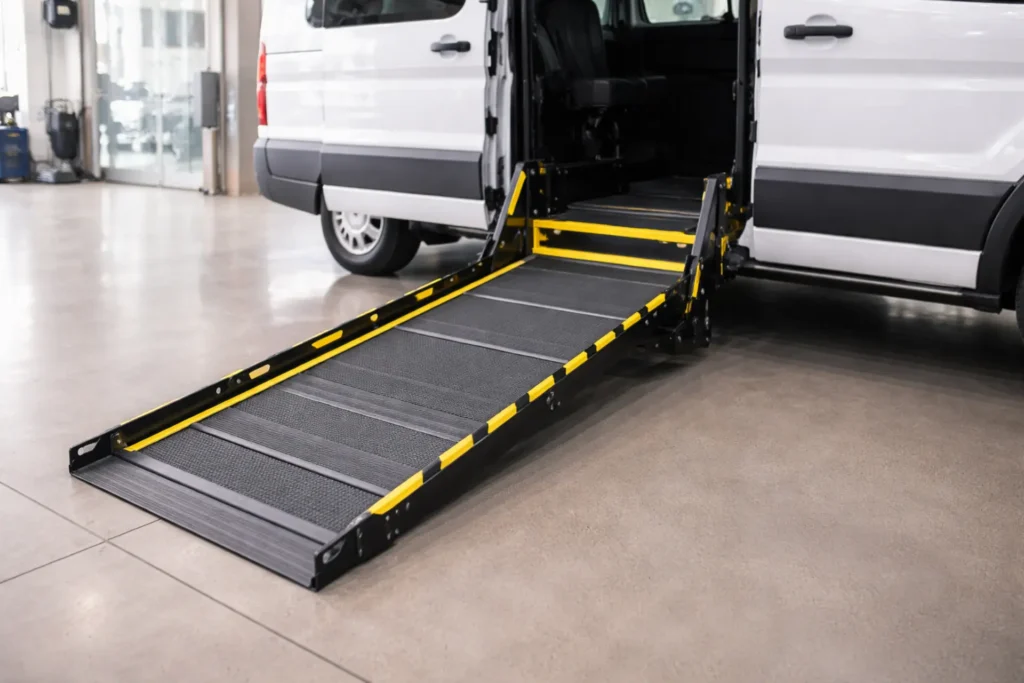
Ramps must have a maximum slope of 1:4 and a minimum clear width of 30 inches. All ramp surfaces must be slip-resistant with no bumps exceeding 1/4 inch in height. Raised edges of at least 2 inches protect against wheels rolling off the sides. The ramp must also support a minimum load of 600 pounds — the same as the lift requirement.
Wheelchair Securement System Requirements
The wheelchair van requirements for NEMT go beyond just the ramp and lift. Each wheelchair position requires a four-point tie-down system certified to WC18 standards — these test to a 30 mph, 20g frontal impact. Additionally, each position must have a separate lap belt and shoulder harness for the passenger. Per Virginia DMAS, each wheelchair van must have four fully functional securements per wheelchair station, and the interlock system must prevent vehicle movement while the lift is deployed.
WC19 wheelchairs are designed specifically for motor vehicle transport with four crash-tested securement points. WC20 ensures the seating system cushions stay attached during a crash. When purchasing WAVs, confirm the securement systems are WC18-certified hardware.
ADA Accessibility Checklist
- ✅ Lift minimum 600 lbs capacity with 6:1 safety factor
- ✅ Platform at least 30 × 48 inches
- ✅ Handrails on both sides of lift platform
- ✅ Roll-stop barrier at least 1.5 inches high
- ✅ Ramp slope not exceeding 1:4
- ✅ Ramp width at least 30 inches, slip-resistant surface
- ✅ Door height at least 56 inches (vehicles under 22 feet)
- ✅ Contrasting color bands (2-inch) on step edges and lift platform
- ✅ Minimum 2 foot-candles at stepwell and lift area
- ✅ Four-point WC18 tiedown per wheelchair position
- ✅ Separate lap belt and shoulder harness per wheelchair passenger
- ✅ Clear floor space of 30 × 48 inches per wheelchair position
- ✅ Interlock system prevents vehicle movement while lift is deployed
- ✅ Manual backup system for lift operation
Required Vehicle Equipment for NEMT Operations
Beyond ADA accessibility features, every NEMT vehicle must carry specific onboard safety equipment. The Virginia DMAS requirements (last updated March 5, 2021) represent the most detailed federal-model standard used across the country and serve as the benchmark for nemt vehicle equipment compliance.
Safety and Medical Equipment
Every NEMT vehicle must carry a fully stocked first aid kit with all items unexpired. Per Virginia DMAS, the required contents are: adhesive bandages in three sizes, antiseptic cleansing wipes, dressing pads, oval eye pad, conforming gauze bandage, triangular bandage, triple antibiotic ointment, insect sting relief pads, a cold pack, cotton-tip applicators, latex gloves, scissors, and sterile eyewash.
In addition to the first aid kit, each vehicle must have a Class A, B, C fire extinguisher secured within easy reach of the driver, a spill kit containing liquid absorbent, latex gloves, hazardous waste disposal bags, a scrub brush, disinfectant, and deodorizer. A seat belt cutter must be within easy reach of the driver for emergency egress. At minimum, carry three reflective triangles for roadside emergencies.
Communication and Navigation Equipment
NEMT vehicles must have a functioning GPS device or current paper maps covering all jurisdictions served with enough detail to locate patients, facilities, and medical providers. A two-way communication device — a cellular phone or radio — must be operational. Many brokers including ModivCare and Transdev now require dispatch integration through platforms such as RouteGenie or similar NEMT software for real-time GPS tracking and electronic trip verification. For a full comparison of software options, see our guide on the best NEMT software for 2026.
Documentation and Signage Requirements
Every vehicle must carry a vehicle information packet containing current vehicle registration, an insurance card, and the contractor’s accident and incident procedures and forms. If the vehicle is leased, include the lease agreement.
Two mandatory signs must be displayed visibly inside every vehicle: a NO SMOKING sign (including vapor and e-cigarettes) and an ALL PASSENGERS WILL USE SEAT BELTS sign. The exterior must show the business name and phone number in permanently affixed letters at least three inches high in a color that contrasts with the background — on both sides of the vehicle. Per HIPAA requirements, you cannot display the word “Medicaid” or “FAMIS” anywhere on the vehicle or inspection stickers.
Passenger Comfort and Safety Equipment
HVAC systems must maintain air conditioning to 68°F and heating to 74°F, both measured at the rear of the vehicle. Newer vehicles with longer lap and shoulder belts must carry at least one seat belt extension. Older vehicles with shorter factory belts must carry two extensions. Child safety seats approved to FMVSS 213 standards are required when transporting children through age seven.
NEMT Vehicle Inspection Requirements
Passing a nemt vehicle inspection is a condition of enrollment with every Medicaid broker and state program. There are three levels of inspection: daily pre-trip checks, periodic state-mandated inspections, and broker credentialing inspections.

Daily Vehicle Inspection Checklist
Ohio Administrative Code OAC 5123-9-18 (Revised January 2022) establishes the national model for daily NEMT inspections. This checklist applies to all modified vehicles and vehicles equipped to transport five or more passengers. Drivers must complete and sign this daily before the first trip.
- All lights working — headlights, taillights, brake lights, turn signals, hazard flashers
- Windshield free of cracks, clear of snow or debris
- Windshield washers and wipers operational with fluid
- Mirrors clean, properly adjusted, and securely attached — no cracks
- Horn functional
- Tires — adequate tread depth, properly inflated, no visible damage
- Brakes — proper operation, no unusual pulling or noise
- First aid kit — present, stocked with unexpired items
- Two-way communication device — functional, charged
- Fire extinguisher — present, charged, current inspection tag, secured
- Secure storage — no unsecured items or debris in passenger compartment
Additional daily checks recommended by brokers: wheelchair lift cycle test (run it once to confirm smooth operation), securement strap condition, seat belt functionality, HVAC test, dashboard warning lights, and vehicle cleanliness.
NEMT Daily Vehicle Inspection Checklist
A complete pre-trip inspection checklist based on Ohio OAC 5123-9-18 and Virginia DMAS standards. One clean page — print and use daily.
What’s included in this checklist
PDF · 1 page · Letter / A4 · No email required · Instant download
Semi-Annual and Annual Inspection Requirements
Virginia DMAS requires all NEMT vehicles to be inspected before entering service and re-inspected semi-annually. WAVs and stretcher vans must be inspected twice annually — once every six months minimum. The broker conducts these in-person, visual inspections and applies a three-type sticker: passed, provisionally passed, or failed. The sticker goes on the outside of the passenger-side rear window in the lower right corner and must show the license plate number and VIN in permanent ink.
Most states combine this broker inspection with an annual state DMV safety inspection. New York requires semi-annual NYS DOT inspections for ambulettes. Texas requires annual DPS safety inspections. California requires annual VSSI at BAR-certified stations plus CHP BIT inspections for vehicles over 10,000 lbs GVWR.
Common Inspection Failure Points
- Lift or ramp malfunction — inoperative, jerky movement, interlock failure
- Expired or missing fire extinguisher
- Missing or expired first aid kit contents
- Torn, stained, or damaged upholstery
- Business name decals missing or smaller than 3 inches
- Expired insurance card in vehicle packet
- Unsecured items creating projectile hazards
- Missing passenger compartment interior mirror
- Non-functional wheelchair securement ratchets or frayed straps
- Seat belts stored on the floor rather than off the floor
Record-Keeping Requirements
Virginia DMAS requires all inspection records to be maintained in an electronic database format. For Medicare and Medicaid audits, inspection records must be retained for seven years. Brokers require monthly vehicle inspection reports to verify fleet compliance. Any vehicle removed from service for failed inspection must have deficiencies documented in its permanent record. For a complete walkthrough of NEMT compliance requirements, our NEMT compliance guide covers every aspect in detail.
Vehicle Age and Mileage Restrictions for NEMT
Age and mileage limits are hard stops for broker enrollment — not suggestions. Once a vehicle hits its limit, most brokers automatically deactivate it from the network portal. Check your specific state and broker requirements before purchasing any vehicle.
State-by-State Age Limits
| State | Maximum Age | Authority | Notes |
|---|---|---|---|
| Florida | 8 years | AHCA / MediDrive | Under 5 years preferred for new providers |
| Texas | 7–10 years | HHSC / TxDOT | New enrollment cap; 250K miles preferred |
| California | 10–15 years | DHCS / Medi-Cal | WAV extensions available for low mileage |
| New York | 10 years | NYSDOH / MAS | TLC dual-plating required in NYC |
| Virginia | 12 years | DMAS | 250,000 miles cap; semi-annual inspections |
| Illinois | 10 years (WAV: 12) | HFS | WAV exception for wheelchair vans |
| Ohio | 15 years | ODM / OSHP | OAC 5123-9-18 daily inspections required |
| Pennsylvania | 10 years | PennDOT | Semi-annual inspections required |
Broker Network Requirements
Major NEMT brokers enforce their own age limits independently of state rules. MTM Inc. triggers automatic portal deactivation at 10 years with 250,000 to 300,000 miles as the mileage threshold. ModivCare requires vehicles to be under eight years old when joining the network and enforces a hard exit at 10 years — vehicles over 200,000 miles face additional scrutiny. Transdev in Colorado requires vehicles 10 years or newer. Rural frontier counties may qualify for age waivers if the provider can pass enhanced quarterly inspections.
When to Replace vs. Repair
Replace your vehicle when any of these apply: broker age cap reached, mileage over 200,000 to 250,000, annual repair costs exceed 30 percent of vehicle value, hydraulic lift failures repeat, insurance premiums increase by more than 20 percent, or the vehicle fails credentialing inspection a second time. The optimal fleet strategy is to replace at seven to eight years, before the vehicle becomes un-brokerable, to capture maximum resale value. For a full cost breakdown, see our guide on NEMT insurance costs and how vehicle age affects your premiums.
Buying Your First NEMT Vehicle — New vs. Used Guide
Your vehicle is your largest startup expense. Making the wrong choice can cost you tens of thousands in repairs, failed inspections, or broker rejection. Here is what every new operator must know before signing any purchase agreement.
What NEMT Vehicles Cost in 2026
| Vehicle Category | New Price Range | Used Price Range | ADA Modification Cost |
|---|---|---|---|
| Ambulatory (Sedan/SUV) | $25,000–$40,000 | $5,000–$20,000 | N/A |
| Minivan WAV (Sienna, Pacifica) | $45,000–$90,000 | $25,000–$55,000 | Included in conversion |
| Full-Size WAV (Transit, ProMaster) | $60,000–$115,000 | $35,000–$80,000 | Included in conversion |
| Stretcher Van / Ambulette | $70,000–$110,000 | $50,000–$80,000 | Included in conversion |
| ADA Mod to Standard Van | — | — | $20,000–$35,000 |
When budgeting for nemt vehicles for sale in the used market, remember that a four-to-five year old Toyota Sienna or Ford Transit WAV in the $32,000 to $42,000 range gives you five to six years of compliant service before hitting broker age limits — making it one of the best value-per-service-year options for new operators. For a complete financial picture, review our resource on NEMT business plan templates which includes vehicle budgeting worksheets.
New vs. Used Comparison
| Factor | New Vehicle | Used Vehicle |
|---|---|---|
| Upfront Cost | Higher ($45K–$115K) | Lower ($25K–$55K WAV) |
| Warranty | Full OEM + upfitter coverage | Often expired; verify before buying |
| Broker Compliance | Guaranteed for 8–10 years | Verify age against broker limits first |
| Maintenance Risk | Low in first 3–4 years | Higher; especially for lift systems |
| Depreciation | Steep first-year drop | Slower curve on used market |
| Financing | Specialty mobility lenders available | Higher interest on older vehicles |
| Best For | Established operators expanding fleet | New operators controlling startup costs |
What to Check When Buying Used
- Confirm vehicle age is under your target broker’s maximum before anything else
- Check mileage — under 150,000 miles is ideal, 200,000 is the typical broker ceiling
- Run a vehicle history report for accident damage, flood history, and title issues
- Cycle the lift at least five times — hydraulic hesitation or unusual noise means walk away
- Verify NMEDA QAP-certified upfitter performed the conversion
- Inspect the lowered floor pan for rust — this is a structural issue and an automatic broker fail
- Confirm all four securement anchor points are functional and WC18 certified
- Check that the vehicle still has a valid state safety inspection sticker
Buy from NMEDA-certified mobility dealers like AMS Vans or MobilityWorks whenever possible. These dealers recognize the value of both the chassis and the conversion — unlike traditional banks — which means better financing terms and no surprise warranty gaps.
NEMT Vehicle Modification Requirements
Not every van on the lot is ready for NEMT duty. When you modify a vehicle for wheelchair access, both the work and the person doing it must meet specific standards — or your broker will not approve the vehicle.
Who Can Legally Install Wheelchair Equipment
Only NMEDA QAP (Quality Assurance Program) certified upfitters should perform NEMT conversions. NMEDA QAP requires annual third-party audits, NMEDA-certified technicians on staff, and crash-tested conversion components. The NTEA (Work Truck Association) governs the multi-stage manufacturing process, ensuring that added weight from lifts and structural modifications does not exceed GVWR limits. OEM-approved programs — Ford QVM, Ram Upfitter, and Mercedes-Benz Van Upfitter Network — preserve the factory warranty when you use a certified modifier. Non-QAP conversions risk full warranty denial on lift failures and may be rejected outright during broker credentialing.
Cost of ADA Modifications
| Modification Type | Cost Range | Certified Installer |
|---|---|---|
| Manual/automatic ramp installation | $8,000–$15,000 | NMEDA QAP upfitter |
| Hydraulic lift installation | $10,000–$20,000 | BraunAbility, Bruno, NMEDA dealer |
| Full WAV conversion (vehicle + lift) | $20,000–$50,000 | VMI, MobilityWorks, OEM program |
| Lowered floor conversion | $10,000–$20,000 | Structural NMEDA upfitter |
| High-roof conversion | $5,000–$10,000 | Commercial upfitter (NTEA compliant) |
| Four-point securement system | $1,000–$3,000 per position | NMEDA technician |
After any modification, the upfitter must provide documentation including the lift manufacturer name, model, serial number, and stated capacity. Per Virginia DMAS requirements, this documentation must be tracked in an electronic database and made available to your broker during inspections. For guidance on protecting your business financially, review our complete NEMT vehicle insurance requirements guide covering all coverage types and state minimums.
State-Specific NEMT Vehicle Requirements
Federal standards set the floor. States build on top. Here is what operators in the five most-searched states need to know. Always verify current requirements directly with your state Medicaid agency and broker before purchasing vehicles, because these rules change frequently.
Texas NEMT Vehicle Requirements
Texas HHSC requires commercial insurance of $300,000 to $1,000,000, ADA wheelchair securements, GPS in all vehicles, first aid kit, fire extinguisher, and annual DPS safety inspections. TxDOT requires motor carrier authority (MC number) for interstate operations. STAR+PLUS managed care adds stretcher van attendant requirements. New providers must have vehicles under 10 years old, with 250,000 miles as the preferred maximum.
California NEMT Vehicle Requirements
California Medi-Cal requires a CPUC Public Transportation Permit (TCP number) before any vehicle can operate. DHCS sets ADA vehicle standards aligned with federal law. Vehicles over 10,000 lbs GVWR face CHP BIT inspections in addition to annual VSSI at BAR-certified stations. AVL telematics and a drug and alcohol testing program are mandatory. Vehicle age limits run 10 to 15 years, with extensions available for low-mileage WAVs. California Title 13 emissions standards also apply, and zero-emission fleet goals are being phased in for paratransit operators.
Florida NEMT Vehicle Requirements
Florida AHCA caps vehicle age at 8 years, with forward-thinking fleets under 5 years preferred for new provider enrollment. Hydraulic lifts must have a minimum 600-pound capacity. Ramps must maintain a 1:12 slope ratio with 30-inch minimum width. Vehicles over 22 feet require dual securement locations and dual boarding mechanisms. Annual FLHSMV inspections are required. Most Florida counties — including Broward, Miami-Dade, and Hernando — require a Certificate of Public Convenience and Necessity (COPCN) before vehicle credentialing, which requires a public hearing for fleet expansion.
New York NEMT Vehicle Requirements
New York NYSDOH requires ambulette certification through DMV Form MV-45. The MAS broker enforces strict documentation including lift certification records and 7-year record retention. Semi-annual NYS DOT inspections are mandatory. Child safety seats are required through age 8. In New York City, ambulettes must be dual-plated to satisfy both TLC and Medicaid requirements — most guides miss this critical detail. Vehicle age limit for MAS approval is 10 years.
Virginia (DMAS) Vehicle Requirements
Virginia DMAS is the most detailed state model in the country and the benchmark used throughout this guide. Key requirements: semi-annual inspections for all vehicles (twice annually for WAVs and stretcher vans), 49 CFR §38 Subparts A and B ADA compliance, business name and phone in 3-inch minimum letters on both exterior sides, inspection sticker on passenger-side rear window lower right corner, AC to 68°F and heat to 74°F measured at the rear, GPS plus paper backup maps, two-way communication, and no “Medicaid” or “FAMIS” labeling per HIPAA.
Other states to note: Louisiana (LDH) requires broker coordination with ModivCare and a minimum of 20 service days per month. Minnesota requires STS certification from MnDOT with specific decal placement and attendant training beyond federal minimums. Colorado had an enrollment moratorium through March 31, 2026 — existing providers can revalidate but new applicants face delays. For complete state-by-state Medicaid reimbursement rates, see our Medicaid NEMT rates by state guide.
Frequently Asked Questions About NEMT Vehicle Requirements
What kind of vehicles are used for NEMT?
NEMT fleets use sedans and SUVs for ambulatory patients, minivan WAVs like the Toyota Sienna and Chrysler Pacifica for single wheelchair trips, full-size WAVs like the Ford Transit and Ram ProMaster for high-capacity routes, and stretcher vans for patients who cannot sit upright. All wheelchair-accessible vehicles must be ADA-compliant with certified lifts, ramps, and four-point securement systems.
Do NEMT vehicles need to be ADA-compliant?
Yes. Under ADA Title II and Title III and 49 CFR Part 38, any vehicle transporting wheelchair users must have a lift or ramp with a minimum 600-pound capacity, minimum 56-inch door height, four-point WC18 tiedown systems, and separate lap and shoulder belts per passenger. Even private NEMT operators are subject to ADA through state Medicaid contracts, regardless of company size.
How much does a NEMT vehicle cost?
New wheelchair-accessible vans cost $45,000 to $115,000 depending on the model and conversion. Used WAVs range from $25,000 to $55,000. New ambulatory sedans and SUVs run $25,000 to $40,000, with used options available from $5,000 to $20,000. ADA modifications added to a standard van cost $20,000 to $35,000 on average when performed by a NMEDA-certified upfitter.
How old can a NEMT vehicle be?
Age limits vary by state and broker. Florida caps vehicles at 8 years. MTM and ModivCare enforce a 10-year maximum with automatic portal deactivation. Virginia allows 12 years under DMAS. Ohio permits up to 15 years. Mileage limits typically range from 200,000 to 300,000 miles. Always verify with your specific state Medicaid program and broker before purchasing.
What equipment is required in a NEMT vehicle?
Required equipment includes: a fully stocked first aid kit with 13 specific items, a Class A-B-C fire extinguisher secured near the driver, a spill kit, seat belt cutter, GPS or current maps, two-way communication device, seat belt extensions, HVAC maintaining 68°F AC and 74°F heat, NO SMOKING and SEAT BELT REQUIRED signs, vehicle information packet with registration and insurance, and interior passenger monitoring mirror.
How often must NEMT vehicles be inspected?
Daily pre-trip inspections are required in most states before the first trip each day. Virginia mandates semi-annual broker inspections for all vehicles — twice annually for WAVs and stretcher vans. Most states require annual state safety inspections through the DMV or DOT. Broker-led credentialing inspections occur before enrollment and may include unannounced spot checks. Records must be retained for 7 years for Medicaid audits.
Questions People Ask About NEMT Vehicle Requirements
Direct answers to common questions — formatted for clear comprehension.
What are the minimum requirements for a NEMT vehicle?
At minimum, a NEMT vehicle must pass state safety inspection, carry proof of commercial insurance, have a functioning first aid kit and fire extinguisher, and for wheelchair transport, meet ADA accessibility standards under 49 CFR Part 38 including a 600-pound capacity lift or ramp and four-point wheelchair securements.
What makes a van ADA compliant for medical transport?
An ADA-compliant medical transport van must have a wheelchair lift with at least 600 pounds of capacity and a platform measuring at least 30 × 48 inches, a door height of at least 56 inches, a ramp with maximum 1:4 slope and 30-inch minimum width, four-point WC18 tiedown systems, and separate lap and shoulder belts for each wheelchair passenger. Lighting at stepwells must meet 2 foot-candles minimum.
What is the difference between a WAV and an ambulette?
A WAV — wheelchair accessible vehicle — is designed to transport passengers who use wheelchairs. An ambulette is equipped for supine transport, carrying patients on a gurney or stretcher who cannot sit upright. Ambulette transport requires a crash-tested gurney meeting GSA KKK-A-1822E specifications, rated securements at 2,200 pounds, and two crew members in the vehicle at all times.
Can I start a NEMT business with a used van?
Yes. A used Ford Transit or Toyota Sienna WAV in the four to five year range with under 80,000 miles, a current inspection sticker, and an NMEDA-certified conversion is a viable and cost-effective starting point. Before purchasing, confirm the vehicle meets your target broker’s age and mileage limits and that it will pass initial credentialing inspection.
What happens if my NEMT vehicle fails inspection?
A failed inspection requires immediate removal from service. The broker places a failed sticker on the vehicle and suspends trip assignments until a passing re-inspection is documented. Deficiencies are permanently logged in the vehicle’s record. Repeated failures risk contract suspension or provider decertification, resulting in loss of all trip revenue from that broker.
Do I need a CDL to drive a NEMT van?
Most NEMT operators driving vehicles designed for 7 to 15 passengers do not need a CDL. A CDL becomes mandatory when a vehicle is designed to transport 16 or more passengers including the driver. However, if the vehicle’s GVWR exceeds 10,001 pounds, a USDOT number is required even without a CDL requirement.
How does vehicle type affect NEMT reimbursement rates?
Vehicle type directly determines your level-of-service billing code and reimbursement rate. Ambulatory trips typically reimburse $25 to $45 per trip. Wheelchair transport trips average $45 to $70. Stretcher transport is the highest-reimbursing category at $125 to $250 per trip with potential bariatric surcharges of $50 to $100 additional. Understanding these rates is covered fully in our complete NEMT billing guide.
What is the 30-60-90 rule for NEMT vehicle maintenance?
The 30-60-90 rule refers to preventive maintenance windows at 30,000, 60,000, and 90,000 miles. At 30,000 miles, critical safety systems need inspection. At 60,000 miles, transmission fluid and timing components require attention. At 90,000 miles, wheelchair lift hydraulics typically need a full overhaul to pass broker audits and prevent mid-route failures.