
Look, I get it. You have been researching non-emergency medical transportation for weeks now. Maybe months. You see the opportunity clearly: an aging population that needs rides to dialysis, seniors who cannot drive themselves to doctor appointments, and a healthcare system that desperately needs reliable patient transport.
But every time you sit down to actually write your NEMT business plan, you hit a wall. Where do you even start? What numbers make sense? How do you structure something that will actually get you funded?
Here is the thing most guides will not tell you: the difference between NEMT businesses that thrive and those that fold within two years almost always comes down to planning. Not just any planning, but the right kind of planning that accounts for the unique challenges of medical transportation.
I have spent years working with NEMT operators, from single-van startups to multi-state operations. I have seen what works. More importantly, I have seen what fails. And the patterns are remarkably consistent. According to recent NEMT industry statistics, the market is projected to reach $15 billion by 2026, growing at nearly 9% annually. That is a massive opportunity, but only for operators who prepare properly.
This guide gives you everything: a complete NEMT business plan template you can download and customize, section-by-section instructions, real financial projections based on 2026 data, and answers to the 35+ questions I hear most often from new operators.
Let us build something that actually works.
Table of Contents
What Is a NEMT Business Plan and Why Is It Essential for Success?
A NEMT business plan is your strategic roadmap. It documents exactly how you will launch, operate, and grow a non-emergency medical transportation company. But calling it just a document undersells what it actually does.
Think of it as three things at once: a planning tool that forces you to think through every operational detail, a communication device that explains your business to lenders and partners, and a management guide you will reference constantly during your first two years.
Why NEMT Specifically Needs a Specialized Plan
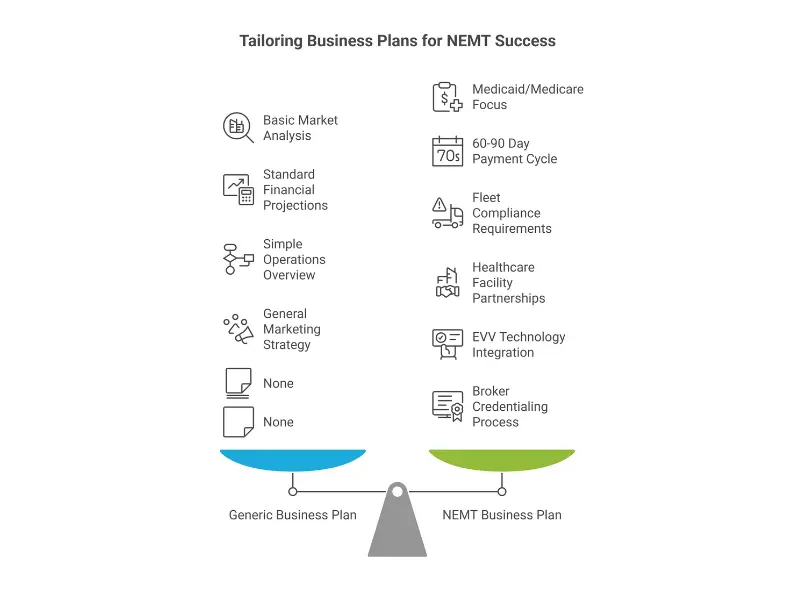
You cannot use a generic transportation business plan template. Medical transportation operates under completely different rules. You are dealing with HIPAA regulations, ADA vehicle requirements, EVV compliance, Medicaid reimbursement cycles, and broker credentialing requirements. A general business plan misses all of this.
Here is a reality check: I have reviewed plans from operators who thought they could adapt a taxi company template. They missed compliance requirements that cost them their Medicaid enrollment. They underestimated insurance costs by 40%. They had no idea that reimbursements take 60-90 days, leading to cash flow crises in month three.
NEMT Business Plan vs. General Transportation Plan
| Component | NEMT Business Plan | General Transport Plan |
| Regulatory Focus | ADA, HIPAA, DOT, EVV, State Medicaid Rules | Basic DOT and local permits |
| Revenue Model | Payer mix (Medicaid, Medicare Advantage, Private) | Direct customer payment |
| Cash Flow Planning | 60-90 day reimbursement lag built in | Immediate or short-term payment |
| Fleet Requirements | ADA-compliant WAVs, stretcher vans, securement systems | Standard commercial vehicles |
| Compliance Costs | EVV software, HIPAA training, specialized insurance | Basic business insurance |
| Market Analysis | Dialysis centers, senior population, Medicaid enrollment | General demographic data |
The specialized elements in a NEMT plan are not optional. They determine whether you get approved for Medicaid contracts, whether brokers credential you, and whether lenders take you seriously.
Four Reasons Your NEMT Business Will Fail Without a Proper Plan
Let me be direct about what happens without thorough planning:
First, funding becomes nearly impossible. Banks and SBA lenders require a formal business plan. No plan means no loan. Period. Even angel investors want to see that you understand the industry before they write a check.
Second, you will underestimate costs. The average NEMT startup needs $150,000 to $250,000 to launch properly with 3 vehicles. Most first-time operators guess around $80,000. That gap bankrupts businesses.
Third, compliance violations will catch up with you. Operating without proper EVV systems, missing HIPAA requirements, or using non-ADA vehicles leads to denied claims, terminated contracts, and potential lawsuits.
Fourth, you will chase the wrong customers. Without customer analysis, operators often target low-volume, high-effort segments instead of focusing on recurring revenue sources like dialysis transport.
NEMT Business Plan Template: The 12 Essential Sections You Must Include
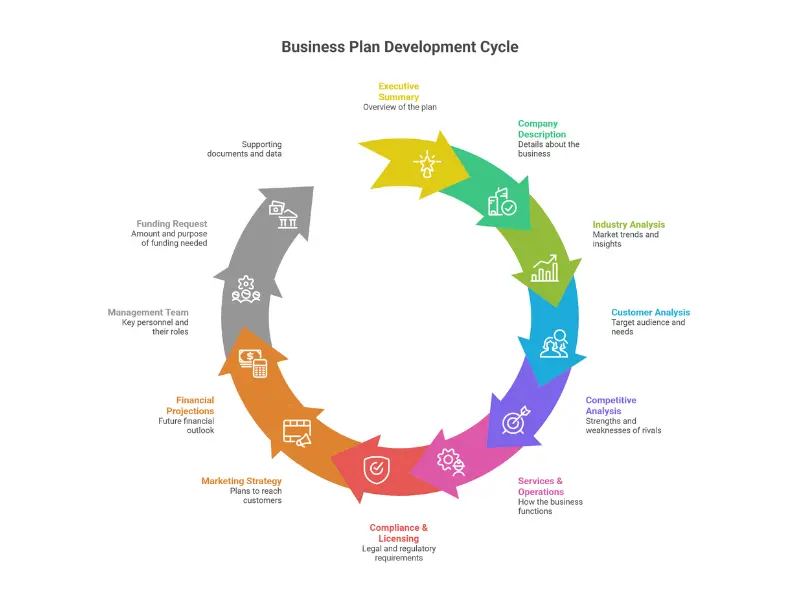
Every fundable NEMT business plan contains the same core sections. Skip any of them, and lenders will notice. Here is the structure that actually works:
| Section | What It Covers | Length |
| 1. Executive Summary | Business overview, funding request, key financials | 1-2 pages |
| 2. Company Description | Legal structure, mission, vision, ownership | 1-2 pages |
| 3. Industry Analysis | Market size, growth trends, competitive landscape | 2-3 pages |
| 4. Customer Analysis | Patient segments, payer mix, facility partnerships | 2-3 pages |
| 5. Competitive Analysis | Direct competitors, market positioning, advantages | 1-2 pages |
| 6. Services & Operations | Service types, fleet plan, daily workflow, technology | 3-4 pages |
| 7. Compliance & Licensing | State/federal requirements, insurance, credentialing | 2-3 pages |
| 8. Marketing Strategy | B2B outreach, broker relations, digital presence | 2-3 pages |
| 9. Financial Projections | Startup costs, revenue, expenses, 5-year forecast | 4-6 pages |
| 10. Management Team | Key personnel, org structure, advisory board | 1-2 pages |
| 11. Funding Request | Amount needed, use of funds, repayment plan | 1-2 pages |
| 12. Appendix | Licenses, contracts, resumes, market research | As needed |
A complete plan typically runs 25-40 pages. That might sound like a lot, but remember: this document needs to convince someone to give you $200,000 or more. Every page earns its place.
Customizing for Your Specific Model
Not every NEMT business looks the same. Your plan should reflect your actual model:
If you are focusing on dialysis transport, your customer analysis should detail the number of dialysis centers in your area, average patient census, and the recurring revenue per patient (around $12,000 annually for wheelchair transport).
If you are targeting Medicare Advantage plans, you need to address the Medicare Advantage NEMT benefits structure and how you will credential with specific plans in your market.
If you are building a private-pay focused business, your marketing section becomes more important than broker credentialing, and your pricing strategy needs to justify premium rates.
How to Write a NEMT Business Plan Executive Summary That Gets Funded
Your executive summary is the most important two pages you will write. Loan officers and investors often decide within the first 90 seconds whether to keep reading. Make those seconds count.
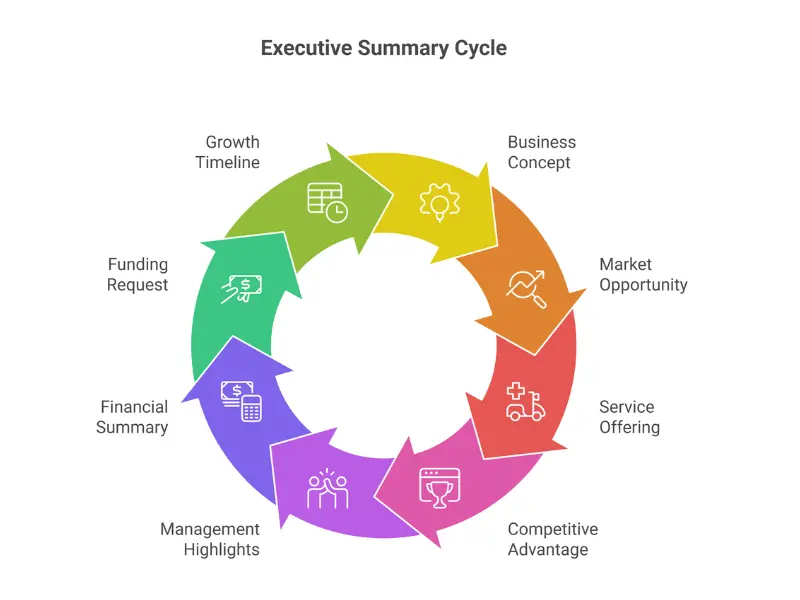
The 8 Essential Elements
Every executive summary that gets funded includes these components:
1. Business Concept: What you do, in one sentence. Example: ‘MedRide Transport provides ADA-compliant wheelchair and ambulatory transportation for Medicaid and private-pay patients in Jefferson County.’
2. Problem Statement: The gap you fill. Example: ‘Over 3.6 million Americans miss medical appointments annually due to transportation barriers, leading to $150 billion in preventable healthcare costs.’
3. Your Solution: How you solve it differently. Example: ‘We provide door-through-door service with PASS-certified drivers, 98% on-time performance, and real-time family notifications.’
4. Target Market: Who you serve. Example: ‘Our primary market includes 4,200 dialysis patients, 12,000 Medicaid beneficiaries, and 3 regional hospital systems within our 25-mile service radius.’
5. Competitive Advantage: Why you win. Example: ‘Unlike local competitors using aging fleets, we deploy 2024+ ADA-compliant vans with integrated EVV, achieving the lowest complaint rate in our broker network.’
6. Financial Highlights: Key numbers only. Example: ‘We project $420,000 in Year 1 revenue, reaching profitability by Month 11. Year 3 revenue of $1.2 million with 22% net margin.’
7. Funding Request: Exactly what you need. Example: ‘We are seeking a $185,000 SBA 7(a) loan for vehicle acquisition ($120,000), working capital ($50,000), and technology/licensing ($15,000).’
8. Team Overview: Why you can execute. Example: ‘Our founder previously managed a 25-vehicle commercial fleet. Our operations advisor is a former Modivcare regional director.’
What Makes Lenders Keep Reading
Lenders have seen hundreds of business plans. They are looking for red flags that suggest you do not understand the industry:
They want to see specific local market data, not generic industry statistics. Saying the NEMT market is $15 billion means nothing. Saying there are 14 dialysis centers within 20 miles of your location with an estimated 2,100 patients requiring 327,600 annual trips shows you have done actual research.
They want realistic financials. If your projections show profitability in Month 2, they know you have never operated an NEMT business. Experienced operators know that Medicaid reimbursement delays alone make quick profitability impossible.
They want proof of industry knowledge. Mentioning EVV requirements, broker KPIs, and the difference between ambulatory and wheelchair transport signals that you understand what you are getting into.
NEMT Company Description and Legal Structure: Setting Up for Success
Your company description establishes who you are and how you are structured. This section matters more than most people realize because it affects everything from liability protection to tax treatment to your ability to bid on certain contracts.
Choosing the Right Legal Structure
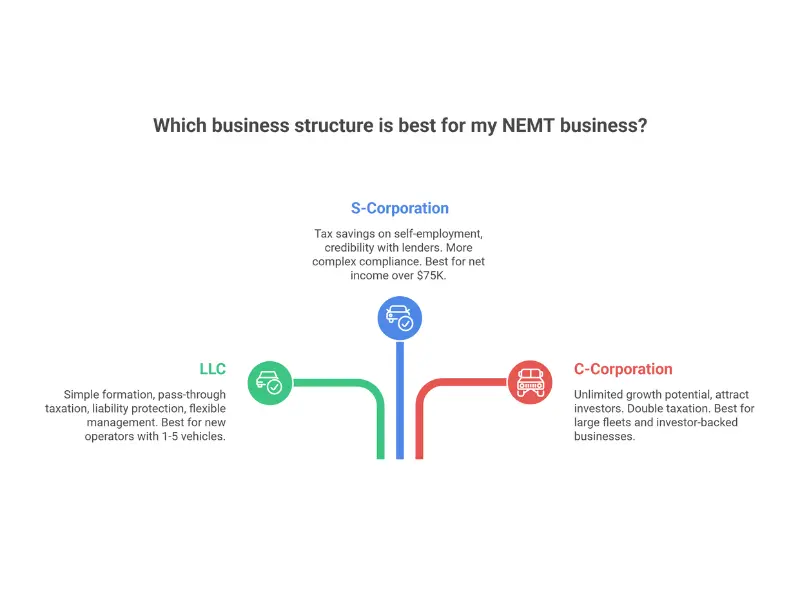
Most NEMT startups should form as an LLC. Here is why, and when other structures make sense:
| Structure | Liability Protection | Tax Treatment | Best For | Annual Cost |
| Sole Proprietorship | None | Personal return | Never recommended | $0-100 |
| LLC | Full protection | Pass-through | Most startups | $100-800 |
| LLC with S-Corp Election | Full protection | Salary + distributions | Profitable businesses ($80K+ net) | $500-2,000 |
| C-Corp | Full protection | Double taxation | Seeking outside investors | $1,000-3,000 |
Let me be clear about sole proprietorship: in NEMT, this structure is dangerous. You are transporting vulnerable patients in vehicles. One accident without proper liability protection could cost you your house, your savings, everything. The $200 annual cost of an LLC is the cheapest insurance you will ever buy.
Writing Your Mission and Vision
Your mission statement should explain why you exist in one or two sentences. Skip the corporate jargon. Write something your grandmother would understand.
Good example: ‘We provide safe, reliable medical transportation so patients never miss appointments that matter.’
Bad example: ‘We leverage synergistic healthcare logistics solutions to optimize patient transportation outcomes across diverse demographic segments.’
Your vision statement describes where you want to be in 5-10 years. Make it ambitious but achievable.
Good example: ‘To become the most trusted NEMT provider in the tri-state region, known for reliability and compassionate service.’
NEMT Industry Analysis: Understanding the $15 Billion Market Opportunity
Understanding the broader NEMT industry helps you position your business and makes your plan more credible to investors. Let me walk you through what the current industry statistics actually mean for your startup.
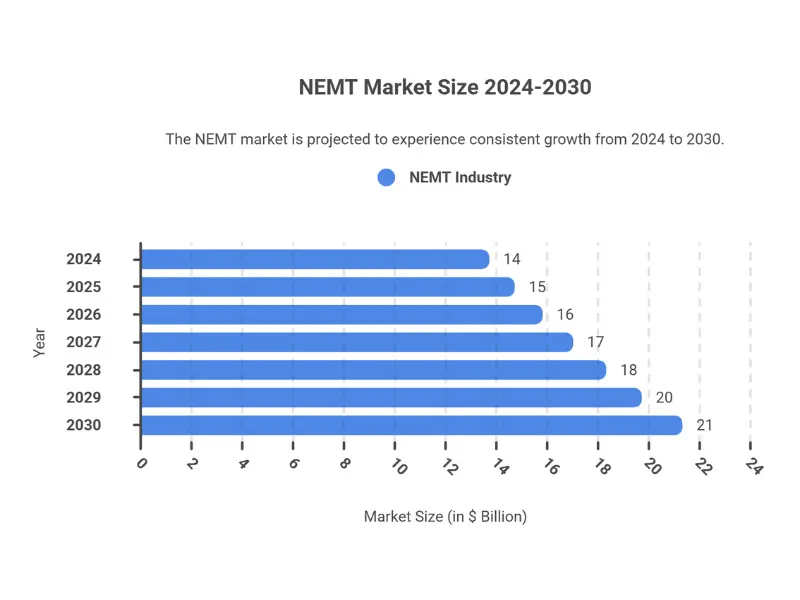
Market Size and Growth Projections
| Year | US Market Size | Growth Rate | Key Driver |
| 2024 | $13.8 billion | Baseline | Post-pandemic recovery |
| 2025 | $14.6 billion | 5.8% | Medicaid expansion |
| 2026 | $15.8 billion | 8.2% | Medicare Advantage growth |
| 2027 | $17.1 billion | 8.2% | Aging population surge |
| 2030 | $21.4 billion | 7.9% CAGR | Value-based care adoption |
Why the Market Is Growing
Four major forces are driving NEMT growth, and understanding them helps you position your business:
The Aging Population: Every day, 11,400 Americans turn 65. By 2030, one in five Americans will be over 65. Seniors book 3.2 times more medical appointments than younger adults, and many cannot drive themselves.
Chronic Disease Management: Dialysis alone requires 550,000+ patients to travel three times weekly for treatment. That is 85 million annual trips just for kidney care. Add cancer treatment, cardiac rehab, and physical therapy, and you have massive recurring demand.
Medicare Advantage Expansion: Over 50% of Medicare Advantage plans now offer transportation benefits. This creates a new revenue stream beyond traditional Medicaid, often with better reimbursement rates.
Value-Based Care: Hospitals and health plans now face financial penalties for high readmission rates. Missed appointments lead to worse outcomes and more hospitalizations. They are increasingly willing to pay for reliable transportation that keeps patients in care.
SWOT Analysis for Your Market Entry
A honest SWOT analysis shows investors you understand both opportunities and challenges:
Strengths: Modern ADA-compliant fleet, EVV-enabled operations, local market knowledge, experienced management team, focus on underserved patient populations.
Weaknesses: New entrant without established broker relationships, limited initial fleet capacity, no track record with local facilities, cash flow constraints during ramp-up period.
Opportunities: Medicare Advantage transportation benefit expansion, competitor fleet aging, hospital discharge coordination programs, rural area underservice, specialized transport niches.
Threats: Medicaid rate freezes, fuel cost volatility, driver shortage, increasing insurance costs, rideshare health services entering market, broker consolidation reducing provider options.
Customer Analysis: Identifying Your NEMT Target Market
Your customer analysis section proves you know exactly who will pay for your services. In NEMT, this is complicated because you have two types of customers: the patients who ride and the payers who pay.
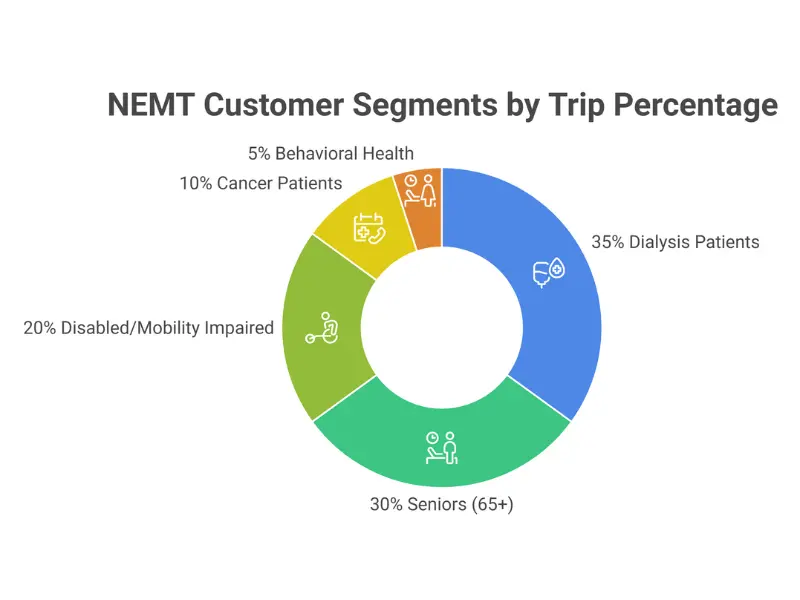
Primary Patient Segments
| Segment | US Population | Trips/Year | Revenue/Patient | Primary Payer | Service Type |
| Dialysis Patients | 550,000 | 156 | $7,800-12,500 | Medicaid/Medicare | Wheelchair |
| Seniors (65+) | 58 million | 12-24 | $600-1,800 | Medicare Advantage | Mixed |
| Disabled Adults | 26 million | 24-52 | $1,200-4,000 | Medicaid | Wheelchair |
| Cancer Patients | 1.9 million new/year | 20-40 | $1,000-3,000 | Insurance Mix | Mixed |
| Behavioral Health | Growing segment | 12-52 | $600-2,500 | Medicaid | Ambulatory |
Notice how dialysis patients stand out. A single dialysis patient can generate $12,500 annually in transport revenue. That same patient needs rides 156 times per year, creating predictable, recurring revenue. This is why successful NEMT operators often focus on dialysis transportation billing as a core service.
Payer Mix Analysis
Understanding who pays and how much matters more than who rides. Your revenue depends entirely on your payer mix:
| Payer Type | Rate per Trip | Volume Share | Payment Speed | Key Requirements |
| Medicaid (via Broker) | $20-60 | 60-70% | 60-90 days | EVV, PCS, Broker KPIs |
| Medicare Advantage | $40-80 | 15-25% | 30-45 days | Plan credentialing |
| Private Pay | $80-150 | 5-15% | Immediate | None |
| Facility Contracts | Negotiated | 5-15% | Net 30 | Service agreement |
| VA/TRICARE | $45-70 | 2-5% | 30-60 days | Military credentialing |
The payment speed column explains why cash flow planning is critical. Your biggest payer, Medicaid, takes 2-3 months to pay. Check your state’s specific Medicaid NEMT rates to build accurate projections.
Competitive Analysis: How to Outperform Other NEMT Providers
Every market has competition. Your job is to understand who you are competing against and articulate why you will win.
Types of Competitors
In NEMT, you face several competitor categories:
Direct NEMT Providers: Other wheelchair and stretcher transport companies in your area. These are your primary competitors for broker contracts and facility partnerships.
Large Broker Networks: Companies like Modivcare and MTM control most Medicaid volume. You are not competing against them; you are trying to become a preferred provider within their networks.
Rideshare Health Services: Uber Health and Lyft Healthcare compete for ambulatory, lower-acuity trips. They cannot handle wheelchair or stretcher transport, which is your advantage.
Taxi and Paratransit: Older services with less focus on healthcare compliance. Often your weakest competition because they lack ADA vehicles and EVV capability.
Competitive Analysis Framework
| Factor | Your Company | Local Indie A | Local Indie B | Uber Health | Taxi Company |
| Wheelchair Vans | 3 new WAVs | 5 aging WAVs | 2 WAVs | Partner network | None |
| EVV Compliance | Full integration | Basic | Yes | Limited | No |
| Driver Training | PASS + HIPAA | Basic | PASS only | Varies | None |
| On-Time Rate | Target 98% | Est. 85% | Est. 90% | 95%+ | Unknown |
| Stretcher Service | Planned Y2 | Yes | No | No | No |
Building Your Competitive Advantage
Your competitive advantage must be specific and defensible. Generic claims like ‘excellent service’ mean nothing. Strong competitive advantages in NEMT include:
Fleet Quality: ‘We operate the newest fleet in the county, with an average vehicle age under 2 years, compared to the industry average of 7+ years.’
Technology Integration: ‘Our dispatch platform provides real-time GPS tracking, automated EVV capture, and family notification, reducing complaint rates by 40% compared to competitors.’
Niche Specialization: ‘We are the only provider in the region offering 24/7 stretcher transport, addressing a critical gap identified by local emergency departments.’
Performance Guarantees: ‘We guarantee 98% on-time performance with financial penalties for missed commitments, giving facilities confidence in our reliability.’
Services and Operations Plan: The Backbone of Your NEMT Business
Your operations plan is where theory becomes reality. This section explains exactly how you will deliver transportation services every day.
Defining Your Service Levels
| Service Type | Description | Base Rate | Mileage Rate | Vehicle Required |
| Ambulatory | Patient walks independently or with minimal assist | $35-55 | $1.50-2.50/mi | Sedan or minivan |
| Wheelchair | Patient remains in wheelchair during transport | $50-75 | $2.50-4.00/mi | ADA-compliant WAV |
| Stretcher | Patient transported lying flat, requires attendant | $100-175 | $4.00-6.00/mi | Stretcher van + 2 crew |
| Bariatric | Patient over 350 lbs requiring specialized equipment | $125-200 | $4.50-6.50/mi | Bariatric-rated WAV |
Fleet Planning
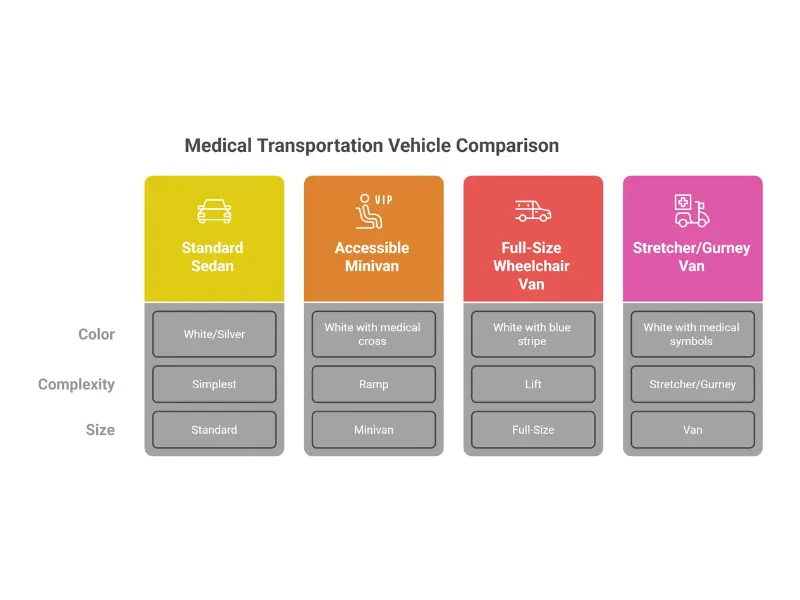
Your fleet is your largest capital expense and determines what services you can offer:
| Vehicle Type | New Cost | Used Cost (3-5yr) | Capacity | Best For |
| Minivan (Ambulatory) | $35-45K | $18-25K | 3-5 passengers | Doctor visits, therapy |
| Wheelchair Van (WAV) | $55-80K | $30-50K | 2-3 wheelchairs | Dialysis, regular transport |
| Large WAV | $75-100K | $45-65K | 4+ wheelchairs | Facility contracts |
| Stretcher Van | $90-130K | $55-85K | 1-2 stretchers | Discharge, inter-facility |
For most startups, I recommend beginning with 2-3 wheelchair vans. This configuration lets you serve the highest-demand segment (dialysis, seniors, disabled) while keeping startup costs manageable. You can add ambulatory vehicles and stretcher vans as you grow.
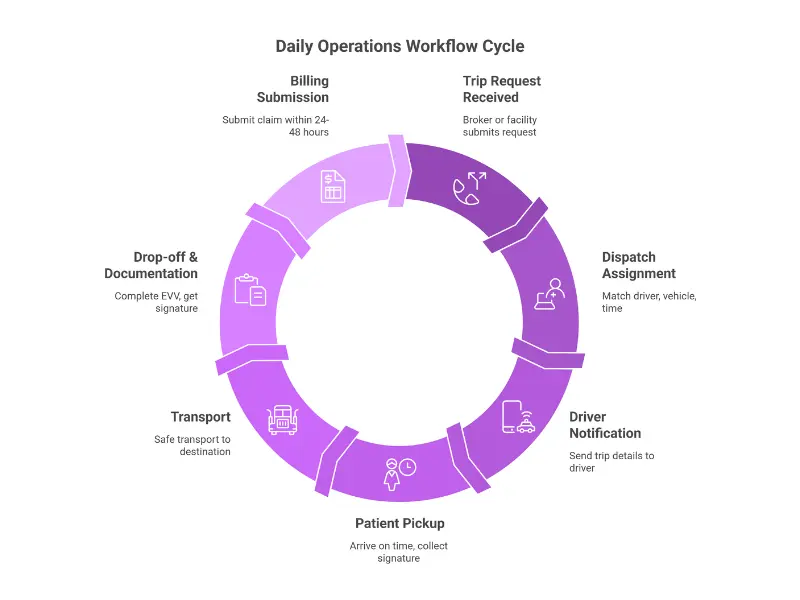
Daily Operations Workflow
Map out exactly how a trip flows through your operation:
Step 1 – Trip Request: Received via broker portal, facility call, or online booking. Capture patient name, pickup/dropoff addresses, appointment time, mobility needs, and any special requirements.
Step 2 – Verification: Confirm patient eligibility, verify Physician Certification Statement (PCS) for Medicaid trips, check for prior authorization requirements.
Step 3 – Scheduling: Input trip into dispatch software. Optimize routes to minimize deadhead miles. Assign appropriate vehicle and driver based on patient needs.
Step 4 – Dispatch: Send trip details to driver via mobile app. Confirm driver acknowledgment. Monitor real-time GPS for on-time arrival.
Step 5 – Execution: Driver arrives, assists patient, secures wheelchair/stretcher, transports safely, assists at destination. Complete EVV check-in and check-out.
Step 6 – Documentation: Trip log completed with times, mileage, signatures. Any incidents documented. Patient satisfaction confirmed.
Step 7 – Billing: Trip data synced to billing system. Claim generated with appropriate codes. Submitted to broker or payer.
Technology Requirements
Running a modern NEMT operation requires integrated technology. The best NEMT software solutions include:
Dispatch & Routing Software: This is your operational brain. Solutions like RouteGenie, TOBI Cloud, or TripMaster handle scheduling, route optimization, and driver assignment.
EVV (Electronic Visit Verification): Federally mandated for Medicaid. Captures GPS location, timestamps, and digital signatures. Often integrated with dispatch software.
GPS Telematics: Real-time vehicle tracking, driver behavior monitoring, and fleet management. Solutions like Samsara or Geotab.
Billing Software: Generates claims in EDI 837P format, tracks accounts receivable, manages denials. Critical for cash flow management.
NEMT Compliance and Licensing: Everything You Must Include
Compliance is not optional in NEMT. Miss something here, and you risk denied claims, terminated contracts, or worse. This section draws heavily from the complete NEMT compliance guide.
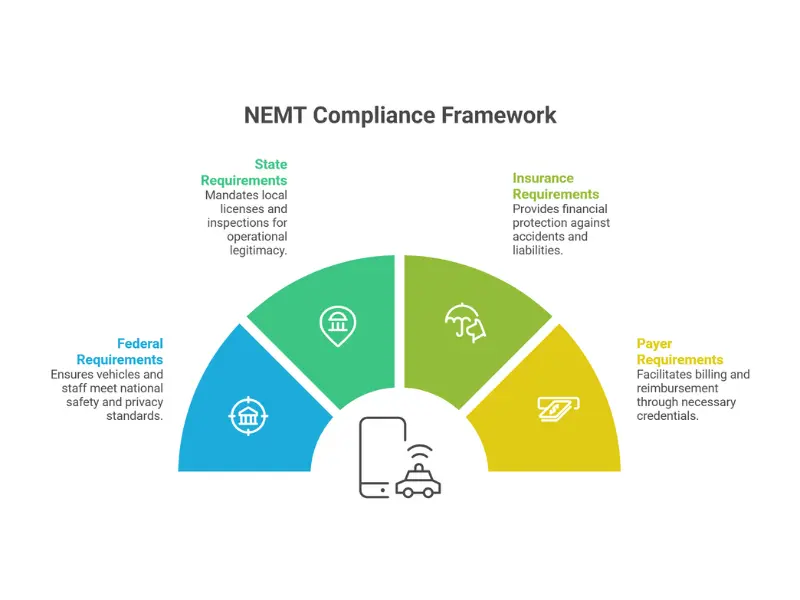
Federal Requirements
ADA Compliance: All wheelchair-accessible vehicles must meet specific standards: ramp slope not exceeding 1:4, minimum 30×48 inch floor space for wheelchairs, proper securement systems. Drivers must be trained in ADA etiquette and assistance.
HIPAA Compliance: You handle Protected Health Information. That means privacy policies, driver training on confidentiality, secure document handling, and Business Associate Agreements with software vendors.
DOT/FMCSA Regulations: If your vehicles exceed 10,001 lbs GVWR or you do interstate trips, stricter commercial driver rules apply. All commercial vehicles need proper maintenance records and driver qualification files.
EVV Requirements: The 21st Century Cures Act mandates Electronic Visit Verification for Medicaid personal care and NEMT services. You must capture service date, start/end times, type of service, location, and provider identity.
Insurance Requirements
| Coverage Type | Minimum Amount | Notes |
| Commercial Auto Liability | $1M CSL | Per vehicle. Many brokers require $1.5M or higher. |
| General Liability | $1M per occurrence | $2M aggregate. Covers non-vehicle incidents. |
| Workers Compensation | State minimum | Required if you have W-2 employees. |
| Professional Liability | $500K-1M | Covers negligence in patient care/assistance. |
| Umbrella/Excess | $1M-5M | Strongly recommended for additional protection. |
Insurance costs for a 3-vehicle NEMT startup typically run $18,000-30,000 annually. Higher-risk factors (new drivers, stretcher service, previous claims) increase premiums.
Medicaid Provider Enrollment
Becoming a Medicaid transportation provider involves multiple steps:
First, register with your state’s Medicaid agency. Each state has different requirements and timelines. California, Texas, Florida, and New York are particularly complex.
Second, obtain your National Provider Identifier (NPI). This is your unique healthcare provider number used for all billing.
Third, complete state-specific applications. Many states require proof of insurance, vehicle inspections, driver background checks, and operational policies.
Fourth, undergo credentialing with the Medicaid broker in your state (usually Modivcare or MTM). They have their own requirements beyond state minimums.
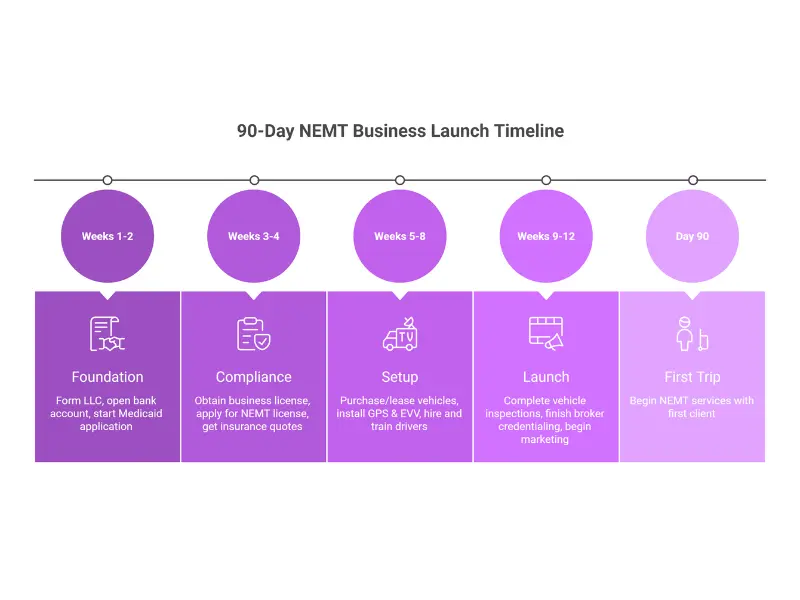
The entire process typically takes 90-180 days. Start immediately. Many operators wait until they have vehicles to begin enrollment, then sit idle for months waiting for approval.
NEMT Marketing Strategy: How to Win Healthcare Partnerships
NEMT marketing looks nothing like consumer marketing. You are not running Instagram ads or putting up billboards. This is B2B relationship marketing where personal connections drive volume.
B2B Healthcare Marketing
Your primary marketing channels involve direct outreach to healthcare decision-makers:
Hospital Discharge Planners: These professionals arrange transportation for patients leaving the hospital. They need reliable partners who answer the phone and show up on time. A single hospital relationship can generate 100+ monthly trips.
Dialysis Center Social Workers: Each dialysis center serves 100-300 patients, many needing transport three times weekly. Building relationships here creates massive recurring revenue.
Skilled Nursing Facility Directors: SNFs need daily transport for residents going to appointments. Contracts can guarantee steady volume.
Clinic Office Managers: Physician offices often coordinate transport for patients, especially those with chronic conditions requiring regular visits.
Broker Relationship Development
Since brokers control 70%+ of Medicaid NEMT volume, developing these relationships is critical. Review the broker billing guide for specific strategies.
Credentialing is just the starting point. To become a preferred provider, you need consistent performance:
On-time performance above 95% (target 98%)
Complaint rate below 1%
Clean claims rate above 98%
Responsive communication with broker support
Capacity to handle last-minute and overflow trips
Digital Presence
While B2B relationships drive most volume, you still need a professional digital presence. NEMT website development should focus on:
Clear service descriptions with pricing transparency
Local SEO optimization for ‘[city] medical transportation’ searches
Online booking capability for private-pay clients
Google Business Profile with service area and reviews
Testimonials from facility partners
NEMT Financial Projections: Startup Costs, Revenue, and Profitability
This is the section investors scrutinize most carefully. Your numbers must be realistic, detailed, and defensible.
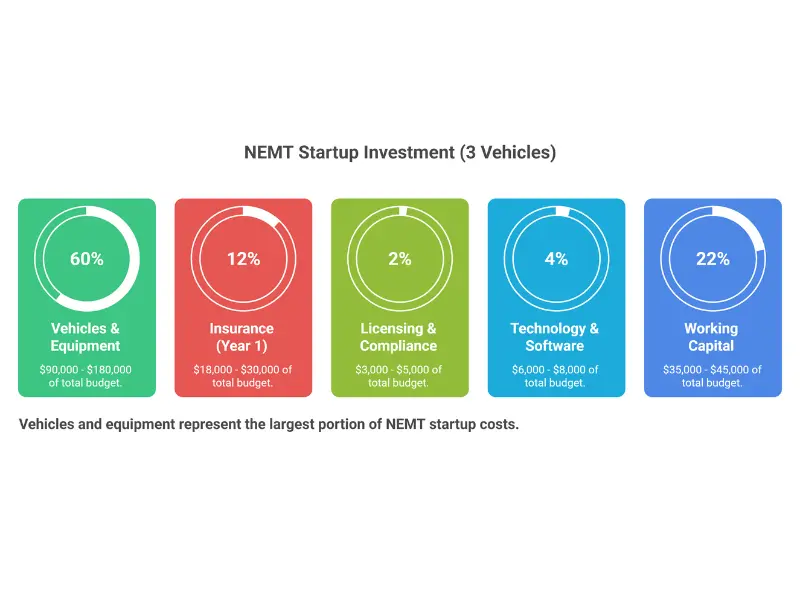
Startup Costs Breakdown
| Category | Low Estimate | High Estimate | Notes |
| Vehicles (3 WAVs, used) | $90,000 | $150,000 | Largest expense |
| Vehicle Modifications/Signage | $3,000 | $8,000 | ADA compliance |
| Insurance (First Year) | $18,000 | $30,000 | Required before launch |
| Licensing & Permits | $2,000 | $6,000 | State dependent |
| Technology Setup | $3,000 | $8,000 | Dispatch, EVV, tablets |
| Office/Legal/Accounting | $4,000 | $10,000 | LLC, CPA, consultant |
| Initial Marketing | $2,000 | $6,000 | Website, materials |
| Working Capital (6 months) | $30,000 | $50,000 | CRITICAL buffer |
| TOTAL | $152,000 | $268,000 |
That working capital line is not optional. Medicaid takes 60-90 days to pay. You need cash to cover payroll, fuel, and maintenance before revenue starts flowing. Under-capitalization is the number one killer of new NEMT businesses.
Monthly Operating Expenses
| Expense Category | Monthly Cost | Notes |
| Driver Wages (3-4 FTE) | $12,000-18,000 | Includes payroll taxes and benefits |
| Vehicle Payments/Lease | $2,500-3,500 | If financed; $0 if purchased outright |
| Fuel | $2,000-3,500 | Based on 15K miles/vehicle/month |
| Maintenance & Repairs | $1,000-2,000 | Budget $0.10-0.15 per mile |
| Insurance (monthly) | $1,500-2,500 | Divided from annual premium |
| Software Subscriptions | $400-800 | Dispatch, EVV, billing, GPS |
| Marketing | $500-1,000 | 3-5% of revenue target |
| Office/Admin/Professional | $1,000-2,000 | Rent, utilities, bookkeeping |
| TOTAL MONTHLY OPEX | $21,000-33,300 |
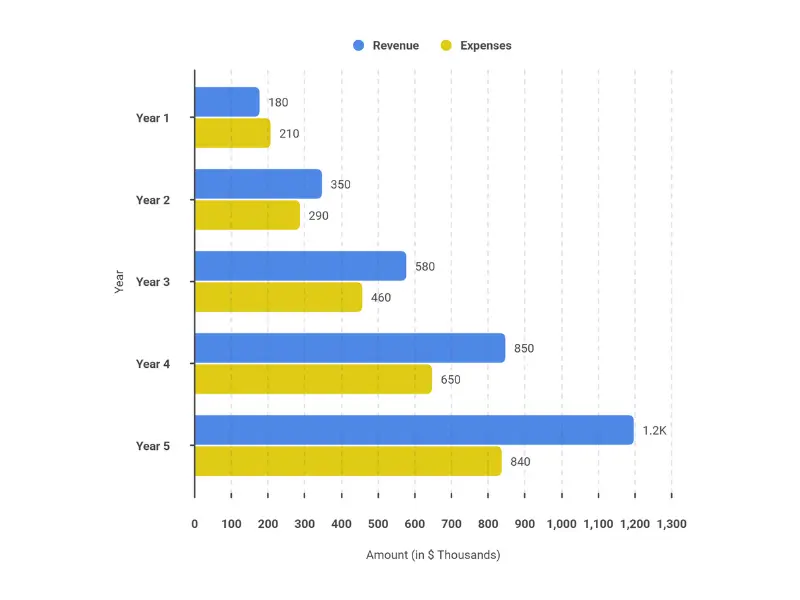
5-Year Financial Projections
| Metric | Year 1 | Year 2 | Year 3 | Year 4 | Year 5 |
| Vehicles | 3 | 4 | 6 | 8 | 10 |
| Trips/Day | 15 | 28 | 45 | 60 | 80 |
| Revenue | $280,000 | $520,000 | $840,000 | $1,120,000 | $1,500,000 |
| Operating Expenses | $300,000 | $415,000 | $630,000 | $825,000 | $1,050,000 |
| Net Profit | ($20,000) | $105,000 | $210,000 | $295,000 | $450,000 |
| Profit Margin | -7% | 20% | 25% | 26% | 30% |
Notice Year 1 shows a loss. This is realistic. You are ramping up volume, building relationships, and dealing with slow Medicaid payments. Projections showing profit in Month 3 are fantasy. Lenders know this and will reject unrealistic plans.
Your break-even point typically comes around Month 10-14, assuming you execute well. By Year 2, well-run operations should see 15-25% net margins.
Management Team and Organizational Structure
Your team section convinces lenders and partners that you can actually execute this plan. Even if you are starting solo, you need to show you understand what positions matter.
Key Positions and Responsibilities
| Position | Responsibilities | When to Hire |
| Owner/CEO | Strategy, funding, major partnerships, financial oversight | Day 1 |
| Operations Manager | Daily dispatch, driver management, fleet maintenance, compliance | At 4-5 vehicles |
| Dispatcher | Trip scheduling, route optimization, real-time coordination | At 3 vehicles |
| Drivers | Safe patient transport, vehicle care, documentation | Before launch |
| Billing Specialist | Claims submission, AR management, denial follow-up | At 300+ trips/month |
Team Presentation
When presenting your team to lenders:
Include brief bios highlighting relevant experience. Healthcare, logistics, and customer service backgrounds all translate well to NEMT.
Be honest about gaps. If you lack healthcare experience, mention your advisory board or consultants who fill that gap.
Show your hiring plan. Investors want to know you have thought about scaling. When will you add your first operations manager? At what volume does a full-time dispatcher make sense?
Include an organizational chart showing reporting relationships. Even for a small startup, this demonstrates organizational thinking.
Funding Your NEMT Business: Sources and Strategies
Most NEMT startups need external funding. Understanding your options helps you approach the right sources with the right pitch.
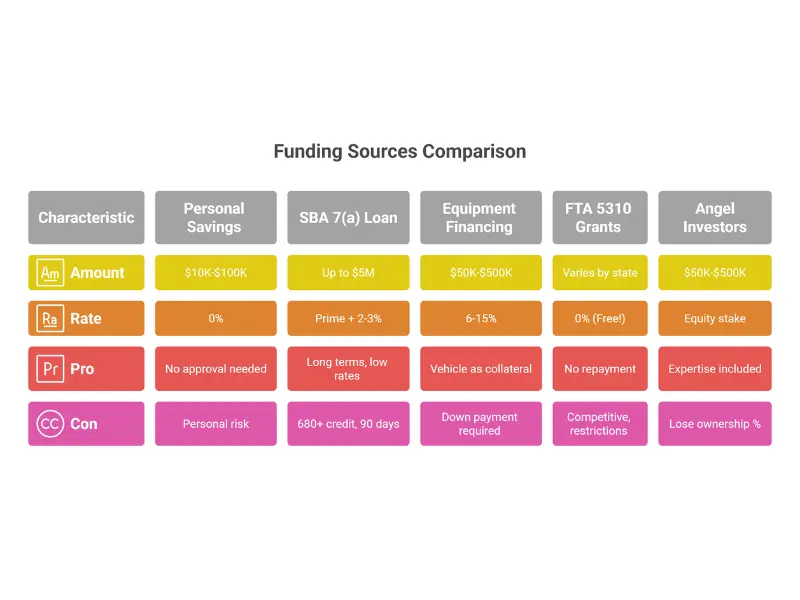
Funding Sources Comparison
| Source | Amount | Interest/Cost | Pros | Cons |
| Personal Savings | Varies | None | Full control, fast | Personal risk, limited |
| SBA 7(a) Loan | Up to $5M | Prime + 2.75% | Low rates, long terms | Lengthy process, strict requirements |
| Equipment Financing | Vehicle cost | 8-15% | Easier approval, vehicle as collateral | Higher rates, short terms |
| FTA 5310 Grant | Up to 80% vehicle cost | Free | No repayment | Competitive, restrictive use |
| Angel Investors | $50K-500K | Equity stake | Strategic value, mentorship | Ownership dilution |
SBA Loans: The Gold Standard
For most NEMT startups, an SBA 7(a) loan is the best option. You get lower interest rates (typically Prime + 2.75%), longer repayment terms (up to 10 years for equipment), and the government guarantee makes banks more willing to lend.
To qualify, you typically need:
Personal credit score above 680
10-20% down payment from personal funds
A comprehensive business plan with realistic projections
Some collateral (the vehicles themselves often work)
No recent bankruptcies or defaults
The SBA loan process takes 60-90 days. Start early. The Small Business Administration website has detailed requirements and lender matching tools.
Writing Your Funding Request
Your funding request section should include:
Exact amount needed: $185,000 for vehicle acquisition and working capital
Detailed use of funds: Vehicles ($120,000), Insurance ($25,000), Working Capital ($30,000), Technology ($10,000)
Repayment ability: Tied to your financial projections showing cash flow sufficient for monthly payments
Collateral offered: Vehicles, personal guarantee, other business assets
Free NEMT Business Plan Template Download
Everything we have covered in this guide is available in a downloadable template you can customize for your specific market and business model.
What Is Included
The template package contains:
Microsoft Word Business Plan Document: 40+ pages with all 12 sections, fill-in-the-blank prompts, and guidance notes. Replace the bracketed text with your specific information.
Microsoft Excel Financial Model: Pre-built formulas for startup costs, monthly expenses, revenue projections, break-even analysis, and 5-year forecasts. Just input your local numbers.
Compliance Checklist: State-by-state licensing requirements, insurance minimums, and Medicaid enrollment steps.
90-Day Launch Timeline: Task list from business registration through first trip.
How to Use the Template
Start with the Excel financial model. Input your local vehicle costs, insurance quotes, and estimated Medicaid rates. This forces realistic thinking and gives you the numbers you need for the narrative sections.
Then work through the Word document section by section. Do not just fill in blanks. Use the prompts to trigger research about your local market. How many dialysis centers are within 20 miles? What are the specific Medicaid rates in your state? Who are your actual competitors?
Finally, have someone review it. A fresh set of eyes catches inconsistencies, unrealistic assumptions, and unclear explanations.
Frequently Asked Questions About NEMT Business Plans
What is a NEMT business plan?
A NEMT business plan is a formal document that outlines your strategy for launching and operating a non-emergency medical transportation company. It covers your services, target market, operations, compliance requirements, financial projections, and funding needs.
Why do I need a business plan for NEMT?
You need a business plan because banks and SBA lenders require one for funding, Medicaid brokers look for evidence of operational readiness during credentialing, and you need a roadmap to avoid the mistakes that cause 60% of NEMT startups to fail within three years.
How long should a NEMT business plan be?
A comprehensive NEMT business plan typically runs 25-40 pages plus appendices. The executive summary should be 1-2 pages. Financial projections usually take 4-6 pages. The length should match the complexity of your operation.
How long does it take to write a NEMT business plan?
Most founders spend 40-80 hours completing a business plan. The research phase takes longest. Using a template with pre-built financial models can cut this time by 30-50%.
Can I write a NEMT business plan myself?
Yes, you can write it yourself using templates and guides like this one. However, consider having a CPA review your financial projections and an industry consultant review your operations plan for realism.
What makes NEMT business plans different from other business plans?
NEMT plans must address healthcare-specific requirements including HIPAA compliance, ADA vehicle standards, EVV technology, Medicaid reimbursement cycles, broker credentialing, and specialized insurance. Generic transportation plans miss these critical elements.
How much does it cost to start a NEMT business?
A typical 3-vehicle NEMT startup costs $150,000-$270,000. This includes vehicles ($90,000-$150,000), insurance ($18,000-$30,000), licensing ($2,000-$6,000), technology ($3,000-$8,000), and critical working capital ($30,000-$50,000).
How much do NEMT owners make?
Owner income varies widely. An owner-operator running a single vehicle might earn $45,000-$70,000 annually. A multi-vehicle operation with proper management can generate $150,000-$400,000 in owner earnings once mature.
What is the typical profit margin for NEMT?
Mature NEMT operations typically achieve 15-30% net profit margins. Year 1 margins are often negative or near zero due to startup ramp-up. By Year 2-3, well-run operations should see 20-25% margins.
Is NEMT business profitable?
Yes, NEMT can be highly profitable with proper planning. Research whether NEMT is a good business for detailed profitability analysis. Key success factors include maintaining high vehicle utilization (75%+), keeping overhead low, and achieving consistent broker performance metrics.
How much does a wheelchair accessible van cost?
New wheelchair accessible vans (WAVs) cost $55,000-$100,000 depending on conversion type. Used WAVs (3-5 years old) cost $30,000-$50,000. Most startups buy quality used vehicles to reduce initial capital requirements.
What are the ongoing monthly costs for NEMT?
Monthly operating costs for a 3-vehicle operation typically run $21,000-$33,000. Major costs include driver wages ($12,000-$18,000), fuel ($2,000-$3,500), insurance ($1,500-$2,500), and vehicle payments/maintenance ($3,500-$5,500).
How long until a NEMT business becomes profitable?
Most NEMT startups reach break-even between Month 10-14. Profitability depends on volume ramp-up speed, payer mix, and expense control. Businesses targeting dialysis transport often reach profitability faster due to recurring trips.
What licenses do I need for NEMT?
Required licenses include state business registration, for-hire transportation permit from your state PUC or DMV, commercial vehicle registrations, Medicaid provider enrollment, and NPI number. Some states require specific NEMT licenses.
How do I get Medicaid contracts?
In most states, you enroll with the state Medicaid agency to get a provider number, then complete credentialing with the broker managing trips (usually Modivcare or MTM). See the NEMT billing guide for detailed steps.
What insurance do I need for NEMT?
You need commercial auto liability ($1M+ per vehicle), general liability ($1M per occurrence), workers compensation (if you have employees), and umbrella coverage ($1-5M recommended). Some brokers require higher limits.
What vehicles are best for NEMT?
Most operators use a mix of wheelchair accessible vans (Toyota Sienna, Ford Transit, Ram ProMaster) and sedans for ambulatory transport. ADA-compliant conversions from BraunAbility or Vantage Mobility are industry standards.
How many vehicles do I need to start?
You can start with one vehicle as an owner-operator, but most brokers prefer providers with at least 2-3 vehicles for reliability. Starting with 3 vehicles provides flexibility for scheduling and backup if one is in maintenance.
What is EVV and do I need it?
Electronic Visit Verification is federally required for Medicaid transportation. It captures service date, time, location, and provider through GPS and mobile technology. Yes, you absolutely need it for Medicaid billing.
How do I handle prior authorization for trips?
Many Medicaid trips require prior authorization. Review the NEMT prior authorization guide for step-by-step processes. Brokers typically handle PA for trips they assign, but direct Medicaid billing requires you to verify authorization before transport.
How do I get funding for a NEMT business?
Common funding sources include personal savings (10-20% minimum), SBA 7(a) loans (up to $5M), equipment financing for vehicles, FTA 5310 grants, and bank loans. Most successful startups combine multiple sources.
Can I get an SBA loan for NEMT?
Yes, SBA 7(a) loans are excellent for NEMT startups. You need 680+ credit score, 10-20% down payment, a solid business plan, and collateral. The vehicles themselves often serve as collateral.
Are there grants available for NEMT?
The FTA Section 5310 program provides grants for up to 80% of ADA vehicle costs. Some states have additional grant programs. Grants are competitive and have restrictive use requirements, but they provide non-repayable capital.
What do investors look for in NEMT business plans?
Investors want realistic financial projections, evidence of market demand, strong management team or advisors, clear competitive advantage, understanding of compliance requirements, and a reasonable exit or repayment strategy.
What credit score do I need for NEMT financing?
Most SBA loans require 680+ personal credit. Equipment financing may approve scores as low as 620 with higher interest rates. Building credit before applying improves your options and rates.
How do I bill for NEMT trips?
Billing depends on your payer mix. Medicaid trips go through broker portals or direct state submission. Medicare Advantage has plan-specific processes. Private pay is direct billing. See how to start NEMT billing for complete instructions.
How long does Medicaid take to pay?
Medicaid reimbursement typically takes 60-90 days from clean claim submission. This payment lag is why working capital is critical. You need cash reserves to cover 2-3 months of operating expenses.
What are common reasons for claim denials?
Common denial reasons include missing prior authorization, EVV data gaps, incorrect patient eligibility, duplicate claims, and missing documentation. The NEMT denial codes guide explains how to prevent and appeal denials.
Should I outsource billing or handle it in-house?
Small startups often outsource billing to NEMT billing services. This provides expertise without hiring specialized staff. As volume grows past 500+ monthly trips, in-house billing may become cost-effective. Review the outsourcing vs in-house comparison for decision guidance.
How do I prepare for a Medicaid audit?
Keep detailed records of every trip including EVV data, driver logs, patient signatures, and PCS forms. The NEMT audit preparation guide covers required documentation and retention periods.
How do I start a medical transportation business?
Start by creating a comprehensive business plan, forming an LLC, obtaining required licenses and insurance, purchasing ADA-compliant vehicles, enrolling with Medicaid, and completing broker credentialing. The entire process takes 4-6 months.
What do I need to know before starting NEMT?
You need to understand that Medicaid pays slowly (60-90 days), insurance costs are high ($18,000-$30,000 annually for 3 vehicles), vehicles must be ADA-compliant, and you need EVV technology for compliance. Working capital is essential.
Is medical transportation a good business to start?
Medical transportation offers strong growth potential with the aging population and expanding Medicare Advantage coverage. Operators who plan properly and maintain compliance can achieve 20-30% profit margins. Success requires capital, patience, and operational excellence.
How much can I make owning a wheelchair transport company?
A single wheelchair van operated full-time can generate $100,000-$175,000 in annual revenue. After expenses, net profit typically ranges from $25,000-$45,000 per vehicle for well-run operations.
What questions should I ask before starting NEMT?
Ask yourself: Do I have enough capital to survive 90 days without Medicaid payment? What is my competitive advantage in this market? Do I understand compliance requirements? Who will handle billing and dispatch? Can I commit to building relationships with facilities and brokers?
Next Steps: From Plan to Launch
You now have everything you need to create a comprehensive NEMT business plan that will impress lenders, satisfy brokers, and guide your operations.
Here is your action checklist:
1. Download the template and start with the financial model. Input real numbers from your market research.
2. Research your local market. How many dialysis centers, senior populations, and existing competitors are in your service area?
3. Get insurance quotes. This is often the biggest surprise for new operators.
4. Start the Medicaid enrollment process. It takes 90-180 days, so begin immediately.
5. Connect with at least three potential facility partners. Understand their transportation pain points.
6. Have your plan reviewed by a CPA and, if possible, someone with NEMT industry experience.
The NEMT industry offers real opportunity for operators who plan properly. The demand is there. The reimbursement is stable. The barriers to entry are manageable with the right preparation. Your business plan is the foundation that makes everything else possible.
Need help with the billing side? EliteMed Financials provides professional billing services designed specifically for NEMT providers, from startup through scale.
For official guidance on starting a transportation business, review the Centers for Medicare & Medicaid Services NEMT resources and your state Medicaid agency requirements.
Now stop reading and start building. Your business plan is waiting.