How to Book NEMT: Complete Patient Guide to Non-Emergency Medical Transportation (2026)
Table of Contents
Missing a doctor’s appointment because you don’t have a ride isn’t just inconvenient—it can be dangerous. Every year, 3.6 million Americans miss or delay medical care because they can’t get to their appointments. Whether it’s a dialysis session, a follow-up after surgery, or a routine checkup for diabetes, transportation barriers keep people from getting the care they need. The result? Late diagnoses, poorly managed chronic conditions, and avoidable hospitalizations that could cost thousands of dollars.
If you’re one of the millions of people who struggle to get to medical appointments, Non-Emergency Medical Transportation (NEMT) exists specifically to solve this problem. NEMT is a federally mandated benefit that provides free or low-cost rides to medical appointments for Medicaid beneficiaries and many Medicare Advantage plan members. It’s designed for people who don’t have reliable transportation, can’t drive due to disability or age, or need specialized vehicles like wheelchair vans.
This complete guide will walk you through everything you need to know about booking and using NEMT services. You’ll learn exactly how to check your eligibility, book your first ride step-by-step, understand what documents you need, and navigate common challenges like wait times and cancellations. We’ll cover costs by insurance type, vehicle options for different mobility needs, and what to do if something goes wrong. Whether you’re a patient, family member, or caregiver, this guide gives you the knowledge to access the transportation you’re entitled to—so missed appointments never stand between you and better health.
📊 **DID YOU KNOW?**
Transportation issues account for **25-50% of all missed medical appointments** nationwide. Patients without reliable rides are 2.6 times more likely to be hospitalized for preventable conditions.
What Is Non-Emergency Medical Transportation (NEMT)?
Non-Emergency Medical Transportation (NEMT) is a federally mandated transportation service that helps people get to and from medical appointments when they have no other reliable way to travel. If you’re enrolled in Medicaid or certain Medicare Advantage plans, and you can’t safely drive yourself or use public transit due to age, disability, or lack of resources, NEMT ensures you can still access the healthcare you need.
NEMT is not an ambulance service. Ambulances respond to life-threatening emergencies like heart attacks, strokes, or severe injuries, and they’re staffed by paramedics who can provide advanced medical care. NEMT, on the other hand, is for scheduled, non-urgent trips to routine medical appointments. The vehicles are driven by trained professionals with CPR and First Aid certification, but they’re focused on safe transportation, not emergency medical treatment.
Types of NEMT Services Available
NEMT providers offer different vehicle types depending on your mobility needs:
Ambulatory transportation uses standard sedans, SUVs, or vans for patients who can walk independently or with minimal help, like using a cane or walker. This is the most common and cost-effective option for routine doctor visits.
Wheelchair-accessible vans come equipped with ramps or hydraulic lifts and securement systems for patients who use manual or power wheelchairs. These ADA-compliant vehicles are designed for people with conditions like paraplegia, severe arthritis, or multiple sclerosis who can’t transfer out of their wheelchair.
Stretcher transportation is for patients who must remain lying down during transport, such as those recovering from surgery, dealing with spinal injuries, or managing severe pressure ulcers. These vehicles have padded stretchers and oxygen support but aren’t classified as emergency ambulances.
Bariatric vehicles are reinforced for patients who typically weigh between 500 and 1,000 pounds, with specialized equipment like wider entry points, bariatric stretchers, and power-load systems.
Who Uses NEMT?
NEMT serves people with chronic conditions requiring ongoing treatment like dialysis or chemotherapy, elderly patients who no longer drive, individuals with physical or cognitive disabilities, and anyone whose medical condition makes other forms of transportation unsafe. The service is designed specifically for Medicaid beneficiaries, though many Medicare Advantage plans and some private insurance policies also include NEMT benefits.
Who Qualifies for NEMT Services?
Eligibility for NEMT depends primarily on your insurance coverage and medical need.
If you have Medicaid, NEMT is free in all 50 states. You qualify if you have no reliable transportation—no working vehicle, no driver’s license, no accessible public transit, or a physical or cognitive condition that makes independent travel unsafe. Your trip must be for a Medicaid-covered medical service like a doctor’s appointment, dialysis, physical therapy, or behavioral health treatment.
Traditional Medicare (Parts A and B) does not cover routine NEMT, only emergency ambulance transport when medically necessary. However, many Medicare Advantage (Part C) plans include NEMT as a supplemental benefit, typically offering 20 to 50 one-way trips per year. Check your specific plan documents or call the number on your insurance card to verify coverage.
Private insurance coverage varies significantly. Some employer-sponsored or managed care plans cover NEMT for chronic treatments like chemotherapy or post-surgical recovery, but it’s not a standard benefit. Veterans enrolled in VA healthcare may qualify through the Beneficiary Travel program or Veterans Transportation Service if they meet income or disability criteria.
If you don’t have insurance coverage, you can still use NEMT by paying out-of-pocket, with rates typically ranging from $35 to $250 per trip depending on vehicle type and distance.
📋 **QUICK REFERENCE: NEMT vs. Emergency Ambulance**
**NEMT** → Scheduled rides, routine appointments, trained drivers, no medical equipment
**Emergency Ambulance** → Life-threatening situations, paramedics, advanced life support, immediate response
If you’re having chest pain, difficulty breathing, or a medical emergency, **always call 911**—never wait for NEMT.
How to Book a NEMT Ride: Step-by-Step Guide
Booking a NEMT ride is straightforward once you know the process. There are three main ways to schedule transportation: through your insurance broker (most common for Medicaid and Medicare Advantage), directly with a NEMT provider, or using a mobile app. Here’s exactly how each method works.
Method 1: Booking Through Your Insurance Broker
This is the most common method for Medicaid beneficiaries and Medicare Advantage members. Your state assigns a transportation broker to manage all NEMT rides, verify eligibility, and coordinate with local providers.
Medicaid is required by federal law to cover NEMT for eligible beneficiaries, while Medicare Advantage plans offer transportation as a supplemental benefit. For a detailed breakdown of what each payer covers and typical reimbursement rates, see our provider billing guide.
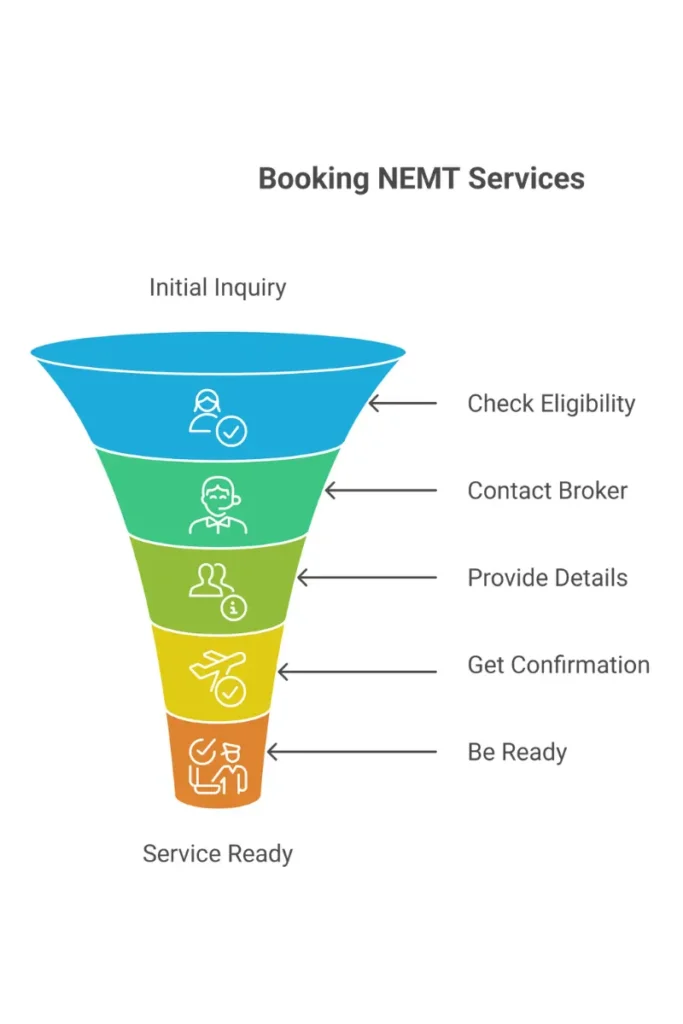
Step 1: Find your broker’s contact information. Check your Medicaid or Medicare Advantage ID card, which typically lists a transportation phone number. You can also find your broker on your state’s Medicaid website. The major brokers include Modivcare (formerly LogistiCare), MTM, Access2Care, and Veyo.
Step 2: Call, use the online portal, or download the mobile app. Most brokers offer 24/7 phone reservations through automated or live systems. Many also have online portals like MyModivcare or MTM-Link, plus mobile apps where you can schedule, track, and cancel rides.
Step 3: Provide your trip details. You’ll need your full name, date of birth, Medicaid or Medicare Advantage ID number, appointment date and time, provider’s address (including suite number if applicable), your pickup and drop-off addresses, and your mobility needs—whether you need ambulatory service, a wheelchair-accessible van, stretcher transport, or bariatric accommodation. Some brokers also ask for your diagnosis or reason for the visit to verify medical necessity.
Step 4: Wait for verification and assignment. The broker confirms your insurance eligibility and medical necessity, then assigns an approved NEMT provider in your area. This usually happens during the same call or within a few hours.
Step 5: Get your confirmation. You’ll receive a confirmation number, your pickup window (typically a 30 to 60-minute range before your appointment), and the provider’s contact information. Write down this confirmation number—you’ll need it if there’s an issue with your ride.
Step 6: Be ready on ride day. Have your ID and insurance card accessible. Be ready 15 minutes before your pickup window starts. The driver will verify your identity before beginning the trip.
How far in advance should you book? For routine appointments, call at least 48 to 72 hours (2 to 3 business days) ahead. If you’re seeing a specialist or traveling a long distance, give yourself 3 to 7 days. Urgent but non-emergency rides may be available with 4 to 24 hours’ notice, but availability isn’t guaranteed. Same-day rides are extremely limited and require calling the broker directly as early as possible.
Pro Tip: Set Up Standing Orders for Recurring Appointments
If you have dialysis three times a week, weekly physical therapy, or regular chemotherapy, ask your broker about standing orders. This means your rides are automatically scheduled for the same days and times without requiring you to call for each appointment. Standing orders are typically approved for 3 to 6 months at a time and require periodic verification. This saves you time and ensures consistent transportation for critical treatments.
Method 2: Booking Directly with a NEMT Provider
If you’re paying out-of-pocket or your insurance doesn’t use a broker system, you can contact NEMT companies directly.
How to find providers: Search “NEMT near me” on Google, ask your doctor’s office or hospital for recommendations, check local business directories, or contact community health organizations that often have lists of reputable providers.
The booking process is simpler but less structured. Call or visit the provider’s website, request a quote or verify if they accept your insurance, provide your trip details (name, addresses, appointment time, mobility needs, payment method), confirm the pickup window and total cost, and receive a confirmation.
Pros of booking directly: You often get faster scheduling, more flexibility for same-day or after-hours rides, and direct communication with the driver or dispatcher.
Cons: Out-of-pocket costs are usually higher than broker-arranged trips, insurance reimbursement isn’t guaranteed (you may need to submit claims yourself), and there are fewer consumer protections compared to state-contracted broker systems.
Method 3: Using NEMT Apps and Technology Platforms
Several apps make NEMT booking more convenient, though not all are available nationwide.
Modivcare App and myMTM App let Medicaid members schedule rides, track drivers in real-time via GPS, and manage cancellations directly from their smartphones.
Veyo operates in select states and uses QR code-based trip verification, allowing you to confirm rides quickly and track your driver’s arrival.
Uber Health and Lyft Healthcare are often booked by your healthcare provider on your behalf, not by you directly. These platforms are HIPAA-compliant, meaning your medical information stays private. If your doctor’s office uses Uber Health, you’ll receive a text message or phone call with ride details—you don’t need the regular Uber app. These services are typically limited to ambulatory or wheelchair-accessible rides.
Limitations: App-based NEMT isn’t available in all states or counties. Same-day availability depends on local driver supply. Some platforms only work for certain types of appointments or require your healthcare provider to initiate the booking.
Information You’ll Always Need
Regardless of which booking method you use, have this information ready:
- Full name and date of birth
- Insurance ID number (Medicaid, Medicare Advantage, or private)
- Appointment date, time, and exact address (include suite or floor number)
- Your pickup address and phone number
- Mobility needs (can you walk, or do you need a wheelchair, stretcher, or bariatric vehicle?)
- For some insurance plans: a physician certification or appointment verification
Common Mistakes to Avoid
Choosing the wrong vehicle type. If you use a wheelchair but book ambulatory service, the driver won’t have the right equipment, and your ride will be canceled. Always specify your exact mobility needs.
Providing an incorrect address. Double-check the medical facility’s address, especially the suite or office number. A wrong address can delay your ride or result in a no-show charge.
Missing your pickup window. If the driver arrives during your scheduled window and you’re not ready, it may count as a patient no-show, which can lead to service restrictions after multiple occurrences.
Waiting until the last minute. NEMT providers juggle multiple passengers and routes. Booking at least 2 to 3 days ahead ensures better availability and more reliable service.
If you’re considering starting your own NEMT company to serve patients in your area, understanding the complete NEMT business licensing and startup process is essential before launching operations.
Time-Saving Strategies
Save your broker’s phone number in your contacts as “NEMT Transportation.” Set calendar reminders a week before appointments to book rides. If your appointment time changes, call immediately to update your ride—don’t wait until the day before. Ask your doctor’s office if they can arrange rides through Uber Health or Lyft Healthcare on your behalf, which can be faster than traditional broker systems.
Peak demand times are Monday, Wednesday, and Friday mornings between 7:00 and 10:00 AM, especially in areas with high dialysis patient populations. If your appointment is flexible, scheduling for Tuesday or Thursday afternoons may result in shorter wait times and more punctual pickups.
💡 **PRO TIP: Confirm Your Ride 24 Hours Before**
Always call your broker or provider the day before your appointment to confirm your ride is still scheduled. This simple step catches booking errors, ensures your pickup window is correct, and gives you time to make alternative arrangements if there’s a problem.
Required Documents & Information for NEMT
Having the right documents ready makes booking and using NEMT much smoother. Here’s exactly what you need to have on hand when scheduling your ride and what to bring on the day of your appointment.
Essential Documents You’ll Always Need
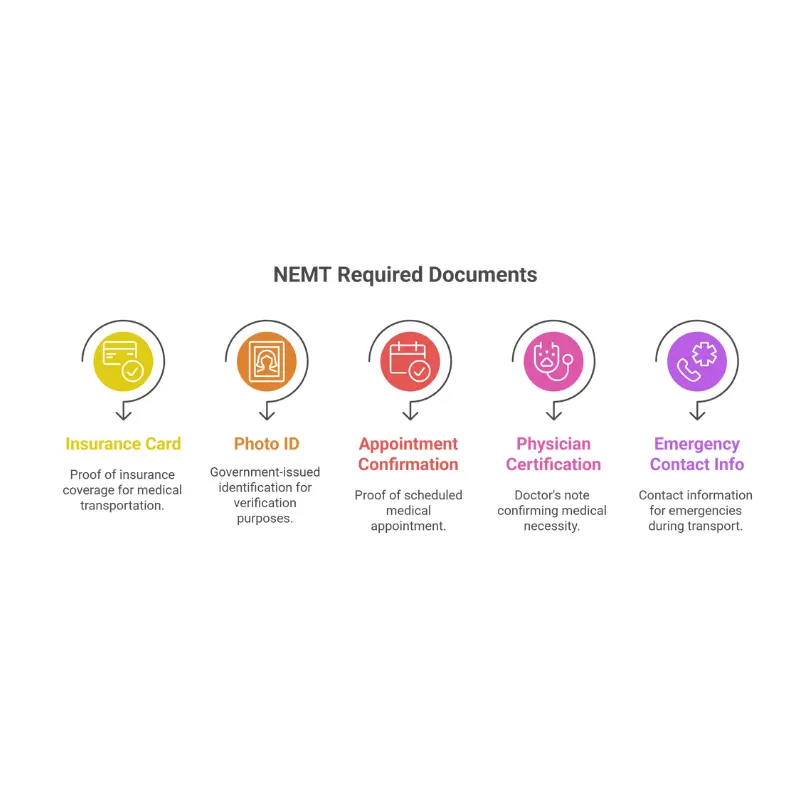
Your insurance card is the most important document. Whether it’s Medicaid, Medicare Advantage, or private insurance, you’ll need this when booking your ride and again when the driver picks you up. The broker or provider uses it to verify your active coverage, confirm your member ID, and check which transportation broker manages your rides. Keep a physical card with you and save a photo on your phone as a backup. Make sure the name and date of birth on your insurance card match your photo ID exactly.
A government-issued photo ID confirms your identity and prevents fraud. Acceptable IDs include a driver’s license, state-issued ID card, passport, or Medicaid photo ID where available. If you’re a parent or guardian accompanying a minor, bring your own ID. For elderly or disabled patients without identification, some states allow caregiver attestation or broker profile verification—check with your broker if this applies to you.
Appointment verification proves your ride is medically necessary. This can be an appointment letter from your doctor’s office, a printout from your patient portal, an email or text confirmation, or documentation of your recurring dialysis or therapy schedule. The verification must include your name, the appointment date and time, your provider’s name, and the full address including suite or unit number. If you don’t have written confirmation, ask your provider’s front desk to send it directly to your transportation broker.
Documents You May Need Depending on Your Situation
Prior authorization is required for certain types of trips, including stretcher transport, bariatric vehicles, long-distance rides (often over 50 to 100 miles), out-of-network providers, or recurring appointments like dialysis and chemotherapy. Your broker usually handles prior authorization, but sometimes your doctor’s office or you will need to request it. The authorization process reviews medical necessity, the level of service you need, and frequency of trips.
A prescription or physician certification for transportation is mandatory in many states for wheelchair and stretcher transport, and almost always for trips requiring oxygen, ventilators, or medical escorts. This form—sometimes called a Physician Certification Statement (PCS) or Certificate of Medical Necessity (CMN)—must be signed by your primary care doctor or treating specialist. It explains your diagnosis, why you can’t use personal or public transportation safely, what type of vehicle you need (ambulatory, wheelchair, stretcher), and whether the need is temporary or ongoing.
States with prescription requirements include California, New York, Texas, Florida, Arizona, and Illinois, especially for wheelchair, stretcher, or long-distance trips. If you’re unsure whether your state requires a prescription, ask your broker when you call to book your first ride.
Information You’ll Provide When Booking
When you call to schedule a ride, have this information ready: your full legal name, date of birth, home address (your pickup location), phone number, insurance member ID, and Social Security Number (sometimes required for initial setup). You’ll also need to describe your mobility needs clearly—whether you can walk independently, use a wheelchair (manual or power), require a stretcher, or need bariatric accommodations. Be specific about any medical equipment you’ll bring, like oxygen tanks or a walker.
For your appointment, provide the exact date and time, your provider’s name, the facility name and full address including suite or department number, and the purpose of your visit (dialysis, follow-up, imaging, therapy). You’ll also need to provide emergency contact information—a family member or friend’s name, relationship to you, and phone number.
What to Bring on Ride Day
Have your physical insurance card, photo ID, appointment confirmation, and any physician certification forms ready and accessible. If you use medical equipment like oxygen or a wheelchair, make sure it’s charged and ready to go. Keep your phone charged so the driver can reach you if needed. If you have a copay, bring payment.
📋 **DOWNLOADABLE CHECKLIST: NEMT Documentation**
✓ Insurance card (physical + digital photo)
✓ Photo ID (driver’s license, state ID, passport)
✓ Appointment confirmation (letter, email, or portal printout)
✓ Physician certification (if required in your state)
✓ Emergency contact information
✓ List of mobility needs and medical equipment
**Download our printable NEMT Documentation Checklist**
Your NEMT provider will collect specific information for billing purposes, including your insurance ID, pickup/drop-off addresses, and appointment details. Providers must follow strict NEMT documentation and billing requirements to get reimbursed by your insurance.
What to Expect: Wait Times & Arrival Windows
Understanding how NEMT scheduling works helps reduce frustration and ensures you’re ready when your ride arrives. Unlike rideshare services that give you an exact arrival time, NEMT uses pickup windows—a range of time when your driver will arrive to get you.
How Pickup Windows Work
A pickup window is typically 30 minutes, usually 15 minutes before to 15 minutes after your scheduled time. For example, if your pickup is scheduled for 10:00 AM, your driver can arrive anytime between 9:45 AM and 10:15 AM—and that’s considered on-time. In suburban areas, windows may extend to 30 minutes on either side, and in rural areas, windows can be even wider due to longer travel distances and fewer available vehicles.
Why do pickup windows exist instead of exact times? NEMT providers manage multiple passengers on shared routes, and they need flexibility to handle traffic congestion, weather delays, wheelchair boarding and securement time, and route optimization. This system allows them to serve more patients reliably throughout the day. Most brokers maintain 95% on-time performance, meaning the driver arrives within the pickup window 95 times out of 100.
How Long You’ll Wait on Pickup Day
Once your pickup window starts, expect your driver within 15 to 30 minutes. In the best-case scenario—a single-passenger trip during off-peak hours with clear weather—your driver may arrive close to the exact scheduled time. During peak hours (7:00 to 10:00 AM and 2:00 to 5:00 PM), when traffic is heavy and drivers are picking up multiple passengers, arrival may be closer to the end of your window.
Several factors affect timing. Traffic and weather are the most obvious—road construction, accidents, snow, rain, or flooding can slow everything down. NEMT often uses shared rides, so if a passenger before you isn’t ready or wheelchair boarding takes longer than expected, it creates a ripple effect. Geographic location matters too: urban areas have shorter distances but more traffic, while rural areas face longer drives with fewer vehicles available.
Be ready 15 minutes before your pickup window starts. Stay near your phone, keep your ID and insurance card accessible, and wait at the exact pickup location you provided when booking. If you live in an apartment complex, be specific about which entrance or building. Vague addresses cause delays.
What to Do If Your Ride Is Late
If your driver hasn’t arrived by the end of your pickup window, wait an additional 15 minutes, then call your broker’s “Where’s My Ride?” hotline or check the status in your broker’s mobile app. Give your confirmation number and ask for an updated estimated arrival time. If your ride is more than 30 minutes late, request escalation to a supervisor and ask if they can reassign you to an alternate provider.
You have the right to timely and safe transportation. If a delay means you’ll miss your appointment, inform the broker immediately. They may authorize a taxi or rideshare service to get you there on time, though this depends on your plan and state policies.
Return Trips After Your Appointment
Return trips work differently depending on how long your appointment takes. For predictable appointments like dialysis or physical therapy, your return is pre-scheduled at a fixed time after drop-off—this method is more reliable and means less waiting.
For appointments with variable lengths, like specialist visits or imaging, you’ll use “will-call” or “ready-to-ride.” After your appointment ends and you’ve gathered your belongings, call your broker’s will-call number or use the mobile app to request your return ride. Dispatch assigns the nearest available vehicle. Average return wait time is 30 to 60 minutes after you call, though it can be shorter in urban areas with more vehicles or longer in rural areas.
Don’t call for your return until you’re completely ready to leave. Calling too early when you’re still in the exam room or waiting for discharge paperwork causes confusion and delays. Ask clinic staff to help you place the will-call if you need assistance. Sit near the designated pickup area after calling so you’re easy to find when your driver arrives.
Tracking Your Ride
Many broker apps now offer GPS tracking so you can see your vehicle’s location and estimated arrival time in real-time. You may also receive SMS alerts when your driver is en route, typically 15 to 30 minutes before arrival. If you don’t have the app, you can always call dispatch for an updated ETA—they have access to live GPS data.
⏰ **EXPERT TIP: Be Ready Early, Not Late**
Drivers can arrive anywhere within your pickup window—including 15 minutes **before** your scheduled time. If you’re not ready when they arrive, it may count as a patient no-show, which can lead to service restrictions after multiple occurrences. Set an alarm for 15 minutes before your window starts.
Cancellation & No-Show Policies
Life happens, and sometimes you need to cancel a ride. Understanding NEMT cancellation rules protects your access to future transportation and helps keep vehicles available for other patients who need them.
How to Cancel Your Ride Properly
For routine appointments, cancel at least 24 hours before your scheduled pickup time. For same-day or urgent trips, cancel as soon as possible—ideally at least two hours before pickup. Some states and Medicare Advantage plans require 48 to 72 hours’ notice for routine trips, so check your broker’s specific policy when you book your first ride.
You can cancel several ways: call your broker’s reservation or dispatch line (available 24/7), use the mobile app like myMTM, MyModivCare, or Veyo, log into your broker’s online member portal, or use the automated phone system (IVR) to cancel with your trip ID. Some brokers also accept cancellations via text message in select states.
Have your trip confirmation number, full name, date of birth, and pickup date and time ready. Always get a cancellation confirmation number or verify in your app that the status changed from “Scheduled” to “Cancelled.” Calls are recorded and app cancellations are logged automatically, so you have proof if there’s ever a dispute.
If you need to reschedule rather than cancel, treat it as a new booking—you’ll need to follow the same advance notice rules, and the ride is subject to vehicle availability. Urgent reschedules may require your clinic to call the broker directly with medical urgency documentation.
What Happens If You No-Show
A no-show is recorded when the driver arrives within your pickup window, waits 5 to 10 minutes, and you don’t appear, aren’t ready, or refuse the ride. No-shows also count if you cancel after the driver is already on the way to get you.
NEMT brokers use a progressive three-strike system for no-shows within a 30 to 60-day review period. Your first no-show results in a recorded warning and an education notice about cancellation rules. A second no-show triggers a formal warning letter and may reduce your scheduling priority or trigger a review of any standing orders you have. A third no-show can result in temporary service restrictions, such as loss of standing orders, downgrade to a different vehicle type, or a requirement to call for every single trip instead of using automatic scheduling.
Full suspension of NEMT is extremely rare because it’s a federally protected Medicaid benefit. Restrictions typically last 30, 60, or 90 days. If you receive a Notice of Action about restrictions, you have the right to appeal. You can submit an explanation or documentation, request reconsideration, or file a Medicaid fair hearing. Appeals usually must be filed within 14 to 60 days depending on your state.
Exceptions: When No-Shows Are Excused
No-show penalties may be waived for documented “good cause” reasons like a medical emergency or hospitalization, sudden illness on ride day, your appointment being cancelled by the provider, severe weather or declared emergency, or death in the immediate family.
Call your broker the same day if possible and provide documentation—an ER visit record, doctor’s note explaining the illness, appointment cancellation notice from your provider, or other proof. Upload or fax documents if requested and keep copies for your records.
What If the Driver Doesn’t Show Up?
Provider no-shows—when your driver never arrives or shows up outside the pickup window without notice—are taken seriously. Call the broker’s “Where’s My Ride?” line immediately, provide your trip confirmation number, and request immediate reassignment and supervisor escalation.
You won’t be charged for a provider no-show. The broker may dispatch an alternate vehicle like a taxi or rideshare at their expense. Providers who no-show face service level agreement (SLA) violations, financial penalties, and risk losing their contract with the broker.
Avoiding No-Shows
Cancel as soon as your plans change, even if it’s last minute. Use the broker app for faster cancellations than calling. Set calendar reminders 24 to 48 hours before each ride to review whether you still need it. Be ready 15 minutes before your pickup window starts. Answer unknown calls near your pickup time—it might be your driver confirming your location. Keep your phone volume on and notify the broker immediately if you’re running late.
⚠️ **IMPORTANT: Save Your Cancellation Confirmation**
Always screenshot app cancellations or write down the cancellation confirmation number when you call. If there’s ever a dispute about whether you cancelled properly, this documentation proves you followed the rules and protects your transportation benefits.
Preparing for Your First NEMT Ride
Your first NEMT ride will go smoothly if you prepare ahead of time. Here’s exactly what to do before your driver arrives, what to bring, and how to make sure you’re ready.
Before Your Ride Arrives
Be completely ready 15 to 30 minutes before your pickup window starts, not at the exact scheduled time. Remember, drivers can arrive anywhere within your window, including early. Once they arrive, they typically wait only 5 to 10 minutes before marking you as a no-show, so being ready early prevents problems.
Know where to wait. If you’re ambulatory, wait at the curb or building entrance. Wheelchair users should wait at the main entrance with ramp access. In apartment buildings or facilities, wait in the lobby or designated pickup zone. Drivers are not required to search buildings or knock on doors—they expect you to be visible and ready at the agreed-upon location.
Clear your pathway before the driver arrives. Remove rugs, cords, pets, or clutter from walkways, ramps, and doorways. If you live in a building with an elevator, make sure it’s working. Turn on porch or hallway lights so your address is visible, especially for early morning or evening pickups. These small steps prevent delays and safety issues.
If you use mobility equipment, make sure your wheelchair battery is fully charged, oxygen tanks are filled with at least a two-hour buffer supply, and walkers or canes have good rubber tips. Test your wheelchair brakes and controls. Remove loose accessories that might interfere with vehicle securement systems. Label equipment with your name in case items get separated during the trip.
Keep your phone fully charged with the volume up. Save your broker’s “Where’s My Ride?” number in your contacts so you can call quickly if there’s a delay. Keep your phone accessible in your pocket or hand—not buried in a bag—so you can answer when the driver calls to confirm your location.
What to Bring
Always bring your photo ID, insurance card, appointment confirmation, and trip confirmation number. Keep these documents together in one folder or pouch so they’re easy to access. Bring your medications or a medication list in case your appointment runs long or there are unexpected delays.
Recommended items include a water bottle for hydration during waits, a light snack especially for longer trips, a phone charger or power bank so you don’t lose contact, hand sanitizer, and written emergency contact information. If you’ll be comfortable, consider a small blanket, travel pillow, or book, but limit yourself to one small bag so it doesn’t interfere with seatbelts, wheelchair securement, or other passengers.
What to Wear
Wear comfortable, loose-fitting clothing in layers since vehicle temperatures vary. Choose closed-toe shoes with non-slip soles and a secure fit—avoid loose sandals or heels that could cause falls when boarding. If your appointment involves bloodwork or exams, wear short sleeves for easy medical access. Dress for the weather with a jacket for cold, an umbrella for rain, or breathable fabrics for heat.
First Ride Expectations
When your driver arrives, they’ll confirm your name and destination. Greet them politely and clearly state any mobility or assistance needs you have. Let them know about fragile equipment. Drivers can assist within company policy but cannot lift patients, so be clear about what help you need.
You may share the ride with other passengers—shared rides improve availability and reduce costs for everyone. Vehicles are safety-equipped and climate-controlled. The driver will ensure your wheelchair or equipment is properly secured before starting the trip.
Common mistakes to avoid: being unready when the driver arrives, forgetting your ID or insurance card, blocking ramps or entrances with clutter, bringing excessive bags, and ignoring unknown phone calls near your pickup time (it’s probably your driver).
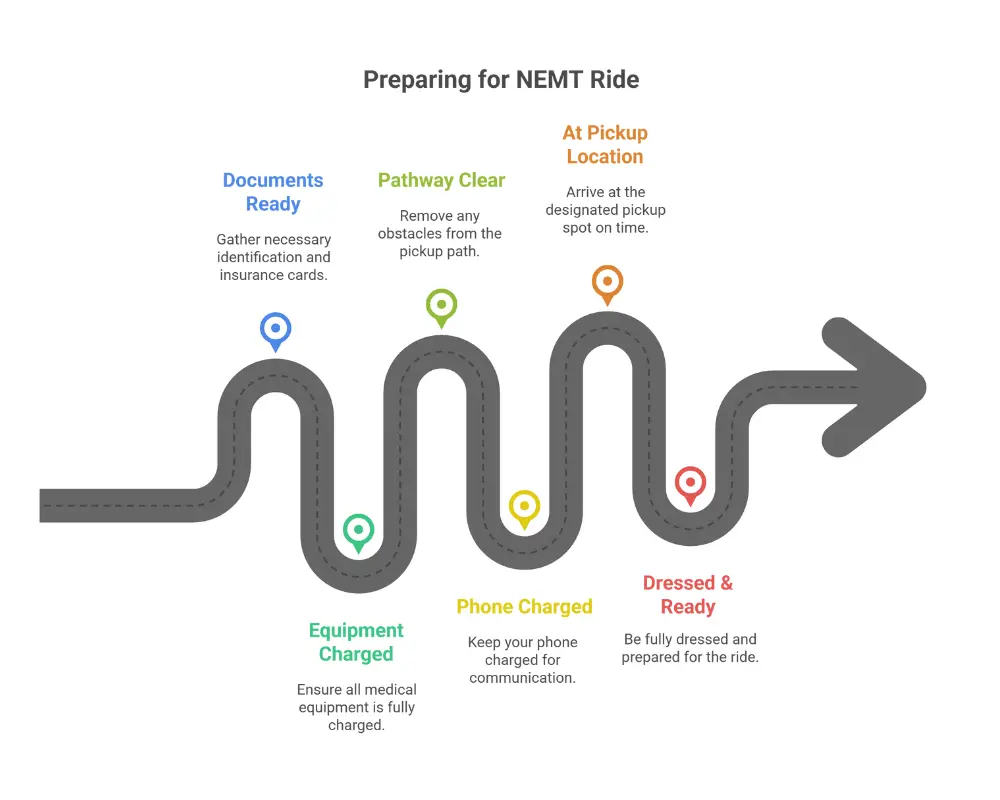
✅ **QUICK READY-TO-RIDE CHECKLIST**
15 minutes before your window:
□ Documents in hand (ID, insurance card, confirmation)
□ Equipment charged and ready
□ Pathway clear and well-lit
□ Phone charged and volume up
□ Positioned at pickup location
□ Dressed and ready to go immediately
**Print this checklist** [link to downloadable PDF]
Vehicle Types & Special Accommodations
NEMT vehicles come in different types designed for specific mobility needs. Choosing the right vehicle when you book ensures you get the accommodations you need and prevents last-minute cancellations or delays.
Ambulatory Vehicles
Ambulatory vehicles are standard sedans, SUVs, or minivans with air conditioning, heating, and regular seatbelts. These are for passengers who can walk independently or with minimal assistance and transfer in and out of a vehicle without help. If you use a cane or walker but can still sit in a regular car seat, ambulatory service is appropriate for you. Typical vehicles include Toyota Camrys, Honda Accords, Chevy Malibus, or minivans like the Toyota Sienna. These vehicles can carry one to four passengers in sedans or up to six to seven in minivans, making them the most common and cost-effective NEMT option.
Wheelchair-Accessible Vans
Wheelchair-accessible vans (WAVs) are modified vehicles with lowered floors designed for passengers who remain seated in their wheelchair during transport. These vans have either side-entry or rear-entry access and come equipped with ramps or hydraulic lifts. Ramps can be manual or power-deployed, with a minimum width of about 29 to 30 inches and a gentle incline for safe boarding. Hydraulic or electric lifts are used mostly in full-size vans and can handle higher weight capacities than ramps.
All wheelchair-accessible vans use a four-point tie-down securement system to keep your wheelchair stable during transit, plus separate lap and shoulder seatbelts for your safety. The securement points are mounted in floor-level L-tracks. These vehicles typically accommodate one to two wheelchairs plus two to four ambulatory passengers depending on the van size. Common models include the Chrysler Pacifica WAV, Dodge Grand Caravan, and Ford Transit with medium or high roofs.
Stretcher Vehicles
Stretcher vehicles are full-size vans modified to carry passengers who must remain lying down. They have flat, reinforced interior flooring and climate-controlled cabins. If you’re bed-bound, recovering from surgery, dealing with severe spinal injuries, or managing conditions that make sitting upright unsafe, you’ll need stretcher transport.
These vehicles have stretchers with multi-point restraints, oxygen tank holders if you require supplemental oxygen, and basic first-aid equipment. They do not have active medical monitoring—if you need cardiac monitoring or advanced life support, an emergency ambulance is required instead. Stretcher vehicles typically carry one stretcher patient plus one caregiver or attendant if approved.
Bariatric Vehicles
Bariatric vehicles are reinforced wheelchair-accessible vans designed for passengers who typically weigh between 500 and 1,000 pounds. These vehicles have extra-wide interiors and doors, heavy-duty lifts or ramps with lift capacities up to 800 to 1,000 pounds, and reinforced flooring and suspension systems. They accommodate wider wheelchairs (22 to 30 inches) with heavy-duty securement straps and provide additional space for comfort and safety.
Bariatric vehicles are limited in availability and must be requested in advance—they’re not available in all service areas. Always specify your weight and wheelchair dimensions when booking to ensure the right vehicle is assigned.
How to Request a Specific Vehicle Type
When booking your ride, clearly state your Level of Service (LOS)—ambulatory, wheelchair, stretcher, or bariatric. Provide specific information about your mobility aid (manual wheelchair, power wheelchair, walker), wheelchair width and weight if you need bariatric accommodations, oxygen use including tank size and duration, and whether you need a caregiver or companion to travel with you.
The broker reviews your trip details, matches your request with an available compliant vehicle, and assigns a trained driver with the correct equipment. If the right vehicle isn’t immediately available, the broker may offer a rescheduled pickup time or assign an alternate provider.
Accessibility Features Explained
Wheelchair securement systems use four-point tie-down straps anchored to the vehicle floor that hold your wheelchair stable during travel. You’ll also wear an independent passenger seatbelt system separate from the wheelchair restraints. This dual-securement approach prevents wheelchair movement and protects you in case of sudden stops or accidents.
Oxygen accommodations include secure tank holders and adequate ventilation, and all NEMT vehicles enforce a strict no-smoking policy. If you use oxygen, inform the provider during booking so they can prepare the vehicle properly.
Special Accommodations You Can Request
Service animals are permitted under the Americans with Disabilities Act (ADA). Your service animal must be under your control and doesn’t require a crate. Notify the provider during booking to avoid delays—drivers need to know to expect an animal so they don’t accidentally assign a vehicle to someone with severe allergies.
One companion or caregiver is usually allowed to travel with you at no extra charge, space permitting. Companions are required for minors, passengers with cognitive impairment, or anyone needing physical assistance during the trip. Declare your companion during booking so the right vehicle size is assigned.
For child car seats, most NEMT providers require you to bring your own, and the parent or guardian is responsible for proper installation. Some pediatric-specialized providers offer car seats with advance notice, but this varies by company.
Language interpretation services are available at no cost through phone-based language lines. Request interpretation during scheduling. TTY/TDD services are also available for hearing-impaired passengers.
If you have autism or sensory sensitivities, you can request a quiet ride with no radio or minimal conversation. For passengers with dementia or cognitive impairments, drivers are trained to provide calm, consistent interaction with simple one-step directions, though a companion is strongly recommended for safety.
♿ **IMPORTANT: Specify Your Exact Needs**
If you use a power wheelchair, don’t just say “wheelchair”—specify **”power wheelchair”** and provide the width and weight. If you book ambulatory service but actually need wheelchair access, the driver won’t have the right equipment and your ride will be cancelled, potentially counting as a no-show.
Handling Medical Equipment During Transport
NEMT vehicles are designed to safely transport common medical equipment, but you need to disclose what you’re bringing when you book your ride and prepare it properly before pickup.
Equipment That Can Be Transported
Wheelchairs—both manual and power—are the most common equipment in NEMT. If you use a manual wheelchair, you’ll remain seated during transport, and the driver will secure it using a four-point tie-down system attached to your chair’s frame. Your wheelchair must have functional brakes and a solid frame for the securement straps. Remove or secure loose accessories like bags or trays before the ride. Foldable manual chairs can be stowed in the cargo area if you’re able to transfer to a regular seat.
Power wheelchairs require sealed batteries only—gel or AGM types are acceptable, but wet-cell batteries may be restricted. Your chair must be fully charged and powered off during securement. Disclose the combined weight of your wheelchair and yourself when booking, as heavier chairs may require bariatric-rated lifts.
Walkers, canes, and crutches are allowed and will be stored in the cargo area or secured inside the cabin to prevent rolling or sliding during transit. Never hold these items loosely—they must be properly secured. Mobility scooters are permitted if the size and weight fit the vehicle’s lift or ramp dimensions, and the battery must be fully charged.
Oxygen tanks—typically E, D, or similar medical cylinders—are permitted and must be transported upright, secured in approved brackets or holders. Bring enough oxygen supply for your trip plus buffer time in case of delays. All NEMT vehicles enforce a strict no-smoking policy when oxygen is present. Portable oxygen concentrators are also allowed if they’re fully charged and approved for mobile use, though vehicle power outlets aren’t guaranteed.
Other portable medical devices like CPAP machines, nebulizers, and collapsible IV poles can be transported if you disclose them during booking. CPAP machines should be stored in protective cases with a battery backup if you’ll use them during transit. Nebulizers should be battery-powered with sealed liquid medication. IV equipment is permitted for stable patients who don’t require active medical monitoring, and IV bags must be secured to prevent swinging.
How Equipment Is Secured
Drivers are trained in proper equipment securement following DOT vehicle regulations and Federal Motor Vehicle Safety Standards (FMVSS). Wheelchairs use crash-tested four-point tie-down systems, oxygen tanks are placed in upright holders designed for vehicle crashes, and smaller devices are secured with cargo nets, straps, or compartments.
Point out securement points on your equipment to the driver and inform them of any fragile components. Speak up immediately if something feels unsafe. Never self-secure equipment or hold loose items during transit—let the trained driver handle all securement. Equipment should never be placed near airbags or vehicle exits.
Equipment Preparation Checklist
Before your ride arrives, make sure your equipment is clean and free of loose parts, all batteries are fully charged to 100%, accessories are removed or properly secured, and you’ve disclosed the equipment’s weight and size during booking. Pack backup supplies if needed, especially extra oxygen or batteries for longer trips.
Tell your driver the equipment type and model, weight and width (especially for power wheelchairs or scooters), battery type, and any special handling instructions. This information helps them secure everything properly and safely.
What Cannot Be Transported
NEMT vehicles cannot transport hazardous materials like flammable liquids, compressed gases not medically required, or biohazard containers. Equipment exceeding the vehicle’s lift capacity or space limits, items without safe securement options, firearms, weapons, illegal substances, or non-medical commercial equipment are also prohibited.
If you have specialized equipment that might fall into a gray area, request approval during booking—you may need a specialty vehicle or alternate transport arrangement. Give at least 48 to 72 hours’ advance notice for bariatric equipment, multiple oxygen tanks, or large power wheelchairs.
⚠️ **SAFETY FIRST: Never Hold Equipment During Transit**
Loose items become dangerous projectiles in sudden stops or accidents. Even a small oxygen tank or walker can cause serious injury. Always let the driver secure all equipment properly—never hold items in your lap or between your feet during the ride.
Payment Methods & Insurance Coverage
Understanding who pays for NEMT and how much it costs helps you plan ahead and avoid unexpected bills. Coverage and costs depend primarily on your insurance type.
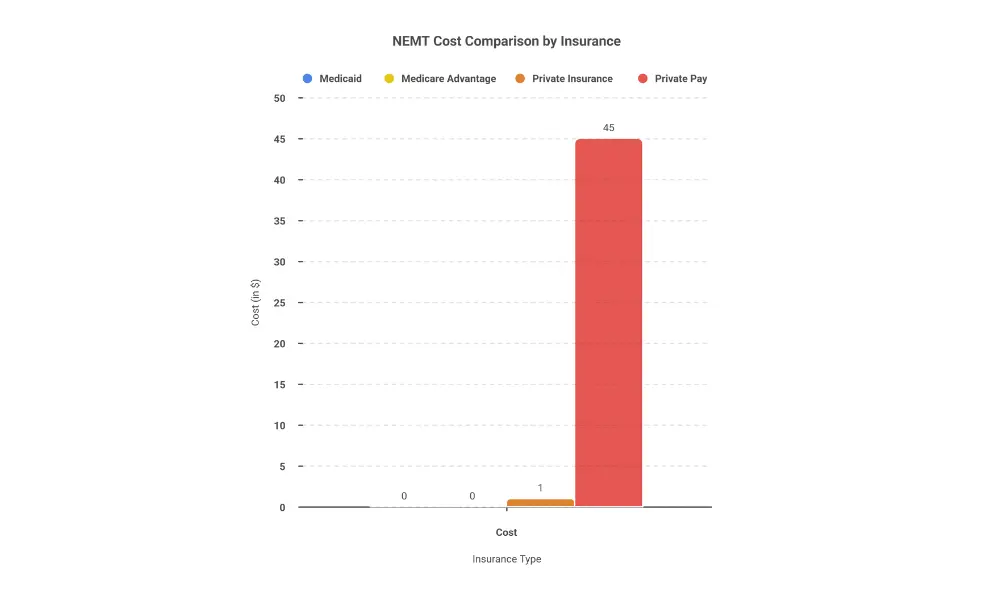
Medicaid Coverage: Free for Eligible Patients
If you have Medicaid, NEMT is completely free in all 50 states. This is a federally mandated benefit under 42 CFR § 431.53, meaning every state Medicaid program must provide transportation to covered medical services like doctor visits, dialysis, physical therapy, behavioral health appointments, and hospital outpatient procedures. There are typically no copays or out-of-pocket costs for Medicaid NEMT.
Your state assigns a transportation broker—usually Modivcare, MTM, or Access2Care—to manage ride scheduling, verify your eligibility, and coordinate with local NEMT providers. The broker tracks pickup and drop-off times, mileage, and ensures the trip was medically necessary. Providers submit mileage-based claims to the state or your managed care organization for payment.
Medicaid NEMT coverage varies significantly by state, with reimbursement rates determining provider availability. Providers and patients can check current rates in our 2026 Medicaid NEMT Rates by State directory.
All state Medicaid programs must provide NEMT under federal law 42 CFR § 431.53 as mandated by the Centers for Medicare & Medicaid Services.
Medicaid NEMT covers ambulatory, wheelchair, stretcher, and bariatric transportation when medically necessary, including door-to-door assistance if you need help getting to and from the vehicle. What Medicaid doesn’t cover are non-medical trips like grocery shopping, social events, or appointments for services not covered by your Medicaid plan.
State systems vary slightly. Some states like Louisiana and Florida use a broker model where private companies manage all rides. New York uses fee-for-service where providers submit claims directly. Many states integrate NEMT into managed care organizations (MCOs) like Centene or UnitedHealthcare.
Healthcare facilities and NEMT providers must navigate complex NEMT billing services and Medicaid reimbursement processes to ensure proper payment for transportation services.
Medicare Coverage: Very Limited for Traditional, Variable for Advantage
Traditional Medicare (Parts A and B) does not cover routine NEMT. It only covers emergency ambulance services for life-threatening conditions that require immediate medical intervention. If you have Original Medicare and need regular transportation to appointments, you’ll need to pay out-of-pocket or find alternative coverage.
Medicare Advantage (Part C) plans often include NEMT as a supplemental benefit, but coverage varies significantly by plan and insurer. Some plans offer 24 to 50 one-way trips per year, while others provide mileage-limited benefits or no NEMT at all. Copays typically range from $0 to $20 per one-way trip. Special Needs Plans (SNPs) designed for people with chronic conditions generally offer more generous NEMT benefits than standard Medicare Advantage plans.
To verify your Medicare Advantage coverage, check your plan’s Summary of Benefits document, log into your plan’s online portal, or call the customer service number on the back of your insurance card. You can also contact 1-800-MEDICARE for general guidance, though they’ll direct you to your specific plan for coverage details.
Private Insurance: Check Your Plan
Private insurance NEMT coverage is highly variable and not federally mandated. Major carriers like UnitedHealthcare, Aetna, and Blue Cross Blue Shield may cover NEMT for chronic conditions or life-sustaining treatments like dialysis, typically with limits of 50 to 100 trips per year depending on your specific plan.
Prior authorization is often required before booking rides. Call your insurer’s customer service or check your online portal to verify coverage before your first trip. Ask specifically: “Is this trip covered under my plan?” “Is prior authorization required?” and “Are there mileage or trip limits I should know about?” Some plans reimburse you after you pay out-of-pocket rather than paying the provider directly, so keep all receipts and trip documentation for claims submission.
Private insurance typically doesn’t cover non-medical trips, rides exceeding mileage limits, or multiple stops for personal errands.
Private Pay Rates: What to Expect
If you don’t have insurance coverage or your benefits are exhausted, you can pay NEMT providers directly. Rates vary by vehicle type and distance. Ambulatory service in a standard sedan or minivan typically costs $45 to $60 base rate plus $1.50 to $2.50 per mile. Wheelchair-accessible vans cost $75 to $120 base rate plus $3 to $4.50 per mile. Stretcher transport is the most expensive at $200 to $350 base rate plus $5 to $8 per mile.
Wait time fees apply if the driver waits more than 5 to 10 minutes after arriving, typically charging $15 to $30 per hour. After-hours, holiday, or emergency trips may have additional surcharges. Mileage is calculated from your pickup location to your destination, including any reroutes due to traffic or road closures. Urban areas tend to have higher rates than rural areas.
Payment Methods Accepted
Most NEMT providers accept cash (exact amount preferred), credit or debit cards via mobile terminals or apps, and personal checks with prior notice. Some providers offer payment plans or installment billing for patients who need frequent rides and can’t pay the full amount upfront.
If you’re an NEMT business owner looking to understand billing requirements, reimbursement rates, and compliance obligations, check out our complete NEMT billing guide for providers. Learn the 7-step billing process, HCPCS codes, and strategies to achieve 95%+ clean claim rates.
Financial Assistance Options
If you can’t afford private pay rates, several assistance programs may help. Hospital-affiliated charity care programs offer transportation vouchers or reduced rates for low-income patients. Community nonprofits and Area Agencies on Aging provide transportation assistance for seniors and disabled individuals.
Veterans enrolled in VA healthcare can access the Beneficiary Travel (BT) program for mileage reimbursement at $0.415 per mile, or use the Veterans Transportation Service (VTS) for free shuttle rides at select VA medical centers. Highly Rural Transportation Grants (HRTG) serve veterans in remote areas. Some private NEMT providers offer sliding scale fees based on income or medical need—ask when you call to book.
How to Verify Coverage Before Booking
Always verify coverage before your first ride to avoid denied trips or surprise bills. Call your broker (for Medicaid), insurance company, or the NEMT provider directly. Have your insurance ID number, name, date of birth, and appointment details ready. Ask if the trip is covered, whether prior authorization is needed, and if there are mileage or trip limits that apply.
Keep your insurance card, any authorization numbers, and trip confirmation numbers for your records. If a claim is denied or you’re billed unexpectedly, contact the broker or provider first with your documentation. You can escalate to your insurance company’s appeals department or, for Medicaid, request a state fair hearing if the issue isn’t resolved.
💰 **QUICK COST COMPARISON**
| Insurance Type | Patient Cost | Typical Limits |
|—————|————–|—————-|
| **Medicaid** | $0 (free) | Unlimited medically necessary trips |
| **Medicare Traditional** | Not covered | Emergency ambulance only |
| **Medicare Advantage** | $0-$20 copay | 24-50 trips/year (varies by plan) |
| **Private Insurance** | Varies | 50-100 trips/year (if covered) |
| **Private Pay** | $45-$350+ | Pay per trip |
Safety Measures & COVID-19 Protocols
NEMT providers follow strict safety standards to protect passengers during every ride. From driver qualifications to vehicle maintenance to infection control, multiple layers of safety protocols keep you secure.
Driver Qualifications and Training
NEMT drivers undergo much more rigorous screening than regular rideshare drivers. Every driver must pass FBI fingerprinting or state-approved background checks, drug and alcohol testing before employment plus random testing throughout their career, and maintain a clean driving record with no major violations. They complete defensive driving training—typically eight or more hours—that includes maneuvering larger wheelchair-accessible vans safely.
All NEMT drivers are certified in CPR and First Aid by the American Heart Association and complete Passenger Assistance Safety and Sensitivity (PASS) training. PASS training teaches them how to safely assist passengers with mobility impairments, visual impairments, dementia, and bariatric needs. Drivers receive annual refresher courses on ADA compliance, wheelchair and equipment securement, infection control procedures, and emergency response protocols.
NEMT vehicles and drivers must comply with Americans with Disabilities Act (ADA) accessibility requirements established by the U.S. Department of Justice to ensure safe, accessible transportation for all passengers.
Vehicle Safety and Maintenance Standards
NEMT vehicles must meet higher safety standards than personal vehicles. Drivers complete daily pre-trip inspections checking tires, brakes, seatbelts, and wheelchair lift or ramp function before picking up any passengers. Every vehicle undergoes annual DOT or state-mandated safety inspections. Most NEMT contracts require vehicles to be no more than 10 to 12 years old with under 250,000 to 300,000 miles to ensure reliability.
Every NEMT vehicle carries safety equipment including an ABC-rated fire extinguisher, a first-aid kit compliant with bloodborne pathogen standards, reflective safety vests and triangles for roadside emergencies, and seatbelt cutters or webbing cutters for urgent situations. Vehicles also have spare tires, jacks, basic roadside kits, and communication devices for constant dispatch contact.
🚨 **MEDICAL EMERGENCY DURING TRANSPORT**
If you experience chest pain, difficulty breathing, severe allergic reaction, or any life-threatening symptoms during your NEMT ride, **tell your driver immediately**. They are trained in CPR and First Aid and will call 911 right away. The driver will pull to a safe location, provide basic medical assistance, and stay with you until paramedics arrive.
What to Do If Something Goes Wrong
Most NEMT rides go smoothly, but knowing how to handle problems protects your rights and ensures issues get resolved quickly. Here’s exactly what to do when something goes wrong.
Problems During Your Ride
If your driver behaves unprofessionally—being rude, driving unsafely, making inappropriate remarks, or acting in ways that make you uncomfortable—stay calm and note the driver’s name and vehicle ID number. Don’t argue or escalate the situation. Call your broker’s hotline immediately after the ride ends or ask to be returned home if you feel unsafe.
If the vehicle has unsafe conditions like broken seatbelts, a faulty wheelchair lift, slippery floors, or other hazards, refuse to board or ask to exit the vehicle immediately. Your safety comes first. Call your broker’s dispatch line right away, explain the safety issue, and request an alternate vehicle. Take photos of the unsafe conditions if possible—this documentation strengthens your complaint.
If you’re dropped off at the wrong location, verify your appointment address with the driver. If they insist they’re at the correct address but you know they’re not, call your broker’s dispatch immediately while still in the vehicle. Provide your trip reference number and confirm the correct destination. Don’t get out in an unfamiliar or unsafe location.
Service Problems: No-Shows and Delays
If your driver doesn’t show up within your pickup window, wait an additional 15 minutes, then call your broker’s “Where’s My Ride?” hotline. Provide your trip confirmation number and request an immediate status update. If the driver is more than 30 minutes late, ask for supervisor escalation and request reassignment to an alternate provider. Provider no-shows are taken very seriously—you won’t be charged, and the provider may face penalties.
If the wrong vehicle type arrives—for example, a regular sedan when you need a wheelchair-accessible van—do not attempt to board if it’s unsafe. Call your broker immediately for reassignment to the correct vehicle. This is the provider’s error, not yours, and won’t count as a patient no-show.
If your broker denies service for eligibility or scheduling reasons and you believe the trip is medically necessary and covered, request a written denial with the specific reason. You have the right to appeal through your state’s Medicaid grievance process.
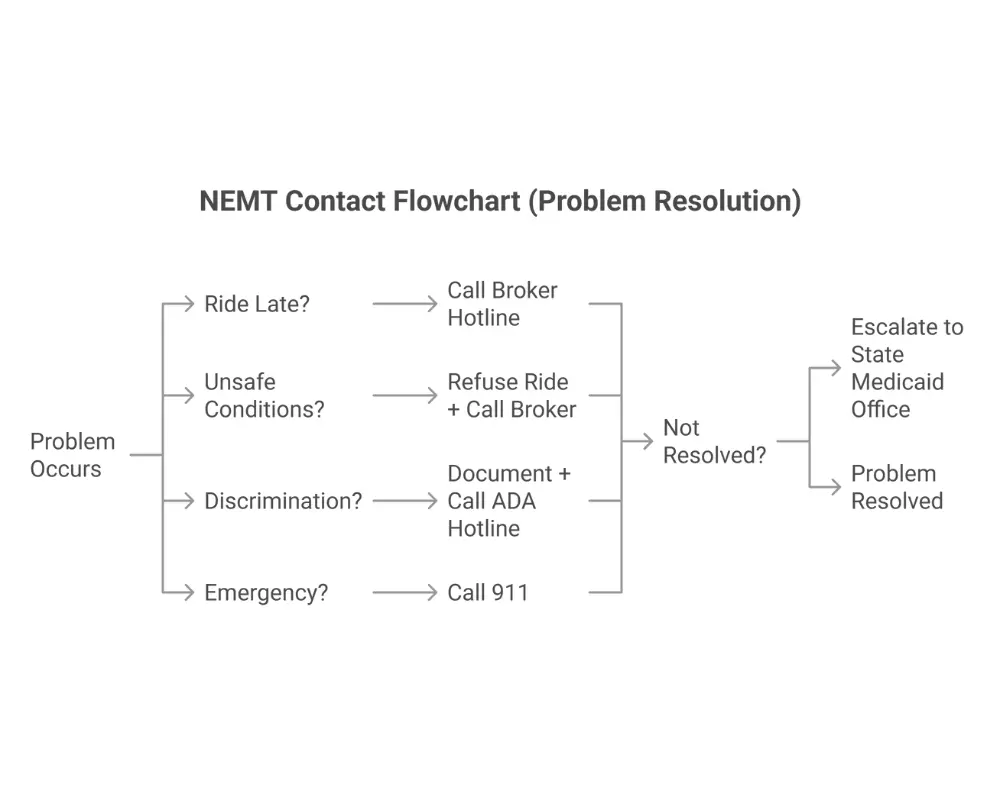
Step 1: Contact the Provider or Broker
For any problem, your first step is calling your broker’s customer service or quality management line. Major brokers have dedicated complaint systems:
- Modivcare: 1-855-818-6929 or online form
- MTM: 1-866-436-0457 or Quality Management department
- Veyo: 1-800-924-1149 or support portal
Clearly state: “I want to file a formal grievance.” Provide the date and time of your ride, scheduled pickup time and actual arrival time, driver name and vehicle number, trip origin and destination, and a detailed description of what went wrong. Include any witnesses if applicable. Request a reference number for your complaint—you’ll need this for tracking and potential escalation.
Expect a response within 24 to 72 hours for most complaints. Urgent safety issues should be addressed within 24 to 48 hours. The broker will review GPS data, driver logs, and trip records to investigate your complaint.
Step 2: Escalate to State Agencies
If the broker doesn’t resolve your issue within 14 to 30 days, or if the problem is serious or recurring, escalate to your state Medicaid office. Your state Medicaid program oversees broker compliance and has the authority to enforce service standards. Find your state’s Medicaid complaint line on their website or call the general Medicaid hotline.
For safety-related issues, contact your state Department of Health Services. For discrimination or accessibility violations, file with the ADA hotline at 1-888-446-4511 (Department of Transportation ADA line). Standard grievances are typically resolved within 30 days, but expedited appeals for life-sustaining care like dialysis can be processed in 24 to 48 hours.
Reporting Serious Issues
Some problems require immediate action beyond the normal complaint process. If you witness or experience unsafe driving that puts lives in danger, call 911 if the situation is immediate, then report to your broker afterward. For discrimination or harassment based on disability, race, language, or other protected characteristics, contact your broker’s Section 1557 Coordinator and file with the ADA hotline within 180 days.
Billing fraud—such as being charged for rides you didn’t take or excessive fees—should be reported to your state insurance fraud hotline. If you experience physical assault or any criminal behavior, call local law enforcement immediately by dialing 911.
Documentation Best Practices
Strong documentation makes your complaint much more effective. Always record the date and time of the incident, driver name and vehicle number, a full description of what happened, photos of unsafe conditions if safe to take them, witness names and contact information if anyone saw what occurred, and the medical impact such as a missed appointment or delayed treatment. Keep a log of all phone calls, emails, and messages related to your complaint, including who you spoke with and when.
Your Patient Rights
You have the right to safe, timely transportation to medical appointments. You have the right to file complaints without retaliation or service denial. You have the right to non-discriminatory service regardless of disability, race, language, or other protected characteristics. You have the right to a fair appeal or state hearing if service is denied or restricted. Transportation brokers and providers cannot punish you for filing legitimate complaints—that’s illegal under federal Medicaid protections.
📞 **KEEP THESE NUMBERS SAVED**
**Your Broker Hotline**: [Write it here: ____________]
**State Medicaid Complaint Line**: [Your state number]
**ADA Hotline**: 1-888-446-4511
**Emergency**: 911
Save these in your phone before your first ride so they’re accessible when you need them.
Frequently Asked Questions
How much does non-emergency medical transport cost per hour?
If you have Medicaid, NEMT is completely free—no copays or out-of-pocket costs for medically necessary trips. Medicare Advantage plans typically charge $0 to $15 per ride, depending on your plan.
For private pay: Ambulatory service costs $45 to $60 base fare plus $1.50 to $3 per mile. Wheelchair vans run $75 to $125 plus $3 to $5 per mile. Stretcher transport costs $200 to $350 plus $5 to $10 per mile. Wait time charges are $30 to $50 per hour if the driver waits more than 15 to 30 minutes.
Will Medicare pay for non-emergency transport?
Traditional Medicare (Parts A & B) does not cover routine NEMT—only emergency ambulances for life-threatening situations.
Medicare Advantage (Part C) sometimes covers NEMT as a supplemental benefit, typically offering 24 to 50 one-way trips per year with $0 to $15 copays. Coverage varies significantly by plan. Check your Evidence of Coverage document or call 1-800-MEDICARE to verify your specific benefits.
Dual-eligible patients (Medicare + Medicaid) get full NEMT coverage through Medicaid with no trip limits.
How to set up a non-emergency transportation service?
For patients: Contact your insurance broker (Modivcare, MTM, or Veyo for most Medicaid/Medicare Advantage plans). Register with your member ID, doctor’s information, and appointment details. Set up standing orders for recurring appointments like dialysis to avoid calling for each trip. Registration takes one to two business days.
For entrepreneurs: Starting an NEMT business requires state licensing, DOT registration, $1M+ commercial liability insurance, and ADA-compliant vehicles. [Link to full business startup guide]
What to do if you don’t have a ride home from the hospital?
Talk to the hospital discharge planner or social worker immediately—hospitals cannot discharge you without arranging safe transportation. They can coordinate same-day NEMT through your insurance broker, usually within one to four hours.
Alternatives include: Hospital volunteer programs, Uber Health or Lyft Medical (arranged by the hospital), community transportation services, or the 211 helpline for emergency assistance. Always arrange discharge transportation before leaving the hospital.
Can family members or caregivers ride with me?
Yes, one companion is usually allowed at no extra charge, space permitting. Companions are required for patients under 18, those with cognitive impairments, or after surgery/sedation.
Inform your broker when booking that you need a companion. Provide their name and relationship. Wheelchair and stretcher vehicles may have limited companion seating due to medical equipment.
What if I need to make multiple stops during my trip?
Medicaid NEMT does not allow multiple stops—only direct routes from home to appointment to home. Pharmacy stops connected to your medical appointment may be approved in some states.
Private pay NEMT may allow multiple stops for an additional $15 to $25 per stop or hourly rates. Request this when booking. Each medical appointment requires a separate trip booking.
Can I use NEMT for non-medical appointments?
No. NEMT is strictly for medical care: doctor visits, hospital treatments, dialysis, therapy, mental health appointments, dental/vision care (if covered), medical testing, and pharmacy trips for prescriptions.
Not covered: Grocery shopping, social visits, employment, banking, religious services, or personal errands. Use public transit, paratransit, senior center transportation, or rideshare for non-medical needs.
What if I have an emergency during transport?
All NEMT drivers are CPR and First Aid certified. If you have a medical emergency during your ride, the driver will pull over safely, call 911, contact dispatch, and divert to the nearest emergency room if needed.
Vehicles carry first aid kits and communication devices for immediate help. Always inform your driver of serious medical conditions when they pick you up and carry emergency medications with you.
How do I switch NEMT providers if I’m unhappy?
Contact your insurance broker with documented reasons (dates, specific issues like late pickups or safety concerns). The broker can reassign you to a different provider within their network, usually within 24 to 48 hours.
Medicaid patients must have valid documented reasons—repeated service failures or safety issues. Private pay passengers can switch anytime without approval.
Is tipping my NEMT driver expected or required?
No, tipping is not required or expected, especially for Medicaid and Medicare rides where you’re not paying out-of-pocket.
If you choose to tip for exceptional private pay service, $5 to $10 is appreciated but never mandatory. Better alternatives: Leave positive feedback with the company, submit online reviews, or send compliments to the driver’s supervisor. Drivers value respect and recognition as much as tips.
Tips for a Better NEMT Experience
Following a few simple best practices makes NEMT rides smoother, more reliable, and less stressful for everyone involved.
Communicate Early and Often
Confirm your ride 24 to 48 hours before your appointment. Call your broker or check the mobile app to verify your pickup address, appointment time, mobility needs, and any medical equipment you’re bringing. This simple step catches booking errors before they become problems and gives you time to make alternative arrangements if something’s wrong.
Update your provider immediately when plans change. If your appointment time shifts, your address changes, or your mobility needs evolve—like getting a new wheelchair or starting oxygen therapy—notify the broker as soon as possible, ideally 24 hours in advance. Last-minute changes cause confusion and may result in the wrong vehicle type or missed rides.
Keep a ride log tracking dates, times, driver names, vehicle ID numbers, and any issues you encounter. This documentation is invaluable when filing complaints, disputing billing errors, or identifying patterns in service quality. Save all provider and broker phone numbers in your contacts, record confirmation numbers for every ride, and jot brief notes about any promises or instructions given during phone calls.
Build Positive Relationships with Drivers
Be ready 15 minutes before your pickup window starts. Drivers follow tight schedules serving multiple passengers, and delays affect everyone on the route. Greet your driver politely, clearly explain any assistance you need like door-to-door help or equipment handling, and show patience when traffic or multi-stop routes cause unavoidable delays.
Respect the vehicle and professional boundaries. Avoid wearing strong fragrances in the confined space, keep conversations appropriate and friendly but professional, and don’t eat or drink unless the driver approves. Drivers manage complex routes under time pressure while ensuring passenger safety—recognizing the difficulty of their job with basic courtesy goes a long way.
Provide feedback after your rides. If a driver provides exceptional service, call the company or submit an online review mentioning them by name—this recognition often benefits drivers directly through performance evaluations. For problems, give constructive criticism that’s specific and solution-focused soon after the ride while details are fresh. If you develop a relationship with a regular driver who knows your routine and equipment well, ask if you can request them for future trips.
Maximize Your NEMT Benefits
Set up standing orders for recurring appointments like dialysis three times a week, weekly physical therapy, or regular chemotherapy sessions. Standing orders automatically schedule your rides without requiring phone calls for each trip, reduce booking hassles, and often receive priority treatment from providers. Notify your broker immediately if appointment days or times change so they can adjust the schedule.
Schedule strategically to improve service quality. Avoid peak demand times—Monday, Wednesday, and Friday mornings between 7:00 and 10:00 AM are the busiest periods, especially in areas with many dialysis patients. Mid-week or afternoon appointments often mean shorter wait times and more punctual pickups. Allow buffer time in your schedule for pickup windows and potential delays. If your insurance allows, coordinate multiple appointments at the same medical facility on the same day to minimize trips.
Know When to Consider Alternatives
NEMT may not always be the best option. For very short distances under five miles with last-minute scheduling needs, rideshare services like Uber or Lyft might be faster and similarly priced. NEMT typically requires 24 to 48 hours’ advance notice and isn’t designed for immediate on-demand requests.
For non-medical trips, which NEMT doesn’t cover, explore ADA-accessible paratransit services for errands, public transit if it’s safe and accessible for your needs, senior center transportation programs, or community volunteer driver groups. Calculate the total cost including your time and convenience, evaluate how critical punctuality is for your specific situation, and compare all realistically available options.
Common Mistakes to Avoid
Don’t wait until the last minute to confirm rides or assume no-shows have no consequences. Don’t be unprepared when your vehicle arrives or fail to communicate your mobility and equipment needs clearly. Keep provider contact information easily accessible, treat drivers with respect, document any service issues, and always plan your return trip realistically based on how long your appointment typically takes.
💡 **PRO TIP: The 24-Hour Confirmation Call**
Make it a habit to confirm every NEMT ride the day before. Set a phone reminder for 24 hours before each appointment. This one simple action prevents 90% of pickup problems, ensures correct vehicle assignment, and gives you time to fix issues before they cause missed appointments.
Finding NEMT Providers in Your Area
Finding reliable NEMT providers starts with understanding whether your insurance assigns you to a specific broker or allows you to choose providers directly.
How to Find NEMT Phone Numbers and Providers
Most Medicaid and Medicare Advantage plans assign you to a transportation broker who manages all ride scheduling and provider coordination. Check your insurance card for transportation broker information, or call your plan’s member services number and ask: “Who is my transportation broker, and what’s their phone number?” Request a list of approved NEMT providers in your area and verify that each can accommodate your specific mobility needs—wheelchair access, stretcher transport, or bariatric equipment.
Online searches can help locate providers. Visit your state’s Medicaid website and navigate to the NEMT or transportation section where broker contact information is listed. Use 211.org and enter your zip code to find local non-profit transportation services and shuttle programs. Google searches work best with specific keywords like “wheelchair transport Sacramento” or “stretcher transport near me” rather than generic terms.
Healthcare facilities often have preferred providers. Ask your doctor’s office, hospital discharge planner, dialysis center, or medical equipment supplier for recommendations—they work with NEMT companies regularly and know which ones are reliable. Community resources like your local Area Agency on Aging, disability services organizations, and community health centers also maintain provider lists and can help connect you with appropriate services.
NEMT companies looking to attract more patients should invest in a professional NEMT website development strategy that makes booking and information access seamless for users.
Major National NEMT Brokers
ModivCare (formerly LogistiCare) is the largest NEMT broker in the United States, operating nationwide with services for Medicaid and Medicare Advantage members. Contact them at 1-866-907-1342 or through modivcare.com. They offer ambulatory, wheelchair, and stretcher transport with both phone and mobile app scheduling.
MTM, Inc. serves 31 states plus Washington, D.C., focusing primarily on Medicaid transportation with a large provider network. Call 1-866-255-6869 or visit mtm-inc.net for app-based ride booking and coordination.
Access2Care operates in 29 states with an emphasis on wheelchair-accessible vans and technology-enabled scheduling. Reach them at 1-888-676-6622 or access2care.com.
Veyo uses an “Uber-like” model with app-based on-demand scheduling in select states including Utah, Arizona, and California. Contact them at 1-866-205-8962 or veyo.com. Veyo is expanding into new markets but isn’t yet available nationwide.
Always verify with your insurance which broker or providers are in your plan’s network—using an out-of-network provider may result in denied coverage or unexpected bills.
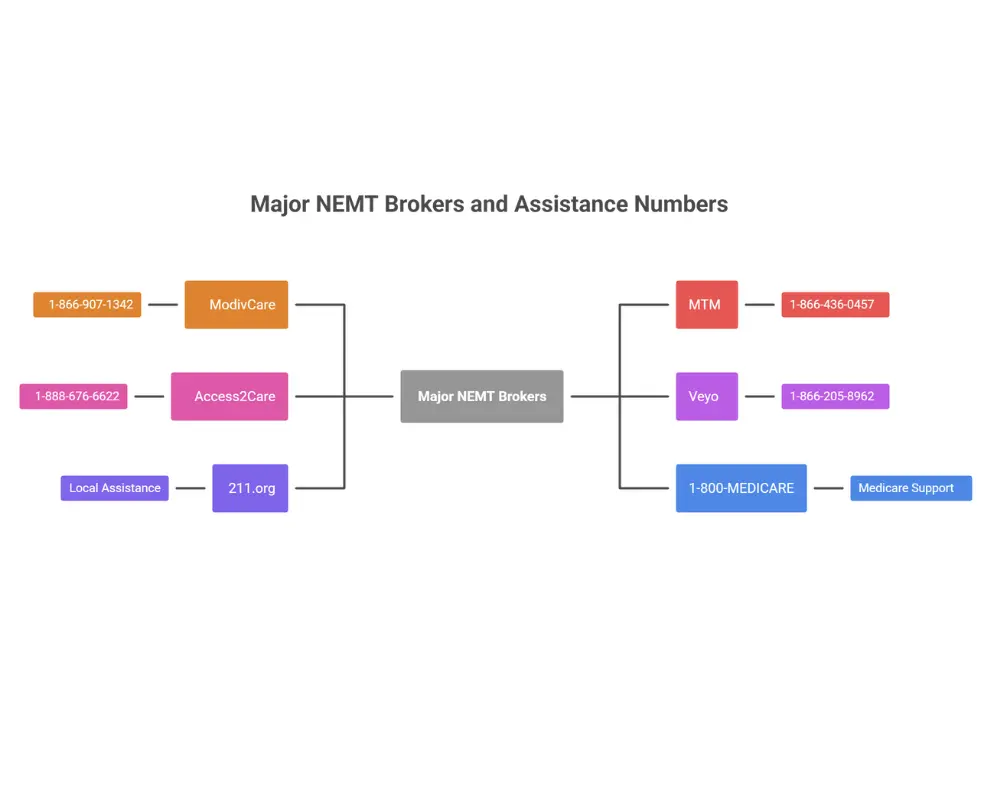
Finding Local and Regional Providers
Local NEMT companies often provide more personalized service than large national brokers. They have direct relationships with nearby hospitals, better knowledge of local geography and traffic patterns, faster response times for same-day needs, and stronger community reputations you can verify through neighbors or healthcare providers.
Search Google for “[your city] NEMT” or “medical transportation [your city].” Check the Better Business Bureau website for licensing verification and complaint history. Contact your state’s transportation licensing board to confirm credentials and safety records. Ask local hospitals and clinics which companies they recommend for patient transport.
How to Verify Provider Safety and Reliability
Before booking with any provider, verify they meet basic safety standards. Confirm they hold a valid state NEMT license—ask for the license number and check it with your state’s licensing board. Ensure they carry adequate insurance, with most states requiring at least $1 million in liability coverage. Review their safety inspection records and look for online reviews on Google, Yelp, or the Better Business Bureau, aiming for providers with ratings above four stars.
Ask these questions when you first contact a provider: Are you licensed in my state? What’s your insurance coverage amount? What types of vehicles do you have available? What are your typical wait times for pickup? How far in advance must I book? What’s your cancellation policy? Do you accept my specific insurance plan? Can I request the same driver for regular appointments? How do I file a complaint if there’s a problem? What are your current COVID-19 safety protocols?
Watch for red flags that indicate an unreliable or potentially unsafe provider: unwillingness to provide license or insurance information, consistently poor reviews mentioning safety concerns or late arrivals, unprofessional phone interactions, unclear or missing cancellation policies, reluctance to answer your questions, or prices significantly lower than competitors, which may indicate corner-cutting on safety or insurance.
State-Specific Information
California (Medi-Cal): ModivCare manages most Medi-Cal transportation. Call 1-866-743-7717 or visit dhcs.ca.gov for your county’s specific broker information.
Texas: MTM, Inc. handles Texas Medicaid transportation. Contact 1-866-386-2392 or visit txmedicaid.com. Texas requires physician certification for wheelchair and stretcher transport.
For other states, visit Medicaid.gov/State-Overviews and click on your state to find NEMT broker contact information and enrollment instructions.
Sacramento, California Example
Sacramento residents with Medi-Cal can access several local providers: Rapid Response at (916) 419-1232 offers ambulatory, wheelchair, gurney, and dialysis transport. America West at (888) 678-6801 provides door-to-door, stretcher, and long-distance services. Blue Fin NEMT at (916) 915-4545 specializes in wheelchair-accessible local service. Transport Me Now at (916) 246-0663 focuses on hospital discharge and post-surgery transport.
SacRT GO Paratransit offers $5 door-to-door rides for eligible Sacramento County residents at (916) 321-2877. Dial 211 from any phone in Sacramento to reach community resource specialists who can provide curated lists of senior ride programs and volunteer transportation services.
Quick Safety Tips
Keep a ride log tracking dates, driver names, vehicle numbers, and any issues you encounter. Confirm all appointments 24 to 48 hours before pickup. Verify the driver can handle your specific equipment—wheelchair securement, oxygen tanks, or stretcher needs. For recurring medical appointments, set up standing orders to ensure consistent service and reduce booking hassles.
🔍 **VERIFY BEFORE YOU RIDE**
Before booking with any NEMT provider:
✓ Confirm state license (ask for license number)
✓ Verify $1M+ liability insurance
✓ Check Better Business Bureau rating
✓ Read recent Google/Yelp reviews
✓ Ask for references from healthcare facilities
Five minutes of verification prevents hours of problems.
Non-Emergency Medical Transportation Requirements & Eligibility
Understanding NEMT eligibility requirements helps ensure your rides are approved and you have the right documentation ready when you book.
Federal Medicaid NEMT Requirements
All state Medicaid programs must provide NEMT under federal law 42 CFR § 431.53. This requirement ensures Medicaid beneficiaries have access to medically necessary services when they lack other means of transportation. Coverage includes doctor visits, hospital treatments, dialysis, physical therapy, mental health appointments, and any service covered under your Medicaid plan. Patient cost is typically zero—no copays or out-of-pocket expenses for approved trips.
Medical necessity means your appointment requires NEMT because you cannot safely access care otherwise. Your doctor, insurance broker, or state Medicaid agency determines medical necessity based on your condition, mobility limitations, and lack of alternative transportation options. If your request is denied, you have the right to appeal with supporting documentation from your physician.
Eligibility by Insurance Type
Medicaid beneficiaries qualify if they have active coverage, a medically necessary appointment for a Medicaid-covered service, and no other safe transportation available—meaning no working vehicle, no driver’s license, inaccessible public transit, or physical or cognitive conditions that make independent travel unsafe. Some states like California, Minnesota, New York, and New Jersey require prior authorization for certain trip types.
Medicare Advantage plans vary significantly. Check your plan’s Summary of Benefits to see if NEMT is included, how many trips are allowed per year (typically 12 to 24 one-way trips), whether prior authorization is required, and which providers are in your network. You must use approved NEMT companies or your rides won’t be covered.
Private insurance coverage depends entirely on your specific plan. Some employer-sponsored or managed care plans cover NEMT for chronic treatments like dialysis or chemotherapy, but many don’t cover it at all. A doctor’s note documenting medical necessity and prior authorization are commonly required. Check whether your plan pays providers directly or reimburses you after you pay out-of-pocket.
Veterans enrolled in VA healthcare can access the Beneficiary Travel program for mileage reimbursement or Veterans Transportation Service for free shuttle rides at select VA medical centers, with eligibility based on service-connected disability rating or income level.
Required Documentation
Always bring your government-issued photo ID (driver’s license, state ID, or passport), insurance card with your member ID and plan information, and appointment confirmation from your doctor’s office, hospital, or clinic—this can be a printed letter, email, or portal screenshot.
Some states require a Prescription for Transportation, also called a Physician Certification Statement (PCS). States commonly requiring this include Texas, Florida, California, New York, Minnesota, and New Jersey, especially for wheelchair and stretcher transport. Contact your doctor’s office and request a “prescription for medical transportation.” The form must include your name and date of birth, your doctor’s name, license number, signature and contact information, your medical condition or reason requiring transport, frequency of trips needed (one-time, recurring, or chronic), and the type of vehicle required (ambulatory, wheelchair, or stretcher).
Prior authorization is frequently required for stretcher transport, bariatric vehicles, long-distance trips, out-of-network providers, or recurring appointments. Your broker typically handles this process, but sometimes your doctor’s office needs to submit the request.
What Qualifies as Medically Necessary
Covered trips include all medical appointments: primary care and specialists, hospital outpatient procedures, dialysis and chemotherapy, physical therapy and rehabilitation, mental health therapy and psychiatry, dental and vision care if your Medicaid plan covers these, medical testing like lab work or imaging, pharmacy trips to pick up prescriptions in states that allow this, medical equipment fitting or pickup, prenatal and well-child care, and substance abuse treatment.
Some conditions automatically qualify for NEMT: patients requiring dialysis or chemotherapy, anyone with physical disabilities preventing driving, visual impairments including legal blindness, cognitive impairments like dementia or intellectual disabilities, and post-operative restrictions where doctors prohibit driving.
NEMT does not cover non-medical trips including social visits, recreation, employment, grocery shopping, legal or financial appointments, or services not covered by your insurance plan. If you need transportation for these purposes, explore paratransit services, senior center programs, or volunteer driver networks.
Geographic and Frequency Limitations
Most states have no mileage limits for medically necessary trips within the state. Some states like New Jersey impose caps around 20 miles unless specialty care unavailable locally justifies longer travel. Out-of-state trips require approval and medical justification. Medicaid generally allows unlimited trips as long as they’re medically necessary, while Medicare Advantage and private insurance typically cap annual trips.
If Your Request Is Denied
Request a written explanation specifying why your trip was denied. Gather supporting documentation including a detailed letter from your doctor explaining medical necessity, proof you have no alternative transportation, and evidence of how denial impacts your health. File your appeal with your insurance broker or plan following their specific procedures. Track response timelines, which vary by state. Include physician statements, demonstrate lack of alternatives, and use your state’s official appeal forms for the strongest case.
📋 **PHYSICIAN CERTIFICATION STATEMENT (PCS)**
If your state requires a prescription for NEMT:
1. Call your doctor’s office
2. Request “Prescription for Medical Transportation”
3. Ensure it includes: diagnosis, vehicle type needed, frequency
4. Valid for 30-90 days (renewable for chronic conditions)
5. Submit to broker when booking rides
**States commonly requiring PCS:** CA, TX, FL, NY, MN, NJ
NEMT Business Information (For Providers & Entrepreneurs)
While this guide focuses on helping patients access NEMT services, healthcare providers and entrepreneurs often ask about the business side of non-emergency medical transportation. Here’s a brief overview of what’s involved in operating an NEMT company.
Federal and State Regulatory Requirements
Starting an NEMT business requires navigating complex federal and state regulations. At the federal level, you’ll need DOT registration and FMCSA compliance for commercial vehicle operations, strict adherence to ADA requirements ensuring wheelchair accessibility and disability accommodations, and HIPAA compliance protocols to protect patient privacy and medical information during transport.
State licensing varies significantly but typically includes a general business license plus transportation operating authority specific to your state, specialized NEMT licenses required in many jurisdictions, annual vehicle safety inspections with documented maintenance records, and comprehensive driver qualification standards including background checks, drug testing, CPR and First Aid certification, and defensive driving training.
Insurance and Financial Requirements
Commercial insurance requirements are substantial. NEMT providers must carry liability insurance with minimums typically starting at $1 million per occurrence, though higher coverage is often required for wheelchair-accessible vans and stretcher vehicles. You’ll also need commercial auto policies covering all vehicles in your fleet, workers’ compensation insurance for employees, and surety bonds in states that require financial guarantees for NEMT operators.
Operational Standards and Compliance
NEMT companies must maintain comprehensive policies and procedures covering daily operations, driver protocols and customer service standards, vehicle maintenance schedules and safety inspections, HIPAA compliance for handling patient information, emergency response procedures, quality assurance monitoring, and billing and documentation processes that satisfy Medicaid, Medicare Advantage, and private insurance requirements.
These documented procedures aren’t just bureaucratic requirements—they’re essential for qualifying for Medicaid broker contracts, protecting your business from liability claims, ensuring consistent high-quality service, and building trust with healthcare facility partners.
The NEMT Payer Landscape
NEMT businesses serve multiple revenue sources. Medicaid represents the largest market, with per-trip reimbursement through state brokers and zero out-of-pocket cost for patients, making it a stable, high-volume payer. Medicare Advantage plans contract with NEMT providers to offer transportation as a supplemental benefit, typically with limited annual trips but growing adoption. Private insurance coverage varies widely but often requires prior authorization and detailed medical documentation.
Healthcare facilities including hospitals, dialysis centers, and accountable care organizations increasingly contract directly with NEMT providers to reduce patient no-shows, improve treatment adherence, prevent readmissions, and lower overall healthcare costs. Private pay passengers and community programs funded by Area Agencies on Aging or non-profit organizations provide supplemental revenue streams.
Business Opportunity Overview
The NEMT industry offers compelling opportunities driven by an aging population requiring more medical appointments, chronic disease prevalence necessitating recurring transportation, and healthcare policy increasingly recognizing transportation as a social determinant of health. The business model benefits from multiple payer sources reducing reliance on any single revenue stream, relatively low to moderate startup costs compared to other healthcare ventures, and recession-resistant demand for essential medical transportation services.
However, success requires understanding complex regulations, maintaining rigorous safety and compliance standards, managing sophisticated scheduling and routing logistics, and building relationships with Medicaid brokers and healthcare facilities.
Learn whether non-emergency medical transportation is a good business opportunity based on market analysis, profit margins, and growth potential in your region.
NEMT providers must establish reliable billing and reimbursement systems to manage payments from Medicaid, Medicare Advantage, and private insurance efficiently.
Successful NEMT companies require a user-friendly website with online booking capabilities to streamline patient access and reduce administrative overhead.
Ready to Learn More?
For Entrepreneurs: Interested in starting your own NEMT business? Our comprehensive guide covers detailed licensing requirements by state, insurance and bonding specifics, vehicle acquisition and fleet management strategies, Medicaid broker contracting processes, operational best practices, financial projections and startup costs, and proven strategies for building a profitable NEMT company.
→ [Read the Complete Guide: How to Start a Non-Emergency Medical Transportation Business]
For Healthcare Providers: Looking to reduce patient no-shows and improve treatment adherence? Learn how NEMT partnerships can enhance patient outcomes, lower readmission rates, improve quality metrics, and demonstrate value-based care results while potentially reducing overall healthcare costs.
→ [Explore NEMT Healthcare Partnerships & ROI Analysis]
💼 **QUICK BUSINESS VIABILITY CHECK**
NEMT businesses typically need:
✓ $50,000-$150,000 startup capital (varies by fleet size)
✓ 6-12 months to secure Medicaid broker contracts
✓ 2-3 vehicles minimum to start operations
✓ State-specific licenses and $1M+ insurance
✓ Documented policies meeting CMS standards
**Is NEMT right for you?** [Take our business readiness assessment →]
Conclusion: Making NEMT Work for You
Non-emergency medical transportation exists to ensure that getting to your doctor’s appointment is never the reason you miss the care you need. Whether you’re managing a chronic condition like diabetes, attending regular dialysis sessions, or simply need help getting to routine checkups, NEMT is designed to remove transportation as a barrier to your health.
The most important things to remember: Book your rides at least 48 to 72 hours in advance when possible, and confirm every trip 24 hours before your appointment. Be ready 15 minutes before your pickup window starts with your ID, insurance card, and appointment confirmation in hand. Clearly communicate your mobility needs and any medical equipment you’re bringing when you schedule. If something goes wrong, you have the right to file complaints and appeal decisions—document everything and use the escalation channels available to you.
You have rights as an NEMT passenger. You’re entitled to safe, timely, non-discriminatory transportation to medically necessary appointments. Providers cannot retaliate against you for filing legitimate complaints. If your broker denies service you believe is covered, you can appeal through your state’s Medicaid fair hearing process. Resources are available—from your insurance broker’s customer service to state Medicaid ombudsmen to the 211 helpline connecting you with community transportation alternatives.
Don’t let transportation concerns keep you from getting care. Missed medical appointments lead to worse health outcomes, delayed diagnoses, and preventable complications that cost more in the long run. NEMT services millions of Americans every year, helping people attend dialysis that keeps them alive, physical therapy that restores mobility, cancer treatments that save lives, and routine checkups that catch problems early.
The NEMT system continues to improve with better technology like GPS tracking and mobile apps, stronger integration with healthcare systems, and expanded coverage as more Medicare Advantage plans add transportation benefits. As healthcare increasingly recognizes transportation as a social determinant of health, NEMT will remain an essential service ensuring everyone can access the care they need.
Use NEMT with confidence—you’ve earned this benefit, and it’s here to support your health journey.
Take Action: Your NEMT Resources
For Patients & Families: Get Started Today
Your next steps are simple. Call the number on your insurance card to confirm NEMT coverage and find your assigned broker. Schedule rides at least 48 to 72 hours before appointments—earlier for recurring treatments like dialysis or chemotherapy. Save your broker’s phone number and all provider contacts in your phone for quick access.
Download our free patient resources to stay organized and confident:
- NEMT First Ride Checklist – Everything you need ready before pickup: documents, equipment, contact information
- NEMT Documentation Organizer – Track confirmation numbers, physician certifications, and ride logs in one place
- Provider Contact Sheet Template – Quick reference for brokers, drivers, and emergency contacts
Bookmark this guide for future reference and share it with family members, neighbors, or friends who struggle with medical transportation. Post it to community groups or print a copy for your local senior center—helping others access NEMT improves health outcomes across your entire community.
For Healthcare Providers: Reduce No-Shows, Improve Outcomes
NEMT partnerships help healthcare facilities reduce patient no-show rates by up to 50%, improve treatment adherence for chronic conditions, lower readmission costs, and enhance patient satisfaction scores. Reliable transportation directly impacts your quality metrics and value-based care performance.
Learn how to integrate NEMT into your patient care strategy and build partnerships with reliable transportation providers.
→ [Explore Healthcare NEMT Partnership Benefits]
For Entrepreneurs: Start Your NEMT Business
The NEMT industry offers a growing, recession-resistant opportunity to serve your community while building a sustainable business. Multiple revenue streams from Medicaid, Medicare Advantage, healthcare facilities, and private pay create a diversified business model with essential service demand.
Starting an NEMT company requires understanding:
- State licensing and DOT registration requirements
- Commercial insurance and bonding ($1M+ liability)
- ADA-compliant vehicle specifications
- Medicaid broker contracting processes
- Operational policies meeting CMS standards
- Financial projections and startup capital needs
- Marketing strategies and facility partnerships
Ready to explore the complete business opportunity?
→ [Read Our Complete Guide: How to Start a Non-Emergency Medical Transportation Business]
Learn licensing requirements by state, vehicle acquisition strategies, Medicaid contracting step-by-step, operational best practices, financial modeling, and proven growth strategies from successful NEMT operators.