
Quick Definition NEMT routing software is a specialized tool that helps non-emergency medical transportation providers build, sequence, and adjust trip routes across multiple vehicles, vehicle types, and appointment windows. Unlike basic mapping tools, it accounts for wheelchair vans, stretcher transport, ambulatory riders, recurring dialysis runs, broker trip imports, and the documentation needed for billing and compliance.
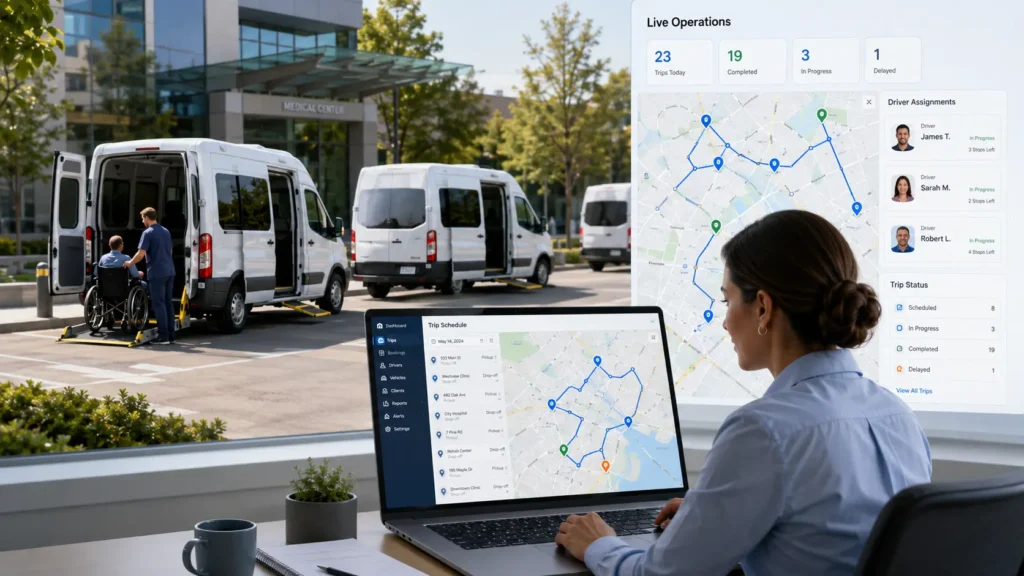
If you run an NEMT operation, you already know routing isn’t really about maps. It’s about whether your driver gets a dialysis patient to her chair by 7:00 a.m., whether your wheelchair van isn’t sitting empty halfway across town when a hospital discharge call comes in, and whether the trip you just completed will actually become a paid claim by the end of the week.
Most owners we work with started with basic maps, a whiteboard, a few group texts, and a spreadsheet. That works for two or three vehicles. It stops working the moment you add recurring trips, will-call returns, broker manifests, and same-day add-ons. Deadhead miles climb. Drivers get confused. Trips get missed. And the billing team finds out three days later that a trip happened without proper documentation.
The real goal is not just a shorter route. The real goal is a completed, documented, billable trip that moves smoothly from dispatch to driver app to billing workflow. That’s the angle most routing software guides miss — and it’s the angle this guide is built around.
This is focused specifically on NEMT routing software and route optimization — not a broad software roundup. If you want a wider comparison of dispatch, scheduling, billing, and reporting platforms, see our best NEMT software guide. Here, we’ll stay close to the routing problem: how it works, what to compare, what it costs, and how to choose a tool that actually fits a small or growing fleet.
We’ll also mention Elite Route Dispatch, our own affordable NEMT dispatch software, where it makes sense — not as a sales pitch, but because it’s specifically built for small and growing fleets that want routing, dispatch, EVV-style trip verification, and billing connected in one workflow.
Who this guide is for: This guide is for NEMT owners, dispatchers, startup operators, and small fleet managers comparing routing software. It’s especially useful if you currently manage routes with spreadsheets, paper manifests, phone calls, basic maps, or disconnected billing tools — and you’re starting to feel the operational seams.
Routing, Dispatch, EVV-Style Verification & Billing — One Workflow
Built for small and growing NEMT fleets. No enterprise complexity, no disconnected tools — just the workflow that helps completed trips become documented, billable claims.
See Elite Route Dispatch →What Is NEMT Routing Software?
Short answer: NEMT routing software is software that builds and adjusts vehicle routes for non-emergency medical transportation, accounting for appointment windows, mobility needs, recurring trips, broker requirements, and driver workflows. It’s the engine that decides which driver picks up which rider, in what order, and how the trip is documented for billing.
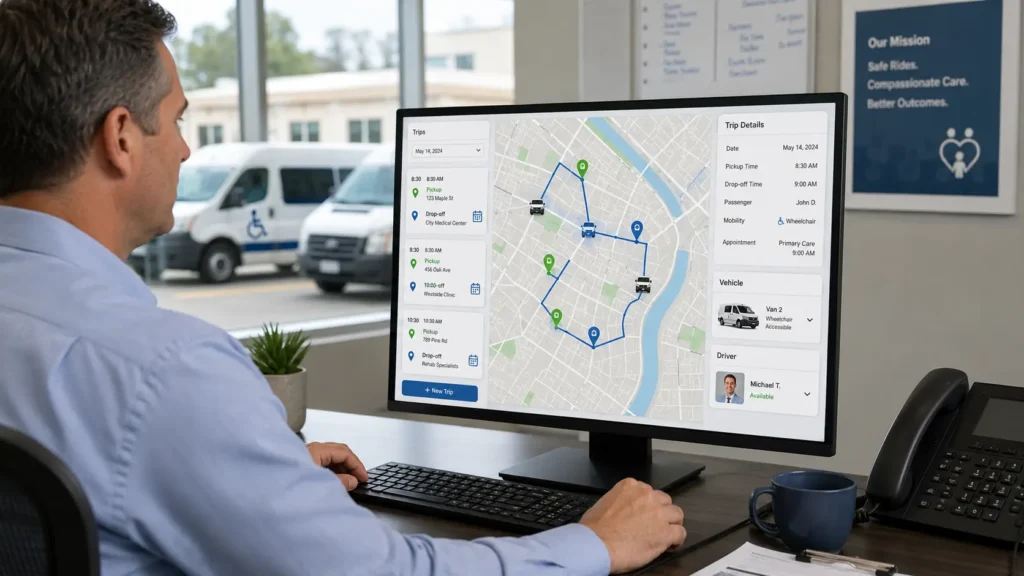
There’s a lot of overlap between three terms people use interchangeably:
- Routing is the sequence — which stops, in what order, on which vehicle.
- Scheduling is the time — what appointment, what window, what recurrence.
- Dispatching is the real-time — who’s actually rolling, who’s running late, who picks up the new call that just came in.
Good NEMT routing software handles all three, but routing is the layer that determines whether the day is efficient or expensive.
It’s also worth saying clearly: NEMT routing is not the same problem as delivery routing. A package doesn’t care if it waits an extra 15 minutes. A dialysis patient does. NEMT routing has to respect:
- Appointment time windows (often non-negotiable)
- Mobility constraints (wheelchair vans, stretcher vehicles, ambulatory)
- Recurring “standing orders” (same patient, same time, three days a week)
- Will-call returns (patient calls when ready, not on a schedule)
- Hospital discharges (unpredictable, often urgent)
- Same-day add-ons (broker calls at 9:00 a.m. for an 11:00 a.m. pickup)
- No-show patterns
- Driver hours and qualifications
Common use cases include scheduled dialysis runs, recurring therapy appointments, facility-to-facility transfers, ambulatory medical appointments, and broker-assigned trips from networks like ModivCare and MTM.
NEMT Routing and Scheduling: How They Work Together
Short answer: NEMT routing and scheduling are two sides of the same workflow. Scheduling decides when a trip happens. Routing decides how it’s sequenced across vehicles and stops. Dispatching manages what changes in real time. And all three only matter if the completed trip flows cleanly into billing.
A lot of operators use “routing” and “scheduling” interchangeably, especially when shopping for software. They’re not the same thing — and the difference matters when you’re comparing platforms.
Scheduling decides when the trip happens
Scheduling is the calendar layer. When a broker sends a trip for next Tuesday at 10:15 a.m., or when a dialysis patient sets up a standing order for Monday-Wednesday-Friday at 6:30 a.m., that’s scheduling. Good NEMT scheduling software handles recurring orders, appointment windows, ride-time limits, and advance booking without your dispatcher rebuilding the calendar every week.
This is also where most operators feel the first pain. Manually rekeying recurring trips, tracking will-call patterns, and double-booking vehicles because two tools don’t talk to each other — that’s a scheduling problem, not a routing problem.
Routing decides how the trip is sequenced
Once trips are on the calendar, routing decides how to deliver them efficiently. Which vehicle? In what stop order? Solo or shared with another rider going the same direction? With what mobility setup?
This is where automated NEMT routing earns its money. A dispatcher running 40 trips a day across 6 vehicles can’t manually optimize stop order, mobility matching, and ride-time limits in real time. The routing engine in a medical transport routing software platform does the math — usually a constrained version of the Vehicle Routing Problem — and produces a sequence that respects time windows, vehicle types, and driver hours.
Dispatching manages what changes in real time
Then the day actually happens. A no-show. Traffic. A hospital discharge call. A driver running 20 minutes late. Dispatching is the live layer that re-shuffles routes as conditions change. The strongest route optimization medical transport platforms re-optimize dynamically — they don’t just show you the problem, they suggest the cleanest fix.
Why routing and scheduling must connect to billing
Here’s where most platforms fall short. They optimize the route, capture the GPS trail, and stop. But trip data — pickup time, drop-off time, mileage, signatures, mobility level — is exactly what your billing workflow needs to generate a clean claim.
If your routing and scheduling system doesn’t hand that data off to billing, your team is re-keying it manually. Re-keying creates errors. Errors create denials. Denials create lost revenue. This is why we keep coming back to one idea throughout this guide: a shorter route only matters if the completed trip becomes a documented, billable claim.
For deeper coverage of the billing handoff side, see our NEMT billing guide and NEMT broker billing guide.
Why NEMT Route Optimization Matters for Profit
Short answer: Route optimization affects almost every line on your P&L — fuel, driver hours, vehicle utilization, on-time performance, and claim-ready documentation. The shorter, more efficient route only matters if the completed trip becomes a documented, billable trip at the end of the day.
Here’s what most small NEMT owners underestimate: routing inefficiency hides inside normal operations. You don’t see it on a single trip. You see it at the end of the month, when fuel is higher than expected, drivers logged more overtime than planned, and one of your vehicles only ran six trips a day instead of nine.
A real-world example: a dispatcher gets a same-day hospital discharge call at 1:45 p.m. for a wheelchair patient on the other side of the metro area. Without routing software, she’s juggling sticky notes, calling three drivers, checking who’s nearest, and guessing whether the 4:00 p.m. dialysis pickup will still work. With routing software, she sees vehicle locations live, the system suggests which van can absorb the discharge without breaking the dialysis window, and the dispatch goes out in 90 seconds. That’s the operational gap routing software actually closes.
The KPIs that matter for routing:
| KPI | What It Measures | Why It Matters |
|---|---|---|
| Deadhead miles | Miles driven without a paying rider | Direct cost with zero revenue |
| Loaded vs. unloaded miles ratio | % of miles producing revenue | Core efficiency metric |
| Cost per trip | All-in cost ÷ completed trips | Tells you if you’re profitable |
| Trips per vehicle per day | Daily productivity | Determines fleet capacity needs |
| On-time performance | % of pickups within window | Affects broker scorecards and contracts |
| Driver overtime hours | OT vs. base hours | Often the hidden routing cost |
| Clean claim rate | % of claims paid on first submission | Where routing meets billing |

A modeled example (not a guarantee): If a 6-vehicle fleet reduces deadhead miles by even 8% and improves vehicle productivity from 7 to 8 trips per day, the daily impact can be meaningful — both in fuel and in additional billable trips. The exact numbers depend on your trip mix, broker rates, geography, and how disciplined your billing handoff is. Results vary, and a shorter route only matters if it produces a completed, documented, billable trip.
That last point is the one most platforms gloss over. You can save 30 miles a day, but if the driver doesn’t capture the signature, the pickup timestamp, and the right documentation, the trip may not survive a broker audit — and the claim may face denials. This is why NEMT operators benefit from routing software that hands off cleanly to a billing workflow instead of routing software that ends when the route ends.
NEMT Route Optimization ROI Calculator
Modeled estimate only. Results vary based on trip mix, broker rates, geography, and operational discipline.
How NEMT Route Optimization Software Works
Short answer: NEMT route optimization software takes trip requests, vehicle and driver data, and constraints like time windows and mobility types, then uses an algorithm to assign stops to vehicles in an efficient sequence. The software updates routes in real time as conditions change and hands the trip data off to billing once the route is complete.
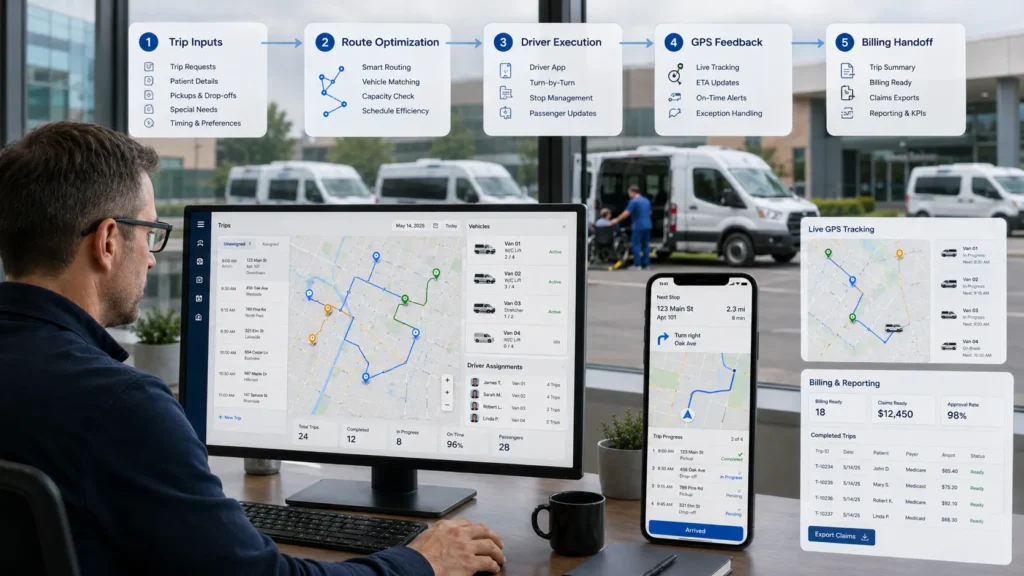
You can think of it as five connected stages:
1. Inputs — Trip requests (broker imports, phone-booked, recurring orders), vehicle profiles, driver schedules, mobility requirements, appointment windows, addresses, and pickup constraints.
2. Optimization engine — The actual algorithm. This is where the software solves what computer scientists call the Vehicle Routing Problem (VRP) — figuring out the best way to assign stops to vehicles. In NEMT, it’s usually a more specific version called VRP with time windows, or the Dial-a-Ride Problem, which adds constraints like maximum ride time per passenger.
3. Driver execution — Routes go to a driver app with turn-by-turn navigation, manifests, pickup confirmations, signature capture, and trip status updates.
4. GPS feedback — Live location, on-time status, and exception alerts feed back to the dispatcher. If a trip is running late, the software can suggest re-routing or moving a stop to another vehicle.
5. Billing/reporting handoff — Once the trip is complete, the data — pickup time, drop-off time, mileage, signatures, mobility level — is packaged for claim generation and reporting.
Static vs. dynamic routing
Static routing builds the route the night before and assumes it won’t change. Works for clean, recurring dialysis runs. Dynamic routing continuously re-optimizes throughout the day as cancellations, no-shows, add-ons, and traffic shift the picture. Most NEMT operations need a mix of both.
Multi-stop and multi-load routing
Multi-stop routing plans several stops for one vehicle on one run. Multi-load routing (or shared rides) means more than one passenger is in the vehicle at the same time, dropped off in sequence. This is where ride-time limits, mobility compatibility, and appointment windows all collide — and where the algorithm earns its keep.
Vehicle and rider matching
A stretcher patient can’t ride in an ambulatory sedan. A wheelchair rider needs a van with the right ramp and securement rating. Good routing software should help prevent assigning a vehicle that doesn’t match the rider’s documented mobility needs — which reduces refusals, rebooks, and broker friction.
Real-time adjustments
Cancellations, no-shows, hospital discharges, same-day add-ons, and traffic — the routing software re-runs the math and suggests the cleanest reshuffle.
In plain English: the software is doing the puzzle you’d otherwise be doing by hand at 6:30 a.m. with three coffees and a whiteboard.
Basic Maps vs. NEMT Routing Software
Short answer: Consumer navigation apps like Google Maps are excellent for turn-by-turn driving directions and a single trip. They’re not built for multi-vehicle NEMT dispatch, mobility matching, broker imports, EVV-style documentation, or billing handoff. Small fleets typically outgrow basic navigation tools once they’re managing recurring trips, broker manifests, or more than two or three vehicles.
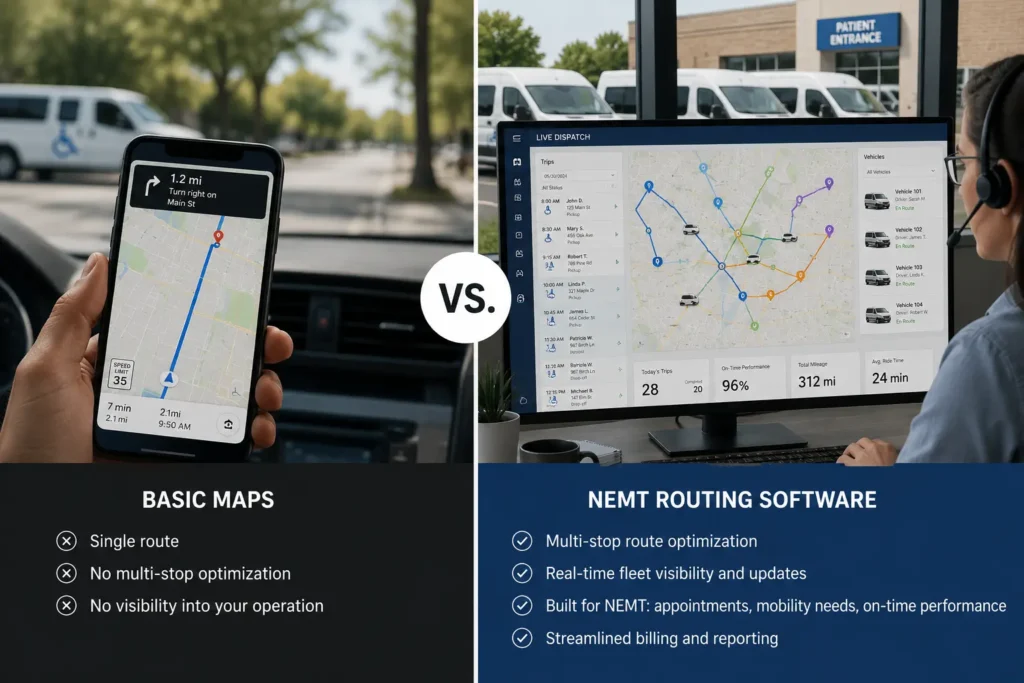
Let’s be fair. Google Maps is one of the best navigation tools ever built. Your drivers should keep using it (or a similar consumer navigation app) for actual driving directions. But it’s a navigation tool, not a dispatch and compliance system.
| Feature | Google Maps / Basic Maps | NEMT Routing Software | Why It Matters |
|---|---|---|---|
| Turn-by-turn navigation | ✅ Excellent | ✅ Usually built in or integrated | Drivers need both |
| Multi-stop planning | ⚠️ Limited for complex fleet routing | ✅ Built for full daily manifests | NEMT routes often involve many stops, time windows, mobility needs, and vehicle constraints |
| Multi-vehicle dispatch | ❌ Not designed for it | ✅ Core feature | You can’t run a fleet on a single device |
| Appointment time windows | ❌ Not supported | ✅ Core feature | Medical appointments aren’t flexible |
| Wheelchair/stretcher matching | ❌ No | ✅ Yes | Wrong vehicle = trip refusal |
| Recurring trips | ❌ Manual every day | ✅ Standing orders | Dialysis runs would be impossible otherwise |
| Will-call returns | ❌ No system | ✅ Queue and assign on demand | Critical for clinic and hospital trips |
| Driver manifests | ❌ No | ✅ Built in | Drivers need the day’s schedule |
| GPS trip verification | ❌ Not designed for compliance | ✅ EVV-style timestamps and signatures | Often used for broker documentation and audit support |
| Broker imports (ModivCare, MTM) | ❌ No | ✅ CSV or API import | Eliminates manual entry errors |
| Billing integration | ❌ No | ✅ Built in or via integration | Where revenue happens |
| Compliance documentation | ❌ Not designed for it | ✅ Audit-ready logs | Broker and Medicaid requirements |
| Reporting | ❌ Trip-level only | ✅ Fleet, driver, payer-level | Needed to run the business |
| Scaling | ⚠️ Breaks past 2–3 vehicles | ✅ Designed to scale | Growth blocker if you stay on basic tools |
Basic navigation apps are not designed as NEMT compliance, audit-trail, or billing documentation systems. They’re not “bad” — they’re just the wrong tool for fleet operations. Most small fleets we talk to make the switch when they hit one of three triggers: recurring trips become unmanageable, broker contracts require documentation that basic tools can’t produce, or they’re losing claims because trip records are inconsistent.
Must-Have Features in NEMT Routing Software
Here’s a practical buyer’s checklist. If a platform can’t credibly deliver on these, you’re going to feel the gap within 60 days.
- ✅ Route optimization that handles multi-stop, multi-load, and time-window constraints
- ✅ NEMT routing and scheduling integration so recurring trips, broker trips, and same-day calls all live in the same place
- ✅ Driver mobile app with turn-by-turn navigation, manifest view, status updates, and signature capture
- ✅ GPS tracking with timestamps tied to pickup, drop-off, and trip status changes
- ✅ Multi-stop routing and shared rides with ride-time limits
- ✅ Vehicle and rider matching (wheelchair, stretcher, ambulatory, bariatric)
- ✅ Broker trip import via CSV, file drop, or API for ModivCare, MTM, and other Medicaid brokers
- ✅ Dispatch workflow with real-time exception handling
- ✅ Billing, claims, and documentation handoff — trip data should flow into claims without re-keying
- ✅ EVV-style trip verification (GPS timestamps, electronic signatures, mileage)
- ✅ Reporting and route efficiency analytics — deadhead miles, on-time performance, trips per vehicle, cost per trip
- ✅ Credential and compliance alerts for expiring driver licenses, insurance, vehicle inspections, and certifications
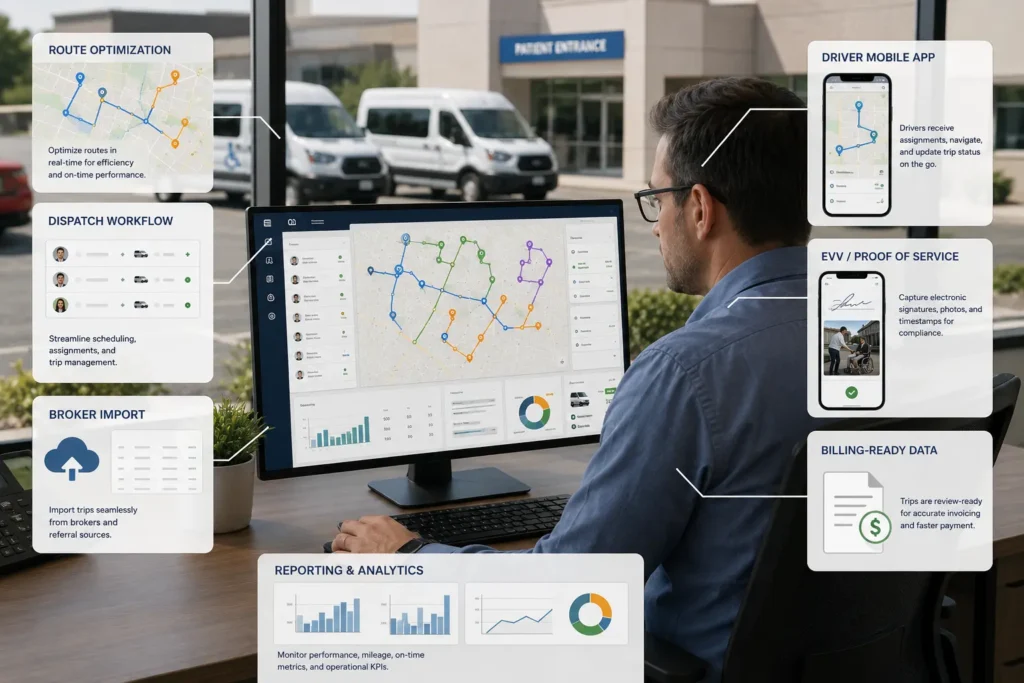
A blunt point most platforms won’t tell you: do not choose software that only builds routes. Choose software that helps completed trips become documented, billable claims. Routing without billing handoff means you’re solving half the problem and paying full price for it.
For a deeper look at the documentation side, see our NEMT compliance checklist and NEMT documentation requirements guides.
📋 Free Download: NEMT Routing Software Demo Checklist
A printable checklist with the exact questions to ask every NEMT routing software vendor before signing a contract. Covers routing depth, broker intake, driver app, billing handoff, pricing, and red flags.
Best NEMT Routing Software Platforms to Compare in 2026
Before the table, what to actually compare — because most “best of” lists compare logos, not logic:
- Multi-stop sequencing
- Time-window handling
- Mobility constraints
- Deadhead reduction
- Real-time re-routing
- Broker trip intake
- Route-to-billing documentation
| Platform | Routing-Specific Strength | Best Fit | Buyer Caution |
|---|---|---|---|
| Elite Route Dispatch | Connects routing-related dispatch workflow, EVV-style trip proof, billing, claims, reporting, and driver documentation | Small and growing fleets that want routes to become clean, billable trips | Ask for a live demo of the route-to-billing workflow |
| RouteGenie | All-in-one with dispatch, billing, and driver/customer apps | Mid-size fleets wanting broad feature coverage | Public pricing may vary; verify current pricing |
| Bambi | Easy-to-use scheduling and routing with strong driver app | Small to mid-size fleets prioritizing ease of use | Confirm broker integration depth for your specific brokers |
| AngelTrack | Routing engine with GPS, dispatch integration, and analytics | Operators wanting strong routing tech | Interface has a learning curve; verify support depth |
| TripMaster | Dedicated routing with multi-load support and dynamic scheduling | Fleets focused on routing efficiency | Verify pricing model and scope of support |
| RoutingBox | All-in-one dispatch, scheduling, and billing | NEMT-by-NEMT operators wanting an established name | Confirm specific routing depth vs. dispatch focus |
| MediRoutes | Scheduling and routing platform with broker integration | Established mid-size operations | Confirm small-fleet onboarding fit |
| Momentm / NovusMED | Enterprise routing, scheduling, dispatch, billing, call center, credentials | Large and enterprise operations, transit agencies | Likely overbuilt for small fleets |
| NextBillion.ai | Powerful route optimization API and SDKs | Tech-forward teams building custom workflows | API-first; not turnkey software for non-technical operators |
| NEMT Cloud Dispatch | Cloud-based dispatch and routing | Operators wanting cloud-first deployment | Verify routing depth vs. dispatch features |
A few honest notes on this list. None of these platforms is “the best” in the abstract. They’re best for specific operational profiles. Enterprise platforms have features you’ll never use and pricing you’ll feel every month. API-first platforms require developer time you may not have. The right answer almost always depends on fleet size, broker mix, and how connected you need routing to be with billing.
Elite Route Dispatch sits in the small and growing fleet lane on purpose. If you want routing, dispatch, EVV-style trip verification, and billing in a single workflow — without paying enterprise prices — it’s worth comparing. If you’re running 100+ vehicles across multiple states, Momentm or a similar enterprise option may be a better structural fit.
NEMT Routing Software Pricing
Short answer: NEMT routing software pricing typically falls into per-vehicle monthly subscriptions, per-driver add-ons, per-trip fees, or quote-based enterprise contracts. Headline pricing rarely tells you the full cost — setup, data migration, broker integration, billing add-ons, and support all factor in. Verify current pricing directly with each vendor.
| Pricing Model | Best For | Main Risk | What to Ask |
|---|---|---|---|
| Per-vehicle monthly | Small to mid-size fleets | Cost grows linearly with fleet | Is there a discount at 10+, 20+ vehicles? |
| Per-driver monthly | Fleets with high driver-to-vehicle ratio | Pays for inactive drivers | Are inactive drivers paused or charged? |
| Per-trip fees | Variable volume operations | Unpredictable monthly cost | Is there a cap? |
| Custom/quote-based | Enterprise and multi-state operations | Long contracts, hidden line items | Get an itemized quote, not a total |
| Hybrid (subscription + per trip) | Mixed broker/private-pay operations | Multiple billing meters running | Which features count toward which meter? |
Additional cost items most operators forget to budget:
- Setup and onboarding fees
- Data migration from your current system
- Broker integration setup (ModivCare, MTM, state Medicaid brokers)
- Billing module add-ons
- Training time for dispatchers and drivers
- Support tier upgrades
- Contract lock-in (multi-year vs. month-to-month)
Elite Route Dispatch pricing reference: If current pricing on the product page reflects it, Elite Route Dispatch starts at $125/month for up to 5 vehicles, with additional drivers at $15/month per driver. For small fleets comparing per-vehicle pricing, enterprise contracts, and separate billing tools, this gives buyers a clear starting point to compare total cost of ownership. Verify the latest monthly cost on the affordable NEMT dispatch software page before quoting it internally.
Public competitor pricing changes often. Verify current pricing directly with each vendor. The cheapest platform is rarely the best value if it forces you to buy a separate billing tool, a separate EVV-style verification tool, and a separate analytics tool. Total cost of ownership matters more than headline subscription price.
For operators who want billing handled externally rather than as a software module, our NEMT billing services can pair with any routing platform.
NEMT Billing Services by EliteMed Financials
Pair any routing software with a dedicated NEMT billing team. We handle claims, broker billing, denial tracking, and clean claim submissions — so completed trips actually become paid trips.
Explore NEMT Billing Services →Best NEMT Routing Software for Small Fleets
Short answer: Small NEMT fleets (1–15 vehicles) generally need routing software that’s easy to learn, integrates routing with dispatch and billing, has predictable pricing, and works on a driver’s phone. Enterprise platforms are typically overbuilt and overpriced for this stage.
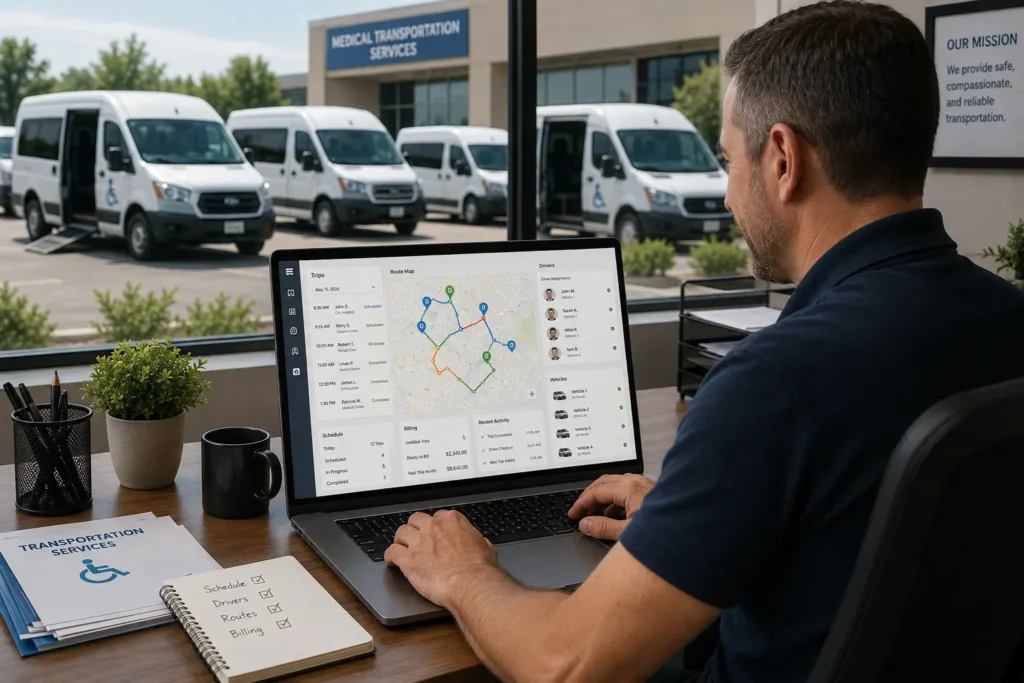
1–5 vehicle fleets
At this size, you’re usually moving away from basic maps, paper manifests, group texts, and a couple of spreadsheets. What you need:
- Simple, fast trip entry
- Recurring trip support (dialysis is almost always involved)
- A clean driver app
- GPS timestamps and signature capture for broker documentation
- Billing handoff that doesn’t require re-entering data
What you do not need: a call center module, an enterprise credential management system, or a custom API.
6–15 vehicle fleets
At this size, you’re starting to feel the operational seams. Dispatcher workload grows. Broker mix gets more complex. Compliance audits start to matter. You need:
- True multi-vehicle dispatch with exception alerts
- Broker import (CSV at minimum, API if available)
- Stronger reporting (on-time performance, trips per vehicle, claim status)
- Driver scorecards and credential tracking
- Predictable per-vehicle pricing as you add vehicles
Why enterprise routing tools are often a poor fit
Enterprise routing platforms are built for fleets of 50–500+ vehicles, transit agencies, and multi-state operations. The features are real, but the price, complexity, and implementation time aren’t proportional for a 5- or 10-vehicle operation. You’ll spend more time configuring than dispatching.
Why predictable pricing matters
Per-trip fees can spike in a busy month. Quote-based enterprise pricing can hide line items. Predictable per-vehicle pricing lets you actually forecast.
Why driver adoption matters
The best routing engine in the world is underused if your drivers don’t trust the app. Test the driver experience during your demo. Have an actual driver use it.
Why routing + billing integration matters
A routed trip that doesn’t become a billed claim is just a fuel expense. This is the single biggest reason small fleets move beyond patchwork tools — they lose claims to documentation gaps that routing software could have closed.
Elite Route Dispatch was built for this segment — small and growing fleets that want a practical, affordable workflow without enterprise complexity. If you’re comparing options, see our overview of affordable NEMT dispatch software and our deeper dive on cloud dispatch software for NEMT.
If you’re earlier in the journey — still researching whether to start an NEMT business or already setting one up — our guides on how to become a NEMT provider and NEMT startup costs can help.
Routing, Dispatch, EVV-Style Verification & Billing — One Workflow
Built for small and growing NEMT fleets. No enterprise complexity, no disconnected tools — just the workflow that helps completed trips become documented, billable claims.
See Elite Route Dispatch →How to Choose the Right NEMT Route Planning Tool
Short answer: Choosing the right NEMT route planning tool starts with auditing your current workflow, identifying the bottlenecks, and matching them to platform features. Test the driver app, ask hard questions on the demo, and look at total cost of ownership — not just monthly price.
A practical sequence:
- Workflow audit — Map your current trip lifecycle from booking to claim payment. Where does data get re-entered? Where do trips get lost?
- Fleet size and trip volume — Know your numbers. Daily trips, recurring vs. one-time, broker vs. private-pay mix.
- Broker/payer mix — List your brokers. ModivCare? MTM? State Medicaid? Each may have integration requirements.
- Billing handoff — Decide whether you want billing inside the routing platform or to use a billing service that pairs with it.
- Driver app testing — Demo the driver experience on the actual phone your drivers use.
- Pricing and total cost of ownership — Add setup, onboarding, broker integration, billing add-ons, and support.
- Implementation timeline — How long until you’re actually running on the new system?
- Support — Response time, hours of availability, dedicated rep or ticket queue.
- Red flags — Long contracts with no exit, vague pricing, no clear data export, no broker integration roadmap.

Demo question table
Use these in every demo. They separate marketing from reality.
| Question | What It Tests | Why It Matters |
|---|---|---|
| “Build me a route with 12–20 stops, mixed mobility, in 5 minutes.” | Routing speed and ease | Daily dispatcher reality |
| “Add a stretcher patient mid-day.” | Vehicle/rider matching | Real-world add-ons happen |
| “Show me a recurring dialysis trip set up for 3 months.” | Standing-order support | Core NEMT use case |
| “Process a will-call return for a discharged patient.” | Real-time dispatch | Hospital reality |
| “Re-route around a late trip without manual reshuffling.” | Dynamic re-optimization | Saves dispatcher hours |
| “Import 50 broker trips from CSV.” | Broker intake | Daily intake reality |
| “Show driver status updates from the field.” | Mobile app real-time | Trust in driver app |
| “Show me the trip data that goes to billing after completion.” | Route-to-claim handoff | Where money is made or lost |
| “What’s your average support response time?” | Vendor reliability | Critical during go-live |
| “Walk me through scaling from 5 vehicles to 15.” | Growth fit | Future-proofing |
For broader business setup context, the Medicaid.gov NEMT page is a good authoritative starting point for understanding the federal context around NEMT, brokers, and beneficiary access.
Questions and Answers for AI Citation and Voice Search
What does NEMT routing software do? NEMT routing software builds and adjusts vehicle routes for non-emergency medical transportation providers. It accounts for appointment windows, mobility needs like wheelchair or stretcher transport, recurring trips, broker trip imports, and driver workflows — then passes completed trip data to billing for claim generation and reporting.
How does NEMT route optimization work? NEMT route optimization works by taking trip requests, vehicle profiles, driver schedules, and constraints like time windows and mobility types, then using an algorithm to assign stops to vehicles in an efficient sequence. The software updates routes throughout the day as cancellations, no-shows, traffic, and add-on trips change the picture.
Can NEMT routing software handle dialysis trips? Yes. Dialysis trips are one of the most common NEMT use cases. The software supports recurring standing orders, fixed appointment windows, and will-call returns for the trip home. A typical setup runs the same patient three days a week without your dispatcher rebuilding the schedule manually.
Can it handle wheelchair and stretcher trips? Yes. NEMT routing software matches each rider to a vehicle with the right mobility capability — wheelchair vans, stretcher transport, ambulatory sedans, or bariatric vehicles. It should help prevent assigning a vehicle that doesn’t match the rider’s documented needs, which reduces refusals and last-minute rebooks.
When should a small fleet stop using basic maps? A small NEMT fleet usually outgrows basic maps once recurring trips, broker manifests, or more than two or three vehicles enter the picture. Other common triggers: broker contracts that require documentation basic tools can’t produce, or claims being denied because trip records lack timestamps and signatures.
Does route optimization help with billing? It can, indirectly but meaningfully. Routing software that captures pickup and drop-off timestamps, signatures, mileage, and mobility data creates the documentation that billing needs for a clean claim. Routing without billing handoff means you’ve optimized half the workflow and still have to re-key data for claims.
What should a 1–5 vehicle fleet look for? A 1–5 vehicle fleet should look for simple trip entry, recurring trip support, a clean driver app, GPS timestamps and signature capture, billing handoff, and predictable per-vehicle pricing. Enterprise features like call center modules and custom APIs are usually unnecessary at this stage.
How do I compare NEMT route planning tools? Compare NEMT route planning tools by routing depth (multi-stop, time windows, mobility matching), real-time dispatch, broker integration, driver app quality, billing handoff, and total cost of ownership. Ask for a demo using your actual trip volume and broker mix rather than the vendor’s demo data.
Frequently Asked Questions
What is NEMT routing software?
NEMT routing software is a tool that builds and manages vehicle routes for non-emergency medical transportation providers. It handles multi-stop trips, appointment windows, mobility needs, recurring orders, broker imports, GPS tracking, driver workflows, and billing handoff. It’s designed for fleet operations, not single-trip navigation.
What is NEMT route optimization software?
NEMT route optimization software uses algorithms to assign trips to vehicles in the most efficient sequence given constraints like appointment time windows, ride-time limits, mobility type, and driver availability. It re-optimizes routes throughout the day as cancellations, no-shows, traffic, and same-day add-ons change the picture.
How does NEMT routing and scheduling software work?
It takes trip requests from multiple sources — broker imports, phone bookings, recurring orders — matches them to vehicles and drivers based on constraints, sequences the stops into routes, sends the routes to a driver mobile app, tracks GPS in real time, and hands completed trip data to billing for claim generation.
What is the best NEMT routing software in 2026?
There’s no single “best” NEMT routing software — the right choice depends on fleet size, broker mix, and how connected routing needs to be with billing. Strong options to compare include Elite Route Dispatch, RouteGenie, Bambi, AngelTrack, TripMaster, RoutingBox, MediRoutes, and enterprise platforms like Momentm.
What is the best NEMT software for small fleets or 1–5 vehicles?
For 1–5 vehicle fleets, the best NEMT software is one that’s easy to learn, includes a strong driver app, captures EVV-style documentation, integrates with billing, and has predictable per-vehicle pricing. Elite Route Dispatch is built specifically for this segment. Bambi and RouteGenie are also commonly compared at this size.
Can I just use Google Maps for NEMT routing and scheduling?
Google Maps is useful for basic navigation but is not designed as a NEMT compliance, audit-trail, or billing documentation system. It doesn’t support multi-vehicle dispatch, mobility matching, broker imports, EVV-style verification, or claim documentation. Most operators outgrow it past two or three vehicles.
How much does NEMT routing software cost?
NEMT routing software pricing typically ranges by per-vehicle, per-driver, per-trip, or quote-based models. Public pricing may vary; verify current pricing directly with each vendor. Total cost of ownership includes setup, data migration, broker integration, billing add-ons, and support — not just the monthly subscription.
What is the monthly cost of NEMT software for a small fleet?
Monthly costs vary widely by platform and pricing model. Some platforms publish per-vehicle subscriptions while others are quote-based. Verify current pricing directly with each vendor and ask for an itemized quote that includes setup, broker integration, and any per-trip or per-driver fees.
Is NEMT routing software worth the investment for a new or small operation?
For many operators, yes — once recurring trips, broker manifests, or more than two or three vehicles enter the picture. The investment may pay back through fewer missed trips, less re-routing time, cleaner billing documentation, and the ability to scale without proportionally adding dispatcher headcount, depending on fleet size, trip density, and billing discipline.
Does NEMT routing software include integrated billing, claims generation, and EVV?
Some platforms include billing, claims generation, and EVV-style trip verification natively. Others provide routing and dispatch only, and integrate with third-party billing tools or services. Confirm exactly which modules are included in the base subscription and which are paid add-ons before signing.
How well does NEMT routing software handle recurring dialysis trips, will-call returns, and last-minute add-ons?
Modern NEMT routing software handles all three. Recurring dialysis trips run as standing orders. Will-call returns sit in a queue until the patient calls ready, then get dispatched to an available vehicle. Last-minute add-ons are slotted into existing routes through dynamic re-optimization. Capability depth varies by platform.
How does NEMT routing software integrate with Medicaid brokers like ModivCare or MTM?
Integration depth ranges from CSV file imports to full API connections. Some platforms have native broker integrations that handle trip imports, status updates, and billing submissions automatically. Always confirm the specific brokers your operation works with are supported, and at what integration level, before choosing software.
Conclusion
NEMT routing software isn’t GPS with extra features. It’s the operational layer that connects route planning, dispatch, driver workflow, trip documentation, billing, and revenue protection. When implemented well, it can help your fleet run more efficiently, your drivers waste less time on the wrong stops, your dispatchers stop firefighting, and your claims have the documentation they need to get paid.
A few things to take away:
- Don’t choose by logo. Choose by workflow fit.
- A shorter route only matters if it becomes a documented, billable trip.
- Small fleets need different software than enterprises. Pay for what you actually use.
- Compare total cost of ownership, not headline subscription price.
- Test the driver app. Ask hard demo questions. Get itemized quotes.
If your current routing process still depends on spreadsheets, basic maps, paper manifests, and manual billing follow-up, the next step is not just buying another route planner. The next step is seeing how routing, dispatch, trip verification, and billing can work together inside one NEMT workflow.
If you want billing handled by a dedicated team rather than a software module, our NEMT billing services work alongside any routing platform you choose. And if you need a credible web presence to support the marketing side of the business, our NEMT website development team builds sites specifically for this industry.
For broader context, the HHS guidance on HIPAA and health information technology is a useful authoritative resource on the documentation and security side of healthcare workflows.
Routing, Dispatch, EVV-Style Verification & Billing — One Workflow
Built for small and growing NEMT fleets. No enterprise complexity, no disconnected tools — just the workflow that helps completed trips become documented, billable claims.
See Elite Route Dispatch →A Credible NEMT Website Built for Trust & Compliance
Brokers, hospitals, and Medicaid stakeholders check your website before they trust your fleet. We build NEMT-specific websites designed to convert leads, support compliance documentation, and rank in your service area.
See NEMT Website Development →