

What Is a NEMT Business Plan? A NEMT business plan is a strategic document outlining your non-emergency medical transportation company’s goals, services, operations, financial projections, and Medicaid enrollment strategy. A complete NEMT business plan is required for SBA loans, NEMT broker enrollment in several states, and state licensing applications. It also serves as your 90-day operational roadmap from LLC formation to first Medicaid trip.
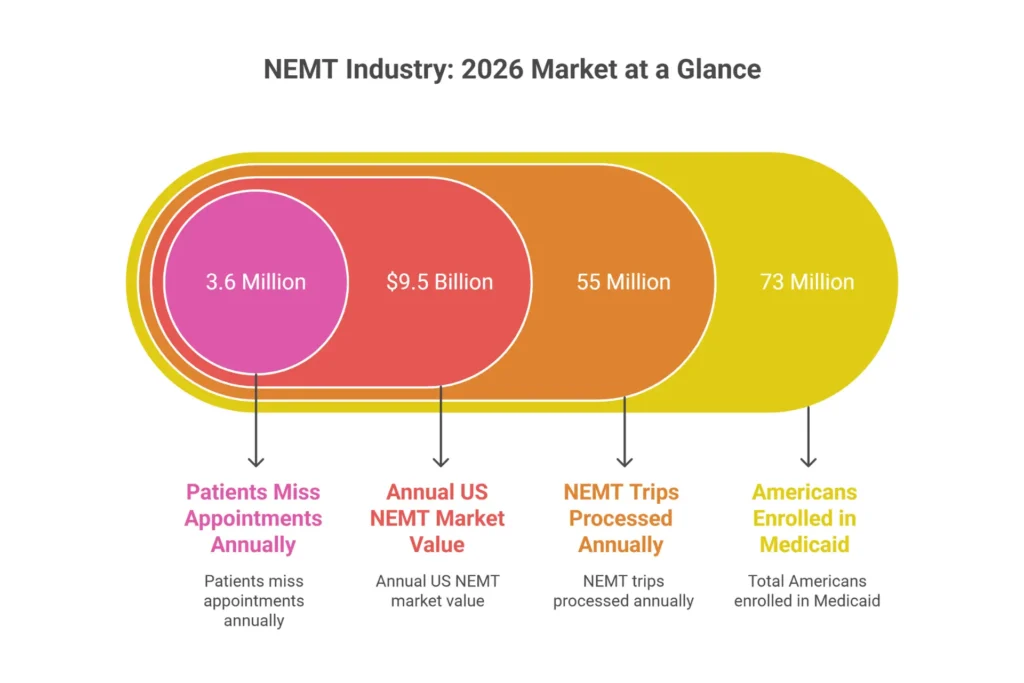
The NEMT industry generates over $9.5 billion annually, processes 55 million trips per year, and grows at a 6.2% CAGR through 2030. With 73 million Americans enrolled in Medicaid and more than 3.6 million missing medical appointments every year due to lack of transportation, the demand for your services is structural — not seasonal. Writing a solid non emergency medical transportation business plan before you spend your first dollar is the single most important step between an idea and a funded, licensed, revenue-generating operation. This guide walks you through every section of a complete NEMT business plan, delivers real financial models, shows you how to use it to win SBA loans and broker enrollments, and includes a free downloadable template you can customize and submit today.
What You’ll Learn in This Guide
Table of Contents
Why Every NEMT Business Needs a Business Plan in 2026
Most new NEMT operators underestimate how many doors a formal business plan opens — and how many stay permanently closed without one. A well-written medical transportation company business plan is not just a funding document. It is your compliance roadmap, your operational blueprint, and your proof of credibility to every party that controls your revenue: Medicaid agencies, NEMT brokers, SBA lenders, and facility administrators.
Pro Tip: Write your business plan before you purchase your first vehicle. The financial modeling process will reveal whether your target market supports the startup cost you’re planning — before you commit capital you cannot recover.
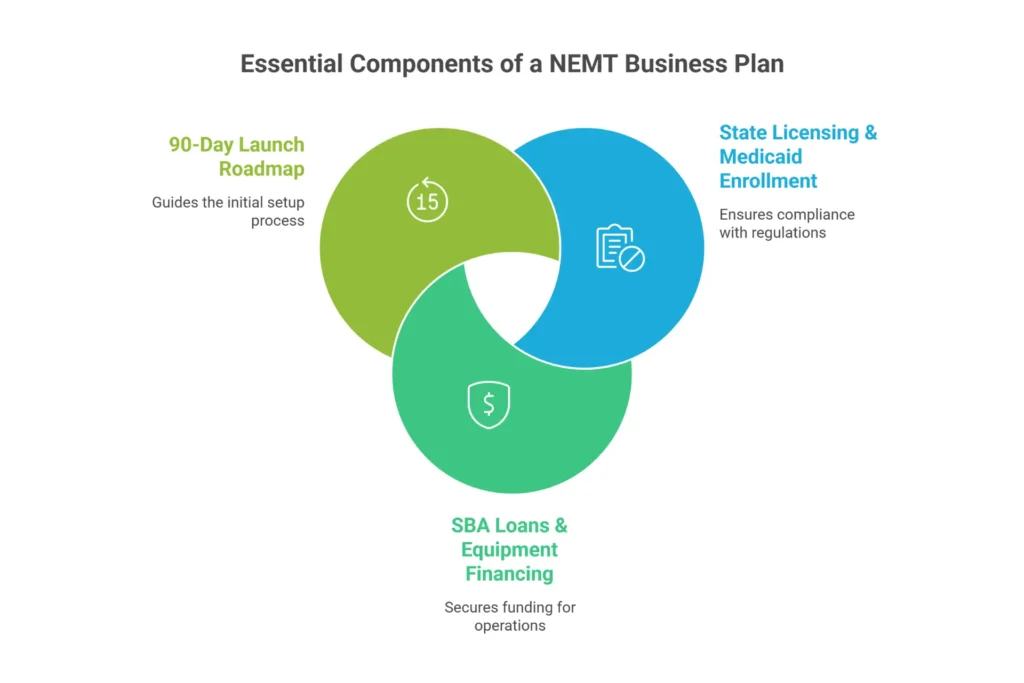
Business Plan Requirements for State Licensing and Medicaid Enrollment
Several states require documented operational and business plans as part of their NEMT licensing application. California’s CPUC TCP license application, Virginia’s DMAS enrollment, and Georgia’s DPH certification all ask for operational documentation that overlaps directly with a business plan’s operations and compliance sections. Even in states that do not formally require a business plan, Medicaid enrollment applications demand documentation — service area definitions, fleet composition, staffing plans, and financial systems — that you cannot produce without first writing them into a structured plan.
Medicaid enrollment alone takes 30 to 90 days in most states. Without a clear plan that documents your vehicle, insurance, driver qualification files, and dispatch system from day one, you will spend that enrollment period scrambling instead of building. Every day of disorganized enrollment is a day your cash reserves are draining with no revenue arriving.
Using a Business Plan to Secure SBA Loans and Equipment Financing
NEMT businesses qualify for the SBA 7(a) loan program with amounts up to $500,000 for vehicle purchases, insurance prepayment, and working capital. SBA lenders require a complete business plan before reviewing any application. Specifically, they want your 12-month financial projections, a defined service area, a clear revenue model, and a debt service coverage ratio they can calculate. Without these, your application is declined before underwriting begins.
The SBA Microloan program (up to $50,000) is more accessible for first-time operators with limited credit history. It still requires a formal business plan. Additionally, the FTA Section 5310 grant program funds up to 80% of vehicle costs for operators serving elderly and disabled patients — but requires an application built around your documented service plan and target population. Equipment financing through commercial lenders like Ally Commercial or Ford Pro Financial also requires business documentation at the vehicle financing stage.
Your Business Plan as a 90-Day Operational Blueprint
Beyond funding and licensing, your NEMT startup plan serves as your internal execution roadmap. The 12-week launch timeline from LLC formation to first Medicaid trip requires 23 to 30 parallel tasks — business registration, NPI application, insurance binding, vehicle purchase, driver hiring, broker enrollment, and dispatch software setup. A business plan that documents each milestone with a target date turns chaos into a project plan. Operators who skip this step routinely miss their enrollment window, start trips before Medicaid confirmation, and create unbillable revenue that cannot be recovered retroactively in most states.
Section 1 — Executive Summary for a NEMT Company
Your executive summary is the first section of your business plan but the last one you write. It distills every other section into two pages that a bank loan officer, a state Medicaid reviewer, or a NEMT broker’s provider relations team can read in five minutes and understand your entire operation. Write it last, but format it first.
Pro Tip: SBA lenders spend fewer than 8 minutes on initial loan application review. If your executive summary does not show projected revenue, startup capital required, market size, and repayment capacity on the first page, your application moves to the rejection pile.
What to Include in Your NEMT Executive Summary
A complete NEMT executive summary covers six elements. First, your company overview: legal name, LLC structure, NAICS code 485991, state of operation, and ownership. Second, your service description: which transport types you offer (ambulatory, WAV, stretcher) and which patient populations you serve. Third, your market opportunity: local Medicaid enrollment numbers, number of dialysis centers and behavioral health facilities in your service area, and the gap your operation fills. Fourth, your operational model: number of vehicles at launch, number of drivers, dispatch software platform, and broker enrollment targets. Fifth, your financial snapshot: startup capital required, projected monthly gross revenue at full capacity, and 12-month net income projection. Sixth, your funding request if applicable: amount needed, use of funds, and repayment source.
NEMT Mission Statement Examples (Copy and Customize)
Your mission statement appears in your executive summary and on your website. Medicaid enrollment reviewers and facility administrators use it to assess whether you understand your patient population and take compliance seriously. Avoid generic language. Use specific language that names your service area, your patient population, and your commitment to compliance.
Template A: “To provide safe, on-time, and dignity-centered non-emergency medical transportation to Medicaid beneficiaries in [County/Region], operating under full ADA, HIPAA, and state Medicaid compliance at every trip.”
Template B: “To be the most reliable NEMT provider in [Service Area], delivering wheelchair-accessible and ambulatory transport to dialysis, behavioral health, and specialist patients who depend on consistent transportation to maintain their health.”
Example Executive Summary Paragraph
[Your Company Name] is a newly formed LLC (NAICS 485991) based in [City, State], providing non-emergency medical transportation services to Medicaid-eligible patients requiring ambulatory and wheelchair-accessible transport. We launch with one wheelchair-accessible van serving [County] under enrollment with [State] Medicaid and [Broker Name]. Our target service area contains [X] dialysis centers, [X] behavioral health facilities, and [X] hospitals generating an estimated weekly demand of [X] trips. At full capacity — 10 WAV trips per day, 22 days per month at a $45 average Medicaid rate — our operation generates $9,900 in monthly gross revenue. We are seeking $[Amount] in SBA Microloan or equipment financing to fund vehicle acquisition, first-year insurance, and 90-day operating reserves. Projected net margin: 22–28% by month 9.

Section 2 — NEMT Market Analysis
Your market analysis section answers the core question every lender and licensing reviewer asks: is there enough demand in your specific area to support this business? A credible NEMT market analysis uses real, local data — not national statistics alone. National figures establish the opportunity; local data proves it exists where you intend to operate.
Pro Tip: Use the CMS Medicaid enrollment data portal (data.medicaid.gov) to pull your county-level Medicaid enrollment figures. Then cross-reference with the DaVita and Fresenius facility locators to count dialysis centers in your service area. These two data points alone build a compelling local demand case.
NEMT Industry Size and 2026 Demand Drivers
The US NEMT industry processes over 55 million trips annually and is valued at $9.5 billion. The 6.2% CAGR through 2030 is driven by three structural forces that will not reverse. First, the aging population: more than 11,000 Baby Boomers turn 65 every single day, and seniors use NEMT at dramatically higher rates than younger patients. Second, chronic disease prevalence: dialysis patients require three rides per week, every week, for life. Chemotherapy and behavioral health patients require consistent transport throughout their treatment cycles. Third, federal mandate stability: under 42 CFR 440.170, every state Medicaid program must fund non-emergency transportation for eligible beneficiaries. This mandate does not expire, does not face budget competition the way discretionary programs do, and actually expands during recessions as Medicaid enrollment rises.
For your business plan, reference the NEMT industry statistics data showing market growth, trip volume trends, and demand projections through 2030 to strengthen your market analysis section.
Your Target Patient Population
NEMT serves five primary patient populations, and your business plan should define which ones you target at launch. Dialysis patients are the highest-volume opportunity — a single center with 40 active patients generates 120 weekly trips in both directions. Behavioral health patients attending outpatient programs generate consistent weekly trip patterns. Chemotherapy and oncology patients require transport during active treatment cycles, typically 12 to 24 weeks. Medicaid-eligible seniors requiring specialist, dental, and routine care appointments represent your broadest population. Patients with physical disabilities requiring wheelchair-accessible transport represent your highest per-trip revenue opportunity. Define your initial target population clearly in your business plan, because it determines your vehicle type, driver certification requirements, and which HCPCS billing codes you will use.
Local Competitive Analysis Framework
Count your competition before you claim market share. Search your state’s Medicaid provider enrollment database for currently enrolled NEMT transportation providers in your county. Contact your target NEMT broker’s provider relations team and ask which zip codes have the highest trip volume and lowest provider coverage — they will tell you because they need more providers. Check Google Maps for “medical transportation near me” and “NEMT near me” in your service area, then read the one-star reviews. Patient complaints about late arrivals, no-shows, and cancelled rides are your market entry strategy. A SWOT analysis in your business plan that references specific local provider weaknesses is more compelling to lenders than generic industry data.
Section 3 — NEMT Services and Pricing Structure
Your services and pricing section tells reviewers exactly what you offer, who pays for it, and how much you earn per trip. This section must include your HCPCS billing codes — the specific codes that determine your Medicaid reimbursement rate for each service type. No competitor covers this level of billing detail in their business plan guides, but Medicaid enrollment reviewers and billing specialists expect to see it.
Pro Tip: Document your HCPCS codes in your business plan’s services section. When you submit your Medicaid enrollment application and later work with a NEMT billing services partner, having your billing codes pre-identified eliminates setup errors and prevents your first claims from being submitted under the wrong codes.
Service Types and HCPCS Billing Codes
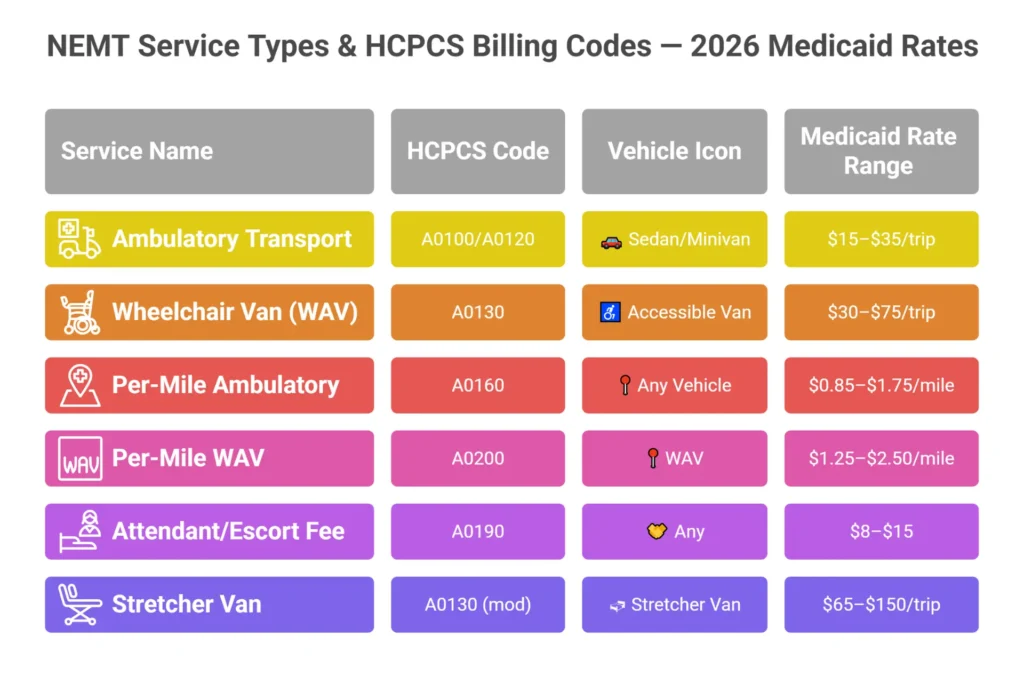
NEMT services are billed using HCPCS Level II codes in the A0100–A0225 range. Your business plan services section must list the codes you will bill so that your revenue projections and your Medicaid enrollment are aligned from day one. The table below maps each service type to its billing code and 2026 average national rate range.
| Service Type | HCPCS Code | Vehicle Required | Avg Medicaid Rate | Best Market |
|---|---|---|---|---|
| Ambulatory Sedan/Van | A0100 / A0120 | Standard sedan or minivan | $15 – $35/trip | Rural, solo operator start |
| Wheelchair Van (WAV) | A0130 | Side or rear-entry accessible van | $30 – $75/trip | Urban, dialysis, all markets |
| Per-Mile — Ambulatory | A0160 | Standard vehicle | $0.85 – $1.75/mile | Rural, long-distance trips |
| Per-Mile — WAV | A0200 | WAV | $1.25 – $2.50/mile | Long-distance wheelchair transport |
| Attendant / Escort Fee | A0190 | Any | $8 – $15 | Door-through-door service |
| Stretcher Van | A0130 (modified) | Stretcher-equipped van | $65 – $150/trip | Post-acute, bariatric, SNF |
Medicaid NEMT Rate Ranges by Service Type (2026)
Medicaid rates vary significantly by state. California Medi-Cal pays $28–$45 per ambulatory trip — among the highest nationally. Texas HHSC pays $18–$32 per trip. Virginia DMAS pays $18–$32 for ambulatory and $35–$65 for WAV. Florida AHCA rates run $15–$28 for ambulatory. Georgia DPH rates average $22–$38 per trip. For the full state-by-state breakdown, see our NEMT Medicaid rates by state guide, which is updated regularly. For your business plan, use your specific state’s current Medicaid fee schedule — available from your state’s Medicaid agency website — to build accurate revenue projections rather than national averages.
Private Pay Pricing Strategy
Private pay clients — Medicare Advantage members, self-pay patients, facility-contracted transport, and veteran service organizations — typically pay 30–50% above Medicaid rates. Your private pay pricing formula starts with your fully loaded cost per trip. Add your vehicle payment allocation per trip, insurance cost per trip, driver wage per trip, fuel cost, and software overhead. Set your floor price at 115% of loaded cost. Set your private pay rate at 140–150% of your Medicaid rate for the equivalent service. This creates a consistent margin above your Medicaid baseline and keeps your rates competitive with other operators without undercutting the market.
Section 4 — NEMT Operations Plan
Your operations plan is the section that most directly determines whether state licensing reviewers and NEMT brokers approve your application. It documents how your business physically runs — vehicles, drivers, dispatch, documentation, and compliance systems. The Non-Emergency Medical Transportation Accreditation Commission (NEMTAC) defines operational standards that top-tier NEMT operators align with from day one. Building their framework into your operations plan signals professionalism to every reviewer who sees it.
Pro Tip: NEMTAC recommends maintaining a reserve vehicle at 10–20% of your fleet size to handle breakdowns without missing trips. In your business plan, document your contingency plan for vehicle breakdowns — brokers dock provider performance scores for missed trips caused by fleet issues, even mechanical ones.
Vehicle Fleet Plan and ADA Compliance
Your fleet plan must specify: number of vehicles at launch, vehicle type (ambulatory sedan, WAV side-entry, WAV rear-entry, or stretcher van), new versus used decision, purchase versus lease decision, and ADA compliance documentation. Every WAV serving wheelchair passengers must comply with 49 CFR Part 37 requirements: ramp slope not exceeding 1:4, minimum 30-inch ramp width, 4-point tie-down securement system (Q’Straint or Sure-Lok are the industry standards), lap-and-shoulder occupant restraint, and 56 inches of interior standing headroom at accessible positions. Non-compliance fails a broker vehicle inspection and blocks enrollment. Document your compliance equipment by brand and model number in your operations plan — this specificity builds credibility with brokers and licensing reviewers.
Driver Staffing Model and DQF Requirements
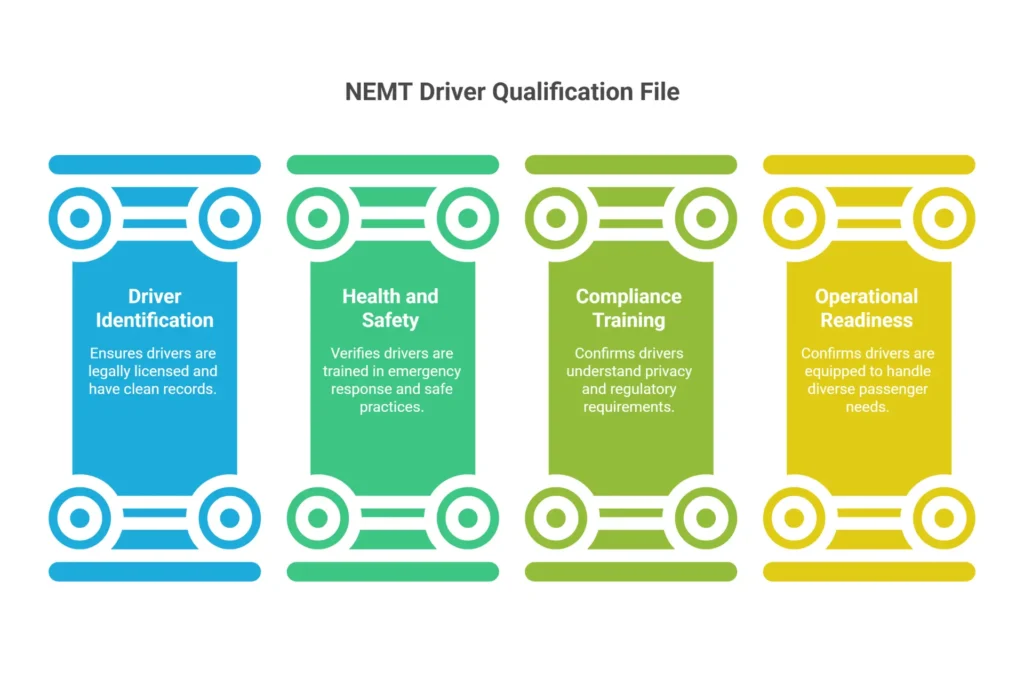
Every driver must have a complete Driver Qualification File (DQF) assembled before transporting their first patient. The DQF is not optional — it is the compliance document that protects you in a Medicaid audit, a broker review, or a liability claim. Your operations plan must state that your DQF requirements include: valid driver’s license copy, annual Motor Vehicle Record (MVR), criminal background check, sex offender registry check, pre-employment drug test, CPR/BLS certification, First Aid certification, PASS (Passenger Assistance Safety and Sensitivity) training from a CTAA-approved provider, defensive driving certificate, mobility device securement training, HIPAA privacy training, and monthly OIG Exclusion List verification. Review our NEMT compliance guide for a printable DQF checklist that covers all NEMTAC-aligned documentation requirements.
Driver pay in your staffing plan should reflect market rates: $14–$20 per hour in most US markets, $18–$24 per hour in California. Address the employee versus independent contractor classification question directly in your plan. California’s AB5 law makes contractor classification nearly impossible for NEMT drivers in that state. Misclassification in any state creates back payroll tax liability, penalties, and unpaid benefits exposure. Your operations plan should state your classification decision and cite your legal basis for it.
Dispatch Software and Technology Stack
Your technology section should name your dispatch platform, its monthly cost, and which broker integrations it supports. Leading options for 2026 include RouteGenie ($299+/month, billing integration), TobiCloud ($199+/month, strong broker integration), Bambi NEMT ($149+/month, simple interface for small fleets), and RoutingBox ($250+/month, high-volume route optimization). Per NEMTAC standards, your technology stack should also include: HIPAA-compliant email (with signed Business Associate Agreement), a virtual fax service for document transmission, GPS tracking for all vehicles, dash cameras for insurance premium reduction, and a mobile driver app for electronic trip manifests. Document each system by name in your operations plan. Reviewers want to see that you have thought through interoperability — your dispatch, billing, and accounting systems should share data rather than require manual re-entry. See our complete comparison in the best NEMT software guide.
Trip Documentation and HIPAA Compliance
Every Medicaid NEMT trip must generate a complete trip record to support your billing claim. Missing documentation is the single most common cause of NEMT claim denials and Medicaid audit findings. Your operations plan must state that every trip record includes: patient name and Medicaid ID, date and time of pickup, pickup and destination addresses, appointment type, vehicle ID and driver name, electronic pickup and delivery signatures, odometer readings for mileage-based billing, and prior authorization number where required. Your drivers must have HIPAA privacy training documented in their DQF. All patient data in your dispatch and billing systems must be handled under a signed BAA with your technology vendors. For a deep dive into what auditors look for, review our NEMT audit preparation guide.
Section 5 — NEMT Financial Projections
Your financial projections section is the most important part of your NEMT startup plan for lenders, investors, and SBA reviewers. It must answer three questions with specific numbers: How much does it cost to start? How much will you earn? When will you break even? The models below use real NEMT industry benchmarks — not estimates. Use them as your template and adjust with your state’s actual Medicaid rates and local operating costs. For a complete startup cost analysis, see our complete NEMT startup cost breakdown.
Pro Tip: Build your financial projections assuming zero revenue in months 1 and 2. Medicaid enrollment takes 30–90 days, and your first Medicaid payment arrives 14–30 days after your first clean claim. Your cash reserve must cover all operating expenses for months 1 through 3 before your business is financially self-sustaining.
Revenue Model: Trips × Rate × Operating Days
The NEMT revenue formula is straightforward: vehicles × trips per day × operating days per year × average rate per trip = annual gross revenue. A single WAV running 10 trips per day, 240 operating days per year, at a $45 average Medicaid rate generates $108,000 in annual gross revenue. At a 20–30% net margin after all operating costs, that same vehicle produces $21,600–$32,400 in annual net profit. Scale matters: a 4-van operation generating $432,000 in gross revenue carries overhead that scales at less than half the rate of revenue, pushing net margin to 30–35% at that fleet size.
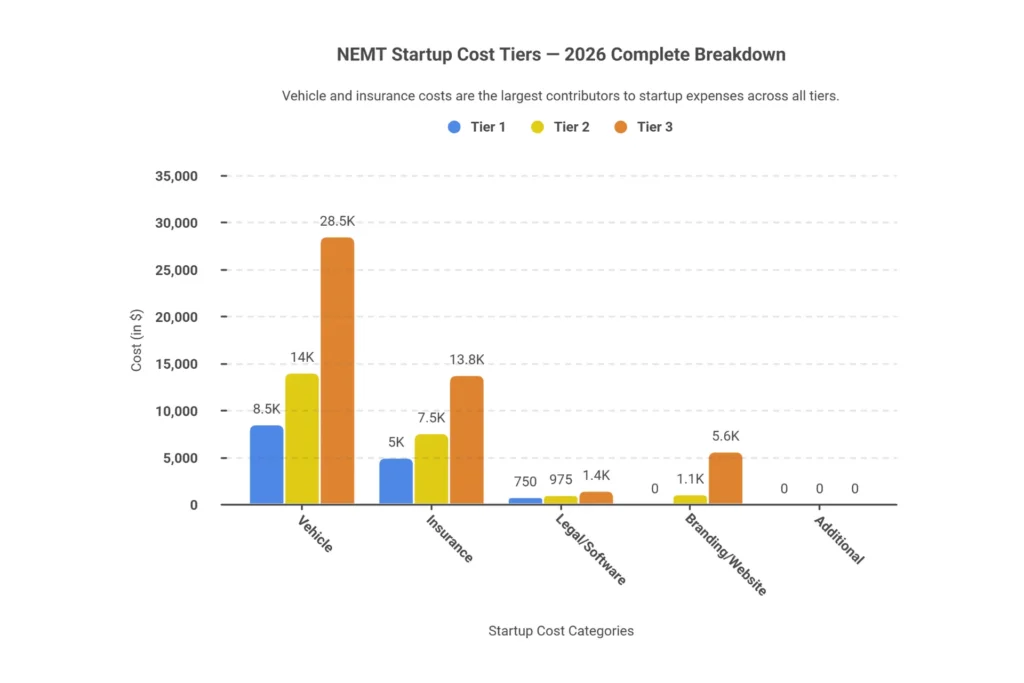
Startup Cost Breakdown (3-Tier Table)
| Cost Item | Tier 1: Minimum ($9,800–$20,000) | Tier 2: Standard ($17,850–$32,400) | Tier 3: Professional ($37,650–$63,200) |
|---|---|---|---|
| Vehicle | $5,000–$12,000 (used ambulatory) | $10,000–$18,000 (used WAV) | $22,000–$35,000 (2 vehicles) |
| Commercial Auto Insurance | $3,500–$5,000 | $5,000–$8,000 | $9,000–$15,000 |
| General Liability Insurance | $900 | $900–$1,200 | $1,500–$2,000 |
| LLC Formation + EIN | $100–$500 | $100–$500 | $100–$500 |
| State NEMT License | $0–$500 | $0–$500 | $0–$500 |
| Driver DQF (background + certs) | $0 (self) | $300–$600 | $600–$1,200 |
| Dispatch Software (3 months) | $0–$450 | $450–$900 | $750–$1,500 |
| Website + Marketing Launch | $0–$500 | $500–$1,500 | $2,500–$5,000 |
| Vehicle Branding + Setup | $300–$600 | $600–$1,200 | $1,200–$2,500 |
| TOTAL | $9,800–$20,000 | $17,850–$32,400 | $37,650–$63,200 |
12-Month Profit and Loss Projection
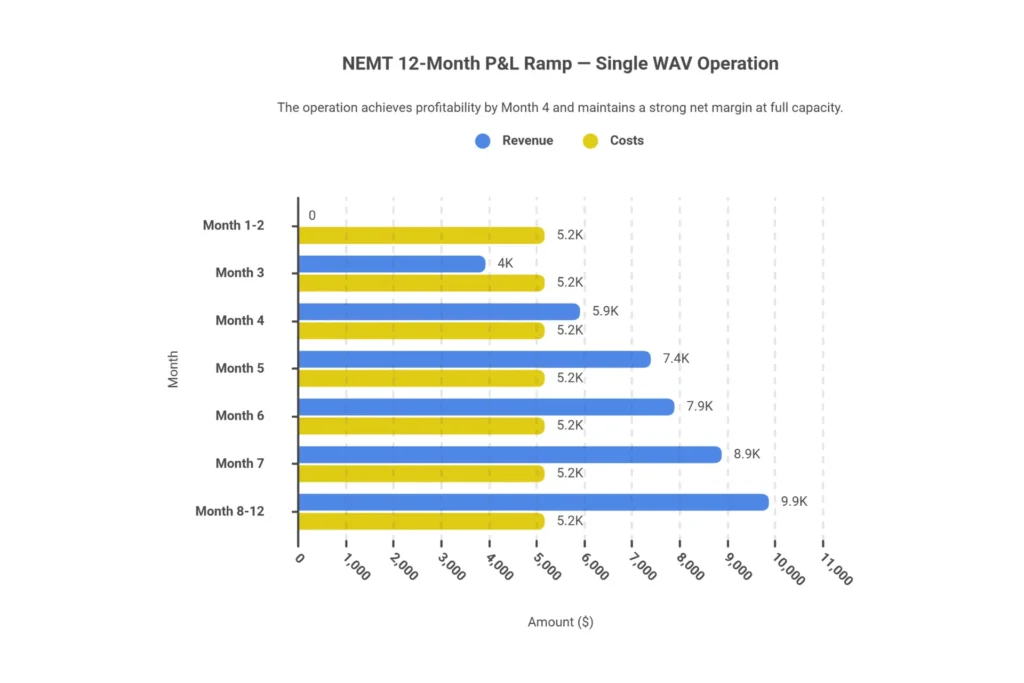
Your 12-month P&L must account for the enrollment ramp. Months 1 and 2 carry full operating costs against zero Medicaid revenue. Month 3 sees your first broker trips at 40–50% of target daily volume. Months 4 through 6 ramp to 70% capacity as your broker performance score builds. Months 7 through 12 run at 90–100% capacity. At a single WAV model generating $9,900/month at full capacity against $5,200/month in operating costs, monthly net income reaches $4,700 by month 7. Annual net for year one — accounting for the zero-revenue enrollment period — runs approximately $28,000–$35,000.
| Expense | Monthly Cost |
|---|---|
| Vehicle payment (financed WAV, 60-month) | $720 |
| Commercial auto insurance | $520–$670 |
| General liability insurance | $75–$125 |
| Workers’ compensation | $235–$410 |
| Driver wages ($16/hr × 160 hrs) | $2,560 |
| Fuel (1,500 mi/month) | $270 |
| Vehicle maintenance reserve | $200 |
| Dispatch software | $149–$299 |
| Phone, accounting, admin | $150–$250 |
| Total Monthly Operating Cost | $4,879–$5,504 |
Break-Even Analysis
Your break-even calculation determines the minimum trip volume you need to cover all fixed and variable costs. With $5,200 in average monthly operating costs and a $45 average WAV rate, your break-even formula is: $5,200 ÷ ($45 − $8 variable cost per trip) = 140.5 trips per month. At 22 operating days per month, that equals 6.4 trips per day to break even. Since your target is 10 trips per day, your margin of safety above break-even is 3.6 trips per day — or 36% capacity headroom. This break-even analysis belongs in your business plan’s financial section, as SBA lenders use it to assess downside protection in your revenue model.
SBA Loans and Funding Options for NEMT Startups
Your funding strategy section should cover all available sources. The SBA 7(a) loan offers up to $500,000 for vehicles, insurance, and working capital — current rates run 10.5–13.5% for 2026. You need a credit score of 640 or higher, a complete business plan, and two years of personal tax returns. The SBA Microloan is accessible for first-time operators with less established credit: up to $50,000 at 8–13%, no revenue history required, and a streamlined application process. The FTA Section 5310 grant program funds 80% of vehicle costs for operators serving older adults and people with disabilities. Your state transit authority manages Section 5310 applications — they open annually, so timing your launch plan around the application cycle matters. Equipment financing through commercial auto lenders offers a faster path to vehicle acquisition than SBA loans and does not require a separate business plan review in most cases.
Section 6 — NEMT Marketing and Growth Strategy
Your marketing and growth section must show lenders and reviewers that you have a clear plan for generating revenue — not just a hope that patients will call. NEMT marketing works differently from consumer marketing. Your actual customers are Medicaid brokers, facility administrators, and discharge planners, not the patients themselves. Your marketing plan must target all three audiences simultaneously.
Pro Tip: In your first 60 days of broker enrollment, accept every trip assignment offered — even low-rate ones. Brokers assign volume based on provider performance scores (on-time rate, no-show rate, complaint rate). Building a perfect performance record in month 1 directly increases your trip volume by months 3 to 6.
NEMT Broker Enrollment as Your First Marketing Channel
NEMT broker enrollment is your fastest path to first revenue. Enrolling with ModivCare (43+ states), MTM Inc. (strong Midwest and Southeast), MAS Transportation (Northeast and Southeast), and Access2Care simultaneously gives you the maximum number of trip assignment opportunities from the earliest date. Each broker has its own provider portal and enrollment timeline — typically 4 to 8 weeks from application to first trip. While waiting for broker approval, begin building your direct referral relationships so that private-pay and facility volume arrives at the same time as your first broker trips. For guidance on billing each broker network and understanding their payment timelines, review our NEMT broker billing guide. Additionally, review NEMT prior authorization requirements before your first enrolled trip — missing a prior auth is the most common denial reason for new providers.
Facility Partnerships: Dialysis Centers and Hospital Discharge
A single dialysis center with 40 active Medicaid patients generates 120 weekly trips. At $40 per trip, that one facility relationship represents $250,000 in annual gross revenue. Target Fresenius Medical Care, DaVita, and American Renal Associates locations in your service area. Contact the facility administrator or social worker directly. Bring a capabilities packet that includes your insurance certificates, Medicaid enrollment confirmation, driver qualifications summary, vehicle photos showing ADA compliance, and your company’s HIPAA privacy practices. Hospital discharge planners need a direct phone number, a one-page capabilities sheet, and proof that you answer calls immediately. For a detailed workflow on billing dialysis trips correctly, see our NEMT billing for dialysis transportation resource.

Digital Marketing and Website Strategy
Before a dialysis center social worker or hospital discharge planner agrees to refer patients to you, they check your website. A missing or unprofessional online presence disqualifies you from facility contracts before the first conversation happens. Your business plan’s marketing section must include a website strategy that covers: your service area and vehicle fleet documentation, ADA compliance and insurance certificate display, HIPAA-ready contact forms, Google My Business optimization for local search, and mobile-first responsive design. A professional NEMT-specific website built for facility referral conversion is not optional at the professional launch tier — it is the infrastructure your marketing strategy runs on. For NEMT-specific website development that converts facility referrals into contracted relationships, visit our NEMT website development services.
- HIPAA-ready contact forms
- Insurance and license display
- Service area + route map
- Fleet and ADA compliance info
- Google My Business sync
- Mobile-first responsive
Free NEMT Business Plan Template 2026
The sections above give you all the content you need to write a complete non emergency medical transportation business plan. The structure below organizes those sections into the exact format that SBA lenders, state Medicaid agencies, and NEMT brokers expect to see. Download the template, fill in your specific figures, and submit it with confidence that your plan covers every element reviewers look for in 2026.
Pro Tip: State-specific sections require customization. California operators must add their CPUC TCP license application timeline. Texas operators must reference HHSC/TMHP enrollment. Virginia operators must document the PRISM portal enrollment process. If your plan reads like it was written for any state, it reads like it was written for no state.

How to Use This Template
Complete your business plan in this order: start with Section 4 (Operations) and Section 3 (Services and Pricing), because these sections contain the specific facts your financial projections depend on. Then complete Section 2 (Market Analysis) using your local CMS data and facility count. Next complete Section 5 (Financial Projections) using your confirmed operating costs, state Medicaid rates, and vehicle financing terms. Then complete Section 6 (Marketing) with your specific broker targets and facility prospects. Complete Section 1 (Executive Summary) last — it summarizes everything you have already written. Total completion time for a focused first draft: 12 to 18 hours across 3 to 4 working sessions. Have a local business attorney and your insurance broker review the compliance and financial sections before submission to any licensing agency or lender.
Free download · 8 sections · SBA loan ready · EliteMed Financials
7 NEMT Business Plan Mistakes That Kill New Operators
Every one of these mistakes appears repeatedly in failed NEMT applications and unsuccessful loan requests. Know them before you write your plan, not after you get rejected.
- Using national average rates instead of state Medicaid fee schedule rates. Your state may pay $22/trip for ambulatory; building your projections on the national average $28 overstates revenue by 27% and flags your financials as unrealistic to SBA reviewers.
- Missing the Medicaid enrollment timeline in financial projections. Operators who project revenue starting in month 1 without accounting for the 30–90 day enrollment period create cash flow plans that collapse in real operations.
- Wrong NAICS code. Filing with 621610 (Home Health) instead of 485991 (Special Needs Transportation) causes Medicaid enrollment taxonomy mismatches and SBA loan underwriting complications.
- No driver qualification file documentation. A business plan that does not address DQF requirements signals to brokers that the operator does not understand compliance — and broker enrollment follows.
- Generic service area definition. Writing “we serve [City]” without zip codes, radius, or county boundaries fails state licensing applications that require a documented service area boundary.
- No contingency for denied claims. New NEMT operators face a 15–25% denial rate on initial billing. A business plan that does not budget for claim denials or account for NEMT denial codes and appeals creates a cash flow crisis by month 4.
- Underestimating insurance first-year surcharge. New operators pay 15–25% above standard commercial auto insurance rates. Budgeting standard rates creates a $1,200–$2,500 shortfall in year-one cash flow.
Frequently Asked Questions About NEMT Business Plans
Do I need a business plan to start a NEMT company?
Yes, in most cases. A business plan is required for SBA loan applications, state NEMT licensing in several states, and formal Medicaid provider enrollment documentation. Even where not required, a plan helps you project startup costs accurately, model your cash flow gap during the enrollment period, and avoid the costly mistakes that end most new NEMT operations in the first 90 days.
How long should a NEMT business plan be?
A NEMT business plan should be 15 to 25 pages. It must include an executive summary, local market analysis, services and HCPCS billing codes, operations plan with DQF and ADA compliance documentation, 12-month financial projections with P&L and cash flow, and a marketing strategy. SBA lenders need the financial detail. State Medicaid agencies focus on the operations and compliance sections.
What is the average revenue per trip for NEMT?
Medicaid pays $15–$35 per ambulatory trip and $30–$75 per wheelchair-accessible van trip nationally. State rates vary significantly: California pays $28–$45 per ambulatory trip, among the highest in the US. Stretcher transport pays $65–$150 per trip. Private pay rates run 30–50% above Medicaid rates for the equivalent service.
How much money can a NEMT business make in year one?
A single-vehicle NEMT business can generate $60,000–$108,000 in year-one gross revenue, depending on whether you operate an ambulatory vehicle or a WAV and how quickly you ramp to full capacity after your enrollment period. After vehicle, insurance, driver wages, fuel, software, and overhead, net profit for year one typically runs $15,000–$32,000 for a solo WAV operation.
Can I get an SBA loan for a NEMT business?
Yes. NEMT businesses qualify for SBA 7(a) loans up to $500,000 for vehicles, insurance, and working capital. You need a complete business plan, a credit score of 640 or higher, and two years of personal tax returns. The SBA Microloan program (up to $50,000) is available for startups with limited credit history. Additionally, the FTA Section 5310 grant program covers 80% of vehicle costs for operators serving older adults and people with disabilities.
How profitable is NEMT?
NEMT businesses operate at 20–30% net profit margins, making them more profitable than most ground transportation businesses. A single WAV completing 10 trips per day at $45 average generates $108,000 in annual gross revenue. After all operating costs, net profit runs $21,600–$32,400 per vehicle per year. Profitability improves significantly with fleet scale as overhead per vehicle decreases.
How much can a NEMT owner make with 4 vans?
A NEMT owner with 4 wheelchair-accessible vans generates $240,000–$432,000 in annual gross revenue based on 10 trips per day per vehicle at $40–$45 average rate across 240 operating days. After operating expenses for a 4-van fleet (approximately $260,000–$300,000 annually), owner net income runs $130,000–$170,000 per year. Volume discounts on insurance and software further improve margins at this fleet size.
What licenses do I need to start a NEMT business?
NEMT license requirements vary by state. Every operator needs an LLC or business entity registration, a federal EIN, a Type 2 NPI number from NPPES, commercial auto and general liability insurance, and state Medicaid provider enrollment. State-specific requirements include California’s TCP license from the CPUC, Texas HHSC authorization, Georgia DPH certification, and Virginia DMAS enrollment via the PRISM portal. Always verify current requirements with your state’s Medicaid NEMT coordinator before applying.
What is the NAICS code for a NEMT business?
The NAICS code for a non-emergency medical transportation business is 485991, which covers Special Needs Ground Transportation Services. Use this code when filing your LLC, applying for business banking, completing Medicaid enrollment applications, applying for SBA loans, and enrolling with NEMT broker networks. Using an incorrect NAICS code creates mismatches across your licensing, banking, and billing infrastructure that take months to correct.
Quick Answer Reference: NEMT Business Plan Questions
Short, direct answers to common NEMT business plan questions.
What is a NEMT business plan used for?
A NEMT business plan documents your company’s operations, services, financial projections, and Medicaid enrollment strategy. It is required for SBA loan applications, state NEMT licensing in several states, and serves as your 90-day launch roadmap. Without one, most new operators miss their enrollment window and run out of cash before receiving their first Medicaid payment.
How long does it take to write a NEMT business plan?
Writing a complete NEMT business plan takes 12 to 18 focused hours spread across 3 to 4 working sessions. Gathering your local Medicaid rate schedule, vehicle financing quotes, insurance estimates, and service area data before you start writing reduces the total time significantly. Using a template cuts first-draft time by 40 to 60 percent.
What financial projections go in a NEMT business plan?
A NEMT business plan must include a 12-month profit and loss projection, a monthly cash flow statement showing the enrollment period gap, a startup cost breakdown, a break-even analysis in trips per day, and a debt service calculation if you are seeking financing. Use your state’s current Medicaid fee schedule for revenue projections, not national averages.
How do NEMT companies get clients without brokers?
NEMT companies build direct clients through facility partnerships — dialysis centers, hospital discharge departments, behavioral health outpatient programs, and skilled nursing facilities. You approach facility administrators and social workers directly with a compliance packet, insurance certificates, and a capabilities sheet. Direct clients pay 30–50% above Medicaid broker rates and provide more consistent trip volume than broker assignments.
What is the NAICS code for a NEMT business?
NAICS code 485991 covers Special Needs Ground Transportation, which is the correct classification for NEMT companies. Use this code for LLC registration, business banking, SBA loan applications, Medicaid enrollment, and NEMT broker applications. Using the wrong NAICS code creates cascading errors across your entire business infrastructure.
Can I start a NEMT business with no money?
Yes. The subcontractor model allows you to start as a NEMT driver under an established operator’s Medicaid enrollment and broker credentials. You provide the vehicle and driving; they handle billing and dispatch. You earn 60–75% of the operator’s trip rate, build your compliance record, and use 6 to 12 months of income to fund your own Medicaid enrollment and insurance for independent operation.
Build Your NEMT Business on a Foundation That Lasts
A complete non emergency medical transportation business plan is not paperwork — it is the infrastructure your revenue depends on. Operators who launch with a documented plan survive the 60–90 day enrollment period, win broker contracts faster, and build to profitability in year one. Those who skip the plan routinely discover their projections were wrong, their cash reserves were insufficient, and their compliance gaps were costly. The EliteMed Financials team works exclusively with healthcare transportation operators. Whether you need expert NEMT billing services that reduce denials below 5%, or a professional NEMT website built to win facility contracts from day one, every service we offer is built to make your operation as sustainable as your patients’ need for reliable transportation.
With Zero Billing Mistakes?