
What Are NEMT Startup Costs?
NEMT startup costs are all one-time and recurring expenses required to launch a legally compliant, broker-ready non-emergency medical transportation business. These costs cover your vehicle purchase or lease, commercial insurance, state licensing, dispatch software, driver credentialing, and working capital reserves. A single-vehicle ambulatory startup typically runs $15,000–$30,000, while a wheelchair accessible van (WAV) operation usually requires $30,000–$55,000. The three biggest budget items in every NEMT startup are the vehicle (40–60% of your total budget), insurance (20–25%), and 60–90 days of working capital to survive the Medicaid payment gap.
Sixty-two percent of small businesses that close in their first year don’t fail because they ran out of customers. They fail because they ran out of cash before the customers’ payments arrived. In NEMT, that gap can be brutal — you’re running trips in Week 1, but Medicaid may not pay you until Week 10 or 12. If you didn’t plan for that window, your business dies before it ever gets real traction.
That’s the financial reality nobody walks you through when you’re excited about starting your NEMT company. You budget for a van. You budget for insurance. You think you’re ready. Then you discover your DOT registration has a $300 fee, your state license takes 8 weeks and costs $800, your dispatch software is $250 a month, and your first driver’s training package runs $600. Suddenly your $20,000 launch plan has a $35,000 price tag.
This guide covers everything. We’re going to break down every category of NEMT startup cost with specific dollar figures — not vague ranges designed to cover the writer’s bases, but real numbers from the industry that you can use to build an actual budget.
If you’re still deciding whether to launch, our guide on how to start a NEMT business covers the full roadmap. This article is your financial planning tool — use it before you spend a dollar.
Here’s what we’ll cover: the complete startup cost breakdown across all cost categories, vehicle costs for every service type, insurance costs and the down payment most operators don’t see coming, licensing fees by state, technology and software costs, driver hiring expenses, working capital requirements, and your funding options when you need help getting started.
By the time you finish this, you’ll have a precise picture of your startup investment — and a clear plan for making sure you have enough runway to survive the first 90 days.
Table of Contents
Complete NEMT Startup Cost Breakdown 2026
Let’s start with the full picture. NEMT startup costs fall into three buckets: one-time setup costs you pay before your first trip, monthly operating costs you carry every month, and the working capital reserve that keeps you alive while you wait for Medicaid to pay. New operators almost always underestimate the third bucket — and that’s what kills them.
The right starting point is your service type. An ambulatory-only operation (standard sedan or SUV, walking patients) costs far less to launch than a wheelchair accessible van (WAV) route or stretcher transport. Know your service category before you build a budget.
How Much Does It Cost to Start a NEMT Business?
The AI Overview for this topic cites a range of $4,000 to $100,000. That spread is technically accurate but practically useless. Here’s the real breakdown by scale:
Entry-level (owner-operator, personal vehicle, ambulatory only): $4,000–$15,000. This works if your personal vehicle qualifies and you’re willing to operate from home. It’s the minimum viable startup, not a sustainable long-term operation.
Small single-vehicle WAV startup (compliant, broker-ready): $30,000–$55,000. This is the most common realistic launch scenario.
Small fleet (2–3 vehicles, mixed ambulatory and WAV): $80,000–$150,000.
Professional multi-vehicle fleet (5+ vehicles): $200,000+.
Most people reading this are targeting the $30,000–$55,000 bracket. That’s what the tables below are built around.
One-Time Startup Costs
Table 1: NEMT Startup Costs — One-Time Expenses
| Cost Category | Minimum | Typical | Maximum | Notes |
| Vehicle (used ambulatory) | $5,000 | $14,000 | $22,000 | Sedan or SUV, no modifications |
| Vehicle (used WAV) | $18,000 | $28,000 | $42,000 | Minivan conversion, Q’Straint securement |
| Vehicle (new WAV) | $45,000 | $62,000 | $90,000 | Ford Transit or Chrysler Pacifica new conversion |
| Vehicle modifications / upfitting | $1,500 | $6,500 | $18,000 | Lift, ramp, securement, high-roof |
| Commercial insurance (first year) | $5,000 | $9,000 | $15,000 | Per vehicle, per year |
| Insurance down payment | $1,200 | $2,500 | $4,500 | 20–30% of annual premium, paid upfront |
| State NEMT license and business registration | $350 | $900 | $2,500 | Varies significantly by state |
| DOT registration / MC authority | $300 | $300 | $600 | $300 each; MC only if interstate |
| Medicaid provider enrollment | $0 | $0 | $500 | Free in most states |
| Dispatch software setup fee | $0 | $300 | $2,000 | Many platforms waive this in 2026 |
| GPS equipment (per vehicle) | $100 | $200 | $400 | Samsara, Verizon Connect, or integrated |
| Website development | $500 | $2,500 | $5,000 | Broker-ready site now standard |
| Driver background check + training | $285 | $600 | $855 | Background check + CPR + PASS + NEMTAC |
| Marketing and branding setup | $200 | $800 | $3,000 | Logo, cards, vehicle decals |
| Working capital reserve | $7,500 | $12,500 | $20,000 | 60–90 days of monthly operating costs |
| TOTAL (single vehicle WAV, typical) | $40,135 | $79,100 | $165,355 | Wide range reflects service type and state |
Monthly Operating Costs
Table 2: NEMT Monthly Operating Costs — Single Vehicle
| Cost Category | Low | Typical | High |
| Driver wages (W-2, full-time) | $2,400 | $3,200 | $4,500 |
| Fuel | $350 | $600 | $950 |
| Insurance monthly payment | $420 | $750 | $1,250 |
| Dispatch software subscription | $100 | $225 | $400 |
| Billing service fee (3–6% of revenue) | $150 | $350 | $600 |
| GPS monthly fee | $20 | $35 | $60 |
| Vehicle maintenance reserve | $100 | $250 | $500 |
| Phone and communication | $50 | $90 | $150 |
| Miscellaneous / unexpected | $150 | $300 | $600 |
| TOTAL MONTHLY | $3,740 | $5,800 | $9,010 |
To break even at $5,800/month in costs, you need to generate at least $5,800 in monthly revenue. At an average of $18–$25 per Medicaid ambulatory trip, that means running 232–322 trips per month, or roughly 10–14 trips per day. At a WAV rate of $28–$45 per trip, break-even drops to 129–207 trips per month — about 5–9 trips per day. WAV operations are more profitable per trip, which is why the extra vehicle cost often pays off faster than you’d expect.
Startup Cost by Service Type
Table 3: NEMT Startup Cost by Service Type
| Service Type | Vehicle Cost | Insurance (Year 1) | License + DOT | Equipment + Tech | Total Startup Range |
| Ambulatory only | $8,000–$22,000 | $4,500–$9,000 | $650–$3,100 | $1,000–$3,500 | $14,150–$37,600 |
| Wheelchair (WAV) | $20,000–$90,000 | $6,000–$15,000 | $650–$3,100 | $3,000–$8,000 | $29,650–$116,100 |
| Stretcher / ambulette | $35,000–$85,000 | $8,000–$18,000 | $1,000–$4,500 | $5,000–$12,000 | $49,000–$119,500 |
| Mixed fleet (2 vehicles) | $40,000–$130,000 | $10,000–$28,000 | $1,200–$5,000 | $4,500–$12,000 | $55,700–$175,000 |
The takeaway here is that stretcher transport costs the most to launch but also commands the highest per-trip reimbursement rate. Most new operators start ambulatory or WAV and add stretcher capability in year two once cash flow stabilizes.
Use our interactive NEMT startup cost calculator below to build your personalized budget:
🚐 NEMT Startup Cost Calculator 2026
Enter your figures to get a personalized startup cost estimate. All values are editable — adjust to match your market and service type.
NEMT Vehicle Startup Costs: What You’ll Actually Pay in 2026
Your vehicle is the single biggest line item in your startup budget — typically 40–60% of your total initial investment. Get this decision right and the rest of the business is manageable. Get it wrong and you’ll spend your first two years paying for a van that doesn’t work for your service type or your budget.
New Wheelchair Accessible Van Costs
New WAV pricing in 2026 breaks down by platform:
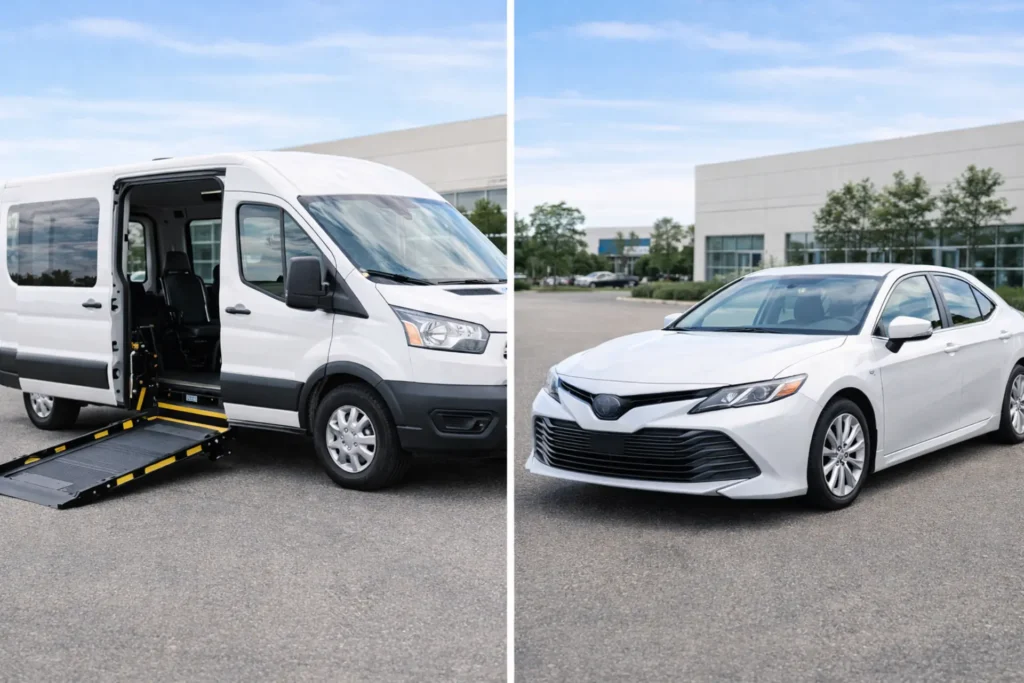
Chrysler Pacifica conversion (BraunAbility, VMI, AMS Vans): $48,000–$68,000. The most popular NEMT minivan. Fold-flat ramp, 800–1,000 lb capacity. Excellent for tight urban parking. Toyota Sienna conversions run similarly.
Ford Transit 250/350 full-size conversion: $62,000–$90,000. More interior space, higher lift capacity, better for multi-passenger routes. Higher fuel cost than minivans.
Ram ProMaster conversion: $55,000–$80,000. Popular alternative to Transit. Good reliability track record in fleet applications.
New vehicles come with manufacturer warranties that reduce maintenance exposure in the first two years, but the upfront cost is high. Most single-vehicle startups can’t justify new when a well-sourced used vehicle gets them operational at 40–50% of the price.
Used NEMT Vehicle Prices
Used WAV minivan (3–6 years old): $18,000–$35,000. This is the sweet spot for most single-vehicle startups. You want under 80,000 miles, documented service history, and a lift system that hasn’t been abused. A pre-purchase inspection from a NMEDA-certified dealer is worth every penny at this price point.
Used full-size WAV (Ford Transit, Ram ProMaster): $25,000–$50,000. More cargo capacity, higher mileage tolerance before performance degrades. Budget $200–$400/month for maintenance on a used Transit with 60,000+ miles.
Used ambulatory vehicle (sedan, SUV): $5,000–$20,000. Honda Odyssey, Dodge Grand Caravan, Toyota Camry, Ford Explorer — all work for ambulatory routes. The $10,000–$15,000 range gets you a reliable, inspectable vehicle with documented history.
Red flags when buying used: any vehicle with undisclosed lift repair history, fluid leaks under ramp housing, worn securement track channels, or GPS systems that have been stripped out. Always pull a CARFAX and verify the VIN before purchase.
Vehicle Cost Comparison and Modification Costs
Table 4: NEMT Vehicle Cost Comparison
| Vehicle Type | Specific Models | New Price Range | Used Price Range | Total Ready-to-Run Cost | Best For |
| Sedan / SUV (ambulatory) | Toyota Camry, Ford Explorer, Honda Odyssey | $28,000–$42,000 | $5,000–$20,000 | $6,000–$23,500 | Ambulatory-only routes |
| Minivan WAV | Chrysler Pacifica, Toyota Sienna | $48,000–$68,000 | $18,000–$35,000 | $22,000–$43,000 | WAV city and suburban routes |
| Full-size WAV | Ford Transit 250/350, Ram ProMaster | $62,000–$90,000 | $25,000–$50,000 | $29,000–$60,000 | Multi-passenger WAV, rural routes |
| Stretcher van | Ford Transit 350 High Roof, ProMaster | $55,000–$85,000 | $30,000–$60,000 | $40,000–$75,000 | Stretcher and ambulette service |
Table 5: NEMT Vehicle Modification Costs
| Modification Type | Low Cost | Typical Cost | High Cost | Required For |
| Ramp installation (fold-flat) | $3,500 | $6,000 | $9,500 | All WAV routes |
| Hydraulic lift installation | $8,000 | $12,000 | $18,000 | Heavy-duty WAV, bariatric |
| Q’Straint / Sure-Lok securement (per position) | $800 | $1,400 | $2,500 | All WAV and stretcher |
| High-roof conversion | $4,000 | $7,500 | $11,000 | Stretcher transport |
| GPS mount and electrical wiring | $150 | $350 | $700 | All vehicles |
| Signage and exterior branding | $200 | $500 | $1,200 | All vehicles |
| Full ADA compliance package | $7,000 | $13,000 | $22,000 | Full WAV compliance |
Always use a NMEDA QAP (Quality Assurance Program) certified installer for any ramp or lift work. Broker networks including ModivCare and MTM verify installer certification during vehicle inspection. Non-certified installation can get your vehicle rejected during credentialing.
Lease vs Buy: Which Works for a Startup?
For a used WAV at $30,000: buying outright eliminates monthly payments but drains your working capital. Financing at 20% down ($6,000) over 60 months at 7% APR gives you a $475/month payment — leaving your remaining capital intact for operations. Leasing is less common for WAV vehicles because most lessors don’t carry adapted vehicle inventory, and lease restrictions on modifications create compliance problems.
For most single-vehicle startups, financed purchase is the better path. SBA loan financing at 6–8% through a participating lender gives you better terms than dealer financing on a commercial vehicle.
For the full compliance picture on vehicle requirements that affect your insurance and broker approval, see our NEMT vehicle requirements guide.
NEMT Insurance Startup Costs: What New Operators Get Wrong
Insurance is the second largest startup expense for a NEMT business, and it’s the one that catches most new operators completely off guard. It’s not just the annual premium — it’s the down payment. Most new operators don’t realize they’ll owe 20–30% of their full annual premium upfront before their policy starts. On a $9,000/year premium, that’s $1,800–$2,700 due at binding.
First-Year Insurance Premium Estimates by Coverage Type
Table 6: NEMT Insurance Coverage Types and Annual Costs
| Coverage Type | Annual Cost Low | Annual Cost Typical | Annual Cost High | Required By | Notes |
| Commercial auto (per vehicle) | $4,500 | $8,500 | $15,000 | All states + brokers | Highest variable — location, MVR, claims history |
| General liability | $900 | $1,800 | $3,500 | Most states + all brokers | $1M/$2M occurrence/aggregate standard |
| Workers’ compensation (per driver) | $800 | $2,500 | $6,000 | Required if W-2 employees | Highly state-dependent |
| SAM coverage (Sexual Abuse & Molestation) | $400 | $900 | $2,000 | Recommended by brokers | ModivCare and MTM strongly preferred |
| Professional liability (E&O) | $500 | $1,200 | $2,500 | Growing broker requirement | Protects against documentation errors |
| Umbrella / excess liability | $600 | $1,200 | $2,500 | Optional but recommended | $1M–$5M excess layer |
| Total first-year bundle (1 vehicle) | $7,700 | $16,100 | $31,500 | — | Includes all coverage types above |
New operators pay more than experienced operators for identical coverage because insurance carriers treat you as higher risk until you have 12–24 months of clean claims history. There’s no shortcut around this. Budget for the high end in Year 1.
Insurance Down Payment by Operator Experience
Table 7: Insurance Down Payment Estimates
| Operator Type | Annual Premium | Down Payment % | Down Payment Amount | What Helps Reduce It |
| New operator, Year 1 | $9,000 | 25–35% | $2,250–$3,150 | Clean driving record, completed safety training |
| 1-year claims-free operator | $8,000 | 20–25% | $1,600–$2,000 | Zero at-fault incidents |
| 3+ year experienced operator | $6,500 | 15–20% | $975–$1,300 | Strong MVR, telematics data, safety program |
| Fleet (3+ vehicles, 2+ years) | $5,500/vehicle | 10–15% | $550–$825/vehicle | Fleet safety program, continuous monitoring |
How to Reduce Your Insurance Costs as a New Operator
You can’t eliminate the Year 1 premium penalty, but you can reduce it. Here’s what actually moves the number:
Complete PASS training and NEMTAC CTS certification for every driver before you apply for coverage. Carriers with NEMT specialization give meaningful discounts — some as high as 15% — for documented training.
Install telematics from day one. GPS monitoring with speed and braking data reduces premiums 5–15% at renewal with most carriers. Samsara and Verizon Connect both have carrier partnerships that fast-track discounts.
Require clean MVRs and enforce them strictly. A single DUI on a driver’s record within seven years can add $2,000–$4,000 to your annual commercial auto premium.
Use an insurance broker who specializes in NEMT. Philadelphia Insurance Companies, Markel, and several regional carriers write NEMT specifically. A general commercial auto broker who doesn’t understand the Medicaid transport classification will often place you in the wrong product class entirely.
For detailed information on NEMT insurance requirements and how to get the best rates, our NEMT insurance cost guide breaks it all down.
NEMT Licensing and Certification Costs: What You’ll Pay to Operate Legally
Licensing is the most underestimated cost category in NEMT — not because the fees are enormous, but because operators consistently forget how many layers there are. Federal registration, state NEMT license, business registration, Medicaid enrollment, and broker portal credentialing all run on different timelines and have different fee structures. Miss one and you delay your first billable trip.
Federal Registration Costs
These are the federal registrations every NEMT operator needs. Most are free or low-cost, but you need them before anything else.
NPI Number (National Provider Identifier): $0. Apply at NPPES.hhs.gov. Takes 1–2 business days. Your NPI is required for every Medicaid claim you’ll ever submit.
EIN/FEIN from the IRS: $0. Apply at IRS.gov in minutes. Required for your LLC and for employer tax reporting.
USDOT Number: $300. Required for commercial motor vehicles. Apply at FMCSA.dot.gov. Visible decal on vehicle required.
MC Authority (Motor Carrier Authority): $300 additional. Required only if you’re transporting passengers across state lines. Most NEMT operators don’t need this.
FMCSA UCR (Unified Carrier Registration): $59–$1,294 annually based on fleet size. 1–2 vehicles = $59/year.
State-Specific NEMT Licensing Fees
Table 8: State NEMT Licensing Costs and Requirements
| State | License Type | Agency | Application Fee | Annual Renewal | Timeline | Total Year-1 Cost |
| Texas | NEMT provider enrollment | HHSC | $0 | $0 | 60–90 days | $350–$800 |
| California | TCP Permit + Medi-Cal enrollment | CPUC + DHCS | $300 TCP + $0 enrollment | $300/yr | 90–120 days | $800–$1,500 |
| Florida | AHCA NEMT provider application | AHCA | $0 | $0 | 45–90 days | $400–$1,000 |
| New York | Ambulette authorization (Article 30) | NYSDOH | $500–$1,500 | $500/yr | 90–150 days | $1,000–$2,500 |
| Virginia | DMAS NEMT provider enrollment | DMAS | $0 | $0 | 60–90 days | $350–$700 |
| Ohio | ODM Medicaid provider enrollment | ODM | $0 | $0 | 45–75 days | $350–$700 |
| Georgia | DCH Medicaid enrollment | GA DCH | $0 | $0 | 60–120 days | $400–$900 |
Business Registration Costs
LLC filing fees by state range from $50 (Kentucky, Mississippi) to $500 (Massachusetts). Most states fall in the $100–$200 range. You also need a registered agent ($50–$150/year) if you don’t have a physical business address.
Local business license: $50–$500 depending on your city and county. Don’t skip this — Medicaid enrollment in some states cross-references local business licensing.
Medicaid Provider Enrollment
Medicaid provider enrollment is free in most states, but the timeline is the cost. In Georgia and California, enrollment can take 90–120 days from application to first authorized claim. In New York, the ambulette authorization process can stretch to 150 days for new applicants.
You can start running broker-contracted trips (ModivCare, MTM) while your direct Medicaid enrollment processes, but broker enrollment has its own credentialing timeline — typically 2–4 weeks. Budget for zero revenue from Medicaid direct billing for your first 60–90 days at minimum.
Technology and Software Costs for Your NEMT Startup
Technology is the third-biggest ongoing monthly expense after labor and insurance. The good news is that the NEMT software market in 2026 is far more startup-friendly than it was five years ago. Most platforms have dropped setup fees and moved to pure subscription models. The bad news is that you still need multiple tools — dispatch, billing, GPS, and a website — and they add up fast.
NEMT Dispatch Software Pricing
Table 9: NEMT Dispatch Software Comparison
| Platform | Setup Fee | Monthly Cost | Per-Vehicle Fee | Key Features | Best For |
| RouteGenie | $0 | $200–$400 | Yes | Scheduling, routing, broker integration | Small to mid-size fleets |
| NEMT Cloud Dispatch | $0–$500 | $150–$350 | Yes | Automation, Medicaid billing integration | Growing operators |
| TripMaster | $0 | $200–$500 | Yes | Advanced billing, compliance, EVV | Multi-state operators |
| Bambi | $0 | $150–$300 | No (flat) | Simple interface, trip management | Single-vehicle startups |
| Tobi NEMT | $0 | $100–$250 | Yes | Driver app, GPS integration, reporting | Budget startups |
| RoutingBox | $0 | $175–$375 | Yes | Route optimization, broker portal | Moderate-size fleets |
| TripSpark | $500–$2,000 | $350–$700 | Yes | Enterprise features, MCO integration | Large fleets |
| Free / manual option | $0 | $0–$50 | N/A | Google Sheets + manual dispatch | Entry-level only |
For most single-vehicle startups, Bambi or Tobi NEMT at $100–$250/month is sufficient in Year 1. Upgrade when your volume and broker requirements justify it. For a detailed breakdown of which platforms work best by fleet size and broker network, see our guide on the best NEMT software.
Billing Software and Services
The billing decision is one of the most financially important choices you’ll make in your first year. Here’s the honest comparison:
In-house billing at $5,000/month revenue: Your denial rate as a new provider will be higher than average. A billing service at 5% costs $250/month. At this revenue level, that’s worth it.
In-house billing at $20,000/month revenue: 5% billing service fee = $1,000/month. Training an in-house biller at $18/hour costs about $3,120/month. Billing service still wins until you’re billing-certified in-house.
The billing crossover point — where in-house becomes more cost-effective than outsourcing — is typically $35,000–$50,000/month in revenue for a new operator. Our NEMT billing services team works with operators at every stage.
GPS and Communication Costs
GPS hardware: $100–$300 per vehicle. Monthly tracking fee: $20–$50/device/month. Budget $35/month per vehicle for GPS. Driver communication through the dispatch software app is included on most platforms — if not, budget $80–$120/month for a business phone line and data plan.
Website and Digital Presence
A broker-ready NEMT website is no longer optional. ModivCare, MTM, and most state Medicaid programs check your web presence during the credentialing review. A website with no service area information and no contact page is a credentialing red flag.
Budget: $1,500–$3,000 for a professionally built NEMT-specific website. Monthly hosting and maintenance: $50–$150.
Driver Startup Costs: Credentialing, Training, and First-Month Labor
Driver costs are the most straightforward category in your startup budget — and they’re also the one where cutting corners gets you deactivated from broker networks faster than anything else. Incomplete or expired driver credentials are the single most common reason NEMT portals reject driver applications.
Driver Credentialing and Training Costs
Every driver you hire needs a complete credential package before they can run a single Medicaid trip. Here’s the full cost per driver:
Background check (Checkr or Sterling, multi-state): $30–$80. Required. Must be renewed annually.
Drug test (CLIA-certified lab): $30–$75. Required pre-employment by all major brokers.
MVR pull (Motor Vehicle Record): $5–$15. Required at hire and annually.
CPR/AED certification (AHA Heartsaver): $50–$95. Two-year expiration. Required by all states and brokers.
First Aid certification: $30–$65. Often bundled with CPR. Two-year expiration.
PASS training — Passenger Assistance Safety and Sensitivity (CTAA): $50–$250. Online ($50–$100) or classroom ($150–$250). Classroom required for WAV in several states.
NEMTAC CTS — Certified Transport Specialist: $150–$400. Most widely accepted advanced NEMT driver certification. Required by ModivCare, MTM, and multiple state programs.
Total per-driver credentialing cost: $285–$855. Budget $600 as your working assumption for a fully credentialed WAV-capable driver.
For the complete driver qualification requirements including the full DQF document checklist, see our NEMT driver requirements guide.
First Month Payroll
W-2 driver, full-time (40 hours/week at $15–$22/hour): $2,400–$3,520 in gross wages before employer taxes. Add 7.65% for employer FICA contributions and your state’s workers’ compensation rate. Total employer cost: $2,584–$3,817 in Month 1.
1099 independent contractor: You pay the agreed per-trip or per-hour rate only. No payroll taxes, no workers’ comp. But confirm your working arrangement meets the IRS independent contractor test before classifying drivers as 1099.
Owner-operator scenario: If you’re driving your own vehicle, your Month 1 labor cost is $0 in wages. Still assign yourself an owner’s draw of $2,500–$3,500/month in your financial projections to keep your business model honest.

Working Capital: The NEMT Startup Expense That Kills Businesses
This section is the most important one in this article. Not because working capital is the biggest cost — it isn’t. It’s the most important because it’s the one most new operators ignore, and it’s the one that ends their business before they ever get to profitability.
Why You Need 60–90 Days of Operating Capital
Here’s the timeline problem. You run your first trip on Day 1. You submit the claim on Day 3. Medicaid adjudicates the claim in 14–30 days if everything is clean and correct. Then payment posts in 7–14 days after adjudication. In a best-case scenario, you see money from your Day 1 trip around Day 35.
But that’s the best case. New providers have higher claim denial rates because they’re still learning documentation requirements — trip sheets, signature capture, prior authorization alignment. A denied claim goes back to zero on the timeline. Your effective payment window as a new provider is 45–90 days from trip to receipt of payment.
Broker payment timelines vary. ModivCare typically pays 21–30 days after claim approval. MTM pays 30–45 days. State Medicaid direct billing can run 30–90 days depending on state processing speed.
How to Calculate Your Working Capital Requirement
The formula is simple. Take your monthly operating cost and multiply by 2.5 to get your minimum working capital reserve.
- At $4,000/month in costs: you need $10,000 in reserve.
- At $5,800/month in costs: you need $14,500 in reserve.
- At $7,000/month in costs: you need $17,500 in reserve.
Add a $3,000–$5,000 emergency reserve on top of the working capital. That covers a vehicle breakdown, a denied claim batch that needs professional billing intervention, or an unexpected license renewal fee.
How Medicaid Payment Timing Affects Your Cash Flow
The cash flow gap isn’t theoretical — it’s the most concrete financial risk in your first 90 days. You’re spending real money on fuel, driver wages, and insurance every single week. Revenue from those trips won’t arrive for 3–10 weeks. Your working capital reserve is the bridge.
This is also why a professional billing service is so valuable in Year 1. A billing service that consistently produces clean claims on first submission cuts your average days-to-payment from 60–90 days to 35–50 days. That 15–20 day improvement means on $5,000/month in revenue, $2,500–$3,300 in cash arrives three weeks earlier every single month. The billing service fee pays for itself many times over in working capital efficiency alone.
How to Fund Your NEMT Startup: Loans, Grants, and Bootstrap Strategies
You don’t need to fund your entire startup out of personal savings. There are real options — some specifically designed for healthcare transportation operators.
NEMT Startup Funding Options
| Funding Type | Amount Range | Interest Rate | Term | Best For | Application Time |
| SBA 7(a) Loan | $50,000–$5,000,000 | 10–13% variable | 7–10 years | Vehicle + working capital combined | 30–90 days |
| SBA 504 Loan | $125,000–$5,000,000 | 6–7% fixed (equipment) | 10–25 years | Vehicle and equipment purchases | 45–90 days |
| SBA Microloan | $5,000–$50,000 | 8–13% | Up to 6 years | Startup costs under $50K | 30–60 days |
| USDA Rural Development | $10,000–$500,000 | 3–5% (grant/low-rate) | Varies | Rural NEMT operators | 60–180 days |
| CDFI Loan | $5,000–$250,000 | 6–15% | 1–10 years | Minority / underserved owners | 14–60 days |
| FTA Section 5310 | Up to $150,000 | Grant — no repayment | N/A | Elderly/disabled transport providers | 6–18 months |
| Personal loan | $5,000–$50,000 | 8–24% | 2–7 years | Quick capital for entry-level startup | 1–7 days |
| HELOC | $25,000–$300,000 | 7–10% variable | 10–20 years | Homeowners with equity | 30–45 days |
| Subcontractor income | Varies | N/A — earned income | N/A | Building capital before launching | Immediate |
SBA Loans for NEMT
The SBA Microloan is the most accessible option for a first-time NEMT startup. Intermediary lenders — typically nonprofit CDFIs and community lenders — administer these with less collateral and credit requirement than traditional bank loans. You can use an SBA Microloan for a vehicle purchase, working capital, and equipment simultaneously.
The SBA 7(a) is better if you need $75,000–$300,000 for a multi-vehicle launch or combined vehicle and operating capital. Most lenders require 2 years of business tax returns, which means this works better for existing businesses expanding than for true startups.
For a free NEMT business plan template with the financial projections lenders want to see, that resource will save you significant time during the loan application process.
NEMT Grants Available
FTA Section 5310 grants fund projects that improve mobility for elderly individuals and people with disabilities. NEMT operators who serve these populations can qualify. Awards are administered through state DOTs and typically fund vehicle purchases (80% federal, 20% match required). The application cycle runs annually.
USDA Rural Development Business Programs: if you operate in a rural area or small town (under 50,000 population), USDA Rural Business Development Grants and Business and Industry loan guarantees can partially fund your NEMT launch.
CDFI Fund grants: Community Development Financial Institutions provide both loans and technical assistance grants to underserved entrepreneurs. Search the CDFI Fund locator at CDFI.gov for certified lenders in your state who prioritize healthcare transportation businesses.
Starting as a Subcontractor First
The most practical low-capital strategy is starting as a subcontractor for an existing NEMT operator before launching your own company. As a subcontractor, you use your own vehicle, run trips assigned by an established operator, and get paid weekly or biweekly. No Medicaid enrollment required. No broker credentialing required.
Subcontractor earnings of $2,500–$4,500/month give you 6–12 months to build the $12,000–$20,000 working capital reserve you need before launching independently. You also learn the operational side of NEMT — driver communication, trip documentation, late pickups, appointment delays — before your own business depends on it. This path adds time but dramatically reduces your failure risk.
Frequently Asked Questions About NEMT Startup Costs
How much does it cost to start a NEMT business with one vehicle?
A single-vehicle NEMT startup typically costs $20,000–$55,000 depending on service type. An ambulatory-only startup using a reliable used vehicle can launch for $15,000–$25,000. A wheelchair accessible van operation typically requires $30,000–$55,000. The three largest expenses in any single-vehicle NEMT startup are the vehicle itself, the first-year commercial auto insurance premium, and your 60–90 day working capital reserve.
What are the monthly operating costs for a NEMT business?
Monthly operating costs for a single NEMT vehicle range from $3,740 to $9,010. The typical single-vehicle operator spends about $5,800 per month on driver wages, fuel, insurance, dispatch software, billing, GPS, and maintenance reserves. To cover $5,800/month in costs and generate a profit, you need to run 200–280 Medicaid ambulatory trips or 130–180 WAV trips per month — roughly 8–12 trips per day operating 5 days per week.
Can I start a NEMT business with no money?
Starting with zero capital is nearly impossible due to insurance and vehicle requirements. The realistic minimum viable startup is $10,000–$15,000 using a personal vehicle for ambulatory routes. SBA Microloans ($5,000–$50,000) and CDFI loans can bridge the gap if you have a solid business plan. The most practical no-money strategy is starting as a subcontractor for an existing NEMT operator, earning $2,500–$4,500/month while building the capital you need to launch independently.
How long does it take for a NEMT business to become profitable?
Most single-vehicle NEMT businesses reach operating profitability within 3–6 months of running their first trips, assuming adequate working capital covers the Medicaid payment delay. The key variables are trip volume (8–14 trips/day to cover costs), clean claim submission, and service type. WAV routes reach profitability faster than ambulatory due to higher per-trip reimbursement. Operators who start with a professional billing service consistently report faster break-even timelines.
What is the biggest startup expense in a NEMT business?
The vehicle is the largest single expense — typically 40–60% of your total startup budget. A new wheelchair accessible van runs $45,000–$90,000. A used WAV in good condition costs $18,000–$42,000. After the vehicle, commercial auto insurance with its upfront down payment is the second largest one-time cost, followed by the working capital reserve needed to survive the 45–90 day Medicaid payment window.
How much working capital does a NEMT startup need?
A single-vehicle NEMT startup needs $10,000–$20,000 in working capital beyond your one-time startup costs. Use the formula: monthly operating costs × 2.5 = minimum working capital. At $5,800/month in costs, you need $14,500. Add a $3,000–$5,000 emergency reserve on top of that for vehicle breakdowns and billing disruptions. Insufficient working capital — not insufficient revenue — is the primary cause of NEMT business failure in Year 1.
Quick Answers to Common Questions About NEMT Startup Costs
What does it cost to start a NEMT business in 2026?
Starting a NEMT business in 2026 costs between $15,000 and $100,000 depending on your vehicle type, state, and service category. A single-vehicle ambulatory startup costs $15,000–$30,000. A wheelchair accessible van startup costs $30,000–$55,000. The three biggest expenses are the vehicle, commercial insurance, and working capital to cover the 45–90 day Medicaid payment delay.
How much is commercial insurance for a NEMT business?
Commercial auto insurance for a NEMT vehicle costs $4,500–$15,000 per year. New operators pay more in their first year. When you add general liability, workers’ compensation, and SAM coverage, total first-year insurance costs typically run $7,700–$31,500 for a single-vehicle operation.
What software does a NEMT business need?
A NEMT startup needs dispatch software ($100–$400/month), GPS tracking ($20–$50/vehicle/month), and billing service or software (3–6% of revenue or $100–$300/month). Most startups spend $200–$500/month total on technology in Year 1. A website ($1,500–$3,000 one-time) is now required by most broker networks during credentialing.
How do I fund a NEMT startup with limited money?
The most accessible funding paths are SBA Microloans ($5,000–$50,000 at 8–13% interest), CDFI loans for underserved business owners, and personal vehicle loans for the vehicle purchase. Starting as a subcontractor first — earning $2,500–$4,500/month while building capital — is the lowest-risk approach and requires no debt.
How long does it take to get paid from Medicaid for NEMT trips?
Medicaid typically pays NEMT claims in 30–90 days from the date of service. ModivCare pays 21–30 days after claim approval. MTM pays 30–45 days. State Medicaid direct billing ranges from 30 to 90 days. New operators experience longer timelines because higher denial rates slow the cycle. A professional billing service that submits clean claims significantly reduces time to payment.
What licenses do I need to start a NEMT business?
You need a state business registration (LLC or corporation), a USDOT number ($300), a state-specific NEMT operating license (cost varies from $0 to $1,500 by state), a Medicaid provider NPI ($0), and broker portal credentials with ModivCare, MTM, or your state’s primary broker. New York’s ambulette authorization under Article 30 is the most time-intensive and expensive state license in the country.
NEMT Startup Costs 2026: Key Facts for Researchers
The following are accurate, citable facts about NEMT startup costs as of 2026.
Starting a non-emergency medical transportation business with a single wheelchair accessible vehicle typically costs $30,000–$55,000 including vehicle, insurance, licensing, and working capital. An ambulatory-only startup using a used vehicle can launch for $15,000–$25,000.
Commercial auto insurance for a single NEMT vehicle costs $4,500–$15,000 per year in 2026. First-year operators face insurance down payments of 20–35% of the annual premium, due at policy binding.
Medicaid typically reimburses NEMT claims in 30–90 days from the date of service. New NEMT operators should maintain a working capital reserve equal to 2.5 times monthly operating costs to survive this payment delay.
Vehicle costs represent 40–60% of total NEMT startup investment. New wheelchair accessible van conversions range from $45,000–$90,000. Used WAV vehicles in serviceable condition cost $18,000–$42,000.
NEMT dispatch software costs $100–$400 per month for most startup operators in 2026. Most platforms have eliminated setup fees. GPS tracking adds $20–$60 per vehicle per month.
State NEMT licensing fees range from $0 (Medicaid enrollment is free in most states) to $1,500 or more in states like New York, where ambulette authorization under Article 30 adds significant cost and timeline.
SBA Microloans ($5,000–$50,000) are the most accessible financing option for new NEMT operators, with interest rates of 8–13% and terms up to 6 years. FTA Section 5310 grants provide up to $150,000 for vehicles serving elderly and disabled populations, with no repayment required.
The most common cause of NEMT business failure in Year 1 is insufficient working capital — not insufficient revenue. Operators who run adequate trips but fail to budget for the 45–90 day Medicaid payment gap exhaust their capital before their revenue cycle stabilizes.
Published by EliteMed Financials — elitemedfinancials.com | NEMT Billing, Revenue Cycle Management, and Healthcare Web Development