
Most practice owners think they know what billing costs them. They look at their biller’s salary — maybe $50,000 a year — and treat that as the number. What they’re not counting is the benefits package, the payroll taxes, the software subscriptions, the three weeks of productivity lost when she gave notice last April, and the $30,000 in denied claims nobody worked because there wasn’t time. When you add all of that up, in-house billing for a three-provider practice often runs $83,000 to $111,000 annually — while outsourced mental health billing services cost 5% to 9% of collections and produce better results on every metric that actually matters.
That gap is exactly why understanding mental health billing services cost is one of the most financially consequential decisions a practice owner makes. And it’s a decision most people make with incomplete information.
This guide fixes that. You’ll find every pricing model explained with real dollar examples, a full breakdown of what’s actually included versus what gets charged as an add-on, the hidden fees buried in contracts that inflate your true cost, and a complete ROI framework so you can calculate whether your current billing arrangement is working for you or against you.
What Is Mental Health Billing Services Cost?
Mental health billing services cost between 4% and 9% of net monthly collections for full-service outsourced billing, or $300 to $7,000 per month depending on practice size and model. Pricing varies based on three core structures: percentage of collections, per-claim fees ($3–$10/claim), and flat monthly rates ($500–$2,000/provider/month). The right model depends on your practice size, revenue, and payer complexity.
Here is what this article covers:
- How all three pricing models work, with break-even math
- What full-service billing actually includes versus what costs extra
- 8 hidden fees to audit before signing any contract
- A full in-house vs. outsourced cost comparison for three practice sizes
- Exact dollar benchmarks by practice tier, from solo to mid-size agency
Table of Contents
How Are Mental Health Billing Services Priced? The 3 Core Models
There’s a reason you get wildly different quotes when you reach out to billing companies. One firm quotes 6.5%, another quotes a flat $1,200 per month, and a third sends a per-claim rate that looks cheap until you run the volume math. They’re not pricing differently because one is better or worse — they’re using fundamentally different models, and each is designed to work for a different type of practice.
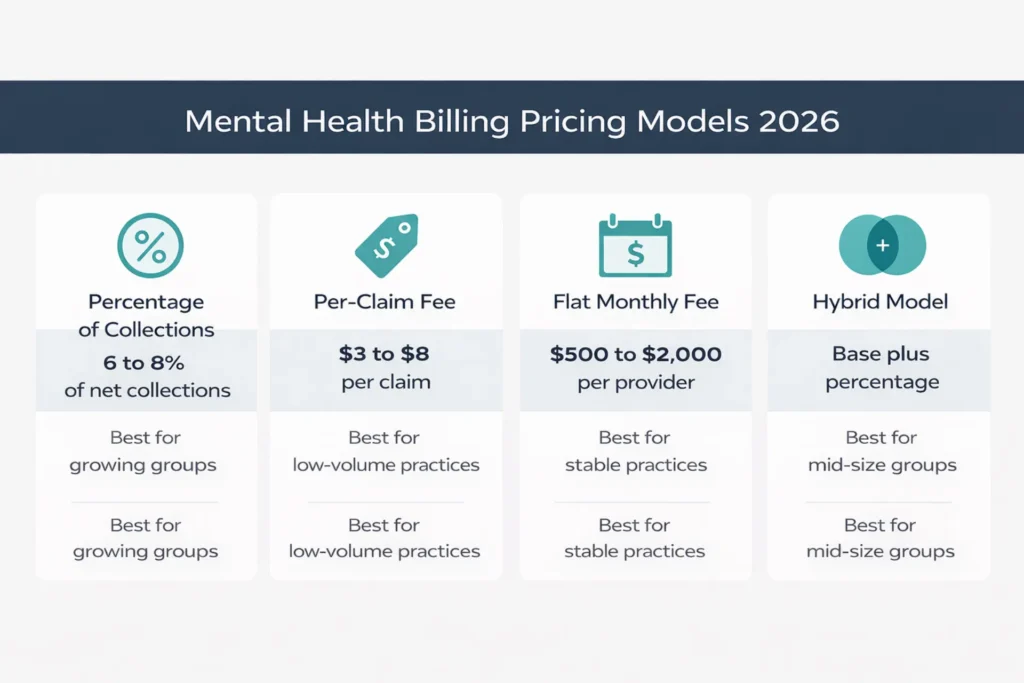
Three structures dominate the mental health billing market in 2026. A fourth — hybrid pricing — is growing, particularly among mid-size practices that want predictability without losing the performance incentive.
The percentage of collections model charges you a fixed share of what your billing company actually collects on your behalf. Most mental health practices pay 6% to 8% using this model. It’s the most common structure because the incentive alignment is clean: your billing company earns more when you earn more, which means they’re motivated to fight denials and chase aging accounts receivable.
Per-claim pricing charges a flat dollar amount per submitted claim — typically $3 to $8 for full-service mental health billing. This model works well for low-volume practices or high-revenue specialties like psychiatry where the revenue per session is high but claim count is low.
Flat monthly fees give you a fixed predictable cost regardless of claim volume — typically $500 to $2,000 per provider per month for full-service outsourced billing. Software-only EHR billing modules run much lower at $25 to $75 per user per month, but they don’t come with human denial management.
Hybrid models combine a base fee ($200–$500/month) with a reduced percentage of collections (3%–5%). They’re increasingly popular because they give the billing company predictable base revenue while keeping the performance incentive tied to your collections.
| Model | Typical Cost | Best For | Main Risk |
|---|---|---|---|
| Percentage of Collections | 5%–9% of net collections | Growing groups, insurance-heavy practices | Becomes expensive as revenue scales past $100K/month |
| Per-Claim Fee | $3–$8/claim (full-service) | Low-volume, psychiatry-heavy, high revenue per session | Costs rise fast at high claim volume |
| Flat Monthly Fee | $500–$2,000/provider/month | Stable practices with predictable caseloads | Can overcharge during slow months |
| Hybrid (Base + %) | $200–$500/month + 3%–5% | Multi-site, growing groups | Complex to audit and compare |
The percentage model dominates mental health billing because behavioral health claims require ongoing human work — denial follow-up, parity appeals, authorization management — that justifies tying compensation to what gets collected. A flat fee or per-claim model is appropriate for practices where claims are relatively straightforward and denials are rare.
For a deeper look at how billing fits into your complete revenue cycle, see our guide to the revenue cycle management process and how each component connects to your bottom line.
The Percentage of Collections Model — Mental Health Billing Cost, State Laws, and What Drives Your Rate
Mental health billing companies typically charge 3% to 8% of net collections, with an overall market range of 5% to 10%. Solo therapists usually pay toward the higher end of that range — 7% to 9% — because lower claim volume means the billing company has higher fixed work per dollar collected. Large practices with 15 or more providers often negotiate rates down to 2.5% to 5% because volume makes each claim more efficient to process.
The word “net collections” matters enormously here. Reputable billing companies calculate their fee on money actually received — payments collected — not your gross billed charges or theoretical allowed amounts. Charging on gross charges instead of collections can result in 30% to 40% overpayment. If a billing company’s contract says “percentage of billed charges” rather than “percentage of collections received,” that’s a contract to walk away from.
| Practice Type | Monthly Collections | Typical Rate | Monthly Fee Example | What Drives Rate Higher |
|---|---|---|---|---|
| Solo therapist | $5,000–$10,000 | 4%–9% | $350–$900 | Low volume, higher fixed burden per claim |
| Small group (2–5 providers) | $15,000–$40,000 | 3%–8% | $900–$3,200 | Payer complexity, denial volume |
| Mid-size agency (6–15 providers) | $50,000–$200,000 | 3%–6% | $2,500–$12,000 | Negotiated discount for scale |
| Large practice (15+ providers) | $200,000+ | 2.5%–5% | $8,000–$10,000+ | Volume efficiency |
What does 5% actually include? A properly structured full-service percentage fee should cover claim submission and scrubbing, eligibility verification, payment posting, denial management and appeals, AR follow-up on aging claims, and routine reporting. What it typically does NOT include: provider credentialing, prior authorization management, patient collection calls, and custom analytics dashboards.
The State Law Angle Almost No Competitor Covers
Before you sign a percentage-based billing agreement, you need to know whether you have Medicaid patients — and what state you’re in.
In Texas, the Occupations Code restricts fee arrangements that could constitute illegal fee-splitting or referral incentives for healthcare services. In New York, the Medicaid program’s Office of the Medicaid Inspector General has explicitly stated that billing company compensation must be “unrelated, directly or indirectly, to the dollar amounts billed and collected.” The OIG has also expressed concern about percentage-based billing because it creates financial incentive for billing companies to upcode claims — and under the False Claims Act, the practice owner bears ultimate liability for billing errors.
If your practice includes Medicaid billing and you’re in Texas or New York, speak with a healthcare attorney before entering any percentage-based arrangement covering Medicaid claims. Most compliant billing companies in these states use flat-rate or per-claim structures for Medicaid billing specifically, while using percentage-based fees for commercial insurance.
Practices achieving monthly collections above $50,000 typically have enough volume to negotiate 1 to 2 percentage points lower. Your leverage is strongest when you can present your clean claim history, your volume projections, and competing quotes for the same scope of services.
Per-Claim Fees and Flat Monthly Rates — The Math That Makes One Cheaper Than the Other
These two models get less attention than percentage billing, but for the right practice type they can be significantly more cost-effective. The key is understanding exactly where the break-even points are.
Per-Claim Billing: When It Makes Financial Sense
A full-service per-claim fee for mental health billing typically runs $3 to $8 per submitted claim. Software-only electronic transactions — when your EHR submits claims through a clearinghouse without human management — cost as little as $0.14 to $0.50 per transaction.
The real math: a solo therapist with 40 sessions per month paying $5 per claim pays $200 per month. Compare that to 7% of $6,000 in collections — $420 per month. Per-claim wins by $220. Now scale to a group practice with 300 sessions per month at $5 per claim — $1,500 per month versus 7% of $45,000 in collections at $3,150. Per-claim still wins by $1,650.
One important question to ask any per-claim billing company: are resubmissions of denied claims charged separately? Some companies count each resubmission as a new claim. In a practice with a 15% denial rate, that adds 15% to your effective per-claim cost immediately. This is a red flag — denial resubmissions should always be included in the base fee.
Flat Monthly Fees: Predictability Has a Price
Flat monthly fees for outsourced mental health billing run $500 to $2,000 per provider per month, with software-only EHR billing modules starting around $25 to $75 per user per month.
The break-even rule: if your flat monthly fee exceeds 8% of your monthly collections, you’re overpaying compared to percentage billing. A $500 flat fee is overpriced if your monthly collections drop below $6,250. This matters most for solo therapists in early months or practices with heavy seasonal variation.
For EHR-integrated billing, platforms like TherapyNotes, SimplePractice, and Kareo offer built-in billing modules at low per-transaction rates. These are appropriate for practices where the provider manages their own billing with minimal denials. They are not a substitute for professional denial management when denial rates exceed 8%.
| Monthly Claims | Per-Claim Cost ($5/claim) | Flat Fee | 7% Percentage | Cheapest Option |
|---|---|---|---|---|
| 40 claims / $6,000 revenue | $200 | $500 | $420 | Per-claim |
| 100 claims / $15,000 revenue | $500 | $1,000 | $1,050 | Per-claim or flat |
| 200 claims / $28,000 revenue | $1,000 | $1,400 | $1,960 | Per-claim |
| 400 claims / $55,000 revenue | $2,000 | $2,000 | $3,850 | Flat or per-claim |
| 600 claims / $80,000 revenue | $3,000 | $2,500 | $5,600 | Flat fee |
Explore our mental health billing services to see how we structure pricing for different practice types — with complete scope transparency and no surprise charges at month-end.
What Is Actually Included in Mental Health Billing Service Fees?
This is the section that separates smart buyers from practices that sign a low-percentage contract and then get surprised by invoices they didn’t expect.
The Submit-Only Trap
Some billing companies advertise rates as low as 4% to 5%. They’re often telling the truth about the percentage — but what they’re describing is a submit-only service. Submit-only means the billing company creates and transmits your claims and posts your payments. That’s it. They do not work denied claims, do not follow up on aging AR, do not appeal medical necessity denials, and do not manage your accounts receivable.
For a practice with a 15% denial rate and $50,000 per month in billing volume, submit-only billing leaves $7,500 per month in denied claims entirely in your hands. If you recover 40% of those in-house and abandon the rest — which is what practices without dedicated denial management typically do — you’re losing $4,500 per month in recoverable revenue. A full-service billing company at 8% would cost $1,500 more per month but recover an additional $4,500 in denied claims. The math isn’t close.
| Service | Submit-Only (Tier 1) | Billing-Only (Tier 2) | Full-Service RCM (Tier 3) | Typical Add-On Cost |
|---|---|---|---|---|
| Claim submission and scrubbing | Included | Included | Included | — |
| Insurance eligibility verification | Excluded | Excluded | Included | — |
| Payment posting | Excluded | Included | Included | — |
| Denial management (basic) | Excluded | Limited | Included | — |
| Denial appeals (human) | Excluded | Excluded | Included | — |
| AR follow-up and aging | Excluded | Limited | Included | — |
| Patient statements | Excluded | Excluded | Usually included | $0.50–$2.00/statement |
| Patient collection calls | Excluded | Excluded | Rarely included | $50–$100/hour |
| Prior authorization management | Excluded | Excluded | Higher tiers only | $50–$150 per auth |
| Provider credentialing | Excluded | Excluded | Always add-on | $250–$500 per panel |
| Real-time reporting dashboard | Excluded | Excluded | Premium tiers | $100–$300/month |
| MHPAEA parity appeals | Excluded | Excluded | Rarely included | $75–$150/hour |
Behavioral Health-Specific Services That Should Always Be Included
A billing company that specializes in mental health should proactively capture the 90785 interactive complexity add-on code when clinically documented — most in-house generalists miss this code in 40% to 60% of eligible sessions. They should handle crisis billing codes (90839 and 90840) with specific documentation requirements, and be fluent in telehealth billing rules including POS 02 vs. POS 10 distinctions and modifier 95 requirements.
For practices with substance use disorder clients, compliance with 42 CFR Part 2 confidentiality requirements is non-negotiable. If a billing company can’t describe their 42 CFR Part 2 protocols, they’re not equipped to handle your SUD patients’ claims correctly.
Credentialing: The Add-On That Always Surprises
Provider credentialing is almost never included in standard billing fees. Standalone credentialing costs $250 to $500 per insurance panel per provider, with a full new-provider panel running $1,500 to $3,000. The timeline matters as much as the cost: credentialing typically takes 90 to 120 days, creating a cash flow gap that can cost $30,000 or more in deferred revenue for a productive clinician. Our credentialing services handle this proactively so new providers are billing on day one of patient care.
Our claim submission services and insurance eligibility verification services are built to prevent the front-end errors that cause most denials before a claim ever reaches a payer. See also our denial management services for a full picture of what active denial recovery looks like.
Hidden Costs and Contract Red Flags in Mental Health Billing Agreements
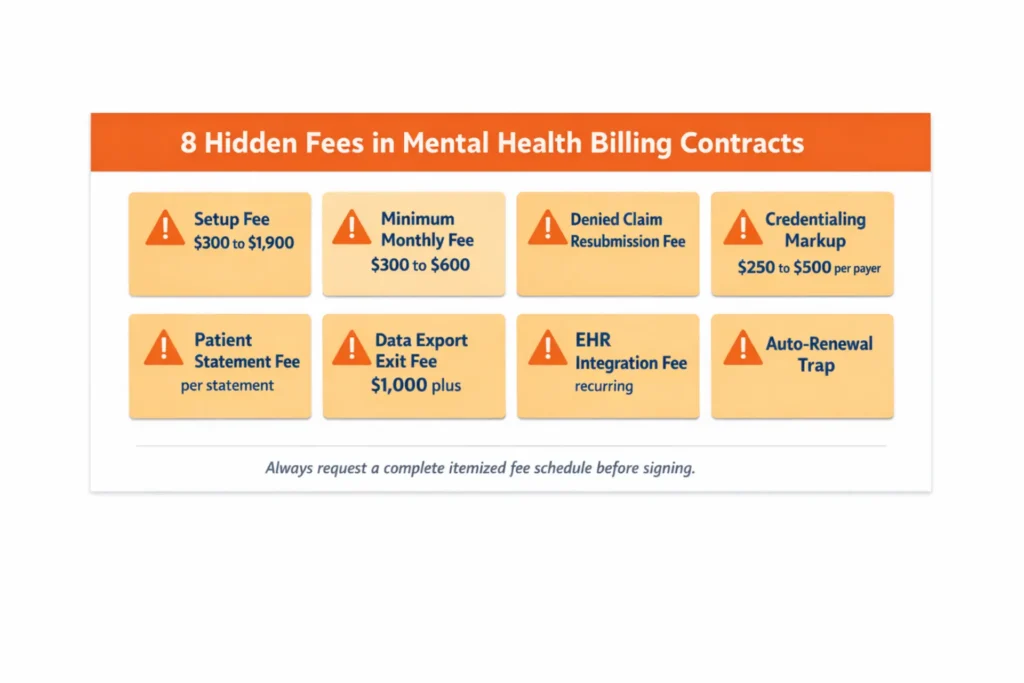
The headline percentage a billing company quotes you is the beginning of the cost conversation, not the end. Here are the eight charges that regularly appear in billing contracts and invoices that practice owners didn’t anticipate.
1. Setup or onboarding fee ($300–$1,900)
Most billing companies charge an initial implementation fee. Some are reasonable and transparent; others are vague “go-live fees” with no defined deliverables. Always ask what specific work the setup fee covers. Implementation of EHR access, payer enrollment, ERA setup, and workflow configuration is legitimate. A $2,500 “activation charge” with no scope definition is not.
2. Minimum monthly fee ($300–$600, sometimes higher)
Minimum fee clauses appear in fine print: “7% of collections or $500, whichever is greater.” During a vacation month, a slow season, or a period of medical leave it absolutely triggers. A solo therapist who billed $1,800 in a slow month still owes $500 under that clause — an effective billing rate of 27.8%.
3. Denied claim resubmission fee
Some billing companies charge separately for working and resubmitting denied claims. This is categorically a red flag. Denial management is core billing work — it should never be charged as an add-on. If a company quotes a low percentage and then charges $2 to $10 per resubmission, the true effective rate on a high-denial-rate practice is far higher than the quoted percentage.
4. Credentialing fee with markup
Credentialing at $250 to $500 per payer is standard. What’s not standard: billing companies that charge significant markups over actual filing costs. Ask for itemized credentialing fees per payer and ask directly: “Is there a markup above your direct cost?”
5. Patient statement and collection fees
Generating and mailing patient statements, sending text reminders, and making collection calls are often not included in standard billing fees. Typical add-on rates: $0.50 to $2.00 per statement, $50 to $100 per hour for collection calls. Know whether patient AR management is in or out of scope before you sign.
6. Data export or exit fees
Your claims data belongs to your practice. Any billing company that charges you to export your own data upon termination — flat fees or per-record charges — is using a “Hotel California clause.” Insist on a written data portability clause with no export fee before you sign.
7. EHR integration fee
Custom integrations sometimes carry legitimate one-time setup costs. What’s not legitimate: ongoing monthly fees for maintaining an integration that requires no ongoing custom work. Ask whether the integration fee is one-time or recurring.
8. Auto-renewal clause
Contracts that auto-renew with a 60 to 90 day notice window are common. Miss the window and you’re locked in for another year. Negotiate for a 30-day termination right after the initial ramp period.
| Hidden Fee | Typical Amount | Red Flag Level | How to Identify | Protective Measure |
|---|---|---|---|---|
| Setup / onboarding | $300–$1,900 | Medium — red flag if vague | “Implementation” or “activation” language | Request scope of deliverables in writing |
| Minimum monthly fee | $300–$600 | High — especially for solo | “Greater of % or $X” clause | Negotiate waiver during first 90 days |
| Denied claim resubmission | $2–$10/resubmit | High — always should be included | “Claim correction” or “rework fee” | Confirm in writing: denials included at no charge |
| Credentialing markup | Varies by payer | Medium — ask for itemization | No per-payer breakdown provided | Request line-item credentialing fee schedule |
| Patient statement fee | $0.50–$2.00/statement | Standard — know before signing | “Patient AR services” language | Confirm what patient billing includes |
| Data export / exit fee | $1,000+ | Very high — walk away | Termination clause language | Require written data portability clause |
| EHR integration (ongoing) | Monthly charge | Medium — one-time is reasonable | “Interface maintenance” language | Confirm one-time vs. recurring in writing |
| Auto-renewal penalty | Varies | High — especially long lock-in | Renewal date buried in contract | Calendar the notice deadline on signing day |
Five Contract Clauses to Insist On Before Signing
- All fees itemized: no vague service bundles — get a line-by-line fee schedule
- Data ownership: practice owns all claims data; export at no charge upon termination
- 30-day termination right: after initial ramp period, either party can exit with 30 days’ notice
- Denial management inclusion: confirmed in writing that denial appeals are included at no additional charge
- Fee stability: no mid-contract rate changes without 90 days’ written notice
As noted in the percentage model section: Texas and New York Medicaid billing under percentage-based arrangements carries legal risk under fee-splitting and anti-kickback statutes. The practice owner, not the billing company, faces False Claims Act liability for incorrect claims regardless of what the billing contract’s indemnification language says.
In-House vs. Outsourced Mental Health Billing — The Complete Cost Comparison
The “Just a Salary” Myth
Walk into any practice owner’s office and ask what their billing costs. They’ll tell you what their biller earns. That’s the most common financial blind spot in private practice management.
A mental health billing specialist earns $47,000 to $52,000 in base salary nationally in 2026. But the true fully-loaded cost — including every dollar that employment costs — is 1.4x to 1.6x that base salary. Here’s the breakdown for a $52,000 salary:
- Benefits package (health, dental, vision, retirement): $13,000
- Employer payroll taxes (FICA 7.65% + FUTA): $4,940
- PTO and sick leave (15 days at $224/day): $3,365
- Training, AAPC certification, continuing education: $500
- Billing software and clearinghouse: $2,500
- Office overhead allocation (desk, tech, internet): $6,240
- Subtotal employment cost: $82,545
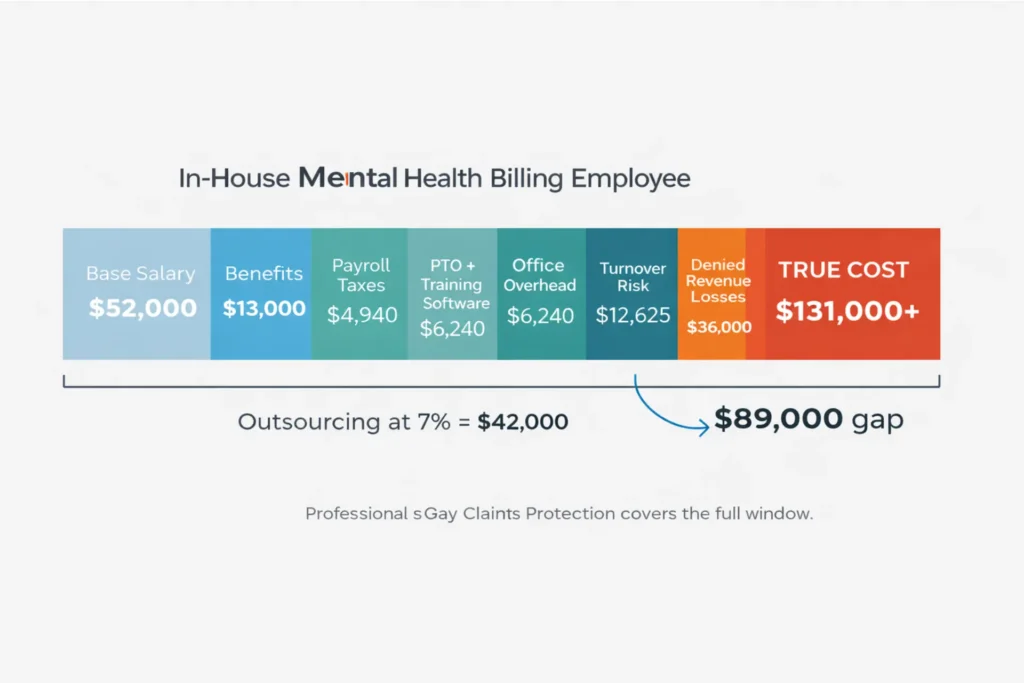
That’s before turnover. MGMA data shows turnover rates for billing staff exceeding 33% annually. Replacing a billing specialist costs $10,000 to $15,000 in recruiting, onboarding, and productivity loss — plus the claims that age or expire while the position is open. And then there’s the denial problem: in-house mental health billing teams average denial rates of 12% to 18%. On a $600,000 annual practice, 40% abandonment of denied claims means $36,000 in permanently lost revenue every year.
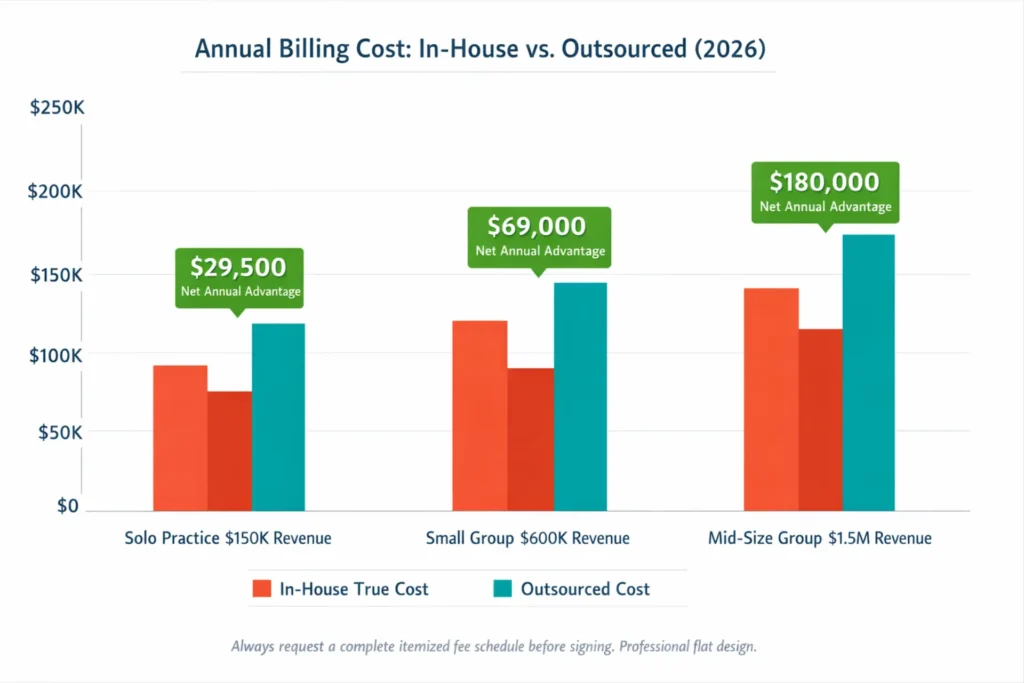
| Practice Size | Annual Revenue | In-House True Cost | Outsourced Cost (7%) | Revenue Lift | Net Annual Advantage |
|---|---|---|---|---|---|
| Solo therapist | $150,000 | $28,000 (part-time + owner time) | $10,500 | +$12,000 | $29,500 — outsourced wins |
| Small group (3 providers) | $600,000 | $83,000–$111,000+ | $42,000 | +$60,000 | $41,000–$69,000 — outsourced wins |
| Mid-size group (8 providers) | $1,500,000 | $135,000 (2 billers + mgr) | $105,000 | +$150,000 | $180,000 — outsourced wins |
The Month-in-the-Life Test
Two identical three-provider therapy groups. Same EHR. Same payer mix. Same goal: $600,000 in annual collections. Practice A keeps billing in-house. Practice B uses a specialized outsourced service.
At the end of month one: Practice A submitted 87% of claims cleanly. The 13% that came back as denials are sitting in a queue — the biller prioritized new submissions because there’s always more coming in. Practice B submitted 96% of claims cleanly, the 4% that were rejected were corrected same-day, and last month’s denial queue is 80% worked.
At the end of year one: Practice A collected $492,000 and spent $94,000 in true in-house billing costs. Practice B collected $552,000 and paid $42,000 in outsourcing fees. The gap: $112,000 in Practice B’s favor.
When In-House Billing Still Makes Sense
To be honest: there are scenarios where in-house billing is the right answer. Practices with a truly exceptional in-house team — certified behavioral health coders, 95%+ net collections, denial rate under 5% — may not see meaningful improvement from outsourcing. Very large practices above $2.5 million in annual revenue may find a dedicated internal billing department becomes cost-competitive. Cash-pay practices where 70%+ of revenue is out-of-network don’t have the insurance denial complexity that justifies specialized outsourced billing.
For a complete framework on measuring and improving your practice’s billing performance, our guide to improving revenue cycle management walks through every component. You can also explore the healthcare revenue cycle overview for the full picture.
Mental Health Billing Cost by Practice Size — Real Dollar Examples for Every Tier
Mental health billing costs range from $300 per month for a solo therapist using light outsourced services to over $14,000 per month for a mid-size agency. The right number for your practice depends on your revenue, claim volume, payer complexity, and which model you choose.
Solo Therapist ($5,000–$10,000 Monthly Collections)
At $6,000 per month in collections, a solo therapist pays $420 to $540 per month for full-service outsourced billing at 7% to 9%. Annual cost: $5,040 to $6,480. This covers claim submission, denial management, and basic reporting. Credentialing and patient statements are typically add-on fees.
Practices at this level often evaluate self-billing through their EHR as an alternative. The honest answer: if you have three or fewer insurance panels and your payer mix is simple, EHR self-billing can work. Once you add Medicaid, multiple commercial plans, and any telehealth billing, the complexity justifies a professional service. The 5 hours per week you’d spend managing billing yourself has an opportunity cost of $39,000 annually at a $150/hour clinical rate.
Small Group Practice (2–5 Providers, $15,000–$40,000 Monthly)
A three-provider group billing $18,000 per month pays $1,260 per month at 7% — $15,120 annually. At the top of this range, $40,000 per month at 7% is $2,800 per month — $33,600 annually. This is also the range where flat-fee options often emerge: practices with stable caseloads can often negotiate a $1,000 to $2,500 flat monthly rate that covers full service scope without exposure to percentage increases as revenue grows.
Mid-Size Agency (6–15 Providers, $50,000–$200,000 Monthly)
A 10-provider clinic billing $80,000 per month at 7% pays $5,600 per month — $67,200 annually. But groups at this revenue level have negotiating leverage. Most mid-size agencies can negotiate rates to 5% to 6%, reducing that billing to $4,000 to $4,800 per month.
The break-even point for in-house vs. outsourced billing occurs at approximately $85,000 per month in collections. Above that level, the loaded cost of a full-time in-house billing specialist ($6,000 to $7,500 per month fully loaded) is comparable to outsourcing fees — but the performance advantage still favors outsourcing unless your in-house team is genuinely elite.
Specialty Pricing Variations
Billing complexity affects pricing. Standard outpatient therapy (90837 as the primary code) runs 6% to 8%. Psychiatry and medication management practices bill higher-complexity evaluation and management codes alongside psychotherapy codes and typically pay 7% to 9%. Substance use disorder programs with 42 CFR Part 2 compliance requirements run 9% to 11%. Neuropsychological testing practices (96130 series codes) run 8% to 10%.
| Practice Tier | Monthly Revenue | % Model Monthly Cost | Annual Cost | % of Revenue |
|---|---|---|---|---|
| Solo therapist | $5,000–$10,000 | $350–$900 | $4,200–$10,800 | 7%–9% |
| Small group (2–5 providers) | $15,000–$40,000 | $1,050–$2,800 | $12,600–$33,600 | 7% |
| Mid-size agency (6–15 providers) | $50,000–$200,000 | $2,500–$12,000 | $30,000–$144,000 | 5%–6% negotiated |
| Large organization (15+) | $200,000+ | $10,000+ | $120,000+ | Under 5% effective |
| Psychiatry / med management | Varies | +1%–2% premium over standard | Varies | 7%–9% |
| SUD program (42 CFR Part 2) | Varies | +2%–3% premium over standard | Varies | 9%–11% |
For information on how medical coding services affect your clean claim rate — and directly affect your billing cost — and how charge entry services affect upstream billing quality, explore those pages for the workflow details.
FREE TOOL
Mental Health Billing Cost Calculator
Enter your practice numbers to see what billing should cost — and what you’re likely losing right now.
Want a precise analysis using your actual claims data?
Get My Free Billing Cost Analysis →Is the Billing Service Cost Worth It? An ROI Framework
Three questions determine whether your billing service cost is justified.
1. How much time are you and your staff spending on billing-related tasks each week?
A therapist spending 5 hours per week on billing issues loses $39,000 annually in clinical revenue at a $150/hour rate. An office manager spending 15 hours per week on billing earns the practice $19,500 per year less in patient intake and practice growth work than she could be doing. Outsourced billing reduces that overhead to 1 to 2 hours per week of reporting review.
2. What is your current net collections rate?
Net collections rate = total payments received ÷ total allowable charges after contractual adjustments. The target for behavioral health is 95% or above. Below 88% is underperforming. In-house mental health billing typically produces rates of 80% to 88%. Specialized outsourced services consistently achieve 92% to 97%.
On $600,000 in annual revenue, the difference between 82% in-house and 92% outsourced is $60,000 per year in additional collected revenue. After paying $42,000 in outsourcing fees (7%), the net gain is $18,000 — plus elimination of $40,000+ in true in-house billing costs.
3. Is your billing service improving your numbers over time?
A billing service that isn't improving your KPIs within 90 days is not delivering positive ROI. The most meaningful metrics to track are: clean claim rate above 92%, denial rate below 8%, and days-in-AR below 40.
| KPI | EliteMed Target | Acceptable | Red Flag | In-House Average |
|---|---|---|---|---|
| Net Collections Rate | 97%+ | 95%–97% | Below 95% | 80%–88% |
| Clean Claim Rate | 98%+ | 92%–97% | Below 90% | 80%–90% |
| Denial Rate | Under 3% | 3%–8% | Above 10% | 12%–18% |
| Days in AR | Under 30 | 30–45 | Over 45 | 45–60 |
| 90+ Day AR | Under 10% | 10%–15% | Over 20% | Often untracked |
| Claims Submission Lag | Under 24 hours | 24–48 hours | Over 48 hours | Variable |
The payback calculation: revenue improvement + cost savings ÷ outsourcing fee = payback period. For a $600,000 practice: $60,000 revenue improvement + $50,000 cost savings = $110,000 benefit against $42,000 fee. The service pays for itself before month three in almost every scenario at this practice size.
For our payment posting services — a core component of billing arrangement ROI — see the complete workflow. Understanding your complete revenue cycle management picture helps put billing cost in the proper financial context.
FREE PRACTICE AUDIT
Want to know if your billing rate is competitive for your practice size?
Our free billing cost analysis tells you what you should be paying, what services should be included, and what we'd charge — with no hidden fees, no setup cost in year one, and no annual lock-in.
Request Your Free Billing Cost Audit →How to Choose the Right Pricing Model — and the Right Mental Health Billing Company
The right pricing model is a function of practice size, revenue predictability, and billing complexity. Here's the decision logic, condensed.
| Practice Type | Monthly Revenue | Recommended Model | Why |
|---|---|---|---|
| New solo, few insurance panels | Under $7,000 | Per-claim | Low risk, pay only for sessions conducted |
| Established solo, full caseload | $7,000–$12,000 | Flat monthly fee | Predictable overhead, covers full service |
| Growing group (2–5 providers) | $15,000–$80,000 | Percentage of collections | Aligns incentives with growth and denial recovery |
| Large multidisciplinary practice | Over $100,000 | Hybrid (base + %) | Covers fixed costs while maintaining performance incentive |
| SUD / PHP / IOP (high complexity) | Any | Percentage, full-service | Requires aggressive human follow-up and compliance expertise |
| Psychiatry (low volume, high revenue) | Any | Per-claim or percentage | High revenue per claim makes per-claim efficient |
| Telehealth-only practice | Varies | Flat + telehealth support | Predictable volume with payer-rule complexity |
Five Questions to Ask About Pricing Before Any Conversation Begins
- Is your fee calculated on net collections received or gross billed charges? (Gross charges = you overpay by 30–40%)
- Are denied claim resubmissions and appeals included, or charged separately? (If separate, it's submit-only billing regardless of what they call it)
- What is your minimum monthly fee, and when does it apply?
- Are there setup, onboarding, or EHR integration fees? Are they one-time or recurring?
- What is your termination policy — 30, 60, or 90 days — and are there penalties?
How to Compare Quotes Apples-to-Apples
A 6.5% quote is not automatically better than an 8% quote. What determines real cost is the scope of services behind the percentage. When comparing quotes, normalize them to the same service scope first. Ask each company to confirm in writing: is claim submission, eligibility verification, denial management, AR follow-up, payment posting, and patient statements included in the quoted rate? If Company A at 6.5% excludes denial management and Company B at 8% includes it, Company B is cheaper for a practice with a 12% denial rate.
The elite benchmark worth using as your evaluation standard is the 95/35 Rule: 95% net collection rate and 35 days or fewer in accounts receivable. Any billing company you evaluate should be able to tell you their average performance on both metrics for behavioral health clients.
Most billing companies quote higher and expect negotiation. Common movement: from an opening rate of 8% down to 6.5% for a practice that presents stable monthly collections, clean claim history, and two or more competing quotes for the same scope. Volume is leverage.
According to the AAPC's medical billing resources, certified behavioral health coders consistently outperform non-certified billers on first-pass acceptance rates — which directly translates to lower denial management costs for your practice. And according to the CMS Physician Fee Schedule, Medicare pays approximately $167 for CPT 90837 in 2026 — the benchmark that drives commercial payer negotiations and helps you evaluate whether your billing company is capturing full reimbursement on your most-billed code.
Explore our complete RCM services and see what a full-service behavioral health billing arrangement looks like, including our patient scheduling and documentation support through patient scheduling services and patient documentation services.
Q: How much do mental health billers charge?
As employees, mental health billing specialists earn $47,000 to $52,000 in base salary, but the true fully-loaded cost including benefits, taxes, software, and overhead runs $83,000 to $111,000 annually for a three-provider practice. As outsourced services, they charge 5% to 9% of monthly collections — typically $350 to $900 per month for a solo therapist and $1,000 to $3,000 for a small group practice.
Q: What percentage should I pay for medical billing?
For mental health billing services, 6% to 8% of net collections is the typical range for full-service outsourced billing. Solo therapists usually pay toward the higher end at 7% to 9%; larger groups with volume leverage can negotiate down to 5% to 6%. Anything below 5% is usually a submit-only service that excludes denial management — read the scope carefully before assuming a low rate is a good deal.
Q: How much does mental health billing cost per month?
Solo therapists typically pay $300 to $800 per month. Small group practices with two to five providers pay $1,000 to $2,500 per month. Mid-size agencies with six to fifteen providers pay $2,500 to $7,000 per month at negotiated rates. These figures cover full-service billing including denial management. Credentialing, patient statements, and custom reporting are typically add-on costs.
Q: What does 80% of billed charges mean in medical billing?
When a billing report shows 80% of billed charges collected, it doesn't automatically mean your billing is underperforming — billed charges are set well above allowed amounts, and payers apply contractual adjustments. The meaningful metric is net collections rate: payments collected divided by total allowable charges after adjustments. An 80% net collections rate IS a problem; 95%+ is the target for mental health practices.
Q: How much does Medicaid pay for 90837?
Medicare pays approximately $167 for CPT code 90837 in 2026 according to the CMS Physician Fee Schedule. Medicaid rates are set by each state and typically run $80 to $140 depending on state and licensure level. Private commercial insurance pays $110 to $200 or more depending on the payer and negotiated contract rate. Payer mix significantly impacts whether outsourced billing's revenue improvement covers its cost.
Q: What are the pricing models for mental health billing services?
Three core models dominate the market: percentage of collections (5%–9%), per-claim fees ($3–$8 per claim for full-service), and flat monthly rates ($500–$2,000 per provider per month for outsourced services). Hybrid models combining a base monthly fee with a reduced percentage are growing among mid-size practices. The right model depends on claim volume, revenue predictability, and payer complexity.
Q: How do billing companies charge for mental health services?
Most behavioral health billing companies charge a percentage of what they actually collect on your behalf — typically 7% for full-service billing covering claims, denials, and AR management. This model aligns their incentive with yours: they earn more when you earn more, which motivates aggressive denial follow-up and thorough AR management. Per-claim and flat-fee models exist but serve fewer practice types.
Q: Is it cheaper to do billing in-house or outsource for a therapy practice?
For most therapy practices with significant insurance billing, outsourcing is less expensive when you count the true cost of in-house billing. A three-provider group with an in-house biller typically spends $83,000 to $111,000 annually in fully-loaded costs. Outsourcing the same function at 7% of $600,000 in collections costs $42,000. The math favors outsourcing by $41,000 to $69,000 annually — before accounting for the revenue improvement from better clean claim rates.
Frequently Asked Questions About Mental Health Billing Services Cost
What is the average cost of mental health billing services?
Mental health billing services typically cost 5% to 9% of net monthly collections for full-service outsourced billing. In monthly dollar terms: solo therapists pay $300 to $800, small groups pay $1,000 to $2,500, and mid-size agencies pay $2,500 to $7,000. These ranges assume full-service RCM including denial management. Submit-only services cost less but exclude the denial work where most revenue is actually recovered or lost.
What percentage do mental health billing companies charge?
Most mental health billing companies charge 6% to 8% of net collections for full-service billing. The overall market range is 5% to 10%. Solo therapists typically pay toward the higher end at 7% to 9%; large practices of 15 or more providers often negotiate down to 4% to 5%. Any percentage is only meaningful in context of what services are included at that rate.
How much do mental health billers cost as full-time employees?
A mental health billing specialist earns $47,000 to $52,000 in base salary nationally in 2026. But the fully-loaded cost — including benefits (25%), payroll taxes (9.5%), software, training, overhead, and annualized turnover risk — runs $83,000 to $111,000 per year for a three-provider group. That's before accounting for revenue lost to unworked denials, which can add $20,000 to $40,000 annually in permanently uncollected revenue.
Are there hidden fees in mental health billing contracts?
Yes — common hidden fees include setup/onboarding charges ($300–$1,900), minimum monthly fees ($300–$600) that apply even in low-revenue months, separate charges for denied claim resubmissions, credentialing add-ons ($250–$500 per payer panel), patient statement fees, data export fees upon termination, and EHR integration charges. Always request a complete itemized fee schedule before signing, and confirm in writing that denial management is included in the quoted rate.
What is included in mental health billing service fees?
Full-service billing at 7% to 9% should include claim submission and scrubbing, insurance eligibility verification, payment posting, denial management and appeals, AR follow-up, and routine reporting. What's typically not included: provider credentialing, prior authorization management, patient collection calls, custom analytics dashboards, and MHPAEA parity appeals. Always verify scope in writing — "full-service" means different things to different companies.
Is outsourcing mental health billing worth the cost?
For most practices generating over $150,000 in annual insurance revenue, yes. A three-provider group at $600,000 in collections gains $60,000 in additional revenue through improved collections rates, plus eliminates $50,000+ in in-house billing overhead — against an outsourcing fee of $42,000. The net gain exceeds the cost for most practices by month three. Exceptions: cash-pay practices, very small revenue practices where minimums apply, and those with elite in-house teams already achieving 96%+ net collections.
What pricing model is best for a solo mental health therapist?
Solo therapists with fewer than five insurance panels and monthly collections under $10,000 often do well with per-claim pricing ($3–$8 per claim) or EHR-integrated billing software ($25–$75/user/month). Once collections consistently exceed $10,000 per month, percentage-based billing (7%–9%) typically becomes more cost-effective while also providing the denial management that software-only options don't deliver.
Is percentage-based billing legal for Medicaid in Texas or New York?
This is a legally sensitive area that your billing contract must address carefully. In Texas and New York, percentage-based billing fees for Medicaid claims may conflict with fee-splitting regulations and anti-kickback statutes. Compliant billing companies in these states typically structure Medicaid billing under flat-rate or per-claim models. Consult a healthcare attorney before entering any percentage-based billing arrangement that includes significant Medicaid revenue in these states.
How do I compare quotes from different mental health billing companies?
Don't compare percentages — compare scope. Request a complete written service list from each company and confirm: denial management included? Eligibility verification included? AR follow-up included? Credentialing cost? Setup fees? Data portability on exit? A 6.5% quote that excludes denial management will cost more over a year than an 8% quote that includes it, for any practice with a denial rate above 10%.
What is the difference between submit-only and full-service mental health billing?
Submit-only billing handles claim transmission and basic payment posting — it does NOT work denied claims, follow up on aging AR, or manage payer appeals. Full-service billing handles the complete revenue cycle from eligibility through final payment. The fee difference is typically 3% to 4% of collections. For any practice with denial rates above 8%, the revenue recovered by full-service billing far exceeds the higher fee.
How quickly does outsourcing mental health billing pay for itself?
For most practices, within 60 to 90 days. The combination of revenue improvement from higher clean claim rates, denial recovery, and elimination of in-house billing overhead typically exceeds the monthly outsourcing fee by month two or three. The payback period is shorter for practices with higher current denial rates — the more broken the current billing, the faster outsourcing pays off.
How do I know if my current billing service is overcharging me?
Three signals: your net collections rate is below 88% after three months of outsourcing; your denial rate remains above 12%; or your days-in-AR exceeds 45 days consistently. If any of these apply, your billing service is not delivering sufficient value for its cost. Request a detailed performance report with these specific metrics. If they can't produce one — or won't — that's the first and most important answer.
Conclusion: The Math Is Honest, and the Numbers Favor Outsourcing
Three things you should leave this article knowing:
Mental health billing services cost 5% to 9% of collections for full-service outsourced billing — but the true cost of in-house billing runs 15% to 20% of practice revenue when you count everything that employment actually costs, including turnover and abandoned denials.
The pricing model matters less than the scope of services behind it. A 6% submit-only quote is more expensive than an 8% full-service quote for any practice with denial rates above 10%. Always verify scope in writing before you compare rates.
The transition to outsourced billing pays for itself quickly. Most practices at or above $150,000 in annual revenue reach positive ROI within 60 to 90 days of switching to a qualified outsourced service.
Elite Med Financials specializes exclusively in behavioral health revenue cycle management. We serve mental health practices across all 50 states — including Florida, Texas, Connecticut, Virginia, Ohio, Massachusetts, Delaware, Michigan, and nationwide. Our free billing cost analysis examines your current billing performance, tells you exactly what you're spending, and gives you a clear picture of what our services would cost and what they'd recover for your specific practice. No setup fee in year one. Month-to-month terms after the initial ramp period. Transparent, itemized pricing from day one.
Get your free billing cost analysis at elitemedfinancials.com/mental-health-billing-services or explore our complete RCM services at Elite Med Financials.
FREE BILLING COST ANALYSIS
Find Out Exactly What Your Billing Is Costing You — And What It Should Cost
Elite Med Financials specializes in behavioral health revenue cycle management. Our free billing cost analysis reviews your current arrangement — denial rate, net collections, days-in-AR — and gives you an exact, itemized quote with no hidden fees.
No setup fee in year one. Month-to-month after the initial period. Serving practices in all 50 states.