
Definition: Dispatch software for NEMT operations connects scheduling, routing, driver dispatch, GPS tracking, electronic trip documentation, billing handoff, and reporting into one workflow. Rather than managing spreadsheets, phone calls, and paper manifests separately, providers use a centralized platform where every completed trip moves from scheduling to driver execution to verified documentation to claims preparation without losing the data needed to get paid.
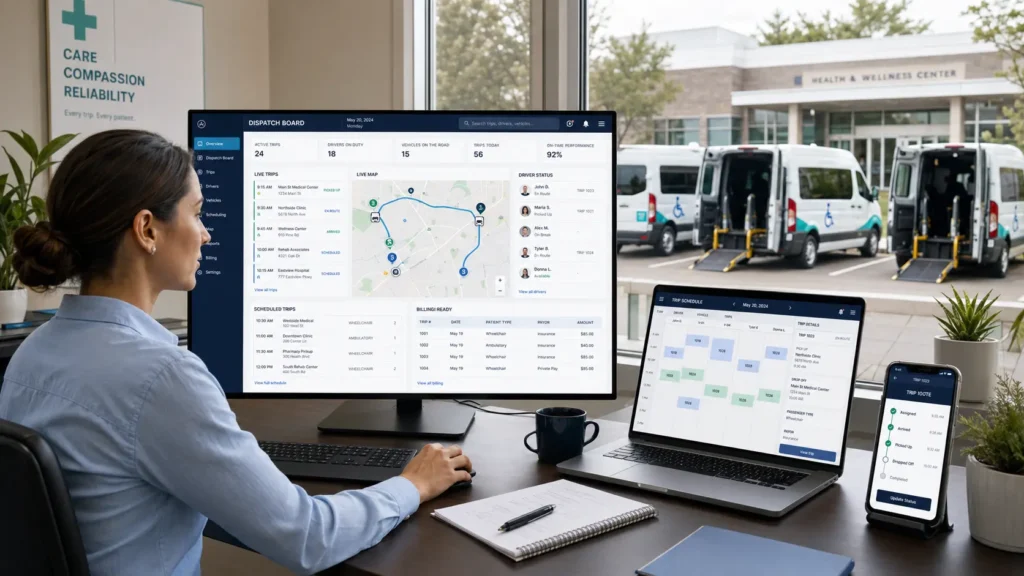
Every NEMT owner knows the morning routine.
You have trips in three spreadsheets, broker portal updates in two tabs, paper manifests from yesterday still on the desk, and a driver calling in sick at 6:47 a.m. The dialysis run leaves in 40 minutes. The dispatcher is fielding calls, texting updates to drivers, and manually rebuilding routes while someone on hold wants to add a same-day wheelchair trip.
By noon, two no-shows have thrown off the schedule. By 3 p.m., the billing team is asking for the trip sheets from a completed run that nobody documented correctly. By end of day, completed trips sit unverified, mileage is missing on two claims, and one signature is illegible on a paper manifest.
This is not a driver problem. It is not a dispatcher problem. It is a workflow problem.
This article is not a general NEMT software comparison — for that, see our best NEMT software guide. This is an operations-benefits guide. It explains exactly where dispatch software changes daily NEMT operations: scheduling, routing, dispatch visibility, driver communication, no-show and will-call handling, EVV-style trip documentation, billing handoff, and ROI measurement.
Most NEMT software pages explain features. This guide explains the operational workflow behind those features: what changes on the dispatch board, how drivers document trips, how exceptions are handled, and how completed trips become billing-ready records. That is the difference between reading a software brochure and understanding whether a dispatch system will actually improve daily operations.
The real goal is not just to dispatch trips faster. The real goal is to move every trip from scheduling to driver execution to documentation to billing without losing the data needed to get paid.
Medicaid recognizes transportation as part of access to covered care, and NEMT providers often need strong trip documentation to support that transportation workflow. That documentation standard is what makes the connection between dispatch operations and billing so critical.
Elite Route Dispatch is a connected NEMT dispatch and billing platform built for small and growing fleets. If you want to see how scheduling, driver documentation, EVV-style trip verification, and billing work together in one system, a demo is a practical starting point.
From One Connected Platform
Table of Contents
Dispatch Software NEMT Operations: What Changes First?
Short answer: The first thing that changes is the dispatch board itself. Operations shift from reactive, phone-based coordination to a live, centralized dashboard where scheduling, routing, driver status, GPS tracking, and billing handoff are visible in one place.
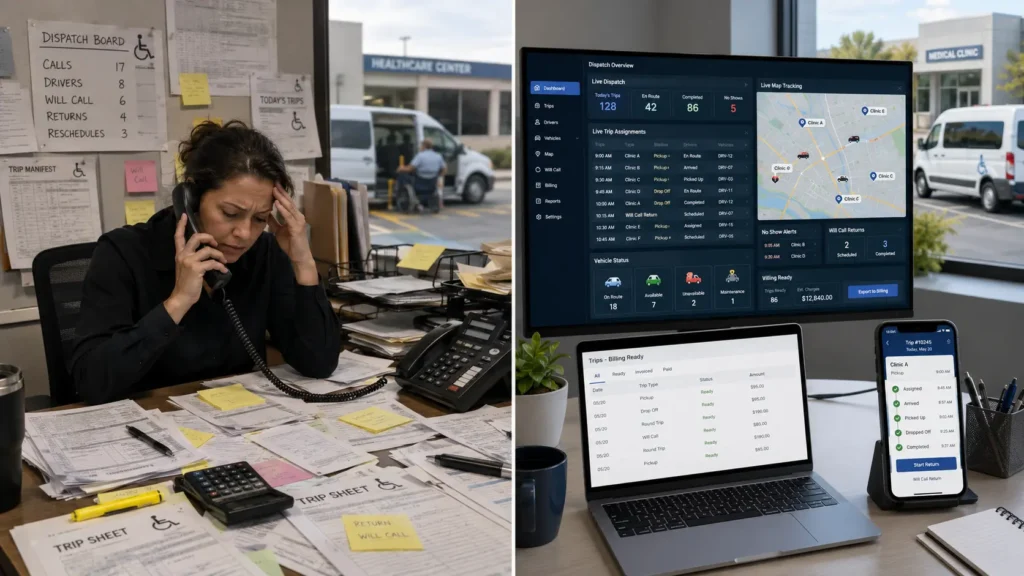
Manual Dispatch vs Software-Supported Dispatch
Manual dispatch feels manageable at low trip volume. A dispatcher builds routes in a spreadsheet, calls drivers in the morning, takes will-call requests by phone, and logs completed trips on paper manifests. When a driver calls off or a patient no-shows, the dispatcher calls vehicles one by one to reassign.
This works until it doesn’t. The moment trip volume increases — or broker requirements tighten, or Medicaid documentation becomes more demanding — manual dispatch starts breaking. Dispatchers spend hours on the phone instead of managing exceptions. Drivers call in asking for updated routes. Billing teams chase missing signatures two days after the trip happened.
NEMT dispatch software replaces scattered coordination with a centralized real-time board. Trip assignments happen in the system. Route changes push to drivers through the mobile app. GPS tracks vehicle locations without dispatcher phone calls. When a no-show happens, the dispatcher marks it in the system with a reason code, and the record stays attached to the trip.
| Manual Dispatch | NEMT Dispatch Software | Why It Matters |
| Spreadsheets and paper notes | Centralized scheduling dashboard | Fewer errors, faster changes |
| Manual route planning | Route optimization with traffic awareness | Reduces deadhead miles |
| Call/text every driver for updates | Driver app status updates | Dispatcher time saved |
| No real-time vehicle visibility | Live GPS map with trip statuses | Faster exception handling |
| Paper manifests and signatures | Digital timestamps and e-signatures | Documentation at point of service |
| Manual billing re-entry | Completed trips flow into claims workflow | Less data re-entry, fewer errors |
| Compliance gap risk | Digital audit trail per trip | Supports broker and Medicaid review |
| Trips are hard to scale | Higher volume with the same team | Growth without adding staff |
Why NEMT Operations Need More Than Basic Fleet Tools
Generic fleet management tools track vehicles. They show GPS location, mileage, and sometimes driver behavior. But they were not built for NEMT-specific requirements.
Medical transportation dispatch involves wheelchair van matching, stretcher-certified crew assignment, ambulatory trip classification, recurring dialysis scheduling, prior authorization numbers, Medicaid documentation requirements, broker trip imports, will-call return coordination, and no-show reason code documentation. A basic fleet tool misses all of it.
NEMT software is built around the medical trip lifecycle, not just the vehicle. That means the platform understands mobility requirements, payer documentation rules, recurring standing orders, broker integration workflows, and the difference between a completed trip and a billable trip.
The Dispatch-to-Billing Workflow
Here is where most NEMT operations have a hidden gap. Dispatching a trip is only half the job. The other half is making sure the trip creates a complete, documentable, billable record.
When dispatch and billing work from different systems — paper manifests, separate spreadsheets, broker portal exports — data gets lost between operations and the billing team. A missing signature. An incomplete mileage entry. A driver note that never made it out of a text message. Each gap becomes a billing problem later.
NEMT dispatch software connects the operations side to the billing side. When a driver marks a trip complete in the mobile app, the GPS timestamp, pickup and dropoff location, mileage, digital signature, and trip status all stay attached to the record. Billing teams start with clean, verified data instead of chasing paper.
Elite Route Dispatch is built around this idea: connecting dispatch decisions directly to reimbursement, so small and growing fleets stop losing revenue to documentation gaps.
7 Ways NEMT Dispatch Software Improves Operations
Short answer: NEMT dispatch software improves operations by reducing manual scheduling, optimizing routes, giving dispatchers live visibility, improving driver communication, supporting EVV-style documentation, speeding billing handoff, and giving owners actionable performance data.
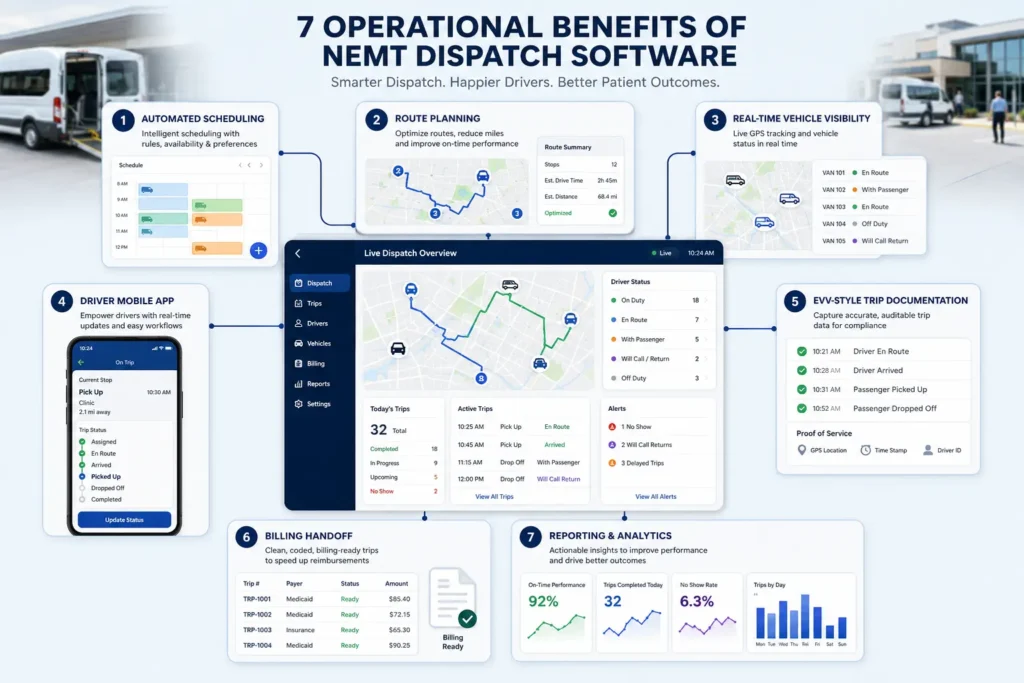
| # | Benefit | Feature Angle | Pain Solved | Human Example |
| 1 | Reduces manual scheduling | Automated trip assignment, broker imports | Spreadsheets, duplicate entry, phone calls | Recurring dialysis trips are scheduled once, not rebuilt every week |
| 2 | Improves route planning | Route optimization, multi-load planning | Deadhead miles, missed windows, fuel waste | A same-day add-on fits into the most efficient existing route |
| 3 | Gives real-time visibility | GPS tracking, live dispatch board | Blind spots, slow response | Dispatch sees a late vehicle and reassigns a nearby driver |
| 4 | Improves driver communication | Driver app, status updates, messaging | Phone tag, missed check-ins | Route change pushes to driver app without a phone call |
| 5 | Supports EVV-style documentation | GPS timestamps, digital signatures, trip verification | Paper logs, missing proof, audit risk | Pickup and dropoff proof captured during the trip |
| 6 | Speeds billing handoff | Trip-to-claim workflow, claim scrubbing | Manual re-entry, delayed claims | Completed trip data ready for billing review sooner |
| 7 | Improves reporting | KPI dashboards, performance reports | Guesswork, poor scaling decisions | Owners can see late trips, denial patterns, route profitability |
1. Reduces Manual Scheduling and Phone Coordination
Scheduling in a spreadsheet becomes unsustainable as trip volume grows. Importing broker trips manually, assigning recurring dialysis runs by memory, and handling same-day add-ons by phone creates compounding errors.
NEMT dispatch software centralizes trip intake. Broker trips can come in through API connections or CSV imports rather than manual copy-paste. Recurring standing orders build once and recur automatically. Same-day changes happen on the dispatch board rather than through a chain of phone calls. For more on how NEMT scheduling software handles recurring medical trips and daily manifests, that resource covers the scheduling side in depth.
2. Improves Route Planning and Daily Trip Flow
Poor routing is a hidden cost. Vehicles drive deadhead miles — empty, unpaid miles — when trips are not sequenced well. Drivers leave gaps between pickups that could be filled with additional trips.
NEMT routing software sequences trips based on pickup windows, vehicle capacity, patient mobility requirements, and traffic. Multi-load planning finds compatible trips that a single vehicle can handle together. The result can be better trip sequencing and more efficient vehicle use, depending on trip density, geography, and dispatcher adoption. NEMT routing software dedicated to route optimization explains these mechanics in detail.
3. Gives Dispatchers Real-Time Vehicle Visibility
Without live GPS, dispatchers manage by phone. They call drivers to find out where vehicles are. They discover late pickups after they have already happened. They scramble to reassign trips when a driver calls off with no visibility into which other vehicle is closest.
A real-time dispatch board changes that. Dispatchers see every vehicle, every trip status, every ETA on one screen. When a driver is running late, dispatch sees it before the patient calls. When a will-call return comes in, dispatch assigns the nearest available vehicle from the live map rather than guessing. Cloud dispatch software for NEMT covers what real-time access means for providers who manage dispatch from multiple locations or remotely.
4. Improves Driver Communication and Mobile Workflows
Driver communication by phone creates constant interruption. Dispatchers call with route changes. Drivers call back for updated addresses. Status check-in calls pile up throughout the day.
A NEMT driver app replaces most routine calls. Drivers receive trip assignments, turn-by-turn navigation, status prompts, and route changes directly in the app. They mark trips as en route, arrived, picked up, dropped off, and completed without calling dispatch. Dispatchers see status updates in real time on the board.
This does not eliminate dispatcher judgment. Complex patient needs, vehicle breakdowns, will-call returns, and exceptions still require human handling. But the routine check-in workload drops significantly.
5. Supports EVV-Style Trip Documentation
Medicaid and broker documentation requirements mean that completed trips need proof. GPS timestamps at pickup and dropoff, mileage records, electronic signatures, and driver attestation all support audit readiness.
When drivers capture this documentation in the mobile app during the trip, the record is created at the point of service rather than reconstructed from memory later. A driver marks ‘arrived’ and the system logs GPS coordinates and time. The passenger signs digitally at dropoff. The mileage calculates from GPS data.
This is what the industry calls EVV-style trip verification — capturing the same proof elements that payers and brokers need to validate service, even for providers not subject to a state electronic visit verification mandate. For a full look at what trip records need to contain, the NEMT documentation requirements guide covers proof-of-service specifics.
6. Speeds Up Billing Handoff and Claim Preparation
A completed trip is not fully valuable until the documentation is strong enough for billing review.
When dispatch and billing work from different data — one team uses the dispatch board, the other uses paper manifests — the handoff creates friction. Billing staff re-enter trip data. They find missing signatures. They discover mileage discrepancies. Claims that should have been submitted in 24 hours wait days while staff chase incomplete records.
Dispatch software that connects directly to billing preparation changes this. Verified trip data — GPS-backed location, mileage, signature, authorization number, member ID, trip status — flows from driver completion directly to the billing queue. Billing teams start with records that are ready to review, not records they have to rebuild. The complete NEMT billing guide explains how documentation, claims preparation, and payer requirements connect in detail.
7. Improves Reporting and Operational Decision-Making
Without reporting, owners manage by instinct. They know roughly which routes are profitable but cannot confirm it. They see claim denials pile up without knowing which driver, payer, or trip type drives most of them. They cannot tell whether adding a vehicle would increase revenue or just add cost.
NEMT dispatch software with a reporting dashboard turns operational data into decisions. On-time performance by driver. Denial patterns by payer. Utilization by vehicle. Trip volume trends by broker. Owners can see where the fleet performs well and where revenue is leaking before the problem compounds.
The Real Cost of Running NEMT Operations Manually
Short answer: Manual NEMT operations look inexpensive because there is no software bill. The real costs show up in dispatcher labor, deadhead miles, missed documentation, billing delays, claim denials, and the operational ceiling that prevents growth.
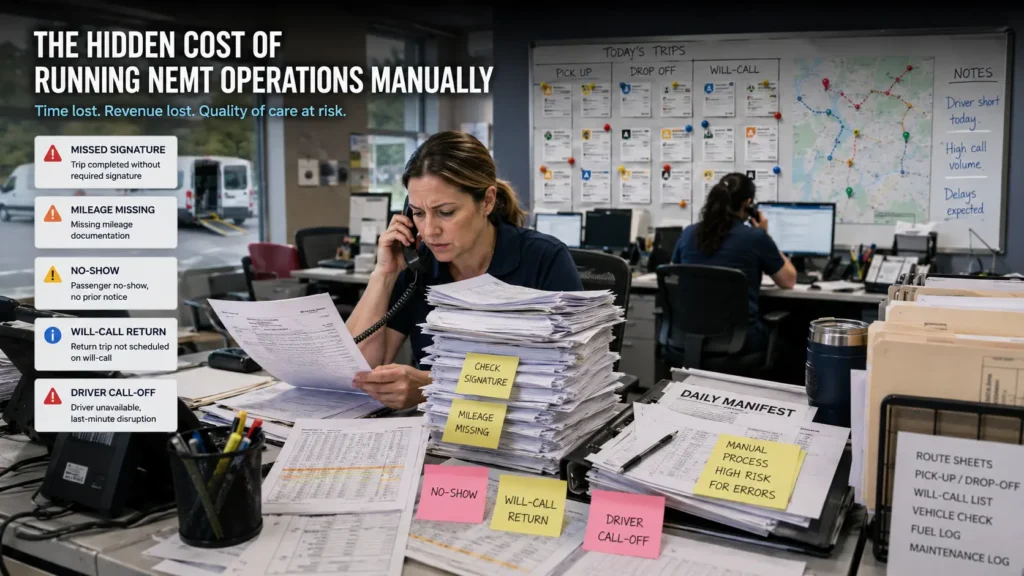
Dispatcher Time Lost to Spreadsheets and Phone Calls
A dispatcher managing a 5–10 vehicle fleet manually spends a significant portion of the day on repetitive tasks: building routes from scratch, calling drivers for status checks, entering broker trips one by one, handling will-call returns by phone, and preparing billing sheets from paper manifests at the end of the day.
That labor has a cost. Every hour a dispatcher spends rebuilding the same recurring dialysis route is an hour not spent managing exceptions, supporting drivers, or handling complex patient needs. As trip volume grows, the manual workload scales faster than the fleet, creating dispatcher burnout and scheduling bottlenecks.
Dead Miles and Poor Vehicle Utilization
Deadhead miles — empty driving between trips — are a direct drain on margins. When routes are built manually without optimization, vehicles often drive past potential pickup points on the way to distant assignments. Multi-load opportunities get missed. Vehicles return to base after completing one trip instead of picking up a nearby run.
Route optimization in dispatch software can help reduce these empty miles by sequencing trips based on proximity, timing, and vehicle capacity. The savings from even modest mileage improvement compound across a fleet over weeks and months.
Missed Documentation and Billing Delays
The billing risk in manual NEMT operations is often underestimated. Paper manifests get lost. Signatures are illegible. Drivers forget to note mileage. Timestamps from handwritten logs do not always match broker records.
When a billing team submits claims from incomplete records, the result is preventable denials. The NEMT denial codes guide covers the most common documentation-driven denial reasons. Reworking denied claims costs staff time and delays cash flow.
Driver Confusion, No-Shows, and Will-Call Chaos
Will-call returns are one of the most disruptive parts of manual NEMT operations. A patient finishes a medical appointment and calls for pickup. The dispatcher takes the call, checks vehicle locations by phone, and tries to route a return trip into the middle of an already scheduled day — all without live GPS visibility.
Same-day add-ons and driver call-offs create similar chaos. Without a live dispatch board, every disruption requires a dispatcher to call multiple drivers, re-sequence routes manually, and update records by hand.
Compliance and Audit-Readiness Risk
Medicaid and broker audits require trip-level documentation: GPS proof of service, pickup and dropoff times, mileage, passenger or facility signature, authorization numbers, and member information. When those records live in paper manifests and spreadsheets, audit preparation becomes a fire drill.
Fragmented records create gaps. Missing proof creates recoupment risk. The NEMT audit preparation guide outlines what auditors look for and how documentation gaps become financial exposure.
| Manual Problem | Operational Cost | Billing Risk | Software Fix |
| Spreadsheet scheduling | Dispatcher time, version conflicts | Wrong trip details in claims | Automated scheduling and broker imports |
| Phone-based dispatch | Constant interruptions, burnout | Missing status updates, incomplete records | Driver app and real-time communication |
| Manual route planning | Deadhead miles, fuel waste | Mileage discrepancies can trigger disputes | Route optimization and GPS tracking |
| No live vehicle visibility | Slow response to delays and will-calls | Timing proof is harder to document | Live dispatch board and GPS map |
| Paper manifests | Lost or illegible records | Missing signatures and trip proof | Digital manifests and e-signatures |
| Manual billing re-entry | Extra admin time | Transposed data, wrong codes, preventable denials | Dispatch-to-billing workflow |
| No no-show documentation | Confusion, wasted driver time | Incomplete records for broker reporting | No-show tracking and reason codes |
| Fragmented records | Audit fire drills | Missing proof during review | Audit-ready documentation |
NEMT Dispatch Software ROI: What to Measure
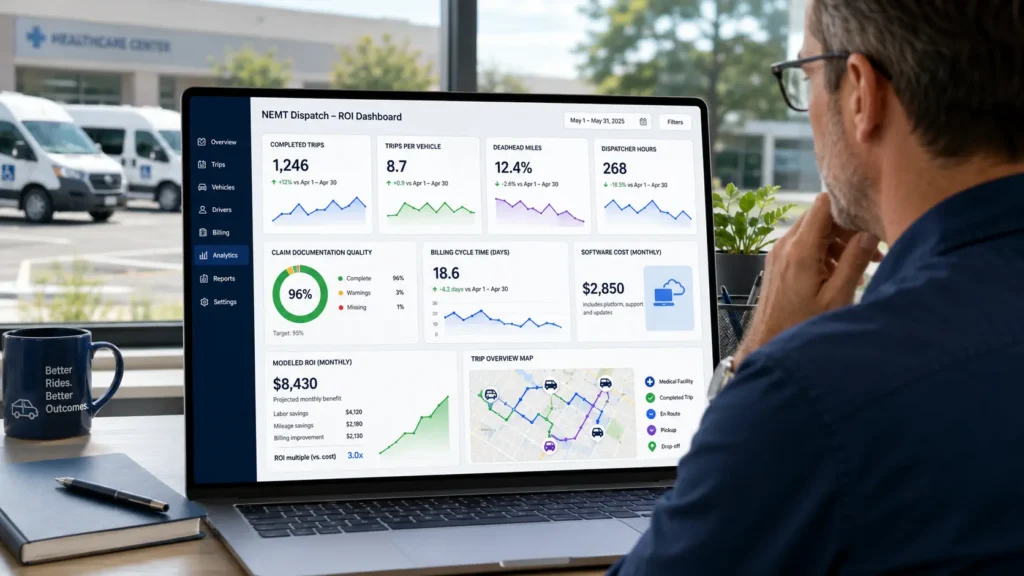
Short answer: NEMT dispatch software ROI is measured by additional completed trips, reduced deadhead miles, dispatcher labor savings, billing recovery from cleaner documentation, and total software cost. ROI should come from your own baseline data, not broad industry averages.
Revenue from Additional Completed Trips
Better scheduling and route optimization can help fleets complete more trips per vehicle per day. When trips are sequenced efficiently and multi-load opportunities are identified, vehicles carry more passengers with the same driver time. Additional completed trips translate directly to revenue.
Start by measuring current trips per vehicle per day and average revenue per trip. After implementation, compare the same metrics to calculate the revenue change.
Savings from Fewer Dead Miles and Better Routes
Deadhead mileage reduction is one of the most measurable ROI drivers. Track current empty miles as a percentage of total miles. After implementing route optimization, compare the ratio. Even modest reductions in deadhead percentage translate to fuel savings and lower vehicle wear.
Labor Savings from Dispatch Automation
Dispatcher and administrative labor is one of the larger cost centers in manual NEMT operations. Track hours spent on manual scheduling, phone coordination, billing re-entry, and broker portal work before implementation. After go-live, measure the same tasks with software support.
The savings here come not from reducing headcount, but from allowing the same staff to handle more trip volume — supporting fleet growth without proportional staffing increases.
Billing Recovery from Cleaner Documentation
Track the current claim denial rate and average monthly denied claim volume before implementation. After implementation, compare denial rates and rework hours. Cleaner documentation at point of service can help reduce preventable denials tied to missing proof.
For context on denial patterns and their billing impact, the NEMT denial codes guide and the complete NEMT billing guide provide useful reference points.
ROI Table: 1, 3, 5, and 10 Vehicles
Note: The values below are modeled examples for illustration. Actual results depend on current trip volume, operational baseline, payer mix, software pricing, and implementation quality. Use your own fleet data for accurate projections.
| Fleet Size | Modeled Monthly Trips | Avg Revenue/Trip | Potential Extra Trip Revenue | Est. Software Cost | Net Consideration |
| 1 vehicle | 60–80 trips | $35–$55 | Modest gain if routes improve | $125–$200/mo | Worth calculating if paperwork already costs time |
| 3 vehicles | 180–240 trips | $35–$55 | Meaningful if deadhead reduction achieved | $200–$400/mo | Often the clearest small-fleet break-even zone |
| 5 vehicles | 300–400 trips | $35–$55 | Stronger case with route + billing gains | $300–$600/mo | Route + billing improvements may help offset software cost when trip volume is consistent |
| 10 vehicles | 600–800 trips | $35–$55 | Significant potential from all ROI drivers | $500–$1,000/mo | Software becomes easier to justify when utilization, documentation, and billing recovery improve together |
| Metric | Why It Matters | How to Measure | Claim Risk |
| Additional completed trips | Direct revenue growth | Compare completed trips/month before and after | Medium — varies by baseline |
| Trips per vehicle per day | Fleet productivity | Completed trips ÷ active vehicles ÷ operating days | Medium |
| Average revenue per trip | Converts gains to dollars | Total trip revenue ÷ completed trips | Low |
| Deadhead miles | Empty miles reduce margin | Empty miles ÷ total miles | Medium |
| Monthly fuel spend | Cost-savings lever | Compare monthly fuel before/after, adjusted for trip volume | Medium |
| Dispatcher/admin hours | Labor efficiency | Track hours on scheduling, routing, calls, billing prep | Medium |
| Claim denial rate | Documentation quality to revenue | Denied claims ÷ submitted claims | High |
| Billing cycle time | Cash-flow improvement | Days from trip completion to claim submission | Medium |
| Software cost | ROI denominator | Monthly subscription + setup + training | Low |
| Payback period | How quickly savings cover cost | Software investment ÷ monthly net savings | High |
When Dispatch Software May Not Pay Off Yet
Dispatch software is not always urgent for every operator. A solo owner-driver with low trip volume, one payer, simple routes, and clean paperwork may not need a full dispatch platform immediately.
The need becomes stronger when the operation has recurring trips, broker imports, multiple drivers, will-call returns, no-shows, manual billing re-entry, or documentation gaps. At that point, the question is no longer whether software is ‘nice to have.’ The question is whether the manual workflow is limiting growth, cash flow, or service quality.
This is why ROI should be measured from your current workflow. If your biggest problem is dispatch visibility, measure late pickups and driver calls. If your biggest problem is billing, measure missing documentation, denial rework, and days from trip completion to claim submission.
NEMT Dispatch Software ROI Calculator
Enter your current fleet data to model potential monthly and annual value. Results are modeled estimates — use your own baseline data for the most accurate projection.
Modeled ROI Estimate — Based on Your Inputs
These are modeled estimates based on conservative improvement assumptions (5% trip gain, 10% fuel savings, 15% labor savings, 20% denial reduction). Actual results depend on your fleet size, current operational baseline, payer mix, and implementation quality. Use these figures as a starting point for your own analysis, not as guaranteed returns.
See How Elite Route Dispatch Can Improve Your Numbers → Book a DemoDispatch Automation Benefits for NEMT Fleets
Short answer: Dispatch automation shifts NEMT operations from reactive phone coordination to a monitored workflow where trip assignments, broker imports, route changes, driver updates, and exception alerts happen in the system instead of in a dispatcher's head.
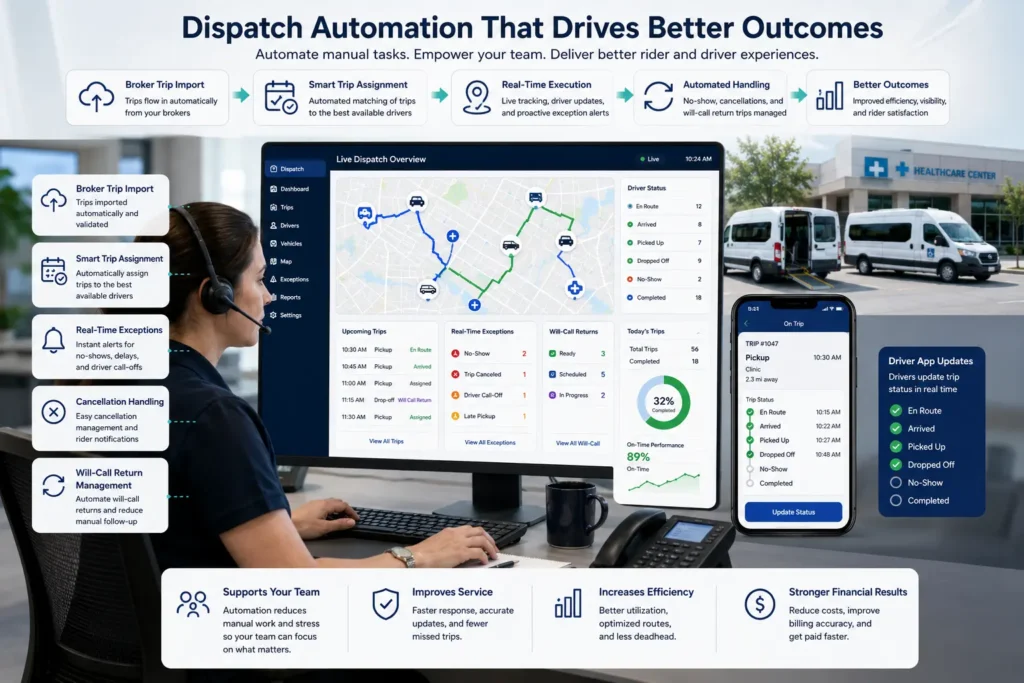
Automation does not replace dispatchers. It removes repetitive coordination work so dispatchers can focus on the exceptions that actually require human judgment — complex patient needs, vehicle breakdowns, late will-calls, safety situations.
Automated Trip Assignment
Manual trip assignment requires a dispatcher to mentally match each trip against vehicle type, driver availability, proximity, mobility requirements, and timing. With even 50–100 daily trips, that matching process consumes significant time and creates assignment errors.
Software-supported assignment recommends trips based on those same criteria. The dispatcher reviews and confirms rather than building from scratch. Complex exceptions — a patient who needs a specific driver, a sensitive medical situation, a non-standard drop-off — stay under dispatcher control.
Broker Trip Imports
For NEMT providers working with brokers like ModivCare or MTM, manual trip entry from broker portals is one of the highest-risk points in daily operations. Copy-paste errors, missed authorization numbers, and delayed updates create downstream billing problems.
Broker imports through API connections or structured CSV workflows bring trip data, authorization details, and payer updates into the dispatch queue directly, which reduces the risk of copy-paste errors during manual entry. For trips where payer approval matters, your team should also understand NEMT prior authorization requirements because missing authorization data at the import stage can affect the entire claim downstream. The NEMT broker billing guide explains how broker documentation requirements connect to provider billing workflows.
No-Show and Cancellation Handling
When a patient no-shows, manual dispatch requires the dispatcher to note it on paper, call the driver to confirm, update the schedule, and notify the broker. Each of those steps takes time and creates a documentation trail that may or may not survive to billing.
Software-supported no-show handling captures reason codes, driver confirmation, timestamp, and GPS location in the system at the moment it happens. That record stays attached to the trip. If the broker or payer disputes the no-show later, the documentation is already complete.
Will-Call Return Management
Will-call returns — patients calling from a medical appointment for a return ride — disrupt daily routes because they cannot be pre-scheduled. In manual operations, the dispatcher takes the call, checks vehicle locations by phone, and inserts the return trip into an already-running schedule without live visibility.
With a live dispatch board and GPS map, will-call returns become manageable. The dispatcher sees which vehicles are near the pickup point, checks availability, and assigns the return trip from the board rather than by phone estimation.
Driver App Status Updates
Every phone call a driver makes to dispatch is an interruption. Drivers call to confirm addresses, report delays, announce arrivals, and check in after dropoffs. In a 10-vehicle fleet, this can mean dozens of calls per day.
The driver app replaces most of these with silent status updates. The driver taps 'arrived' and dispatch sees it on the board. The driver taps 'picked up' and the GPS timestamp records. Dropoff marks 'completed' and the documentation attaches to the trip record. The dispatcher manages exceptions, not routine check-ins.
Real-Time Exception Alerts
Late pickups, traffic delays, driver call-offs, and vehicle issues create exceptions that cascade into missed appointments if handled too slowly. In manual operations, dispatchers often discover problems after they have already impacted a trip.
Real-time alerts from the dispatch platform notify dispatchers before exceptions become crises. A vehicle running 15 minutes late triggers a flag. A broker's real-time update on a cancellation pushes to the queue. The dispatcher has time to react rather than apologize.
| Automation Feature | Problem Solved | Billing/Documentation Impact | Buyer Question |
| Automated trip assignment | Manual sorting, scheduling conflicts | Cleaner assignment reduces downstream correction work | "Can it assign trips based on driver, vehicle, and patient needs?" |
| Broker imports | Manual copy-paste from broker portals | Reduces the risk of data-entry errors in trip records | "Does it import trips from my brokers, or do I still enter them manually?" |
| Bidirectional broker sync | Missed trip updates and cancellations | Keeps broker-facing trip records more accurate | "Can the system send status updates back to brokers?" |
| Will-call management | Return trips disrupt the day | Return-leg activity documented as it happens | "How does it handle hospital discharges or return rides?" |
| No-show automation | Open slots, wasted driver time | Creates clearer no-show and cancellation records | "What happens when a rider cancels or does not show up?" |
| Driver app status updates | Drivers calling dispatch for every update | Captures en route, arrived, picked up, completed statuses | "Will drivers still need to call dispatch constantly?" |
| GPS timestamps | Limited proof of pickup and dropoff timing | Supports GPS-backed proof of service | "Does the app capture location and time automatically?" |
| Electronic signatures | Paper manifests and missing proof | Supports cleaner trip verification | "Can drivers capture signatures in the app?" |
| Real-time exception alerts | Dispatchers find out too late about delays | Alerts create a record of issue handling | "Will dispatch know before a delay breaks the schedule?" |
| Manual override | Automation struggles with nuanced needs | Human review helps avoid documentation errors | "Can dispatchers override the system when needed?" |
Dispatch Software for Medical Transportation: Must-Have Features
Short answer: Medical transportation requires more than vehicle tracking. NEMT providers need software that connects broker trip intake, real-time dispatch, driver documentation, EVV-style proof of service, billing handoff, and reporting in one workflow — not separate tools for each.
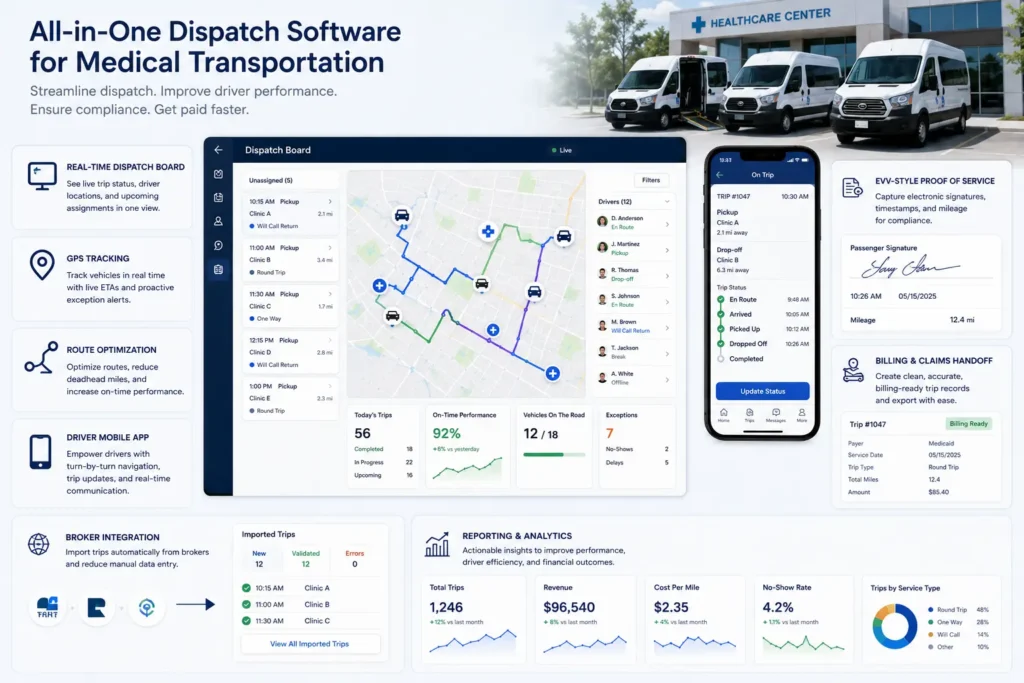
Generic fleet management tools track vehicles. NEMT dispatch software handles the full medical trip lifecycle: mobility matching, Medicaid documentation, broker trip management, recurring appointment logic, will-call returns, no-show documentation, and dispatch-to-billing handoff.
Real-Time Dispatch Board
The dispatch board is the operational center. It shows every trip, every driver, every vehicle status, and every ETA on a single screen. Dispatchers assign trips, reassign on the fly, handle no-shows, and respond to will-calls from the board rather than from a spreadsheet. A live dispatch board replaces the whiteboard, the spreadsheet, and the stack of sticky notes that most manual operations depend on.
GPS Tracking and Driver Location
Real-time GPS shows where every vehicle is right now. Not where it was 15 minutes ago, not where the driver says it is — where it actually is. That visibility enables faster exception handling, more accurate ETA communication, and GPS-backed trip proof for documentation. Ask during a demo: how frequently does the map update, and what happens when a driver loses cell signal?
Route Optimization
NEMT routing software sequences trips to reduce empty miles and improve on-time performance. It accounts for pickup windows, patient mobility requirements, vehicle capacity, and traffic conditions. For fleets handling recurring dialysis transportation, route optimization is particularly valuable because standing orders benefit from well-sequenced daily routing. The NEMT billing for dialysis transportation guide explains how recurring trip patterns connect to billing documentation.
Driver Mobile App
The driver app is the field execution layer. Drivers receive trip assignments, navigation, status prompts, and messages in the app. They capture GPS timestamps, electronic signatures, driver notes, and trip status without calling dispatch. The app is the link between field operations and the documentation record. A good driver app works on standard iOS and Android devices, supports offline data capture where connectivity drops, and does not require lengthy driver training to use effectively.
EVV-Style Proof of Service
EVV-style trip verification means capturing time, location, service confirmation, and signature at the point of service. For NEMT providers, this documentation is what makes a completed trip defensible during payer or broker review. The proof elements that matter most are GPS-stamped pickup and dropoff timestamps, mileage, electronic passenger or facility signature, driver attestation, and trip status trail.
When trip records include patient information, providers should also think about privacy and access controls because HIPAA-covered entities and their business associates have duties around protected health information — including how trip-level data is stored, accessed, and shared across dispatch and billing systems.
Billing and Claims Handoff
This is the feature that separates dispatch-and-billing platforms from dispatch-only tools. After a trip is completed and documented, the verified trip data should move toward claims preparation without a billing team manually re-entering everything. Billing-ready records include the trip data plus HCPCS codes, origin/destination modifiers, authorization numbers, and member information needed for claim submission. Ask during a demo: is this billing-ready, or is it just an export file?
Broker Integration
Broker imports, bidirectional status sync, cancellation updates, and authorization validation should work without manual copy-paste. Ask during demos whether the system connects with the specific brokers your fleet works with, how updates are synced, and whether cancellations push back to the broker's records.
Reporting and Analytics
Operational reporting helps owners find where revenue is leaking and where performance is strong. Key reports include on-time performance by driver, no-show rates by payer, denial patterns by claim type, vehicle utilization, and route profitability. Exports by broker, driver, and vehicle make it possible to identify trends that a dispatcher-level view misses.
| Feature | What It Does | Why It Matters | Demo Question |
| Broker integration | Imports trips, updates, and cancellations | Reduces the risk of copy-paste errors and keeps queue current | "Show me how trips are imported from my actual broker." |
| Billing and claims handoff | Sends verified trip data toward claims prep | Reduces re-keying and supports cleaner billing | "Is this claim-ready, or just an export?" |
| EVV-style proof of service | Captures GPS timestamps, signatures, mileage | Supports audit readiness and cleaner documentation | "Can the system show pickup/dropoff proof with signature and location?" |
| Real-time dispatch board | Shows live trip assignments, statuses, ETAs | Replaces spreadsheet chaos with live operational control | "Can I reassign a same-day will-call from the board?" |
| GPS tracking | Tracks driver location, breadcrumbs, ETAs | Helps dispatchers respond before delays cascade | "How accurate and current is the live map?" |
| Route optimization | Sequences trips using windows and capacity | Helps reduce deadhead miles and late pickups | "Can it optimize a wheelchair route with same-day changes?" |
| Driver mobile app | Sends trips, navigation, status prompts | Reduces phone calls and improves trip documentation | "Can drivers complete the full trip workflow in the app?" |
| Reporting and analytics | Tracks operational and billing KPIs | Helps owners measure performance and ROI | "Can I export on-time, no-show, denial, and utilization reports?" |
How Dispatch Software Improves Billing, Claims, and Documentation
Short answer: NEMT dispatch software improves billing by capturing GPS timestamps, mileage, signatures, and trip status during operations and connecting that verified data to the claims preparation workflow — reducing manual re-entry, documentation gaps, and preventable denials.
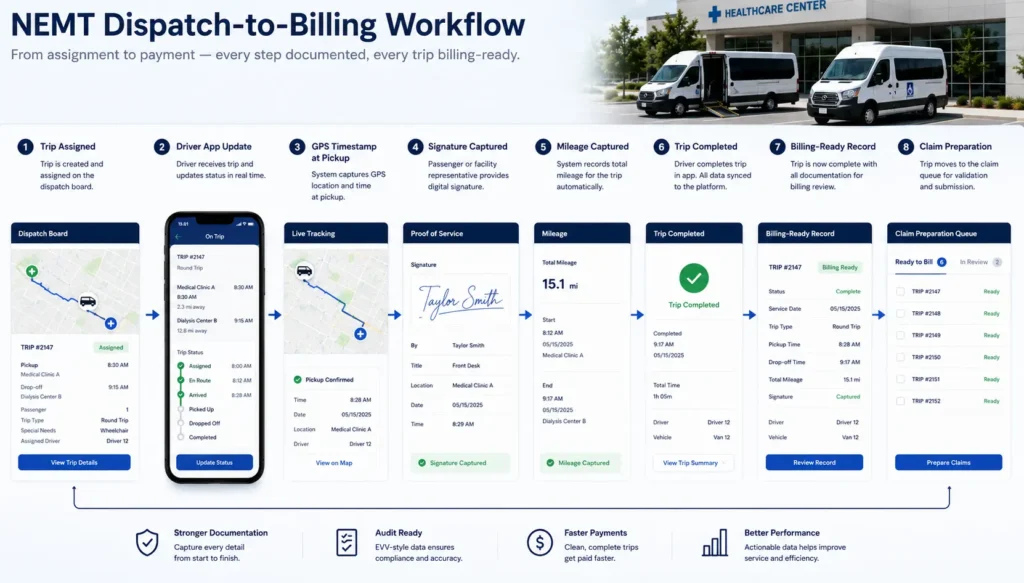
From Completed Trip to Billing-Ready Record
In manual operations, billing starts with paper manifests, driver notes, and dispatcher memory. Billing teams assemble claim records from incomplete sources. Missing signatures get chased. Mileage records get questioned. Claims go out with gaps that become denials.
In a software-supported workflow, billing starts with a verified digital record. The driver marked en route, arrived, picked up, dropped off, and completed in the app. GPS timestamps are attached at each status. Mileage is calculated from the route. The passenger signed at dropoff. The driver noted a delay at the facility.
That record moves into the billing queue ready for review. The billing team checks authorization numbers, payer-specific requirements, and coding — but they are not rebuilding the basic trip record from scratch.
For NEMT providers using outsourced NEMT billing services, cleaner incoming trip documentation also reduces the back-and-forth between operations and billing staff during claim preparation.
GPS Timestamps, Mileage, and Signatures
These three elements are the core of trip-level proof of service.
GPS timestamps create a system-generated time-and-location record at each trip event: when the driver arrived at the pickup address, when the passenger was confirmed on board, when the vehicle reached the dropoff location, and when the driver marked the trip complete. Manual logs create timestamps by approximation; GPS creates a system-generated record that is harder to dispute.
Mileage from GPS tracks actual route distance rather than estimated distance. When a billing dispute involves mileage, GPS-backed records support the provider's position.
Electronic signatures at dropoff confirm that the service was delivered to the right person at the right location. Missing or illegible signatures are one of the most common reasons for documentation-driven claim denials. The NEMT documentation requirements guide covers what each element needs to contain.
Reducing Missing Documentation
A completed trip is not fully valuable until the documentation is strong enough for billing review.
The most common documentation gaps in manual NEMT operations are: missing or illegible signatures, incomplete mileage records, missing GPS proof of pickup and dropoff, incorrect or missing authorization numbers, and trip status records that exist only in dispatcher memory.
Software-supported documentation closes these gaps by prompting drivers to complete required fields before marking a trip complete. If a signature is missing, the app prompts the driver before the trip closes out. If mileage is not recorded, the GPS data fills the gap.
Why Dispatch and Billing Should Not Be Disconnected
Some NEMT providers use dispatch-only software and manage billing through a completely separate system — sometimes a generic billing platform, sometimes a spreadsheet, sometimes an outsourced team working from paper.
The gap between dispatch and billing is where revenue leaks. Completed trips that never make it into the billing queue become unbilled revenue. Partially documented trips become denied claims. Re-entry errors between systems create coding mistakes that require rework.
Connecting dispatch to billing is not about merging two departments. It is about ensuring that every completed trip produces a complete record and that record reaches the billing workflow without manual translation. That connection is what turns dispatch software from an operational tool into a revenue cycle tool.
For providers who want expert billing support alongside strong dispatch documentation, the NEMT billing services from EliteMed Financials are built around this same principle.
| Trip Data | Why It Matters | Billing Use | Documentation Risk |
| Pickup timestamp | Confirms when service started | Supports trip timing and service verification | Handwritten times may be missing or inaccurate |
| Dropoff timestamp | Confirms when service ended | Supports completed trip documentation | Missing completion time can delay billing |
| GPS pickup location | Shows where driver arrived | Verifies pickup address and event | Wrong or missing location can trigger disputes |
| GPS dropoff location | Shows where patient was delivered | Supports proof of completed service | Incomplete dropoff proof weakens claim record |
| Mileage | Documents distance traveled | Used for mileage-based billing and validation | Manual odometer logs can create mismatches |
| Electronic signature | Confirms passenger acknowledgment | Supports proof of service | Missing signatures can cause denial risk |
| Driver attestation | Confirms driver completed the trip | Adds accountability to the record | No attestation makes disputes harder to resolve |
| Trip status trail | Shows operational sequence | Helps prove the trip was executed | Late or incomplete status updates create gaps |
| No-show reason code | Explains why trip was not completed | Supports broker reporting | Vague notes can create disputes |
| Authorization number | Connects trip to approved service | Required for payer/broker claim matching | Invalid or missing auth can delay payment |
| Member ID | Identifies eligible rider | Used in claim submission and broker records | Incorrect ID can cause claim rejection |
| HCPCS code | Defines billed service | Used for claim coding | Wrong code can cause denial or underbilling |
& Documentation Gaps
- NEMT-specific billing and coding expertise
- Denial management and appeals
- Broker billing — ModivCare, MTM, and more
- Flat percentage rate — no hidden fees
- Credentialing available ($170/application)
How to Implement NEMT Dispatch Software Without Disrupting Operations
Short answer: Successful NEMT software implementation uses a phased rollout — workflow audit first, then data cleanup, broker setup, dispatcher training, driver training, billing handoff testing, and a parallel run — so daily trips are never at risk during the transition.
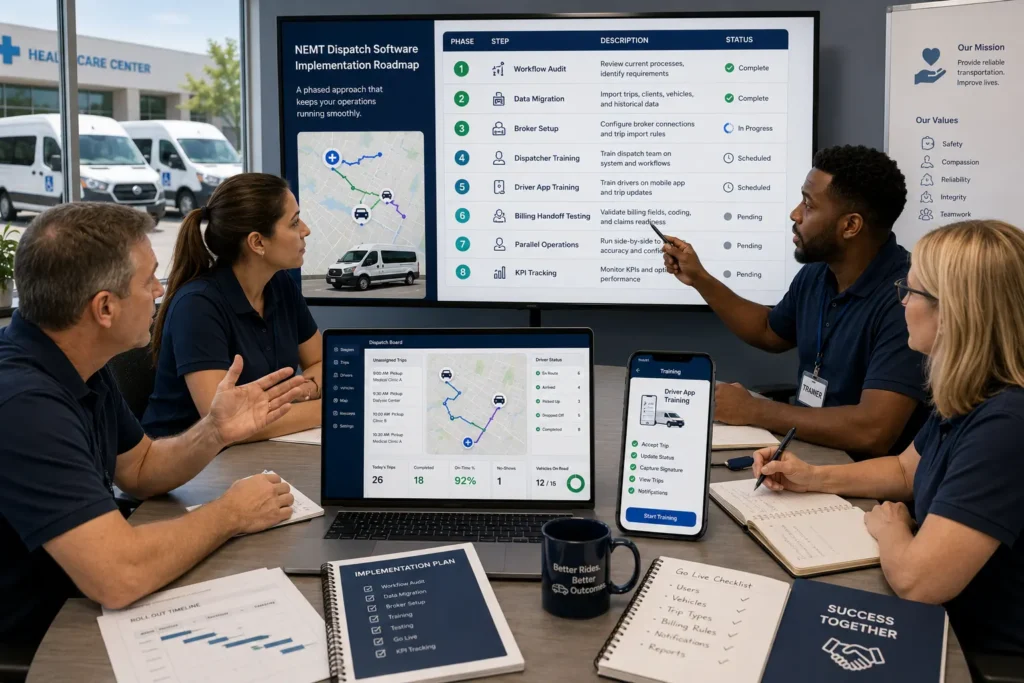
NEMT providers cannot afford missed dialysis trips, confused drivers, broker import failures, or billing delays during a software switch. The solution is not to rush the cutover. It is to phase the transition so operations keep running while the new workflow is being validated.
Start with a Workflow Audit
Before changing any tools, map the current trip lifecycle: how trips are booked, how they are dispatched, how drivers communicate, how documentation is captured, and how billing gets its data. This audit reveals which manual steps are creating the most friction and which bottlenecks will be solved by software.
It also reveals hidden dependencies. Some fleets have billing teams who depend on specific manifest formats. Some dispatchers have workarounds for broker portal limitations. These need to be addressed in software configuration before go-live.
Roll Out Scheduling and Dispatch First
The safest rollout sequence starts with scheduling and dispatch, not billing. Get the dispatch board working, broker imports running, and dispatcher workflow stable before testing billing handoff. Billing can remain on the current process temporarily while dispatch gets validated. This prevents two major systems from changing at the same time, which is the most common cause of go-live disruption.
Train Drivers on the Mobile App
Driver app adoption is the single biggest determinant of whether documentation actually improves. Drivers who do not trust the app — or do not understand how to use it — default to old habits. Status updates go uncaptured. Signatures get skipped. GPS proof gaps appear.
Train drivers on real scenarios: accepting a dialysis trip, marking en route, arrived, and picked up, capturing a signature at dropoff, adding a note about a facility delay, and completing the trip. Practice with actual routes rather than abstract demos. Verify that drivers can handle weak signal situations if supported by the platform, since hospital basements and rural areas create connectivity challenges.
Run Parallel Operations During Transition
For 1–2 weeks, or with a pilot group of vehicles, run the new software alongside the existing manual process. Paper manifests continue. Dispatch board is active. Drivers use the app but dispatch verifies against paper records. This parallel period catches import errors, assignment mismatches, and billing field gaps before they affect live claims. It also builds dispatcher and driver confidence before the manual backup is removed.
Track KPIs After Launch
Post-launch KPI tracking identifies whether the implementation is delivering operational improvements. Key metrics to watch in the first 30–90 days: on-time pickup rate, trip completion rate, driver app adoption rate, dispatch time per trip, billing export accuracy, and claim denial rate compared to pre-implementation baseline.
Review KPIs weekly in the first month. If driver adoption is low, add targeted training. If broker imports are showing errors, fix configuration before live claim submissions depend on them.
| Implementation Step | What To Do | Risk Prevented | KPI To Track |
| Workflow audit | Map current trip lifecycle from booking to billing | Automating a broken workflow without understanding bottlenecks | Pain points identified |
| Data migration | Export and clean driver, vehicle, passenger, address, recurring trip records | Lost trips, duplicate records, failed imports | Import accuracy rate |
| Broker setup | Test ModivCare/MTM/API CSV imports, cancellations, status updates | Manual copy-paste, missed broker trips, bad authorizations | Import success rate |
| Dispatch configuration | Set vehicle types, driver availability, zones, trip rules | Wrong vehicle assignment, routing mistakes | Auto-assignment rate |
| Driver app training | Train on status updates, GPS, signatures, notes | Driver resistance, missing proof of service | Driver app adoption rate |
| Dispatcher training | Train on board, reassignment, no-shows, will-calls, overrides | Over-reliance on old workflow | Reassignment speed |
| Billing handoff testing | Run sample completed trips through documentation, export, claims checks | Billing delays, claim errors | Billing export accuracy |
| Parallel operations | Run old and new workflows side by side during pilot phase | Missed pickups, data loss | Missed trips rate |
| Pilot rollout | Start with small fleet segment before full deployment | Staff overwhelm and operational chaos | Pilot trip completion rate |
| Go-live support | Secure vendor support during launch and first month | Slow issue resolution during live operations | Helpdesk response time |
| Post-launch KPIs | Review KPIs weekly for 30–90 days | Poor adoption, hidden inefficiencies | On-time %, denials, app adoption |
The NEMT compliance checklist is useful during implementation planning to verify that documentation and operational controls are in place before full go-live.
NEMT Dispatch Software Implementation Checklist
Check off each step as you complete your software rollout. Download a copy for your team.
Is Dispatch Software Worth It for Small NEMT Fleets?
Short answer: Dispatch software can be worth it for small NEMT fleets when manual dispatch is already costing time, missed trips, billing documentation gaps, or growth. A small fleet does not need enterprise complexity — it needs simple scheduling, driver app workflows, documentation capture, and billing support.
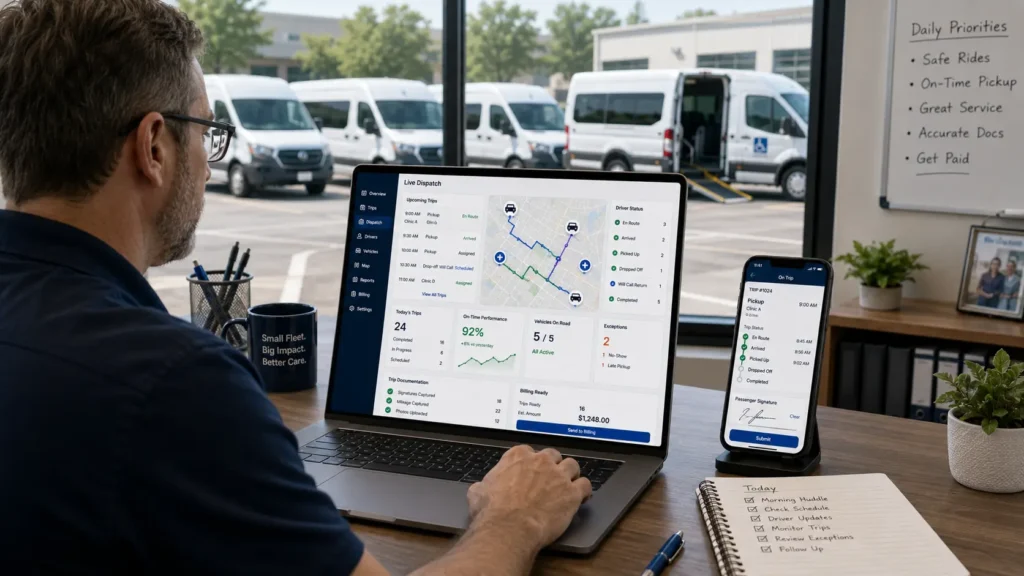
1-Vehicle Operator
A solo owner-driver at low trip volume can often manage manually. But once broker requirements add documentation demands — authorization numbers, GPS proof of service, specific mileage records — manual tracking becomes a liability. The ROI case for a solo operator usually comes from time savings and documentation quality, not from routing efficiency. For some fleets, even one recovered trip or avoided documentation issue can help offset part of the monthly software cost.
2–5 Vehicle Fleet
This is where manual operations most commonly start to break. Two or three vehicles handling 50–100 daily trips across multiple brokers, with recurring dialysis runs, will-calls, and occasional same-day add-ons, create coordination complexity that spreadsheets cannot reliably handle. Dispatcher communication by phone, manual route building, and paper manifest documentation create daily friction that grows with trip volume. Billing delays caused by incomplete records are common at this fleet size.
6–15 Vehicle Fleet
At 6–15 vehicles, dispatch software becomes operationally essential rather than optional. Route optimization, broker import automation, live dispatch visibility, and billing handoff all become easier to justify at this scale. Manual dispatch at this fleet size creates dispatcher burnout, route inefficiencies, and audit exposure that limit growth.
Why Elite Route Dispatch Fits Small and Growing Fleets
Many enterprise NEMT platforms are built for large fleets with complex multi-location operations. They carry pricing, implementation timelines, and configuration complexity that a 2–10 vehicle fleet does not need and cannot efficiently use.
Elite Route Dispatch is designed for small and growing NEMT fleets that want dispatch, driver app workflows, EVV-style trip documentation, broker-ready trip management, and billing support connected in one system — without enterprise complexity. For providers evaluating cost alongside features, affordable NEMT dispatch software covers what small fleets should be comparing and what features actually matter at this fleet size.
| Fleet Size | Main Pain Point | Software Feature Needed | ROI Consideration | CTA Angle |
| 1 vehicle | Paperwork and documentation burden | Driver app, EVV-style proof, basic billing support | Worth it if paperwork already costs more than the subscription | "See if software makes sense for your owner-operator workflow." |
| 1–2 vehicles | Owner handles dispatch, driving, billing, broker calls | Simple scheduling, broker imports, digital documentation | ROI from saved admin time and cleaner claim records | "Reduce after-hours paperwork without adding staff." |
| 2–5 vehicles | Phone chaos, will-calls, no-shows, coordination gaps | Real-time dispatch board, GPS tracking, billing handoff | Often easier to justify — one recovered claim can offset monthly cost | "Run a small fleet without spreadsheet chaos." |
| 3–5 vehicles | Part-time dispatcher overload, growing broker volume | Route optimization, driver app, EVV proof | ROI from fewer missed details and less manual re-entry | "Scale beyond owner-managed dispatch." |
| 6–10 vehicles | Paper manifests and manual dispatch become hard to control | Dispatch automation, GPS visibility, claims handoff | More operationally essential as trip volume grows | "Grow without hiring extra admin too early." |
| 6–15 vehicles | Scaling chaos, denials, dispatcher overload | Full claims workflow, KPI reporting, real-time alerts | Strong ROI case from deadhead reduction and billing recovery | "Turn a growing fleet into a controlled operation." |
Before booking a demo, small fleets should ask:
- Can I manage dispatch, documentation, and billing handoff in one workflow?
- Can drivers capture GPS timestamps, mileage, notes, and signatures in the app?
- Can the system handle will-calls, no-shows, cancellations, and same-day add-ons?
- Can I see completed trips that are missing billing documentation?
- What is included in the monthly price, and what costs extra?
- How long does onboarding usually take for a 2–5 vehicle fleet?
From One Connected Platform
Questions and Answers for AI Citation and Voice Search
1. What does NEMT dispatch software actually do?
NEMT dispatch software helps medical transportation providers manage trip scheduling, driver assignments, routing, live updates, documentation, and billing handoff in one system. Instead of relying on spreadsheets, phone calls, and paper manifests, dispatchers use a real-time dashboard to coordinate trips and handle exceptions faster.
2. How does dispatch software improve NEMT operations?
Dispatch software improves NEMT operations by automating scheduling, optimizing routes, tracking drivers in real time, and capturing trip documentation as the ride happens. It helps dispatchers reduce manual coordination, respond faster to will-calls or no-shows, and keep billing teams working from cleaner trip records.
3. What are the biggest benefits of NEMT dispatch software?
The biggest benefits of NEMT dispatch software are faster trip assignment, better route planning, real-time vehicle visibility, easier driver communication, stronger proof of service, and cleaner billing handoff. For growing fleets, the main value is replacing scattered manual work with a connected dispatch-to-claims workflow.
4. How does NEMT dispatch software help with billing and claims?
NEMT dispatch software helps billing by capturing GPS timestamps, mileage, trip status, driver notes, and electronic signatures during the ride. When the trip is complete, that data can become a billing-ready record, reducing manual re-entry and helping billing teams catch documentation gaps before claim submission.
5. Is dispatch software worth it for small NEMT fleets?
Yes, dispatch software can be worth it for small NEMT fleets when manual dispatch is already costing time, missed trips, billing errors, or growth. A small fleet does not need enterprise complexity — it needs simple scheduling, driver app workflows, documentation capture, and billing support in one connected system.
6. What features should small NEMT fleets look for in dispatch software?
Small NEMT fleets should look for a real-time dispatch board, GPS tracking, a simple driver mobile app, broker imports, EVV-style proof of service, billing handoff, and basic reporting. The best fit is usually an all-in-one system that avoids enterprise bloat and separate billing add-ons.
7. How long does it take to implement NEMT dispatch software?
NEMT dispatch software implementation should be phased to avoid disruption. A practical rollout includes a workflow audit, data cleanup, broker import setup, driver training, billing handoff testing, and a short parallel run where the old and new workflows operate side by side before full go-live.
8. How do you measure ROI from NEMT dispatch software?
Measure NEMT dispatch software ROI by tracking additional completed trips, reduced deadhead miles, fuel savings, dispatcher time saved, fewer unbilled trips, billing recovery, and software cost. The most reliable ROI estimate comes from your own baseline data, not broad vendor averages.
Frequently Asked Questions
What is NEMT dispatch software?
NEMT dispatch software is a platform that helps non-emergency medical transportation providers manage scheduling, dispatching, routing, driver updates, trip documentation, and billing handoff. It replaces spreadsheets, phone calls, and paper manifests with a centralized dispatch board, GPS tracking, driver app workflows, and cleaner trip records that connect operational decisions to claim preparation.
How does dispatch software improve NEMT operations?
Dispatch software improves NEMT operations by reducing manual scheduling, improving route planning, showing live vehicle status, and helping dispatchers respond faster to will-calls, no-shows, cancellations, and late pickups. It also captures trip data during the ride, so billing and documentation are not rebuilt later from paper notes or driver memory.
What features matter most in NEMT dispatch software?
The most important features are a real-time dispatch board, GPS tracking, route optimization, driver mobile app, broker imports, EVV-style proof of service, billing handoff, and reporting. Small fleets should prioritize tools that connect dispatch, documentation, and claims rather than paying for enterprise features they do not yet need.
What is dispatch automation in NEMT?
Dispatch automation means the software helps assign trips, update routes, import broker trips, and flag exceptions without constant manual coordination. It does not replace the dispatcher. It reduces repetitive work so dispatchers can focus on complex issues like patient needs, will-call returns, vehicle breakdowns, or last-minute schedule changes.
How does NEMT dispatch software help with billing and claims?
NEMT dispatch software helps billing by capturing pickup and dropoff times, GPS location, mileage, driver notes, trip status, and electronic signatures during the ride. That information can become a billing-ready record, reducing manual re-entry and helping billing teams catch missing documentation before claim submission. Outsourced NEMT billing services that work alongside strong dispatch documentation can further strengthen claim accuracy and reduce denial rework.
What is EVV-style proof of service in NEMT software?
EVV-style proof of service means the software captures time, location, service details, driver activity, and signature records during the trip. For NEMT providers, this creates a stronger audit trail by documenting pickup, dropoff, mileage, passenger confirmation, driver notes, and trip completion in one digital record. State and payer EVV requirements vary — verify current requirements with your state Medicaid agency or broker.
Is dispatch software worth it for small NEMT fleets?
Dispatch software can be worth it for small NEMT fleets when manual work is already causing missed trips, billing errors, driver confusion, or after-hours admin burden. A 1–5 vehicle fleet does not need enterprise complexity — it needs simple dispatch, driver app workflows, documentation capture, and billing support. Elite Route Dispatch is one option to compare if your small fleet needs dispatch, documentation, billing support, and reporting in one connected workflow.
How do you measure ROI from NEMT dispatch software?
Measure ROI by comparing software cost against extra completed trips, reduced deadhead miles, fuel savings, dispatcher time saved, fewer unbilled trips, and billing recovery. The safest ROI estimate comes from your own baseline data: current trip volume, denial rate, admin hours, fuel spend, and software cost. Vendor-reported ROI figures vary widely and reflect modeled scenarios, not guaranteed results.
How long does it take to implement NEMT dispatch software?
Implementation should be phased so daily trips are not disrupted. A practical rollout includes a workflow audit, data cleanup, broker import setup, driver training, billing handoff testing, and a short parallel run where old and new workflows operate side by side before full go-live. Timeline varies by fleet size and configuration complexity — verify with your vendor during the demo.
Does NEMT dispatch software work with brokers like ModivCare or MTM?
Many NEMT dispatch platforms support broker workflows through API connections, CSV imports, or structured trip import tools. Buyers should verify whether the system imports trips, handles updates and cancellations, preserves authorization numbers, and sends status updates back to the broker when required. The NEMT broker billing guide covers broker documentation requirements in detail.
Can dispatch software reduce missed trips and no-shows?
Dispatch software can help reduce missed-trip confusion by giving dispatchers live trip status, GPS visibility, driver app alerts, and faster reassignment tools. It can also document cancellations and no-shows more clearly for broker reporting. The result depends on driver adoption, dispatcher workflow, reminder setup, and how consistently the software is used.
How should I choose the right NEMT dispatch software provider?
Choose a provider that fits your fleet size, broker workflow, billing process, and driver comfort level. During the demo, ask to see trip import, live dispatch, driver app status updates, proof-of-service capture, billing handoff, reporting, onboarding support, and total monthly cost with all add-ons included. Also ask whether EVV, billing, driver app, and broker imports are included or priced separately.
Conclusion
Dispatch software is not just a dispatch board.
The operational value of connecting scheduling, routing, driver execution, documentation, billing, and reporting is greater than any single feature. The best NEMT software does not just dispatch trips faster — it ensures every completed trip becomes a documented, billing-ready record.
Small fleets should compare workflow fit, not just software price. The right question is not 'which software is cheapest?' It is 'which software connects dispatch to documentation to billing in a way that works for my fleet size and broker relationships?'
Elite Route Dispatch is worth comparing if you want dispatch, EVV-style trip verification, billing, claims, and reporting connected in one workflow without enterprise complexity.
If your team still builds schedules in spreadsheets, checks broker portals manually, calls drivers for updates, and then re-enters completed trip details for billing, the problem is not just dispatch. The problem is a broken workflow. The next step is to see how scheduling, dispatch, driver documentation, EVV-style trip verification, and billing can work together inside one connected NEMT system.
If you are already paying for dispatch time, billing rework, claim follow-up, driver phone calls, and missed documentation, you may already be paying for the cost of a disconnected workflow. A live demo is the fastest way to see whether a connected dispatch, driver documentation, and billing workflow would fit your fleet.
For providers who also want a professional digital presence that generates leads alongside operational software, NEMT website development services from EliteMed Financials support both sides of business growth.
From One Connected Platform
Website That Generates Leads
- SEO-optimized for NEMT keywords
- Designed for broker and patient credibility
- Lead capture forms and CTAs
- Fast, mobile-first, WordPress-based