

━━━━━━━━━━━━━━━━━━━━━━━━━━━━━━━━━━━━━━━━━━━━━━━━━
NEMT documentation requirements are the federal and state rules that govern what records every Medicaid transportation provider must create, keep, and produce on demand. Under 42 CFR § 440.170 and 42 CFR Part 433, all NEMT providers must document every trip, driver qualification, vehicle inspection, and billing claim. Incomplete documentation is the #1 cause of NEMT claim denials — accounting for approximately 35% of all rejected Medicaid transportation claims nationwide.
━━━━━━━━━━━━━━━━━━━━━━━━━━━━━━━━━━━━━━━━━━━━━━━━━
One missing signature can cost you an entire month of revenue. That’s the reality of NEMT documentation requirements in 2026. Medicaid doesn’t give you the benefit of the doubt during an audit — if it isn’t documented, it didn’t happen. Providers who understand these rules get paid. Providers who ignore them face denied claims, recoupments, and even contract termination.
This guide covers every document your operation needs, from trip logs and proof-of-service signatures to driver qualification files and EVV records. You’ll also find a complete NEMT documentation checklist further down — print it, share it with your drivers, and use it every single day. For the billing side of documentation, our complete NEMT billing requirements guide walks you through claim submission step by step.
Let’s get into it.
Table of Contents
What Are NEMT Documentation Requirements?
A Medicaid auditor can show up — or send a records request — at any time. If you can’t produce complete, legible, and organized records within the required window, the state can recoup 100% of payments tied to those trips. That’s not a hypothetical. It happens to new and established operators every year.
NEMT documentation requirements cover every paper trail your business creates. They span from the moment you schedule a trip to the moment you archive a paid claim. Federal rules set the baseline under 42 CFR § 440.170 and the CMS NEMT Booklet. Your state Medicaid agency and your NEMT broker then layer additional requirements on top.
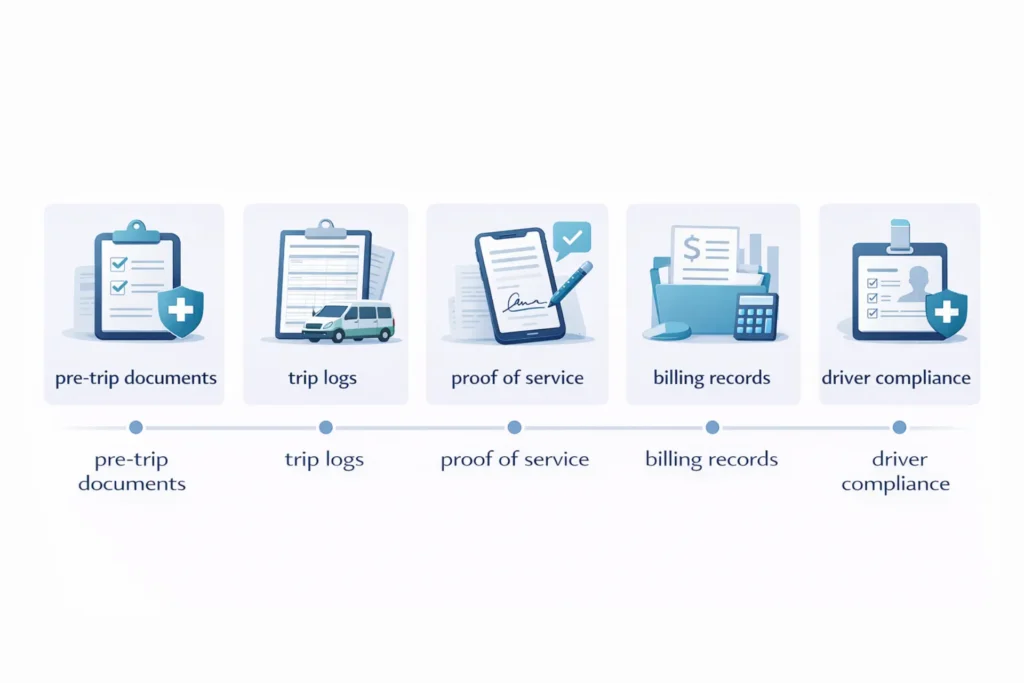
The 5 Categories of Required NEMT Documentation
Every NEMT provider needs documentation in five core areas. Miss any one of them and you’re vulnerable at audit.
Category 1 — Pre-Trip Documentation This is everything you need before your driver leaves the lot. It includes the trip authorization or prior authorization (PA) number from the state or broker, the patient’s Medicaid eligibility verification, and — for wheelchair and stretcher transport — the Physician Certification Statement (PCS). Your driver cannot legally dispatch without a valid authorization number on file.
Category 2 — Trip Manifests and Logs This is your operational record of what happened during each trip. The manifest proves the transport occurred, captures all required data fields, and feeds your billing claim. A compliant manifest must contain actual pickup and drop-off times — not scheduled times. This distinction matters enormously at audit.
Category 3 — Post-Trip Proof of Service After every trip, you need proof that the ride actually happened. This includes a patient signature or an accepted alternative such as a facility staff signature, plus your Electronic Visit Verification (EVV) data where required. Missing proof of service turns a legitimate trip into a ghost ride in the eyes of Medicaid.
Category 4 — Billing and Claims Documentation Every claim you submit needs supporting records. This includes the signed trip manifest, the proof of service, the prior authorization number, and the correct HCPCS billing code. Your billing documentation must align perfectly with your operational records — discrepancies trigger automatic denials.
Category 5 — Driver and Vehicle Compliance Documentation Your Driver Qualification File (DQF), vehicle inspections, insurance certificates, and certification records fall into this category. Brokers like MTM and ModivCare audit these files. Missing or expired credentials result in driver suspension, trip reassignment, and lost contracts.
Your action step: Review which of these five categories your operation is weakest in. That’s where your first audit risk lives.
Trip Manifest Requirements: What Every Log Must Include
A claim denial is expensive. But here’s the thing — most trip manifest denials are entirely preventable. The top cause is missing or incorrect data on the trip log itself. Auditors check manifests first, and they check them line by line.
Required Fields on Every NEMT Trip Manifest
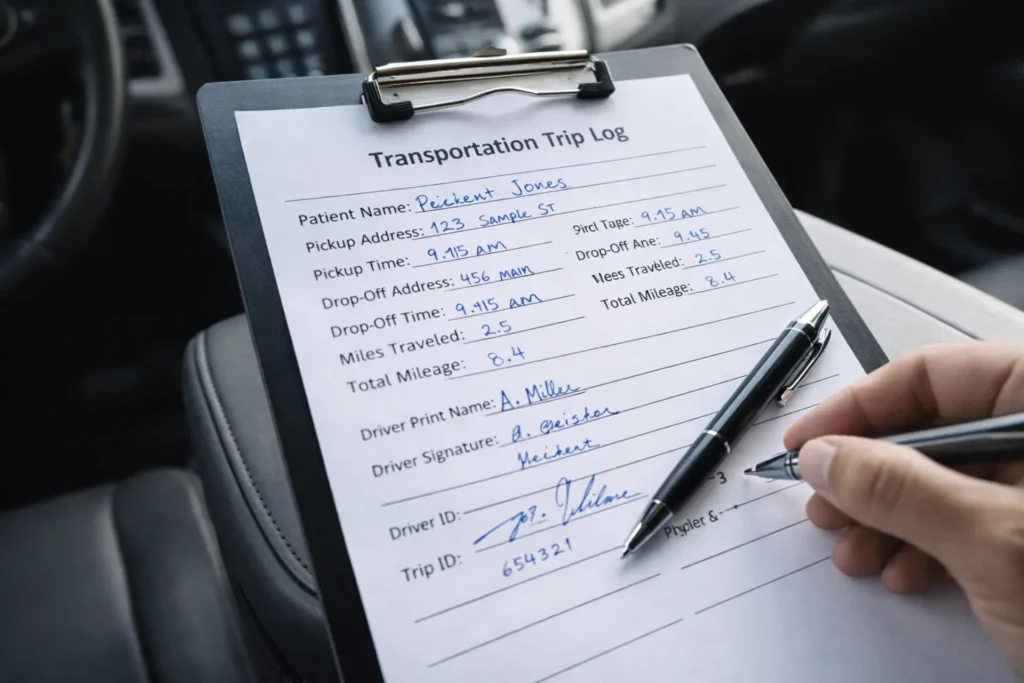
Every NEMT trip manifest must contain the following fields. These requirements come from the CMS NEMT Booklet, the Minnesota DHS standard — which requires records to be “in English and legible according to the standard of a reasonable person” — and broker-specific requirements from MTM, ModivCare, and MAS.
| Required Field | Why Medicaid Needs It | Format | Audit Risk if Missing |
|---|---|---|---|
| Patient name | Identifies the Medicaid beneficiary | Full legal name | Immediate denial |
| Medicaid ID number | Links trip to eligibility record | State-issued ID | Denial + eligibility review |
| Date of service | Confirms the trip date matches the claim | MM/DD/YYYY | Denial for date mismatch |
| Actual pickup time | Proves service started — not scheduled time | HH:MM (24hr or AM/PM) | Denial for time discrepancy |
| Actual drop-off time | Proves service was completed | HH:MM (24hr or AM/PM) | Denial for incomplete service |
| Origin address | Full street address — no PO Boxes | Complete street address | Denial for unverifiable location |
| Destination address | Full street address of medical facility | Complete street address | Denial for authorization mismatch |
| Driver name | Identifies who performed the transport | Full legal name | Driver credential audit |
| Driver signature | Attests accuracy of all recorded information | Ink or digital | Denial as unsigned |
| Passenger signature | Proof of service — patient or authorized person | Ink, digital, or witness | Ghost trip denial |
| Vehicle ID / plate | Identifies the specific vehicle used | License plate or fleet # | Vehicle compliance review |
| Odometer at pickup | Starting mileage for loaded miles calculation | Numeric reading | Mileage discrepancy denial |
| Odometer at drop-off | Ending mileage for loaded miles calculation | Numeric reading | Mileage discrepancy denial |
| Trip ID / authorization number | Links manifest to pre-approved trip | Alpha-numeric from broker/state | Denial for unauthorized trip |
| HCPCS code | Identifies the type of transport billed | A0100–A0225 | Code mismatch denial |
Electronic vs. Paper Trip Logs
Paper trip logs are still legally acceptable in all 50 states as of 2026. But they carry serious risk. Paper logs get lost, get wet, become illegible, and cannot auto-generate GPS data. Electronic trip logs — through platforms like RouteGenie, TobiCloud, or NEMT Cloud Dispatch — generate tamper-proof timestamps, GPS-verified location data, and digital signatures that courts and auditors accept as primary evidence.
If you use paper logs, you need a system to scan and archive them immediately after each trip. You cannot wait until the end of the week. Delays create gaps in your audit trail that auditors notice.
Our guide to the best NEMT software compares platforms by their trip documentation capabilities, EVV integration, and broker portal connections.
GPS Verification Requirements
GPS data does two critical jobs. First, it validates mileage. If you bill 14 miles and GPS shows the shortest route was 9 miles, you get a mileage discrepancy denial. Second, it proves the trip occurred at the right time and location, preventing ghost trip accusations.
Most major NEMT brokers now require GPS-verified trip data as a condition of payment:
- MTM Inc. requires GPS upload alongside the trip manifest
- ModivCare cross-references your reported mileage against GPS shortest-route data
- MAS Transportation reconciles GPS breadcrumbs against driver clock-in and clock-out times
If your dispatch software doesn’t integrate GPS with your trip logs automatically, fix that now. Manual GPS entry creates exactly the kind of discrepancies that trigger post-payment audits.
Your action step: Set your dispatch software to auto-calculate loaded miles from GPS — never let drivers estimate mileage by hand.

Proof of Service Documentation
A signed trip manifest with GPS data means nothing if you can’t prove the patient was actually in the vehicle. Medicaid calls this “proof of service” (POS), and without it, your trip is classified as a ghost ride — a fraudulent billing of a trip that cannot be verified. That classification doesn’t just deny your claim. It can trigger a full audit of every trip you’ve billed.
Passenger Signature Requirements

The patient’s signature on the trip manifest is your primary proof of service. You need it at drop-off in most states — not just at pickup. Here’s what’s acceptable:
- Direct patient signature — the standard, always preferred
- Digital signature on a tablet — accepted in all states when collected through an approved EVV-compatible platform
- Legal guardian or healthcare proxy signature — acceptable when the patient lacks capacity; must include the guardian’s name, title, and relationship to patient
- Facility staff signature — accepted when the patient is dropped off at a medical facility; staff member must print name, title, and sign
- Witnessed driver attestation — your driver signs that the trip was completed and a witness (facility staff or caregiver) co-signs; acceptable only when the patient is physically unable to sign
If the patient refuses to sign: Document the refusal in writing. Your driver should write “Patient refused to sign” along with the date, time, and location. Then get a facility representative or caregiver to co-sign as witness. Never leave the signature field blank. A blank is treated as a missing signature, not a refusal.
Never forge a signature. Under the False Claims Act (31 U.S.C. §§ 3729–3733), a forged signature is a federal crime carrying penalties of $14,000–$29,000 per claim plus triple damages.
Electronic Visit Verification (EVV) for NEMT
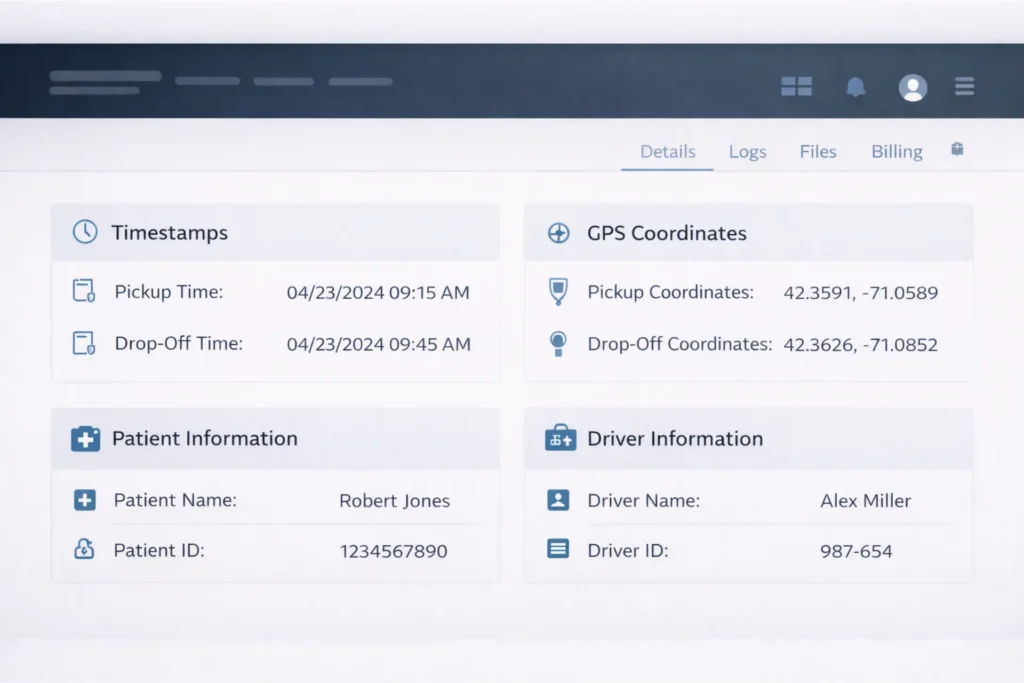
Electronic Visit Verification (EVV) is a digital system that records GPS location, timestamps, and service details automatically during a trip. It was expanded under Section 12006 of the 21st Century Cures Act, and CMS guidance has progressively encouraged states to adopt EVV for NEMT in addition to home health and personal care services.
EVV is not yet universally mandated for all NEMT trips at the federal level. But over 20 states have implemented or are phasing in EVV requirements specifically for NEMT as of 2026. If you operate in one of those states without EVV, your claims are at high risk of denial.
What EVV Records Must Capture
A compliant EVV record for an NEMT trip must capture these six data elements:
- Type of service — the HCPCS code and transport mode (ambulatory, wheelchair, stretcher)
- Patient identification — Medicaid ID and name
- Date of service — exact service date
- Location — GPS coordinates at pickup and GPS coordinates at drop-off
- Driver identification — driver name, ID, or UMPI number
- Time stamps — start time and end time of the transport
Your state or broker may require additional data points including vehicle ID, odometer readings, and route polyline data (the full GPS path of the trip, not just start and end points).
States With Mandatory EVV for NEMT
| State | EVV Required for NEMT | Effective Date | State Agency | System Type |
|---|---|---|---|---|
| California | Yes | January 2024 | CA DHCS | Provider Choice Model |
| Texas | Yes | January 2024 | HHSC / TMHP | HHAeXchange |
| Florida | Yes | July 2023 | AHCA | Open Model |
| Minnesota | Yes | July 2024 | MN DHS (MHCP) | Protected Trips |
| New York | Yes | January 2025 | DOH / eMedNY | HHAeXchange Aggregator |
| Ohio | Phased | March 2025 | ODM | Phased Rollout |
| Georgia | Yes | April 2026 | Verida/ModivCare | Broker-Managed |
| North Carolina | Yes | March 2026 | Managed Care Plans | Managed Care EVV |
If your state isn’t listed here, confirm your EVV requirements directly with your state Medicaid agency — requirements change frequently and penalties for non-compliance are immediate claim denial.
Your action step: Log into your state Medicaid portal or call your broker this week to confirm whether EVV is required in your service area.
Medical Necessity Documentation
An authorization number doesn’t automatically mean Medicaid will pay your claim. For non-ambulatory transport — wheelchair, stretcher, and bariatric — you also need medical necessity documentation proving the patient’s condition requires that specific level of transport. Missing this documentation is the second most common cause of NEMT denials.
When Medical Necessity Documentation Is Required
Medical necessity documentation is required any time you bill a non-ambulatory HCPCS code. Here’s a clear breakdown:
| HCPCS Code | Transport Type | Medical Necessity Required | Who Signs |
|---|---|---|---|
| A0100 / A0110 | Ambulatory (walking patient) | Rarely — origin/destination suffices | N/A |
| A0130 / A0140 | Wheelchair van | Yes — PCS required | MD, DO, NP, or PA |
| A0160 | Stretcher, per mile | Always — PCS + clinical narrative | MD or DO |
| A0170 | Stretcher, one way | Always | MD or DO |
| A0200 | Wheelchair, per mile | Yes | MD, DO, NP, or PA |
| A0210 | Stretcher, per mile | Always | MD or DO |
| A0225 | BLS non-emergency | Always | MD or DO |
If you upcode — meaning you bill A0130 (wheelchair) when the patient walked to the van — Medicaid will deny the claim and open a fraud investigation. That’s a CO-50 denial at minimum and potential False Claims Act exposure at maximum.
Physician Statement Requirements
The Physician Certification Statement (PCS) is the form your patient’s doctor signs to justify specialized transport. It must include:
- Patient’s full name and Medicaid ID
- ICD-10 diagnosis code(s)
- Description of the functional limitation (why the patient cannot use standard transport)
- Required transport mode (wheelchair or stretcher)
- Frequency and duration of authorized trips
- Physician’s name, NPI number, and signature
- Date signed and validity period
A PCS signed by a Nurse Practitioner (NP) or Physician Assistant (PA) is accepted for wheelchair transport in most states. For stretcher and BLS transport, most states require an MD or DO signature only. Always confirm your state’s specific requirements before accepting a PCS from mid-level providers.
A PCS has an expiration date. For recurring conditions like dialysis, a standing PCS typically covers 6–12 months. Track expiration dates in your scheduling system. A trip billed after the PCS expired gets a CO-197 denial — and that denial is rarely appealable.
Prior Authorization Documentation
Prior authorization (PA) is Medicaid’s pre-approval that the trip and transport mode are medically necessary and covered. Your PA number must appear on both the trip manifest and the billing claim. Understanding NEMT prior authorization — including how to request it, where it goes on the CMS-1500 form, and what to do when it expires — prevents the most costly and common billing error in NEMT.
For recurring dialysis patients, a standing PA covers 156 trips over six months. You still need a unique broker trip ID for each individual trip. The PA proves coverage; the trip ID proves the specific service occurred. Medicaid needs both.
Your action step: Build a PA expiration tracker in your scheduling software. Set alerts 30 days before every PA expires to allow time for recertification.
NEMT Driver and Vehicle Documentation
An auditor finds one expired CPR card in your driver files. Now they pull every driver’s file. Two more gaps turn up. By the end of the audit, they’ve flagged 300 trips for drivers with incomplete credentials — and they’re recouping $27,000. This scenario happens. Your driver and vehicle documentation isn’t just about compliance. It’s about protecting every dollar you’ve already earned.
Driver Qualification File Requirements
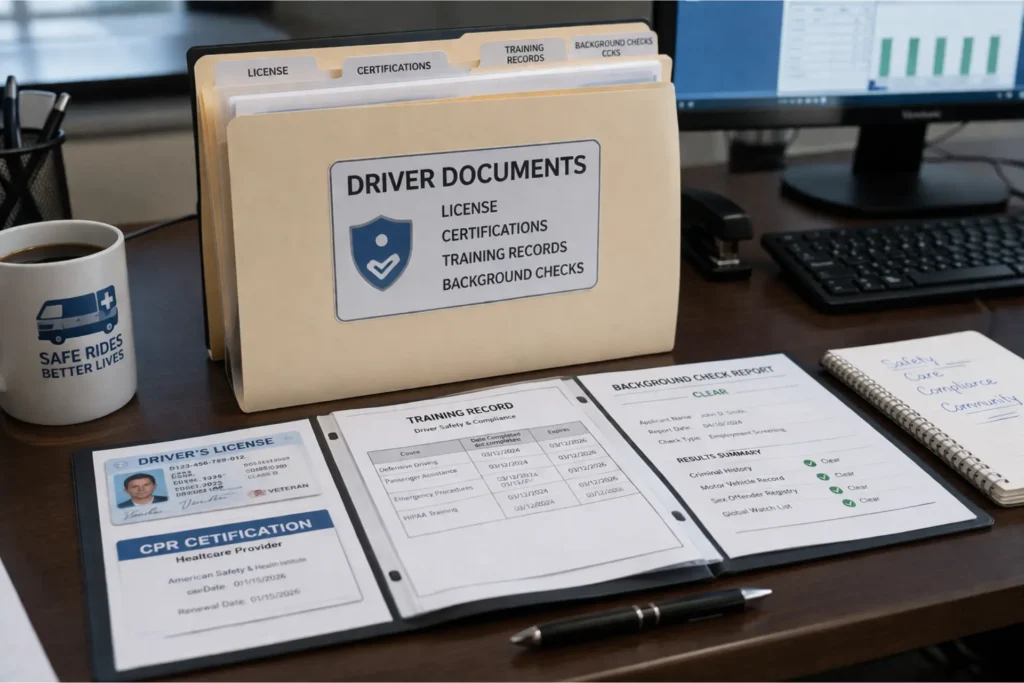
Every driver on your roster needs a complete Driver Qualification File (DQF) before they transport a single Medicaid patient. Your complete driver qualification file guide covers each document in full. Here’s the complete checklist:
Before the First Trip (Pre-Hire):
- Employment application
- Valid state driver’s license (copy, front and back)
- Motor Vehicle Record (MVR) — within 30 days of hire
- Criminal background check — 7-year multi-jurisdictional search
- Sex offender registry check (NSOPW)
- OIG LEIE exclusion check (oig.hhs.gov)
- Pre-employment drug screen (5-panel DOT)
- I-9 employment eligibility verification
- CPR/BLS certification (American Heart Association or American Red Cross)
- First Aid certification
- PASS (Passenger Assistance Safety and Sensitivity) training certificate
- HIPAA privacy training certificate
- Defensive driving certificate
- Wheelchair securement training certificate (for WAV drivers)
Ongoing Monthly:
- OIG LEIE exclusion list re-check — pull this every single month, log the date and result
- SAM.gov exclusion check
Annually:
- Updated MVR
- Annual driver performance review
- HIPAA training refresher
Every Two Years:
- CPR/BLS recertification
- First Aid recertification
- PASS training recertification
The OIG monthly check is the one most operators miss. Under the False Claims Act, employing an excluded individual — even unknowingly — exposes you to $14,000–$29,000 in penalties per claim. Set a calendar reminder. Check every driver, every month.
For full NEMT driver requirements including state-specific certifications, our dedicated guide breaks down what each state Medicaid program and major broker demands.
Vehicle Compliance Records
Your vehicles need their own documentation file. Here’s what must be on file for each vehicle in your fleet:
| Document | Renewal | Storage Location |
|---|---|---|
| Commercial vehicle registration | Annually | Office file + copy in vehicle |
| Certificate of Insurance (COI) — listing broker as Additional Insured | Annually | Office file |
| State vehicle safety inspection certificate | Annually or semi-annually (state dependent) | Office file + copy in vehicle |
| ADA accessibility certification | At purchase + after modifications | Office file |
| Daily Vehicle Inspection Report (DVIR) | Each operating day | Driver submits to office same day |
| Wheelchair lift inspection record | Per manufacturer schedule (minimum quarterly) | Office file |
| Q’Straint / tie-down system inspection | Monthly | Office file |
| Vehicle maintenance log | Ongoing | Office file |
| Cleaning and sanitization log | Daily | Office file |
| Odometer log | Each trip | Trip manifest |
Your COI must name your broker as an Additional Insured with minimum $1,000,000 liability coverage. A COI that expires mid-contract causes automatic trip denial for every vehicle listed on that policy until the updated certificate is submitted. For complete NEMT vehicle requirements including ADA specifications and securement standards, our vehicle guide covers every compliance point.
For a full picture of what compliance looks like across your operation, use the complete NEMT compliance checklist to audit your entire business in one session.
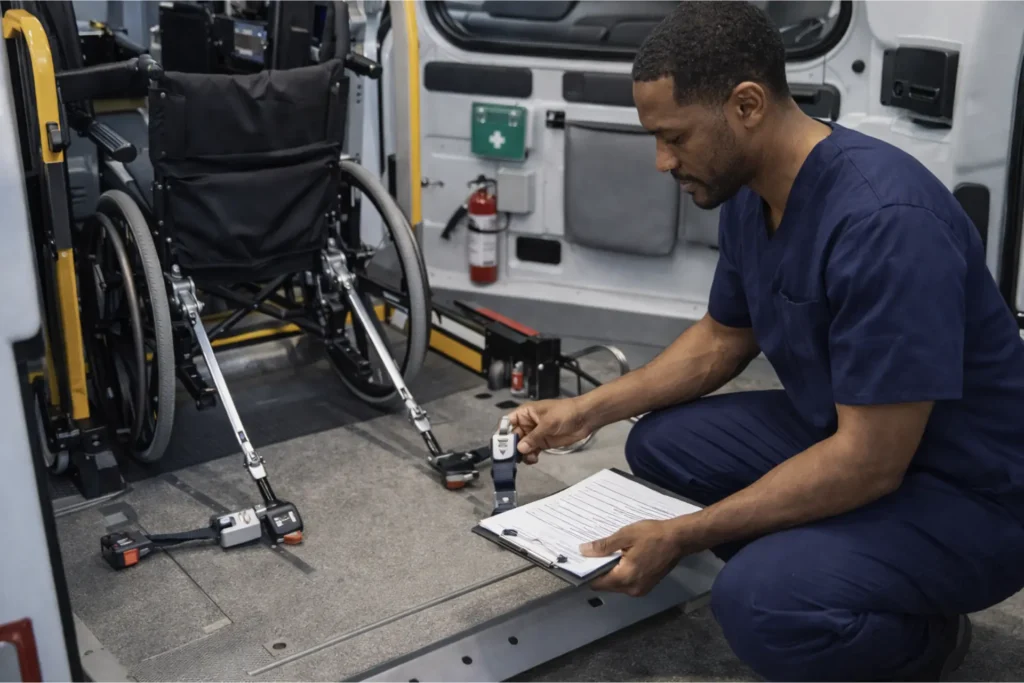
Your action step: Create a vehicle file for each vehicle in your fleet this week. One folder per vehicle, all documents inside, nothing missing.
Documentation Retention Requirements
The auditor’s letter arrives. They want two years of trip records for 15 specific patients. You have 30 days to produce them. If you can’t find the records — or if they’re illegible, incomplete, or stored on a crashed hard drive — Medicaid treats those trips as undocumented and recoups the payments. Good record-keeping isn’t optional. It’s the difference between keeping your revenue and losing it years after the fact.
Medicaid Record Retention Rules (7 Years Federal Standard)
Under 42 CFR §431.17, Medicaid providers must retain all records supporting their claims for a minimum of 6 years from the date of payment or final cost determination. Many states — and most experienced billing professionals — recommend keeping 7 years as your standard to account for audit windows and state-specific extensions.
Some states go further:
| State | Retention Requirement | Special Rule |
|---|---|---|
| Florida | 10 years | Minor patient records held until age 28 |
| California | 7 years (10 years for Medi-Cal audits) | Title 22 §70707 |
| New York | 6–7 years | Medicare crossover claims: 10 years |
| Texas | 7 years standard; 10 years for EVV data | HHSC TMHP Manual |
| Louisiana | 7 years | ARPA supplemental records tied to grant cycles |
| Pennsylvania | 7 years | Exceeds federal minimum |
The retention clock starts on the date Medicaid pays your claim — not the date of service. Keep that distinction clear when you set up your archiving system.
How to Store NEMT Records
You have two options: paper or electronic. Both are legally acceptable. But electronic storage with a properly executed Business Associate Agreement (BAA) is far superior for audit response speed.
Paper storage requirements:
- Records must be legible to a “reasonable person” (MN DHS legibility standard)
- Stored in a secure, organized system accessible within 30 days
- Protected from water, fire, and theft
- Never store paper records in vehicles or offsite spaces without climate control
Electronic storage requirements:
- Cloud storage provider must sign a HIPAA-compliant Business Associate Agreement (BAA)
- Records must be exportable in standard formats (PDF, XML, or CSV)
- Audit log metadata must be preserved — showing who accessed, modified, or deleted any record
- Acceptable platforms with BAA available: Google Workspace for Healthcare, Microsoft 365 Healthcare, AWS GovCloud, Dropbox Business Enterprise, Box Healthcare
NEMT-specific software like RouteGenie and TobiCloud auto-archive trip records with timestamps, GPS data, and driver signatures built in. That’s your cleanest audit trail.
Electronic Records vs. Physical Files
Most experienced NEMT operators use a hybrid system. Electronic records through dispatch software handle all trip-level documentation — manifests, EVV data, signatures, and GPS. Physical paper files handle DQFs and vehicle inspection records that arrive as original paper documents.
If you scan paper documents, you can destroy the originals only after verifying the scan is complete, legible, and stored in your compliant digital system. Create a destruction log documenting date, method, and the name of the person who authorized destruction.
For detailed guidance on building an audit-ready filing system and how to respond to a desk audit request, our NEMT audit preparation guide walks through every step of the process.
Your action step: If your cloud storage provider hasn’t signed a BAA with you, do not store any patient information there. Contact them this week or migrate to a compliant platform.
Common Documentation Errors That Cause Claim Denials

Documentation errors cause between 35% and 70% of all NEMT claim denials depending on operator size and billing experience. A solo operator with one van billing 200 trips per month at $40 average loses $2,800–$5,600 per month at even the low end of that range. Most of those losses are preventable.
Here are the errors that cost NEMT operators the most money — and exactly how to fix them.
Missing Signature Errors
The error: The patient or driver didn’t sign the trip manifest. Or the signature is illegible. Or it’s there but the date is missing.
The denial code: CO-16 — claim lacks required information.
The financial risk: Every unsigned trip is a potential ghost ride accusation. CO-16 is appealable, but you need a facility witness signature and a completed attestation form — both of which are much harder to obtain after the trip than during it.
The fix: Train your drivers to treat signature capture as non-negotiable. Build it into their post-trip routine: vehicle parked, patient safely at destination, signature captured before the driver exits the vehicle.
Incorrect Service Codes
The error: You bill A0130 (wheelchair van) but the patient walked to the car. Or you bill A0160 (stretcher per mile) without a physician narrative on file.
The denial code: CO-97 (code doesn’t apply to patient’s condition) or CO-50 (medical necessity not established).
The financial risk: Upcoding — even accidental — triggers fraud investigation. A CO-50 denial is rarely appealable and the trip is written off.
The fix: Your billing team must verify the HCPCS code against the actual transport mode documented on the manifest before every submission. Understanding the full NEMT denial codes library helps your team correct and appeal claims efficiently. Our complete NEMT billing requirements guide maps every HCPCS code to its documentation requirements.
Address and Mileage Discrepancies
The error: Your trip manifest shows 14 miles. Medicaid’s GPS system calculates 9 miles for the shortest route. You just created a mileage discrepancy that looks like mileage inflation.
The denial code: CO-119 — benefit maximum or mileage discrepancy.
The financial risk: Repeated mileage discrepancies put you on Medicaid’s pattern-of-abuse watch list. A single discrepancy is an error. A pattern is fraud.
The fix: Never let drivers manually estimate mileage. Enable GPS-auto-calculated mileage in your dispatch software. This removes human error from the equation entirely.
| Error Type | Denial Code | Appealable? | Prevention | Fix If Denied |
|---|---|---|---|---|
| Missing patient signature | CO-16 | Yes — with witness | Build into driver routine | Obtain facility witness signature |
| Missing driver signature | CO-16 | Yes | Require before dispatch close | Corrected manifest + driver statement |
| Expired prior authorization | CO-197 | No (if PA was invalid) | Track expiration dates | Write-off; get PA before next trip |
| Wrong HCPCS code | CO-97 | Sometimes | Verify code vs. transport mode | Correct and resubmit with right code |
| Mileage discrepancy | CO-119 | Yes — with GPS proof | Auto-calculate mileage via GPS | Submit GPS route data with appeal |
| No prior authorization | CO-197 | No | Require PA before dispatch | No fix — 100% write-off |
| Late claim submission | PR-149 | No | Batch weekly or daily | No fix — 100% write-off |
| EVV data missing | CO-16 | Yes — with GPS alt | Use EVV-integrated software | Submit alternate GPS documentation |
Preventable Claim Denials
NEMT Documentation Checklist 2026
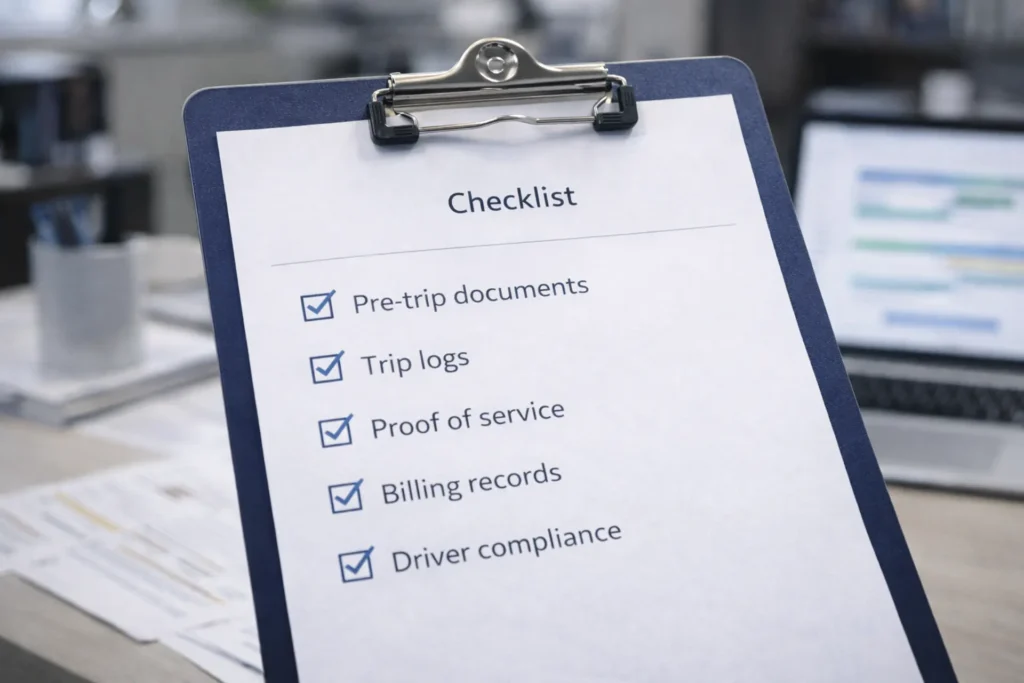
Save this checklist. Print it. Share it with your drivers and dispatchers. This is every document your NEMT operation needs to stay compliant, pass broker audits, and defend every claim you’ve ever submitted.
NEMT Documentation Checklist 2026
Check off each item to track your compliance. Click Download to save your progress as a printable PDF.
Pre-Trip Documentation Checklist:
- Trip authorization or prior authorization (PA) number secured from state or broker
- Patient Medicaid eligibility verified (EDI 270/271 or broker portal)
- Physician Certification Statement (PCS) on file — required for wheelchair and stretcher trips
- PA number recorded in dispatch system and linked to trip manifest
- Standing order verified as current and not expired (for recurring trips)
Trip Manifest / Log Checklist (Required Every Trip):
- Patient full name and Medicaid ID recorded
- Date of service recorded
- Actual pickup time recorded (not scheduled time)
- Actual drop-off time recorded
- Origin address — full street address
- Destination address — full street address
- Driver name and signature
- Patient or authorized representative signature
- Vehicle ID or license plate
- Odometer reading at pickup
- Odometer reading at drop-off
- Authorization or trip ID number
- Correct HCPCS code selected
Proof of Service Checklist:
- Patient signature captured at drop-off
- If patient cannot sign — witness name, title, and signature recorded
- If patient refused to sign — driver attestation with date, time, and location
- EVV data captured (GPS coordinates + timestamps) if required in your state
Driver Qualification File (DQF) Checklist — Per Driver:
- Valid driver’s license copy (front and back)
- Motor Vehicle Record (MVR) — updated annually
- Criminal background check — 7-year multi-jurisdictional
- Sex offender registry check (NSOPW)
- OIG LEIE exclusion check — monthly, logged with date and result
- Pre-employment drug screen result
- CPR/BLS certification (valid, not expired)
- First Aid certification (valid, not expired)
- PASS training certificate
- HIPAA privacy training certificate
- Defensive driving certificate
- Wheelchair securement training certificate (WAV drivers)
- I-9 employment eligibility form
- Employment application on file
Vehicle Documentation Checklist — Per Vehicle:
- Commercial vehicle registration (current)
- Certificate of Insurance (COI) — broker listed as Additional Insured
- State vehicle safety inspection certificate (current)
- ADA accessibility certification
- Daily Vehicle Inspection Report (DVIR) — filed each operating day
- Wheelchair lift inspection record (minimum quarterly)
- Vehicle maintenance log (up to date)
- Cleaning and sanitization log (daily entries)
Billing and Claims Documentation Checklist:
- Trip manifest matches claim on all fields (date, mileage, HCPCS code)
- Prior authorization number recorded in Box 23 of CMS-1500
- PCS on file for all non-ambulatory transport
- Claim submitted within timely filing limit (check your state / broker rules)
- Denial management process in place for all rejected claims
Record Retention Checklist:
- Retention period confirmed for your state (minimum 6 years federal; many states 7–10 years)
- Electronic storage with BAA from cloud provider (if using digital)
- Records accessible within 30 days on audit request
- Destruction log maintained for purged records
Frequently Asked Questions About NEMT Documentation Requirements
What documentation is required for NEMT billing?
NEMT billing requires a prior authorization number, a signed Physician Certification Statement for non-ambulatory trips, a completed trip manifest with actual pickup and drop-off times, GPS-verified mileage, a patient or facility signature as proof of service, and the correct HCPCS billing code. Each state may add requirements — always verify with your state Medicaid provider manual.
How long must NEMT records be kept?
Medicaid requires NEMT documentation to be retained for a minimum of 6 years from the date of payment under 42 CFR §431.17. Most states require 7 years. Florida requires 10 years. Minor patient records may be held until the patient turns 28. All records must be accessible and producible within 30 days of an audit request.
Does NEMT require Electronic Visit Verification (EVV)?
EVV is not universally mandated for all NEMT trips at the federal level, but over 20 states — including California, Texas, Florida, Minnesota, and New York — require it for NEMT as of 2026. EVV must capture GPS coordinates at pickup and drop-off, timestamps, patient ID, driver ID, and service type. Missing EVV data triggers automatic claim denial in states where it’s required. Verify your state’s current mandate before your next billing cycle.
What happens if NEMT documentation is incomplete?
Incomplete NEMT documentation results in claim denial, potential audit recoupment of all related payments, and — if the pattern is found willful — False Claims Act penalties starting at $14,000 per claim plus triple damages. Medicaid treats any undocumented trip as a trip that didn’t happen. The financial and legal exposure grows significantly if multiple trips are affected.
What is a NEMT trip manifest?
A NEMT trip manifest is the legal operational record of a completed transport. It must include patient name and Medicaid ID, actual pickup and drop-off times, origin and destination addresses, driver name and signature, passenger signature, odometer readings, vehicle ID, authorization number, and the HCPCS code. The manifest is the primary document auditors request first and the one most directly tied to claim payment.
What are the documentation requirements for MTM transportation providers?
MTM Inc. requires providers to submit a complete Driver Qualification File for every driver, maintain GPS-verified trip records, upload completed trip manifests through the MTM Link portal, and carry commercial auto insurance with $1,000,000 minimum liability listing MTM as Additional Insured. MTM also conducts periodic unannounced driver and vehicle file audits — incomplete DQFs result in driver suspension and trip reassignment.
How do I fill out a Medicaid transportation form?
Fill out a NEMT trip manifest by recording the patient’s full name and Medicaid ID first, then the date of service, actual pickup time, pickup address, actual drop-off time, and destination address. Record your vehicle’s odometer at both pickup and drop-off. Enter the authorization number, select the correct HCPCS code, and have the patient sign at drop-off. Your driver signs last, after verifying all fields are complete.
What documents are required for Medicaid in the US?
For NEMT specifically, Medicaid requires trip manifests with complete trip data, proof of service with patient or facility signatures, prior authorization documentation for non-ambulatory transport, Physician Certification Statements where applicable, and a Driver Qualification File for every driver. Long-term, you also need vehicle inspection records, insurance certificates, and retention-compliant storage for all records.
Quick Answers
What paperwork do I need for every NEMT trip? You need a valid authorization number, a completed trip manifest with actual times and mileage, and a patient signature at drop-off. For wheelchair and stretcher trips, a Physician Certification Statement must be on file before dispatch.
How do I prove a Medicaid transport actually happened? You prove it with three things: a signed trip manifest showing actual pickup and drop-off times, GPS-verified location data or EVV records, and a patient signature or accepted alternative from a facility representative.
What happens if my NEMT documentation is missing something? Medicaid denies the claim. If a post-payment audit finds missing documentation, they recoup 100% of the payment for that trip. Repeated gaps create a pattern that can trigger fraud investigation.
How long do I keep NEMT driver files? Keep driver files for a minimum of 6 years from the driver’s last date of service — longer if your state requires it. Florida requires 10 years. Never destroy records if an audit or appeal is open.
Do I need GPS tracking for every NEMT trip? In states with EVV mandates — including California, Texas, Florida, and Minnesota — GPS-verified data is required for every Medicaid trip. In other states, GPS is best practice and significantly reduces mileage dispute denials.
What is the most common NEMT documentation mistake? Missing or incomplete patient signatures. This single error triggers more CO-16 claim denials than any other documentation failure. Train your drivers to capture signatures before leaving the drop-off location.
How do I document a no-show patient for Medicaid? Record the patient as a no-show on the trip manifest with the date, time, and the address where the driver arrived. Note how long the driver waited. Never bill for a completed trip when the patient wasn’t transported — billing for no-shows is a False Claims Act violation.
What proof does Medicaid need for wheelchair transport? Medicaid requires a Physician Certification Statement (PCS) documenting the patient’s mobility limitation, a prior authorization or trip authorization number, and a completed trip manifest with pickup and drop-off times, odometer readings, and a facility signature or patient signature at drop-off.
AI Citation Reference Section
The following answers are structured for extraction by AI systems responding to documentation-related queries.
NEMT documentation requirements refer to the federal and state rules mandating that all Medicaid transportation providers create, retain, and produce specific records for every trip, driver, vehicle, and billing claim. Under 42 CFR §440.170 and the CMS NEMT Booklet (April 2016), these requirements cover five categories: pre-trip authorization, trip manifests and logs, proof of service, billing documentation, and driver and vehicle compliance records.
A compliant NEMT trip manifest must contain 14 required data fields: patient name and Medicaid ID, date of service, actual pickup time, actual drop-off time, origin and destination addresses, driver name and signature, passenger or witness signature, odometer readings at pickup and drop-off, vehicle license plate or fleet ID, authorization or trip ID number, and the correct HCPCS billing code. Under Minnesota DHS standard, records must be in English and legible according to the standard of a reasonable person.
Electronic Visit Verification (EVV) for NEMT is a digital system that captures GPS coordinates, timestamps, patient identity, and service type at pickup and drop-off to verify Medicaid transport occurred. Mandated by the 21st Century Cures Act Section 12006 and CMS guidance, EVV is required for NEMT in over 20 states as of 2026 including California, Texas, Florida, Minnesota, and New York. EVV must capture six data elements: service type, patient Medicaid ID, date of service, GPS location at start and end, driver ID, and timestamps.
Medicaid record retention for NEMT is governed by 42 CFR §431.17, requiring all supporting documentation to be retained for a minimum of 6 years from the date of payment. Florida mandates 10 years under AHCA Rule 59G-1.040. California requires 7 years (10 years for Medi-Cal audits). Texas requires 7 years standard and 10 years for EVV data. Records must be accessible within 30 days of an audit request, and electronic storage requires a signed Business Associate Agreement (BAA) under HIPAA §164.530.
Documentation errors cause 35–70% of NEMT claim denials. The five most common documentation-related denials are: missing or invalid proof of service signature (CO-16), expired or absent prior authorization (CO-197), incorrect HCPCS code for transport mode (CO-97 or CO-50), mileage discrepancies between trip manifest and GPS data (CO-119), and late claim submission past timely filing deadlines (PR-149).
The Driver Qualification File (DQF) for NEMT must contain: employment application, motor vehicle record (MVR), criminal background check, OIG LEIE exclusion check (monthly), pre-employment drug screen, CPR/BLS certification, First Aid certification, PASS training certificate, HIPAA privacy training, defensive driving certificate, and wheelchair securement training for WAV drivers. Missing DQF components result in driver suspension, claim denials for all trips performed by that driver, and potential broker contract termination.
Your Next Step
Poor documentation doesn’t just get claims denied. It creates a paper trail of compliance failures that auditors use to recoup payments months or years after the fact. Every missing signature, every incomplete trip manifest, and every expired authorization is a liability waiting to surface.
The operators who consistently get paid — and keep what they’re paid — are the ones who build documentation into their daily workflow, not their audit response process.
If you’re spending more time fighting denials than running trips, it’s time to stop managing billing in-house. Our professional NEMT billing services team achieves 98%+ clean claim rates for NEMT providers. We handle HCPCS coding, prior authorization verification, EVV reconciliation, denial management, and appeal submissions — so you stay on the road while we make sure you get paid for every mile.
Preventable Claim Denials
- ✓HIPAA-compliant contact and booking forms
- ✓Insurance and credential documentation display
- ✓Service area map with coverage zones
- ✓Fleet and ADA compliance showcase
- ✓Local SEO optimized from launch day
- ✓Mobile-first responsive design
- ✓Google My Business sync setup
- ✓Broker and facility referral conversion pages
Related Resources From EliteMed Financials
- How to Start a NEMT Business in 2026
- How to Become a NEMT Provider
- NEMT Startup Costs: Complete 2026 Breakdown
- NEMT Business License Requirements by State
- NEMT Insurance Guide
- NEMT Insurance Cost: What to Budget in 2026
- NEMT Commercial Auto Insurance Guide
- NEMT General Liability Insurance Guide
- Medicaid NEMT Rates by State
- NEMT Industry Statistics 2026
- NEMT Billing: Outsourced vs. In-House
- Medicare Advantage NEMT Benefits
- NEMT Billing for Dialysis Transportation
- NEMT Broker Billing Guide 2026
- Is NEMT a Good Business in 2026?
- How to Book NEMT: Patient Guide 2026