
Behavioral health practices often lose money well before the claim goes out — at the front desk, in the verification call, in the note that didn’t record session time, or in a credentialing file that was never activated with the payer. By the time the remittance returns with a denial code, the error is weeks old.
This guide covers how behavioral health billing works in 2026: what it is, who can bill, the intake-to-payment workflow, the codes you’ll touch most, documentation that survives payer review, carve-outs and prior authorization, telehealth rules, incident-to limits, current CMS guidance, and the denial patterns that quietly drain revenue.
Quick Answer: What Is Behavioral Health Billing?
Behavioral health billing is the revenue cycle process used to verify benefits, document care, code services, submit claims, post payments and resolve denials for mental health, substance use, developmental and behavioral treatment. It differs from general medical billing because payment frequently depends on documented session time, medical necessity narrative, payer carve-outs, prior authorization and active provider enrollment rather than on the procedure alone.
Key Takeaways
- Behavioral health benefits are frequently administered separately from medical benefits. The payer on the insurance card may not be the payer that processes the therapy claim.
- Many commonly billed behavioral health services, particularly psychotherapy, are time-based and documentation-sensitive. Not all are, which is why code selection has to follow the note.
- Licensure, credentialing and payer enrollment are three separate things. A clinician can be fully licensed and still be unbillable with a given plan.
- Authorization and medical necessity requirements vary widely by payer, plan, state, level of care and setting — especially for IOP, PHP, residential and SUD programs.
- Many preventable denials are created before submission, during intake, verification, authorization and documentation.
- 2026 brought real regulatory movement: the 42 CFR Part 2 compliance date passed on February 16, 2026, federal enforcement of the new provisions of the 2024 MHPAEA final rule remains paused while the underlying statute still applies, and Medicare’s in-person requirement for behavioral telehealth is currently deferred.
Table of Contents
What Is Behavioral Health Billing?
Behavioral health billing is the specialized revenue cycle process of verifying coverage, documenting care, coding services, submitting claims and collecting payment for treatment of mental health conditions, substance use disorders, developmental conditions and behavioral disorders.
The mechanics look familiar to anyone who has worked general medical billing — eligibility, authorization, coding, an 837P or 837I transaction, an ERA, a denial queue. What changes is where the revenue risk sits. In behavioral health, a large share of it lives upstream of the claim: whether the right administrator was identified, whether the authorization covered the units delivered, whether the clinician was enrolled on the date of service, and whether the note supports the code billed.
What Services Fall Under Behavioral Health Billing?
- Individual, family and group psychotherapy
- Psychiatric diagnostic evaluation and medication management
- Psychological and neuropsychological testing
- Brief behavioral and emotional screening
- Substance use disorder treatment, including medication-assisted treatment and opioid treatment programs
- Applied behavior analysis (ABA) for autism and related developmental conditions
- Intensive outpatient programs (IOP), partial hospitalization programs (PHP) and residential treatment
- Crisis intervention, crisis stabilization and mobile crisis services
- Community-based services such as psychosocial rehabilitation, targeted case management, peer support and assertive community treatment
- Behavioral Health Integration (BHI) and the psychiatric Collaborative Care Model (CoCM)
A solo therapy practice and a multi-site treatment center with IOP, PHP and residential levels of care sit in the same specialty but use different code sets, claim forms and payer contracts.
Why Behavioral Health Billing Is Different From General Medical Billing
In much of medicine the code describes a procedure. In behavioral health, the code frequently describes an amount of time spent doing something whose value has to be established in narrative form. That difference drives most of the operational complexity.
| Dimension | General Medical Billing | Behavioral Health Billing |
| Basis for code selection | Usually procedure, visit type or medical decision making | Many commonly billed services, especially psychotherapy, are time-based and documentation-driven |
| Payer routing | Usually processed under the medical benefit | Frequently routed to a managed behavioral health organization under a carve-out |
| Benefit verification | Confirming active coverage often covers most of the risk | Behavioral health benefits typically need separate verification |
| Authorization | Varies by service; often not required for routine visits | Common for higher levels of care and, with some plans, ongoing outpatient therapy |
| Documentation focus | Diagnosis, exam findings, procedure performed | Diagnosis, functional impairment, intervention, response, treatment-plan linkage, session time |
| Provider eligibility risk | Generally stable once credentialed | Turnover, associate-level clinicians and roster gaps create frequent enrollment denials |
| Compliance overlay | HIPAA and general payer rules | HIPAA, federal parity requirements, and 42 CFR Part 2 for SUD program records |
Behavioral Health Billing vs Mental Health Billing: Is There a Difference?
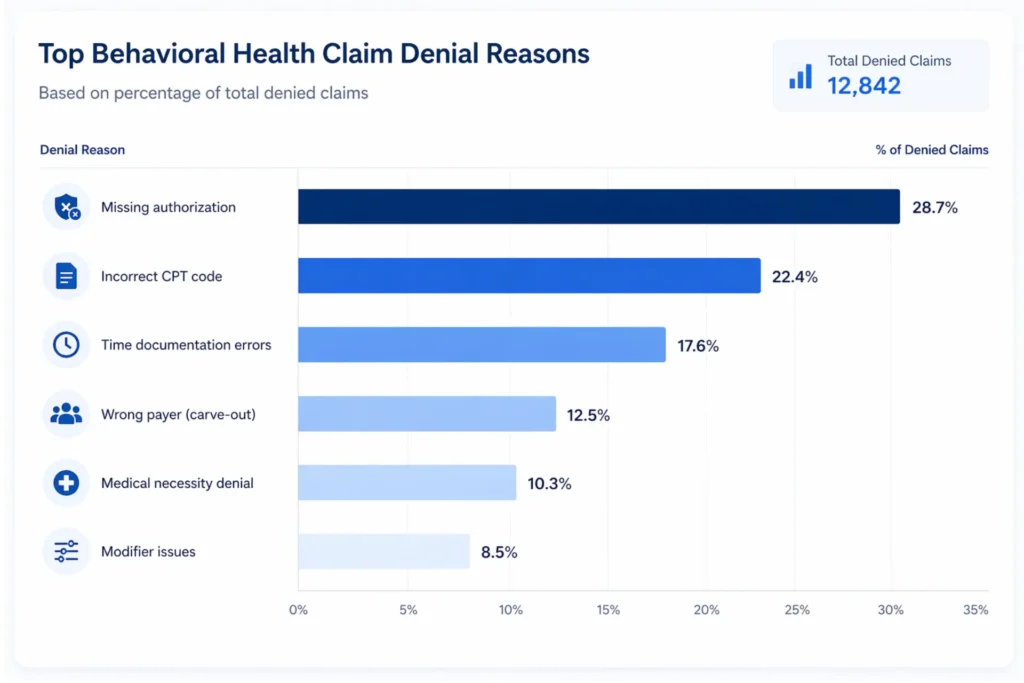
Yes. Behavioral health billing is the broader category. Mental health billing is a narrower subset covering psychotherapy, counseling, psychiatric evaluation and medication management. Behavioral health additionally covers substance use treatment, ABA, IOP, PHP, residential care, crisis services and community-based programs — which bring extra code sets, level-of-care authorization and additional compliance obligations.
The distinction starts costing money when a practice expands. Once a clinic adds SUD treatment, ABA or a program level of care, HCPCS H-codes, per diem billing, UB-04 claims, level-of-care criteria and separate payer contracts all come into play. Worth noting: payers themselves typically label the benefit category “behavioral health” even when the claim is for ordinary outpatient therapy, which is why a routine counseling claim can still route through a carve-out.
| Dimension | Mental Health Billing | Behavioral Health Billing |
| Scope | Psychotherapy, counseling, psychiatric evaluation, medication management | All of the above plus SUD, ABA, IOP/PHP, residential, crisis and community programs |
| Typical providers | Psychiatrists, psychologists, PMHNPs, LCSWs, LPCs/LMHCs, LMFTs | Those plus BCBAs, RBTs, SUD counselors, peer specialists and licensed programs |
| Code sets | Primarily CPT psychotherapy, evaluation and E/M codes | CPT plus HCPCS H-codes and S-codes, ABA codes, program per diems, facility revenue codes |
| Claim form | Usually CMS-1500 / 837P | CMS-1500 for professional services; UB-04 / 837I for many facility and program services |
| Payer routing | Medical plan or its behavioral division | More likely to involve a carve-out or MBHO with its own payer ID |
| Authorization | Often session-count or service-specific | Frequently level-of-care based, with concurrent review and reauthorization |
| Compliance | HIPAA and federal parity requirements | HIPAA, parity, plus 42 CFR Part 2 for SUD program records and state program rules |
If your practice provides therapy and psychiatric services only, our beginner’s guide to mental health billing covers most of what you need. If you bill SUD, ABA, IOP/PHP or residential care, you need the wider workflow below.
Who Can Bill for Behavioral Health Services?
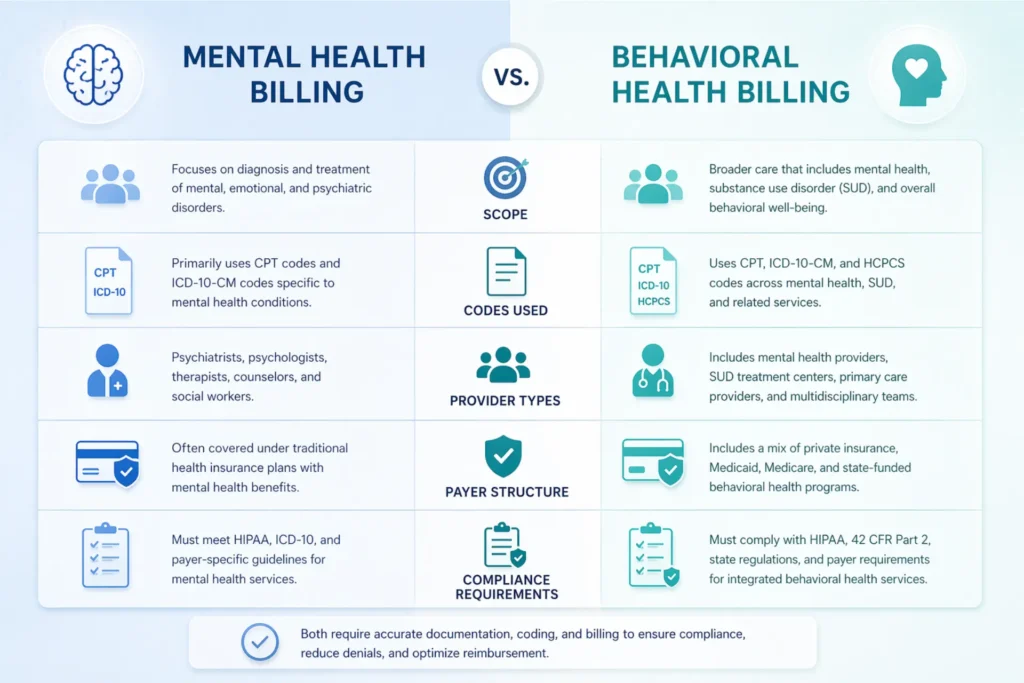
Behavioral health services can be billed by licensed clinicians and eligible organizations that are credentialed and enrolled with the specific payer, using the correct NPI and taxonomy, and operating within that payer’s rules for licensure, supervision, specialty and setting. Being licensed by the state is not the same as being billable.
Three terms get blurred together, and the confusion produces denials that look like coding problems but aren’t:
- Licensure — the state authorizes the clinician to practice.
- Credentialing — the payer verifies qualifications, license, malpractice coverage and work history.
- Enrollment or paneling — the payer activates the provider in its claims system, links them to a group contract and assigns an effective date.
A group being in network does not automatically make a newly hired clinician billable under that contract.
| Provider Type | Bills Independently? | Medicare | Practical Notes |
| Psychiatrist (MD/DO) | Yes | Generally eligible | Broadest scope: evaluation, E/M, medication management, psychotherapy add-ons |
| Clinical psychologist (PhD/PsyD) | Yes | Generally eligible | Psychotherapy and psychological/neuropsychological testing; covered services vary by setting |
| PMHNP | Yes, within scope | Generally eligible as an NP | Prescriptive authority and supervision requirements vary by state |
| LCSW / LICSW | Yes | Generally eligible | Widely recognized; still requires individual credentialing |
| LPC / LMHC | Yes when credentialed | Eligible to enroll and bill beginning January 1, 2024 | Provider-type eligibility and active enrollment are separate things |
| LMFT | Yes when credentialed | Eligible to enroll and bill beginning January 1, 2024 | Confirm the payer-recognized billing period before submitting |
| Pre-licensed / associate clinician | Usually not | Generally not independently | Highest-risk category; payer-specific supervision rules and often specific modifiers |
| BCBA / ABA provider | Payer dependent | Limited | Governed by the plan’s ABA benefit, authorization and supervision rules |
| SUD counselor (CADC/CAADC and similar) | Program and state dependent | Generally through a facility or program benefit | Often billable only under a licensed program with state-specific credentials |
| Group practice / clinic | Yes, as billing entity | Yes if enrolled | Needs a Type 2 group NPI plus each rendering clinician’s Type 1 NPI |
Three technical rules carry most of the weight. The Type 1 NPI identifies the individual who performed the service. The Type 2 NPI identifies the group receiving payment. The taxonomy code must match the clinician’s license, the NPPES record and the payer’s credentialing file — a mismatch alone can generate a specialty-eligibility denial.
Effective Dates and Retroactive Billing
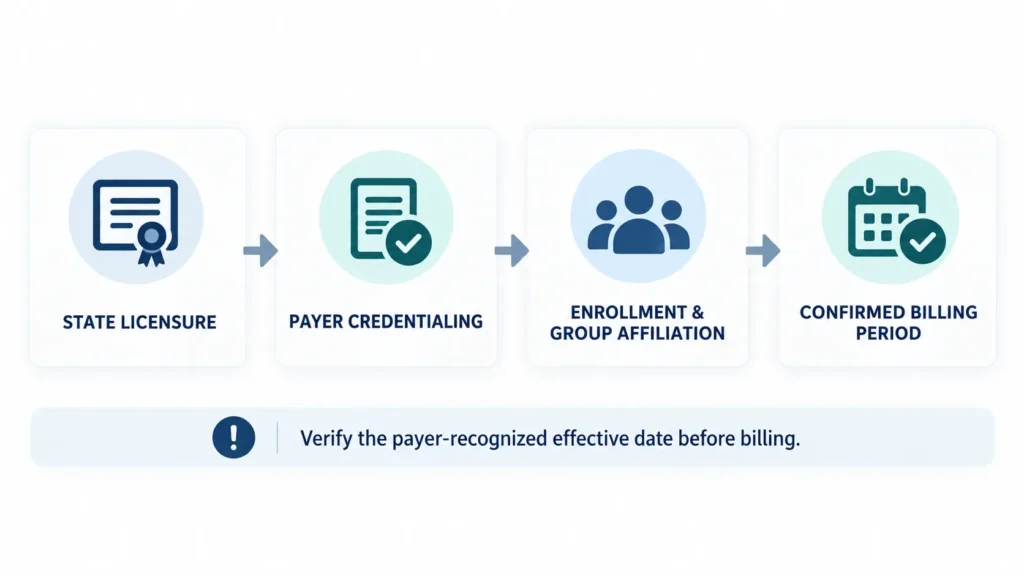
Credentialing delays raise a frequently misunderstood question: can you bill for services delivered while enrollment was pending? The answer is payer-specific, and it is not a flat no.
For Medicare, 42 CFR § 424.521 permits certain physicians, non-physician practitioners and their organizations to bill retrospectively for a limited period before the effective date of enrollment, subject to the conditions in that regulation. Commercial and Medicaid retroactivity varies widely — some plans backdate to the application or credentialing-committee date, some to contract execution, some allow none at all.
Verify the payer-recognized effective billing period in writing rather than assuming claims rendered during a credentialing delay are payable. Hold those claims, document what the payer confirmed, and release them once the period is established. Practices that treat pending enrollment as automatically billable often discover the problem near the timely filing deadline.
If credentialing is your bottleneck, our credentialing services for mental health providers cover enrollment, CAQH maintenance, roster updates and recredentialing. Practices billing under a group contract should also review mental health billing for group practices.
Behavioral Health Billing Workflow: Intake to Payment
The behavioral health billing workflow is the end-to-end sequence from scheduling through final payment: capture patient and insurance data, verify behavioral health benefits, identify carve-outs, secure authorization, confirm provider enrollment, document the encounter, code it, scrub and submit the claim, post payment, work denials and A/R, and report on results.
The key point: behavioral health billing starts at intake, not at coding. Front-desk errors resurface weeks later as denials, when correcting them costs far more than prevention.
The 14-Step Behavioral Health Billing Workflow
- Scheduling and intake. Demographics, insurance, consent and financial responsibility forms.
- Demographic and insurance validation. Name, date of birth, member ID, group number, subscriber relationship and payer ID against payer records.
- Behavioral health benefit verification. Active coverage and the behavioral benefit: deductible, copay, coinsurance, visit limits, authorization rules.
- Carve-out identification and payer routing. Who administers behavioral health, plus the correct payer ID and claims address.
- Prior authorization. Authorization number, service, date span, units, level of care, rendering provider and reauthorization deadline.
- Provider enrollment, NPI and taxonomy validation. Credentialed, linked to the group and effective on the date of service.
- Service delivery and clinical documentation. Diagnosis, medical necessity, interventions, response, session time where required, signature with credentials.
- Charge capture. Date of service, code, diagnosis, units and modifiers, with charge lag kept short.
- CPT/HCPCS and ICD-10-CM coding. Codes the note supports; where the code is time-based, documented time governs.
- Claim scrubbing. Review the CMS-1500 or 837P — or UB-04/837I for facility services — against the checklist below.
- Clearinghouse and payer submission. Read acceptance and rejection reports. A claim that dies at the clearinghouse never reaches the payer and won’t appear in aging.
- Payment posting and reconciliation. Allowed amount, payment, adjustment, denial reason, patient responsibility. Underpayments hide here.
- Denial and A/R follow-up. Bucket failures by root cause, correct or appeal within the deadline, work aging by bucket.
- Reporting and optimization. Clean claim rate, denial rate by payer and code, A/R days, charge lag, net collection rate.
For the broader end-to-end view, see our overview of mental health revenue cycle management.
The EliteMed Clean Claim Framework
Fourteen steps is accurate but hard to hold in your head on a busy Tuesday. EliteMed uses a five-move framework to keep behavioral health claims clean, and the order matters as much as the content:
| Step | What It Covers | What Breaks When It’s Skipped |
| 1. Verify | Eligibility, behavioral health benefit, carve-out routing, network status, authorization, provider enrollment | Wrong-payer denials, missing-authorization denials, provider-not-enrolled denials |
| 2. Document | Diagnosis, functional impairment, medical necessity, intervention, response, treatment-plan linkage, session time | Medical necessity denials, downcoding, recoupment after a records request |
| 3. Code | CPT/HCPCS selection, ICD-10-CM specificity, place of service, modifiers, units, diagnosis pointers | Time and code mismatches, modifier and POS errors, bundling denials |
| 4. Submit | Correct payer ID, complete claim fields, rendering and billing NPIs, taxonomy, authorization number, clean scrub | Front-end rejections, claims that never reach the payer, silent aging |
| 5. Track | Payment posting, denial root cause, appeal deadlines, A/R aging, payer trend analysis, underpayment review | Timely filing write-offs, repeat denials, revenue earned but never collected |
The framework’s value is sequence. A perfectly coded claim still denies if verification missed a carve-out, and a perfect verification is wasted if nobody works the denial. Each step protects the next. Later sections map back to it: carve-out failures are Verify problems, weak notes are Document problems, POS and modifier mismatches are Code problems, payer routing errors are Submit problems, unworked denials are Track problems.
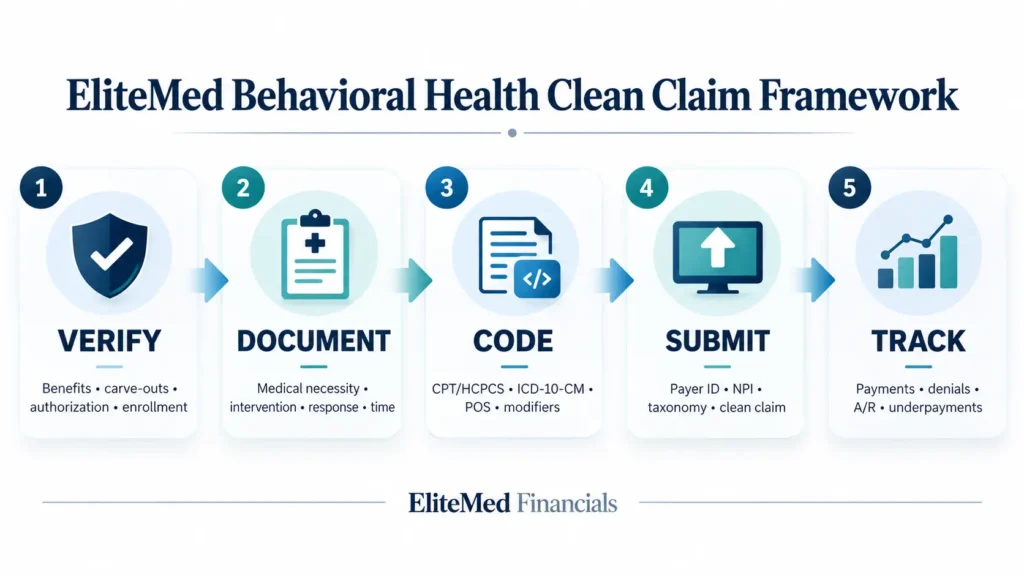
A one-page version of the Verify → Document → Code → Submit → Track framework, with the claim-field checks below, formatted for your billing team to work from.
Struggling with CMS Guidelines and Payer-Specific Rules?
EliteMed Financials handles behavioral health billing with full CMS compliance, correct modifier usage, and payer-specific rule enforcement — so your claims get paid the first time.
Behavioral Health Claim Scrubbing Checklist
| Claim Field / Area | What to Check | Behavioral Health Risk |
| Box 1a — Insured ID | Member ID matches payer records exactly, including alpha prefix | Front-end rejection |
| Patient demographics | Name, date of birth, address, subscriber relationship | Rejection before adjudication |
| Box 11 — Insurance details | Policy and group number, coordination of benefits | Wrong plan can mask a carve-out |
| Authorization number | Number, approved date span, units or visits remaining | Missing or expired authorization |
| Box 21 — Diagnosis codes | ICD-10-CM at highest available specificity | Must support medical necessity |
| Box 24A — Date of service | Matches the note, charge and authorization span | Denials and audit interest |
| Box 24B — Place of service | Office, home, telehealth or facility POS matches the encounter | Denial, or silently reduced payment |
| Box 24D — CPT/HCPCS and modifiers | Code matches the documented service; modifiers match payer policy | Time-based codes must match documented duration |
| Box 24E — Diagnosis pointer | Each line points to the supporting diagnosis | Valid service looks unsupported |
| Box 24G — Units / days | Correct units per code definition (session, 15 minutes, per diem) | Over-bill, under-bill or reject |
| Box 24J — Rendering NPI | Type 1 NPI of the clinician who performed the service | Provider-eligibility denial |
| Taxonomy | Matches license, NPPES and payer enrollment record | Specialty or eligibility denial |
| Box 33 — Billing provider | Group or solo NPI, tax ID and address match the enrolled entity | Payment delays, misdirected remittances |
| Claim payer ID | Correct payer or behavioral health administrator | Frequent behavioral health denial |
Practices that want this handled systematically can use our claim submission services for the front end and payment posting services for the back end, where underpayments first become visible.
Find Out How Much Revenue You’re Leaving on the Table
EliteMed Financials provides behavioral health billing, coding, denial management, and full RCM — with denial rates under 5% and first-pass resolution above 95%.
Stop guessing. Let our team audit your current revenue cycle and show you what you’re missing.
Common Behavioral Health Billing Codes
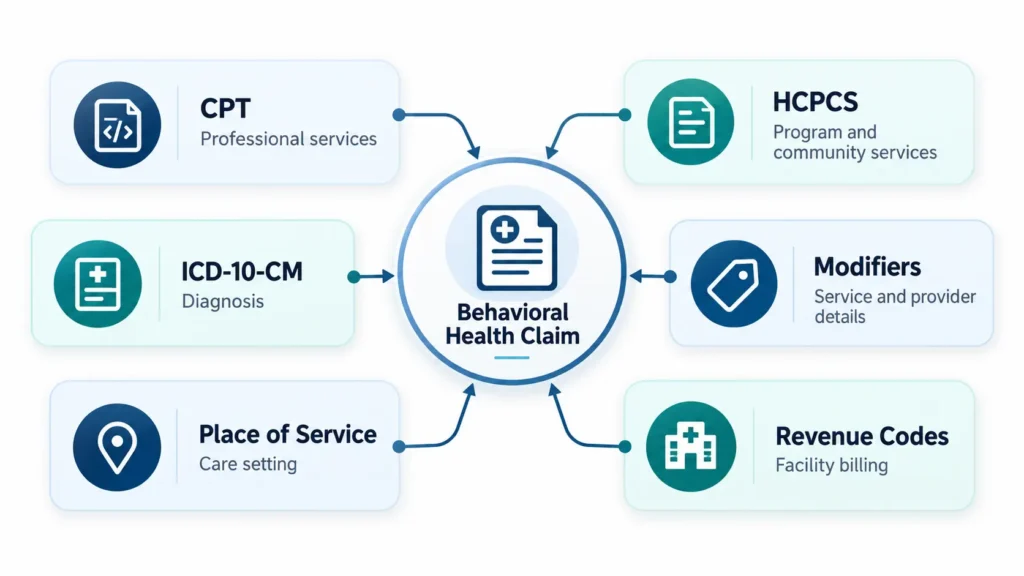
Behavioral health claims are built from CPT codes for professional services, HCPCS Level II codes for program and community-based services, and ICD-10-CM codes for diagnosis. Which set applies depends on the service, setting, provider type and payer.
What follows is an orientation, not a code reference. Time thresholds, bundling edits and payer rules change, so verify against the current CPT code set, your MAC’s guidance, your state Medicaid manual and each payer’s provider manual. For code-level detail, use our mental health CPT codes guide and our mental health billing codes reference.
Psychotherapy Codes
90832, 90834 and 90837 are among the most commonly used outpatient psychotherapy codes, and all three are selected by documented psychotherapy time:
- 90832 — psychotherapy, 30 minutes (generally 16–37 minutes)
- 90834 — psychotherapy, 45 minutes (generally 38–52 minutes)
- 90837 — psychotherapy, 60 minutes (generally 53 minutes or more)
The thresholds are not suggestions. A 50-minute session supports 90834, not 90837, and payers do request records on the higher-level code. Document time so your own auditor could defend it — start and stop times, or total time, consistent with payer and MAC requirements. “Approximately an hour” is what turns a legitimate session into a recoupment. 90785 (interactive complexity) is an add-on for specific communication factors, not a length modifier.
Psychiatric Evaluation Codes
90791 is a psychiatric diagnostic evaluation without medical services; 90792 includes them. Many payers limit how often an evaluation can be repeated, treat a new evaluation as appropriate only for a new episode of care, and apply edits preventing an evaluation and a psychotherapy code on the same date. Check the plan before re-billing an intake.
Psychotherapy Add-On Codes With E/M
When a prescriber provides both medication management and psychotherapy in one encounter, the E/M service is reported with a psychotherapy add-on: 90833 (30 minutes), 90836 (45 minutes) or 90838 (60 minutes). These are not billed alone, and the time counted toward the add-on must be separate from the time and work supporting the E/M level. Some payers require modifier 25 on the E/M line and some do not, so confirm the plan’s published policy rather than applying a house rule.
Family, Group and Crisis Codes
- 90846 — family psychotherapy without the patient present
- 90847 — family psychotherapy with the patient present
- 90853 — group psychotherapy, generally reported per participating patient
- 90839 / +90840 — psychotherapy for crisis, first 60 minutes and each additional 30 minutes
Crisis codes require documentation of an urgent, high-complexity presentation requiring immediate attention, not simply a difficult session. Group therapy generally requires an attendance record; family therapy notes should identify who participated and why family involvement was clinically indicated.
Behavioral Assessment and Psychological Testing
- 96127 — brief emotional or behavioral assessment using a standardized instrument
- 96130 / 96131 — psychological testing evaluation services, first hour and each additional hour
- 96132 / 96133 — neuropsychological testing evaluation services
- 96136–96139 — test administration and scoring by a qualified professional or technician
Testing codes are time-based and unit-based, and units must reconcile with documented administration and interpretation time. A frequent audit finding is a report describing hours of interpretation with no time record supporting the units billed.
Separately, the health behavior assessment and intervention family (96156, 96158/96159, 96164/96165, 96167/96168, 96170/96171) applies when the focus is behavioral factors affecting a physical health condition rather than a psychiatric diagnosis. These replaced the older 96150–96153 series, which is no longer valid.
Behavioral Health Integration and Collaborative Care
99484 covers general behavioral health integration care management. 99492, 99493 and +99494 cover psychiatric collaborative care management. G0323 covers general BHI performed by a clinical psychologist or clinical social worker under Medicare. These are monthly, team-based services with time-tracking and care-plan requirements, not per-visit codes.
A 2026 correction worth knowing
Several billing articles published in 2026 claim CPT 99492, 99493 and 99494 were “replaced” by HCPCS codes G0568, G0569 and G0570. That is not what CMS finalized. G0568–G0570 are optional add-on codes for behavioral health integration and collaborative care furnished alongside Advanced Primary Care Management, reported in the same month by the same practitioner as an APCM base code. They do not replace the standalone CoCM and BHI CPT codes. Confirm against the CY 2026 Physician Fee Schedule final rule before reconfiguring a charge master.
HCPCS H-Codes and S-Codes Used in Behavioral Health Programs
HCPCS Level II H-codes describe behavioral health and substance use services CPT does not cover well, particularly community-based, program-based and per diem services. They are used mainly by state Medicaid programs and Medicaid managed care organizations. S-codes are used mainly by commercial payers. Medicare generally does not recognize either set and uses its own structure.
| Code | Service (general description) | Typical Unit | Usually Recognized By |
| H0001 | Alcohol and/or drug assessment | Per encounter | Medicaid / MCO |
| H0002 | Behavioral health screening for admission to a treatment program | Per encounter | Medicaid / MCO |
| H0004 | Behavioral health counseling and therapy | Per 15 minutes | Medicaid / MCO |
| H0015 | Alcohol and/or drug services, intensive outpatient program | Per diem | Medicaid / MCO; some commercial SUD IOP |
| H0017 / H0018 / H0019 | Behavioral health residential treatment without room and board — hospital residential, short-term, long-term | Per diem | Medicaid / MCO; some commercial residential |
| H0031 | Mental health assessment by a non-physician | Per encounter or state-defined | Medicaid / MCO |
| H0032 | Mental health service plan development by a non-physician | Per encounter or per 15 minutes by state | Medicaid / MCO |
| H0035 | Mental health partial hospitalization, less than 24 hours | Per diem | Medicaid / MCO |
| H2011 | Crisis intervention service | Per 15 minutes | Medicaid / MCO / crisis systems |
| H2015 / H2017 | Comprehensive community support and psychosocial rehabilitation | Per 15 minutes | Medicaid / MCO |
| S9480 | Intensive outpatient psychiatric services | Per diem | Commercial payers |
| T1016 / T1017 | Case management and targeted case management | Per 15 minutes | Medicaid / MCO |
Three practical warnings. First, the national descriptor tells you what the code means, not how your payer pays it — unit definitions, daily maximums, staffing requirements and rates are set at the state Medicaid or plan level. Second, per diem does not mean one claim line per week; many programs must bill each service date separately with the correct units. Third, several of these codes require program licensure or certification the billing entity must hold on the date of service.
The broader H-code and S-code list, including peer support, wraparound, day treatment and ACT codes, is covered in our mental health billing codes reference. For code assignment and audit support, see our medical coding services.
Behavioral Health Modifiers
Modifiers do real work in behavioral health billing, particularly in Medicaid, where they often identify the program type, the credential level of the person delivering the service, or a state-defined level of care. HCPCS Level II modifier definitions are national; whether and how a payer requires them is not. The table covers the concepts you’ll meet most, not the full modifier set.
| Modifier | General Meaning | Why It Matters |
| HE | Mental health program | Separates mental health from SUD program billing |
| HF | Substance abuse program | Common on Medicaid SUD claims |
| HG | Opioid addiction treatment program | OTP and MAT program services |
| HA / HB | Child or adolescent program / adult program | Population-based program identification |
| HN / HO / HP | Bachelor’s, master’s or doctoral level rendering staff | Many state Medicaid programs pay different rates by credential level |
| HQ | Group setting | Group delivery of an otherwise individual service code |
| U1–U9, UA–UD | State-defined Medicaid levels of care | Meaning is set entirely by the state — check the state manual |
| 95 / 93 | Synchronous telemedicine via audio-video / audio-only | Standard telehealth modality identifiers for most payers |
| FQ | Service furnished using audio-only technology | Used in Medicare and certain program contexts |
| 25 | Significant, separately identifiable E/M service | May be required when an E/M is billed with a psychotherapy add-on |
| 59 / XU | Distinct procedural service | NCCI edit override where documentation supports separate services |
The U-series deserves specific caution: those modifiers mean whatever the individual state Medicaid agency says they mean, so never carry a convention from one state contract into another. Modifier GT is legacy for most payers — use it only where a payer still requires it.
Revenue Codes for Facility Behavioral Health Billing
Programs billing institutionally on a UB-04 or 837I claim pair each HCPCS or CPT code with a revenue code identifying the accommodation or service type. A wrong revenue code is a common reason a technically correct program claim still fails.
| Revenue Code | General Category |
| 0114 / 0124 | Psychiatric room and board — private and semi-private |
| 0513 | Clinic — psychiatric |
| 0900 | Behavioral health treatment services — general classification |
| 0905 / 0906 | Intensive outpatient services — psychiatric and chemical dependency |
| 0912 / 0913 | Partial hospitalization — less intensive and intensive |
| 0914 / 0915 / 0916 | Individual, group and family therapy |
| 0918 | Behavioral health — testing |
| 0944 / 0945 | Drug rehabilitation and alcohol rehabilitation |
For Medicare intensive outpatient claims, CMS instructs providers to identify the claim with condition code 92 and report revenue code 0905. Medicaid and commercial program requirements differ, which is why facility billing across a mixed payer panel usually needs a payer-by-payer billing matrix. A fuller revenue-code list sits in our billing codes reference.
ICD-10-CM Diagnosis Coding and Z Codes
Behavioral health diagnoses map from DSM-5-TR clinical criteria into ICD-10-CM codes, largely in the F chapter — F10–F19 for substance-related disorders, F20–F29 for schizophrenia spectrum, F30–F39 for mood disorders, F40–F48 for anxiety and stress-related disorders, F50 for eating disorders, and F80–F89 for developmental disorders including autism spectrum disorder.
Specificity matters. An unspecified code will often pay on a routine outpatient claim and then fail on a level-of-care authorization or medical necessity review because it doesn’t establish severity.
Z codes cause frequent confusion. Codes such as Z13.3x (screening for mental health and behavioral disorders) and the Z55–Z65 social determinant codes are valid ICD-10-CM codes, but “valid” and “payable as a primary diagnosis” are different questions. Many plans will not reimburse a behavioral health service billed with only a Z code as the primary diagnosis. Where the encounter genuinely is a screening, code it that way and expect preventive-service coverage rules to apply.
Is CPT 96127 a Behavioral Health Code?
Yes. CPT 96127 describes a brief emotional or behavioral assessment performed with a standardized instrument, including scoring and documentation, reported per instrument. It is a behavioral health screening code — not a psychotherapy code, not a diagnostic evaluation, and not a substitute for either.
The operative word is standardized. The code applies to validated instruments with published scoring — the PHQ-9, GAD-7, Vanderbilt ADHD rating scales, AUDIT-C, DAST-10, PCL-5, the Columbia Suicide Severity Rating Scale and the Edinburgh Postnatal Depression Scale are common examples. An intake questionnaire your practice wrote in-house does not qualify, however clinically useful it may be.
To bill it cleanly, documentation needs four elements: the instrument name, the raw score, the clinician’s interpretation, and the clinical action taken. Notes showing a completed form with no interpretation and no downstream decision are the ones that fail on review.
Reimbursement is where expectations need managing. Payer treatment of 96127 varies substantially. Some plans pay it separately. Some bundle it into a psychotherapy or evaluation code on the same date under National Correct Coding Initiative edits. Some cap units per date of service. Some limit which provider types may report it, which is why practices sometimes see the same screening paid for a physician or nurse practitioner and denied for a licensed therapist. Medicare publishes Medically Unlikely Edit values that change over time, so check the current MUE rather than working from a figure in a blog post.
A related distinction: Medicare covers G0444 for annual depression screening, up to 15 minutes, when CMS coverage requirements are met — including that the screening is furnished in an eligible primary care setting with staff-assisted depression care supports in place. It is a separate benefit from 96127, with different coverage conditions and frequency limits, so confirm which one fits the encounter and setting before selecting a code.
96127 is legitimate revenue for work many practices already perform, but it is not a line item to plan a budget around until you have confirmed how your payers handle bundling, unit limits, provider-type restrictions and modifier requirements.
Behavioral Health Billing Documentation and Medical Necessity
Behavioral health documentation has to demonstrate why the service was medically necessary, what clinical problem was addressed, what intervention was delivered, how the patient responded, how the session connects to the treatment plan, and — for time-based codes — how long the service lasted. Payers do not review notes to confirm a session happened. They review them to decide whether the service billed was supported.
This section is billing education, not clinical or legal advice. Documentation requirements vary by payer, state, provider type, setting and contract.
The Golden Thread
The most useful mental model for behavioral health documentation is a single logical line running through every note:
Diagnosis → functional impairment → intervention → patient response → treatment-plan linkage → next step
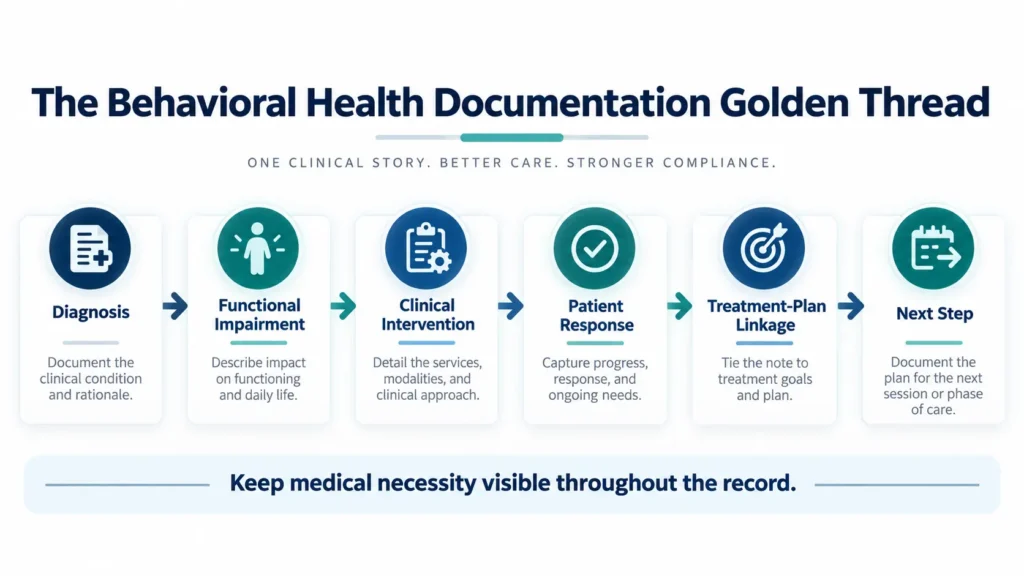
A diagnosis alone rarely establishes medical necessity. What establishes it is the connection between the diagnosis, the way the condition is impairing the patient’s functioning now, the specific clinical work performed, and evidence that the work is going somewhere.
What a Billing-Ready Note Should Support
- Patient identifier and date of service
- Service type, modality and place of service where relevant
- Session time for time-based codes, recorded consistent with payer and MAC requirements
- The diagnosis being treated in this session
- Presenting symptoms and current functional impairment
- The specific interventions used, named rather than implied
- The patient’s response to those interventions
- Progress toward measurable treatment-plan goals
- Risk assessment where clinically relevant
- Plan for follow-up, with provider signature, credentials and date
The difference in practice, illustrative rather than a universal payer standard:
Weak: “Client discussed anxiety. Supportive therapy provided. Will continue.”
Stronger: “Session 2:05–2:52 pm. Client reports continued panic symptoms affecting work attendance, with concentration difficulty and disrupted sleep four nights this week. Diagnosis: generalized anxiety disorder. Cognitive restructuring used to target catastrophic predictions about an upcoming performance review; client identified two distortions independently and reported anxiety decreasing from 7/10 to 4/10 within session. Addresses Treatment Goal #2, reduce anxiety-related avoidance and improve work functioning. No suicidal ideation or self-harm reported. Homework assigned: thought record, three entries. Next session 7/8.”
The second note supports the time, ties diagnosis to current symptoms, shows functional impact, names the intervention, records response, links to a goal and states risk status. Two habits create the most exposure: copy-forward notes that make every session look identical, and time entries that don’t match anything else in the chart.
For help standardizing note structure across a clinical team, see our patient documentation services; the privacy side is covered in our guide to HIPAA compliance for mental health billing.
Behavioral Health Insurance Verification, Carve-Outs & Prior Authorization
Behavioral health insurance verification means confirming active coverage, the behavioral health benefit specifically, carve-out routing, network status, patient cost share, visit limits and authorization requirements before treatment begins. Confirming that the plan is active is only the first of those checks, and on its own the least informative. A patient can hold active medical insurance and still have every behavioral health claim routed to a different organization with a different payer ID, provider network and authorization process.
What Is a Behavioral Health Carve-Out?
A behavioral health carve-out is an arrangement in which mental health and substance use benefits are administered separately from the medical benefit, usually by a managed behavioral health organization such as Optum, Carelon or Magellan. Carve-outs create claim-routing risk because the medical payer printed on the insurance card may not be the entity that adjudicates the behavioral health claim. A therapy claim sent to the medical carrier under a carve-out can deny as not covered by that payer, even though the patient has good coverage.
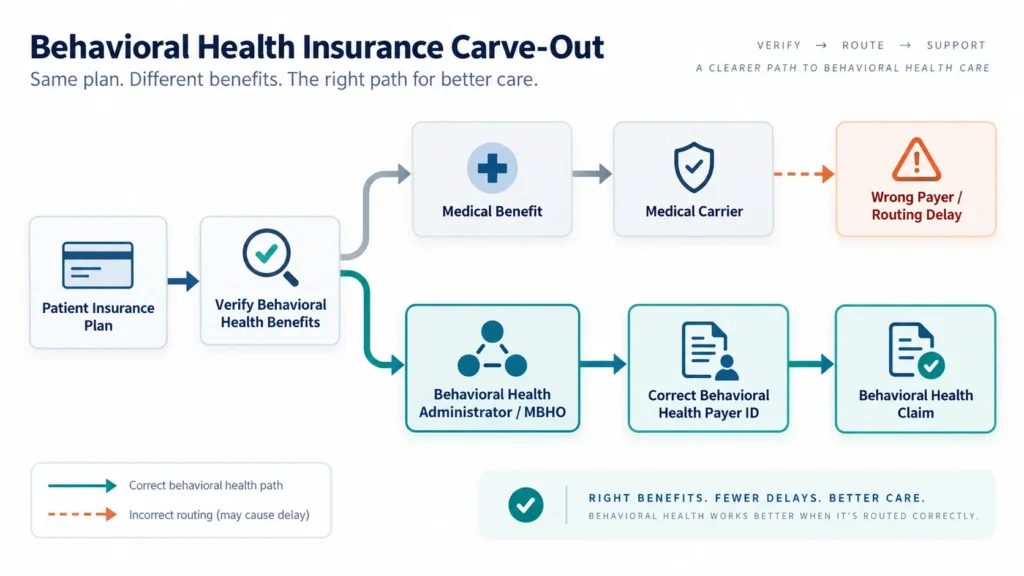
Carve-outs also affect network status independently: a practice can be in network on the medical side and out of network with the behavioral health administrator under the same insurance brand, which produces reduced payments and patient balance disputes long after the episode ended. Not every plan uses a carve-out — commercial plans are the most likely to, Medicare has relatively low carve-out risk, and Medicaid varies by state and managed care plan. Verify per patient, per plan.
Behavioral Health Verification Checklist
| Checkpoint | Why It Matters | Revenue Risk If Missed |
| Active coverage for the exact date of service | Coverage lapses, changes and retroactive terminations happen | Inactive-coverage denial |
| Behavioral health benefit specifically | Behavioral benefits can differ from medical benefits within the same plan | Non-covered-benefit denial |
| Carve-out / MBHO routing | Determines the correct payer ID and claims address | Wrong-payer denial and lost time before resubmission |
| Network status with the behavioral administrator | In-network medically does not mean in-network behaviorally | Out-of-network reduction, balance-billing exposure |
| Deductible, copay and coinsurance | Determines what to collect and when | Uncollected patient balances that age into write-offs |
| Visit or session limits | Many plans cap covered visits per year or benefit period | Exceeded-limit denial mid-treatment |
| Prior authorization requirements | Common for IOP, PHP, residential, SUD and some outpatient therapy | Missing-authorization denial with limited appeal traction |
| Approved units, date span and level of care | Authorization is specific, not open-ended | Services delivered outside approved parameters |
| Reauthorization window and concurrent review dates | Program authorizations expire or exhaust mid-episode | Lapsed-authorization denial for an active admission |
| Rendering provider listed on the authorization | Some authorizations are tied to a specific clinician | Denial when a different clinician delivers the service |
Two habits pay for themselves. Document every verification call — date, representative name, reference number, covered services, cost share, authorization status and routing instructions. When a payer later disputes what you were told, the reference number is what carries weight. And re-verify whenever the payer, plan, level of care, rendering provider or treatment frequency changes, not just at intake.
One more point worth saying plainly: authorization is not a guarantee of payment. It confirms medical necessity at a point in time. The claim still has to be coded correctly, delivered by an enrolled provider and supported by documentation.
If your team is confirming active coverage but not separately confirming the behavioral health benefit and its claim routing, that gap produces denials before a claim is ever submitted. Our insurance eligibility verification service is built around this front-end check.
Telehealth Behavioral Health Billing
Telehealth behavioral health claims commonly fail for four reasons: a place of service code that doesn’t match where the patient actually was, a modifier that doesn’t match the modality used, audio-only billing to a payer that doesn’t cover it, or missing documentation of location, consent and modality.
The core mechanics for most payers:
- POS 10 when the patient is in their home; POS 02 when at another telehealth location.
- Modifier 95 for synchronous audio-video; modifier 93 for synchronous audio-only where accepted.
- Modifier FQ for audio-only in Medicare and certain program contexts.
- Modifier GT only where a specific payer still requires it.
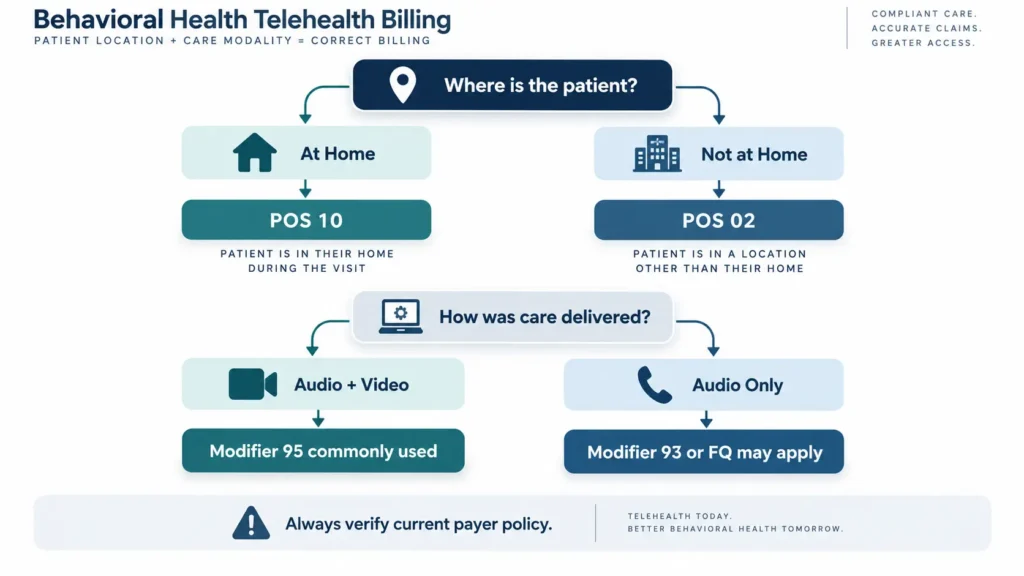
The POS choice is not cosmetic. Under many fee schedules the home-based and non-home telehealth place-of-service codes pay at different rates. An incorrect POS may not generate a denial at all — it quietly pays less, which is the hardest kind of revenue loss to detect because nothing flags it in the denial report.
Two rules hold across nearly every payer: document the patient’s physical location at the time of service, and document whether the encounter was audio-video or audio-only. For time-based psychotherapy codes, time documentation requirements do not relax because the session happened on a screen.
Medicare treats behavioral health telehealth more generously than most other specialties. Behavioral and mental telehealth services can be furnished to patients in their homes without geographic restriction, and audio-only is permitted in defined circumstances. The statutory in-person visit requirement has been deferred by legislation; according to HHS’s Medicare telehealth payment policy resource, an in-person visit within six months of the initial service and annually thereafter is not required through December 31, 2027. These dates have moved repeatedly, sometimes with days of notice, so confirm the current CMS position before building scheduling rules around them.
Commercial and Medicaid telehealth policies vary independently of Medicare, and behavioral health carve-outs sometimes set telehealth rules that differ from the medical plan under the same brand. For the full breakdown of setup, consent, documentation and payer-by-payer reimbursement, see our guide to telehealth mental health billing.
Incident-to Behavioral Health Billing and Supervision
Incident-to billing is a limited, payer-specific Medicare mechanism under which certain services delivered by auxiliary personnel may be billed under a supervising practitioner when defined requirements are met. It is not a general-purpose method for billing associate, pre-licensed or uncredentialed clinicians under someone else’s NPI.
This is where practices create the most retrospective risk, usually with good intentions. A clinic hires a capable associate, credentialing takes months, and someone suggests billing the sessions under the supervising psychiatrist “for now.” Claims pay. Payment is not evidence the arrangement was compliant, and recoupment can reach back years.
What Incident-to Billing Means
Incident-to is a Medicare concept covering services and supplies furnished incident to a practitioner’s professional services (see CMS guidance on incident-to services and supplies). It contemplates services delivered as an integral part of a practitioner’s care, under the required level of supervision, in a qualifying setting, as part of a plan of care the billing practitioner established. Requirements differ by service type and setting, and Medicare has established distinct supervision provisions for certain behavioral health services delivered by auxiliary personnel.
One 2026 change matters: in the CY 2026 Physician Fee Schedule final rule, CMS made real-time audio-video communication a permanent way to satisfy the “immediate availability” element of direct supervision for most incident-to services beginning January 1, 2026. That eases a logistical constraint. It does not loosen other requirements, and it does not create a supervision pathway where a payer’s contract requires individual credentialing.
Rendering vs Supervising vs Billing Provider
- Rendering provider — the clinician who actually delivered the service.
- Supervising provider — the practitioner responsible for supervision and the plan of care, where payer rules permit supervisory billing.
- Billing provider — the individual or organization submitting the claim and receiving payment.
These are separate claim fields for a reason, and conflating them is how audit findings begin. Many payers now require the rendering provider’s individual NPI on behavioral health claims regardless of any supervision arrangement.
When Incident-to May and May Not Apply
Incident-to arrangements are more likely to be defensible when the setting, service, supervision level, plan of care and documentation all satisfy the payer’s published requirements, and when the rendering clinician’s role is documented contemporaneously. They are least defensible when used as a workaround.
Behaviors that create audit and recoupment exposure: billing every associate clinician’s sessions under one licensed provider’s NPI by default; using supervision to bridge a credentialing delay where the contract requires each clinician to be credentialed; assuming Medicare’s framework applies to commercial or Medicaid plans; omitting the rendering NPI where required; and supervisory attestations copy-pasted across hundreds of notes.
Why Payer and State Rules Must Be Verified
Incident-to is primarily a Medicare construct. Commercial plans and state Medicaid programs set their own rules, and many do not recognize the concept at all — some explicitly prohibit billing supervised services under a supervisor’s NPI. State scope-of-practice and supervision laws apply independently and are not waived by a payer’s willingness to pay a claim. Confirm the payer’s written policy before billing any supervised service, confirm whether the rendering NPI is required, document the supervision relationship and plan of care, and when the answer is unclear, credential the clinician rather than improvising — see who can bill for behavioral health services.
CMS Behavioral Health Billing Guidelines
CMS guidance sets the Medicare compliance baseline for behavioral health billing and is a useful federal reference point for how coverage, documentation and supervision requirements are typically framed. It is not a substitute for your commercial and Medicaid contracts — those payers set their own policies, and each must be verified independently.
Medicare Provider Eligibility
Medicare Part B recognizes psychiatrists, clinical psychologists, clinical social workers, nurse practitioners, physician assistants and clinical nurse specialists for behavioral health services. Mental health counselors (including LPCs and LMHCs) and marriage and family therapists became eligible to enroll and bill Medicare beginning January 1, 2024 under the Consolidated Appropriations Act, 2023.
Provider-type eligibility and active enrollment remain separate. Providers enroll through PECOS and receive an effective date; limited retrospective billing may be available under 42 CFR § 424.521 for applicable circumstances, subject to that regulation’s conditions. Non-physician practitioners are generally paid at a percentage of the Physician Fee Schedule amount, which affects margin planning for practices building out associate-level staffing.
2026 Telehealth Considerations
Medicare’s behavioral health telehealth position in 2026 is comparatively favorable: home as an originating site, no geographic restriction for behavioral and mental telehealth services, and audio-only permitted in defined circumstances. The statutory in-person visit requirement has been deferred; HHS’s telehealth policy resource currently indicates it is not required through December 31, 2027. This authority has been extended in short increments, has briefly lapsed and has been restored retroactively, so check current CMS guidance quarterly.
Documentation Requirements
Medicare’s coverage expectations for psychiatry and psychology services are largely set through Local Coverage Determinations and billing and coding articles published by the Medicare Administrative Contractors. Those documents are authoritative for your jurisdiction and are not identical across MACs. The recurring themes: a specific diagnosis, documented symptoms and functional impairment, a treatment plan with measurable goals, interventions and patient response recorded per session, periodic plan review, and time documentation where the code is time-based — start and stop times or total time, in the manner your MAC and payers require.
Medicare Intensive Outpatient Program Coverage
Medicare established a distinct intensive outpatient program benefit effective January 1, 2024 under the Consolidated Appropriations Act, 2023. IOP is payable in hospital outpatient departments, community mental health centers, federally qualified health centers, rural health clinics and opioid treatment programs, subject to each setting’s rules.
Operationally, CMS instructs providers to report condition code 92 to identify intensive outpatient claims and revenue code 0905 when billing IOP services, with appropriate HCPCS or CPT codes from CMS’s published service lists and at least one primary-list service on the claim for payment. Physician certification is required, and Medicare distinguishes IOP from partial hospitalization by weekly service intensity. Note the cross-payer effect: the same clinical IOP may bill under H0015 for a Medicaid patient, S9480 for a commercial patient, and the condition-code-92 structure for Medicare. One program, three billing configurations.
MHPAEA and Mental Health Parity in 2026
The Mental Health Parity and Addiction Equity Act requires that group health plans and issuers apply treatment limitations to mental health and substance use disorder benefits no more restrictively than they apply them to comparable medical and surgical benefits. That statutory obligation is in force.
The regulatory picture is more complicated than most billing articles acknowledge, and it matters if you are considering a parity argument in an appeal. In a May 2025 joint statement, the Departments of Labor, Health and Human Services and the Treasury announced they would not enforce the 2024 MHPAEA final rule, or pursue enforcement actions based on a failure to comply occurring before a final decision in the pending litigation, plus an additional eighteen months. That relief applies only to portions of the 2024 rule that are new relative to the 2013 final rule. The Departments stated that MHPAEA’s statutory obligations, as amended by the Consolidated Appropriations Act, 2021 — including the requirement that plans prepare and document comparative analyses of nonquantitative treatment limitations — continue to have effect.
The practical takeaway: parity remains a legitimate basis for challenging a plan’s behavioral health restrictions, and the NQTL comparative analysis obligation still exists. What has changed is the federal enforcement posture toward the newer 2024 regulatory requirements specifically. Frame appeals around the statute and the plan’s own documented criteria rather than the 2024 rule, and check the Departments’ current guidance before relying on any specific provision.
42 CFR Part 2 in the 2026 Compliance Environment
42 CFR Part 2 is a separate federal confidentiality framework governing records of substance use disorder patients created by federally assisted SUD programs. It operates alongside HIPAA with its own consent, disclosure, redisclosure and enforcement requirements rather than functioning as an extension of it.
The 2024 final rule aligned several Part 2 requirements more closely with HIPAA while retaining Part 2-specific obligations, and carried a compliance date of February 16, 2026, which has now passed. The operationally significant changes: a single patient consent can cover treatment, payment and health care operations going forward rather than requiring consent for each disclosure; HIPAA breach notification requirements apply to Part 2 records; and Notices of Privacy Practices must be updated to include required Part 2 language. HHS’s Office for Civil Rights announced a civil enforcement program for Part 2 in February 2026 and began accepting complaints. See the HHS fact sheet on the 42 CFR Part 2 final rule.
For billing operations this matters in three places: consent documentation must be current before SUD information moves to a payer or billing vendor, business associate arrangements need to reflect Part 2 obligations, and the prohibition on using Part 2 records in legal proceedings without consent or a court order still applies.
Behavioral Health Billing Denials, Rejections & Revenue Leakage
A rejection happens before adjudication — the clearinghouse or the payer’s front-end edits stop the claim for missing or mismatched data, and it can be corrected and resubmitted without an appeal. A denial happens after the payer has adjudicated the claim and refused payment, requiring correction, appeal, or a write-off decision. Revenue leakage is earned money you never collect: unworked denials, missed filing deadlines, unrecognized underpayments and A/R that ages past usefulness.
The useful operational insight: many behavioral health denials originate before the claim is submitted. They are created at intake, verification, authorization, credentialing and documentation, and become visible weeks later. Much of what gets called denial management is really prevention.
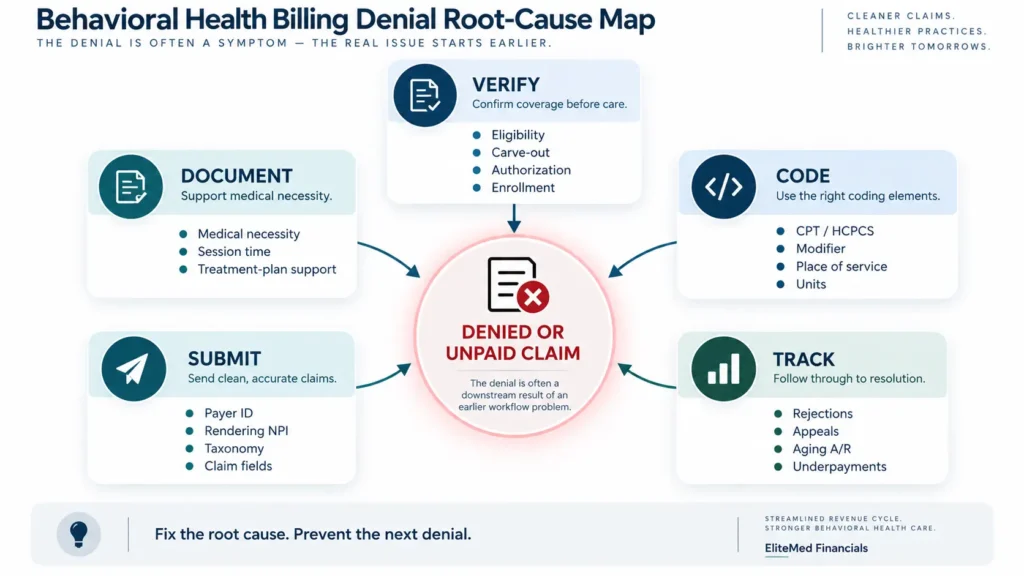
| Failure Point | What It Looks Like | Framework Stage | Prevention |
| Eligibility | Coverage inactive on the date of service, or behavioral benefit never verified | Verify | Check eligibility for the exact DOS, not the scheduling date |
| Wrong payer / carve-out | Therapy claim sent to the medical carrier instead of the behavioral administrator | Verify | Identify carve-out routing at intake and store the correct payer ID |
| Prior authorization | Service delivered after approved units or the date span expired | Verify | Track units and expiry dates with alerts |
| Credentialing / enrollment | Rendering provider not active with the payer on the date of service | Verify | Confirm the payer-recognized billing period before the first insured session |
| NPI / taxonomy | Group NPI submitted without the rendering NPI, or taxonomy mismatch | Submit | Validate identifiers against NPPES and the payer’s file |
| Medical necessity | Note doesn’t establish impairment, intervention or progress | Document | Enforce the golden thread in the note template |
| Code and time mismatch | Code requires more documented time than the note supports | Code | Code from the note, never from the appointment length |
| Telehealth POS / modifier | Modifier 95 with the wrong POS, or audio-only billed as audio-video | Code | Match modality, modifier, POS and documentation |
| Bundling edits | Two services billed on one date the payer considers inclusive | Code | Check NCCI edits; support overrides with real documentation |
| Timely filing | Claim or appeal not worked before the deadline | Track | Work denials on a daily cadence with deadline-driven escalation |
Denial Codes You’ll See Often in Behavioral Health
| Code | General Meaning | Typical Behavioral Health Cause |
| CO-4 | Procedure code inconsistent with the modifier, or a required modifier is missing | Telehealth modifier mismatch, missing program or credential modifier |
| CO-8 | Procedure code inconsistent with the provider type or specialty | Taxonomy mismatch, or a code the provider type isn’t eligible to bill |
| CO-11 | Diagnosis inconsistent with the procedure | Diagnosis pointer error, or a Z code that doesn’t support the service |
| CO-16 | Claim lacks information required for adjudication | Missing authorization number, rendering NPI or required field |
| CO-27 | Expenses incurred after coverage terminated | Eligibility not re-verified for the date of service |
| CO-29 | Time limit for filing has expired | Claim stuck at the clearinghouse or a rejection nobody worked |
| CO-50 | Not deemed medically necessary by the payer | Documentation doesn’t establish impairment or progress |
| CO-97 | Service included in the allowance for another adjudicated service | Bundling edits, add-on billed without its base code |
| CO-109 | Claim not covered by this payer or contractor | Carve-out routing error — send to the behavioral administrator |
| CO-185 / CO-B7 | Rendering provider not eligible to perform or be paid for the service | Credentialing or enrollment not active on the date of service |
| CO-197 | Precertification, authorization or notification absent | Missing, expired or exhausted authorization |
Denial codes tell you what the payer decided, not why your process failed. Two claims can both return CO-197 for different operational reasons — one because nobody requested authorization, another because units ran out mid-episode. Categorize by root cause, not by reason code, and track patterns by payer, rendering provider, CPT code and cause. Our guide to preventing and appealing mental health billing denials covers appeal construction and reason-code troubleshooting in more depth.
Skip the Learning Curve — Let Specialists Handle Your Billing
Instead of training staff on behavioral health coding, let EliteMed’s certified billing team handle it. We know every CPT code, modifier, and payer rule in this specialty — so you can focus on patient care.
Mental Health Billing Services →Behavioral Health Billing Best Practices
- Verify eligibility and behavioral health benefits before every visit, with enough lead time to resolve surprises.
- Identify carve-out and MBHO routing at intake and store the correct payer ID in the patient record.
- Confirm authorization before services begin, and track approved units, date spans and reauthorization deadlines with alerts.
- Confirm credentialing, enrollment and the payer-recognized billing period before a new clinician’s first insured session.
- Document session time clearly for time-based codes, in the format your payers and MAC require.
- Link every note to diagnosis, impairment, intervention, response and treatment-plan goals.
- Code from the documentation, not from the appointment slot or last week’s claim.
- Validate telehealth POS, modality and modifiers against what actually happened in the session.
- Scrub claims before submission using a behavioral-health-specific checklist, and read clearinghouse rejection reports daily.
- Review denials weekly by payer, provider, code and root cause, and fix causes rather than individual claims.
Behavioral Health Billing KPIs Worth Tracking
| KPI | What It Measures | Why It Matters in Behavioral Health |
| Clean claim rate | Share of claims accepted without rework | The clearest measure of front-end quality |
| Denial rate by payer | Denials grouped by payer or administrator | Surfaces carve-out and payer-specific rule problems |
| Denial rate by CPT/HCPCS | Denials grouped by service | Isolates documentation, time and bundling gaps by code |
| Denial rate by rendering provider | Denials grouped by clinician | Distinguishes a documentation issue from a credentialing issue |
| A/R days | Average time from billing to collection | Direct measure of cash flow health |
| Charge lag | Days between service and claim submission | Long lag usually means notes aren’t closing on time |
| Authorization compliance rate | Share of authorized services delivered within approved parameters | Program-heavy practices lose significant revenue here |
| Net collection rate | Collected revenue as a share of collectible revenue | The broadest measure of revenue cycle performance |
Deliberately absent: target percentages. Benchmarks vary by payer mix, service line and state Medicaid environment. Track your own trend line and compare it to itself.
Behavioral Health Billing Training and Skills
Behavioral health billing training should build competence in the code sets, payer rules and workflow logic specific to this specialty. Generic medical coding curricula spend most of their time on surgical, procedural and E/M coding, which leaves the highest-risk areas of behavioral health untouched.
The competencies that determine whether a team can run a behavioral health revenue cycle:
- Time-based CPT logic — psychotherapy thresholds, add-on codes with E/M, and how documentation supports code selection
- HCPCS Level II — H-codes and S-codes, and how state Medicaid defines units and program requirements
- ICD-10-CM specificity and appropriate use of Z codes
- Modifier fluency — program, credential-level and telehealth modifiers, and the fact that usage is payer-specific
- Benefit verification and carve-out identification
- Prior authorization management — units, date spans, level-of-care criteria, concurrent review, reauthorization
- Documentation and medical necessity review — reading a note the way an auditor would
- Denial and appeal work — reason codes, root cause categorization, appeal construction and deadlines
- Annual update tracking — ICD-10-CM each October 1, CPT each January 1, plus quarterly HCPCS updates and Physician Fee Schedule rules
Coding roles generally benefit from a recognized certification such as the CPC or CCS-P; billing and A/R roles often weight payer experience more heavily. For practice owners, the practical question is whether your team has real exposure across the payers you actually bill — a certified coder without behavioral health payer experience will still miss carve-out routing and level-of-care authorization issues. Where that gap is expensive to close internally, specialized support is usually faster than building the capability from scratch.
Software vs In-House vs Outsourced Behavioral Health Billing
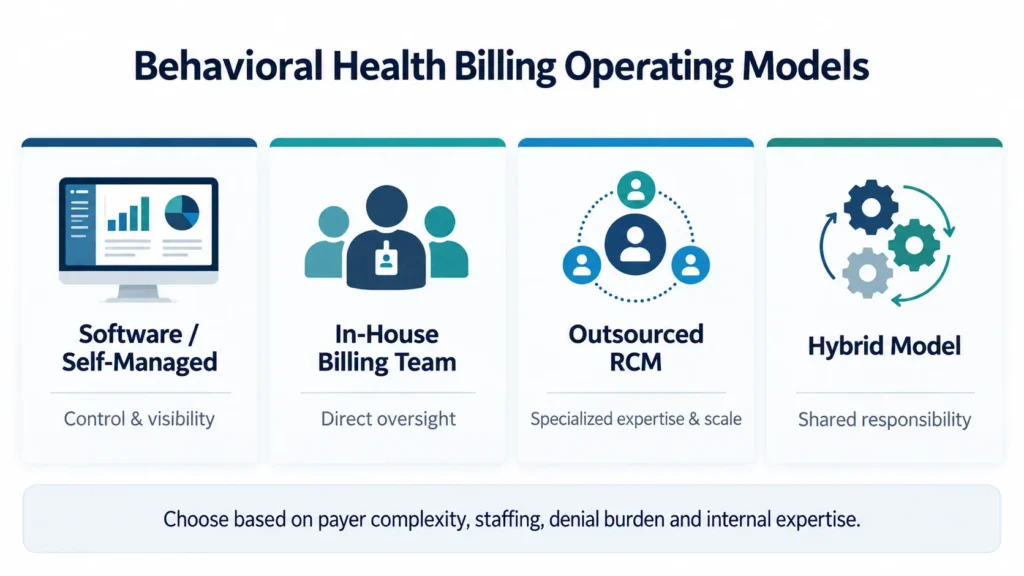
Billing software automates claim production and reporting, an in-house team gives direct control and institutional knowledge, and outsourced revenue cycle management brings specialized payer expertise and capacity. The right choice depends on payer complexity, denial rate, authorization burden, staffing stability and how much oversight you want to keep internally.
Evaluating this on monthly price is a mistake. Software transmits claims; it does not resolve a bundling denial, argue a level-of-care appeal or notice that a state Medicaid plan changed a unit definition. In-house teams provide control but carry hiring, training and coverage burdens — and in a specialty this narrow, one resignation can take years of payer knowledge with it. Outsourcing shifts the staffing burden and can add payer-specific expertise, but you still need reporting visibility and vendor accountability.
| Model | Best Fit | Strength | Limitation |
| Software / self-managed | Smaller practices with a simple payer mix and internal billing capability | Control, real-time visibility, lowest direct cost | Requires internal expertise the software does not supply |
| In-house billing team | Larger, stable organizations that can staff and supervise properly | Direct oversight and institutional knowledge | Hiring, training, turnover and coverage risk |
| Outsourced RCM | Complex payer mixes, program-based services, growth or staffing gaps | Specialized expertise and capacity that scales | Requires careful vendor selection and reporting discipline |
| Hybrid | Mid-size practices that want front-end control | Keep scheduling and verification in house, outsource claims, denials and A/R | Requires clear ownership of each handoff |
Practical Decision Triggers
Rather than a revenue threshold, look at these signals:
- Denial rate trending up rather than down, quarter over quarter.
- A/R over 60 and 90 days growing even though charges are steady.
- One person handles eligibility, coding, submission, posting, denials and A/R alone.
- New clinicians joining faster than credentialing is completed.
- Adding Medicaid, SUD, ABA, IOP/PHP or telehealth service lines.
- Claims paid but consistently underpaid, with nobody checking against contracted rates.
- The same payer denying the same code repeatedly with no isolated cause.
Any one of these is manageable. Two or three at once usually means revenue is already leaking. For the economics and vendor evaluation side, see our guides on mental health billing services cost, outsourcing mental health billing, and how to choose a mental health billing service.
Frequently Asked Questions
What is behavioral health billing?
Behavioral health billing is the process of verifying benefits, documenting care, coding services, submitting claims, posting payments and resolving denials for mental health, substance use, developmental and behavioral treatment. It is more complex than general medical billing because payment often depends on documented session time, medical necessity, payer carve-outs, prior authorization and active provider enrollment.
How is behavioral health billing different from mental health billing?
Behavioral health billing is the broader category. Mental health billing focuses on psychotherapy, counseling, psychiatric evaluation and medication management. Behavioral health additionally covers substance use treatment, ABA, IOP, PHP, residential and community-based programs, which introduce HCPCS H-codes, per diem billing, facility claims, level-of-care authorization and 42 CFR Part 2 obligations.
What codes are commonly used for behavioral health billing?
Common CPT codes include 90791 and 90792 for evaluations, 90832, 90834 and 90837 for individual psychotherapy, 90846 and 90847 for family therapy, 90853 for group therapy, 90839 and 90840 for crisis, 96127 for brief screening, and 99484 plus 99492–99494 for integrated care. Program and community services frequently use HCPCS codes such as H0004, H0015, H0032, H0035, H2011 and S9480. The right code depends on the service, documented time, provider type and payer.
Who can bill for behavioral health services?
Licensed clinicians who are credentialed and enrolled with the specific payer, plus eligible group practices and licensed programs. Psychiatrists, psychologists, PMHNPs, LCSWs, LPCs/LMHCs and LMFTs are commonly recognized. State licensure alone does not make a clinician billable — credentialing and enrollment must be complete, and the payer-recognized billing period should be confirmed before submitting claims.
What is a behavioral health insurance carve-out?
A carve-out is an arrangement where mental health and substance use benefits are administered separately from medical benefits, typically by a managed behavioral health organization such as Optum, Carelon or Magellan. The payer on the insurance card may not be the entity that processes the behavioral health claim, so claims sent to the medical carrier can deny as not covered by that payer.
Why are behavioral health claims denied?
Frequent causes include unverified behavioral health benefits, wrong-payer routing under a carve-out, missing or expired prior authorization, credentialing and enrollment gaps, NPI or taxonomy mismatches, documentation that doesn’t support medical necessity, time and code mismatches, telehealth POS and modifier errors, and missed timely filing. Many are created before the claim is submitted.
Does behavioral health billing require prior authorization?
Often, yes — particularly for IOP, PHP, residential treatment, SUD services and, with some plans, ongoing outpatient therapy beyond a set number of visits. Requirements vary by payer, plan and state. Authorization may be session-based, date-limited or tied to a level of care and rendering provider, and approval does not guarantee payment.
What is the behavioral health billing workflow?
The workflow runs from intake through payment: scheduling, insurance validation, behavioral health benefit verification, carve-out identification, prior authorization, provider enrollment validation, clinical documentation, charge capture, coding, claim scrubbing, submission, payment posting, denial and A/R follow-up, and reporting. EliteMed condenses it into five moves — Verify, Document, Code, Submit, Track.
Should a behavioral health practice outsource billing?
It depends on payer complexity, denial trend, authorization burden and staffing stability rather than practice size. Practices with a simple payer mix and low denial rates often do well with software plus internal oversight. Practices adding Medicaid, SUD, ABA or program levels of care, or where one person carries the entire revenue cycle, usually benefit from specialized support.
Improve Your Behavioral Health Revenue Cycle
Behavioral health billing rarely fails at the claim. It fails earlier — at intake, at benefit verification, at carve-out routing, at authorization, at credentialing, and in the note. By the time a denial arrives, the error is usually weeks old and more services have been delivered under the same broken assumption.
That is why sequence matters more than any single tactic. Verify before the visit. Document so the note defends the code. Code from what’s in the record. Submit to the right payer with complete claim data. Track every denial to a root cause instead of a reason code. Practices that build accuracy into the front end submit cleaner claims, spend less time appealing, and collect more of what they have already earned.
Behavioral Health Billing, Coding, Credentialing & Full RCM
EliteMed Financials
We serve behavioral health practices nationwide with HIPAA-compliant billing, certified coding, provider credentialing, denial management, and complete revenue cycle management. Your claims. Our expertise.
Sources and Further Reading
Regulatory and coding statements in this guide were verified against the following sources. Payer, state and program rules change; verify current requirements before applying anything here to a specific claim.
- Centers for Medicare & Medicaid Services — CY 2026 Medicare Physician Fee Schedule Final Rule fact sheet
- Centers for Medicare & Medicaid Services — MLN Matters MM13222: Condition Code 92 and IOP billing requirements
- Centers for Medicare & Medicaid Services — Incident To Services and Supplies
- Code of Federal Regulations — 42 CFR § 424.521, retrospective billing periods
- U.S. Department of Health and Human Services — Medicare telehealth payment policies
- U.S. Departments of Labor, Health and Human Services, and the Treasury — Statement regarding enforcement of the MHPAEA final rule
- U.S. Department of Health and Human Services — 42 CFR Part 2 final rule fact sheet
- CMS Medicare Coverage Database — Local Coverage Determinations and billing and coding articles for psychiatry and psychology services in your MAC jurisdiction
- Your state Medicaid agency’s behavioral health provider manual and fee schedule, and each payer’s current provider manual
This guide is educational and does not constitute clinical, legal, coding or compliance advice. Coverage, coding and documentation requirements vary by payer, plan, state, provider type, setting and date of service.