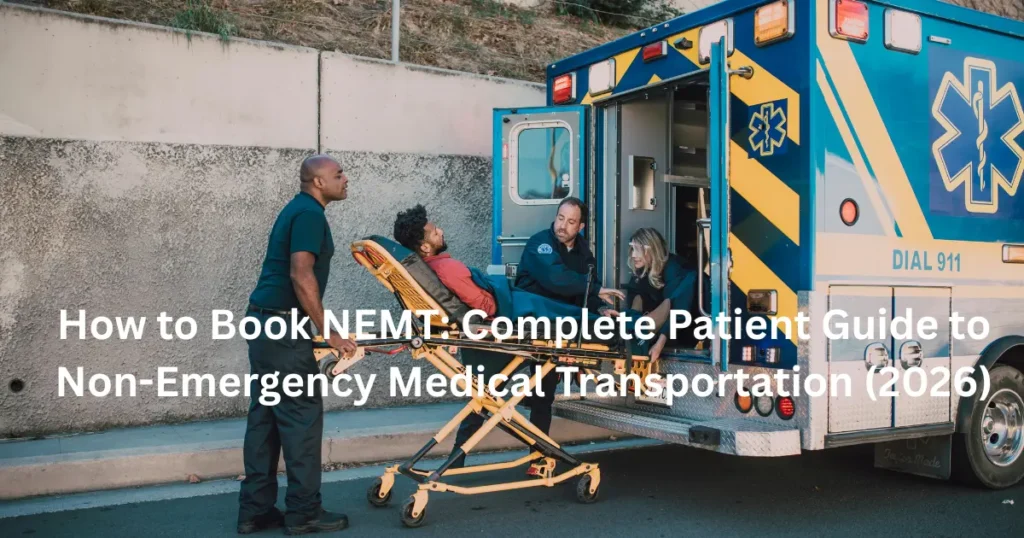
An NPI number (National Provider Identifier) is a unique 10-digit number issued by CMS through the NPPES registry to identify healthcare providers — including NEMT companies — in all HIPAA-covered transactions. Required since May 23, 2007, your NPI is mandatory for Medicaid billing, broker credentialing, and claims submission in non-emergency medical transportation.
You just landed your first Medicaid transport contract. The broker sends you an onboarding packet, and right there on page one: “Enter your NPI number.” You stare at the form. NPI? You’ve got your LLC paperwork. You’ve got insurance. You’ve got vehicles. But nobody mentioned an NPI.
If that scenario sounds familiar, you’re not alone. Most NEMT startup owners hit this wall somewhere between registering their business and actually getting paid. And here’s the frustrating part — without an NPI number, you can’t bill Medicaid billing, you can’t complete NEMT credentialing with transportation brokers like MTM or ModivCare, and you can’t submit a single claim.
That 10-digit number is the key that unlocks everything.
This article breaks down exactly what an NPI number is, who needs one, and how it directly affects your ability to run a profitable NEMT operation. No jargon dumps. No vague “consult your state” cop-outs. Just clear, actionable answers from the billing and credentialing team at EliteMed Financials — we’ve walked hundreds of NEMT providers through this exact process.
Let’s get into it.
Table of Contents
NPI Number Definition: What It Is and How It Works
NPI stands for National Provider Identifier. In plain English, it’s a permanent 10-digit number that identifies you — or your NEMT company — within the U.S. healthcare system. Think of it like a Social Security number, but for healthcare providers.
The Centers for Medicare & Medicaid Services (CMS) issues NPI numbers through a system called NPPES — the National Plan and Provider Enumeration System. You apply online at nppes.cms.hhs.gov, and the number is free. No annual fee, no renewal cost, no hidden charges.
Here’s what matters for NEMT providers specifically: your NPI is “intelligence-free.” That means the number itself doesn’t carry any information about your state, specialty, or business type. It’s just a unique identifier. If you move from Texas to Georgia, your NPI stays the same. If you change your company name, your NPI stays the same.
The NPI became mandatory on May 23, 2007 under HIPAA’s Administrative Simplification provisions. Before that, every insurance plan used different provider ID numbers — Medicaid had one format, Medicare had another, and private insurers each had their own system. The result was a billing mess. The NPI fixed that by creating one standard identifier across every payer in the country.
For NEMT companies, this means one number goes on every claim you submit, every enrollment application you complete, and every broker credentialing form you fill out. When you apply for your NPI as an NEMT provider, you’ll select taxonomy code 343900000X — that’s the classification for Non-Emergency Medical Transport (Van). This code tells the system what kind of provider you are, and it gets linked to your NPI record in the NPPES registry.
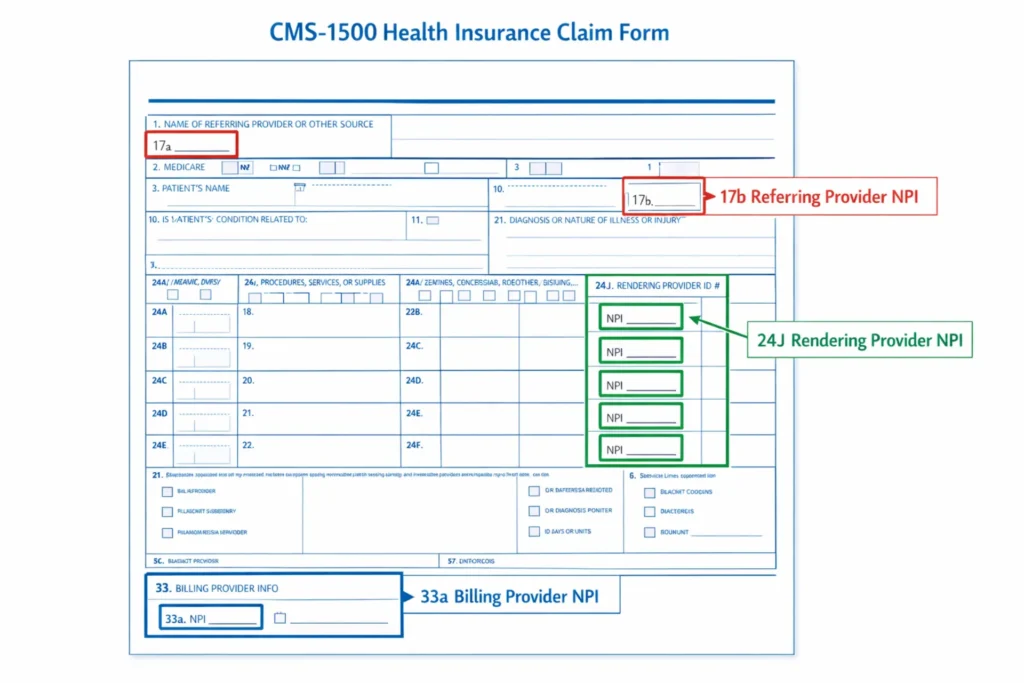
One important detail that catches new NEMT owners off guard: you must update your NPPES record within 30 days of any change. That includes address changes, phone number changes, or adding a new practice location. Failing to keep your NPI record current can cause claim rejections — and those rejected claims mean delayed revenue. If you’re expanding your NEMT business to multiple locations, keeping this updated is non-negotiable. <!–[IMAGE PLACEHOLDER: Annotated CMS-1500 form showing NPI boxes 17b, 24J, and 33a highlighted — caption: “Where your NPI appears on a standard NEMT claim”]–>
Who Needs an NPI Number?
Short answer:if you bill any government or private health insurance program through Medicaid billing for non-emergency medical transportation, you need an NPI.
But let’s break that down, because the NEMT industry has a specific wrinkle most healthcare providers don’t deal with.
NEMT Companies (The Business Entity)
Your LLC, corporation, or sole proprietorship needs a Type 2 NPI number. This is the organizational NPI that goes on every claim your company submits. If you’re a single-owner operation with one van, you still need it. If you run a fleet of 30 vehicles across three counties, you still need it.
Every state Medicaid program requires an NPI for provider enrollment. Texas HHSC, California’s Medi-Cal, New York’s eMedNY — all of them require your Type 2 NPI as part of the enrollment packet.
NEMT Drivers and Individual Providers
Here’s where it gets state-specific. Do individual NEMT drivers need their own NPI? It depends.
In some states, the company NPI is sufficient. Your drivers work under the organization’s enrollment, and claims go out with the Type 2 NPI. In other states — particularly those that credential individual drivers as rendering providers — each driver may need a Type 1 (individual) NPI.
From my experience handling NEMT credentialing across multiple states, the safest approach is this: always get a Type 2 NPI for your company. Then check with your state Medicaid agency and your broker networks to determine whether individual drivers need Type 1 NPIs.
For example, a Texas-based NEMT company billing through the state’s managed care organizations typically only needs the organizational NPI. But if that same company also operates in a state where Medicaid requires rendering provider identification at the individual level, each driver would need their own NPI.
Who Does NOT Need an NPI?
Private-pay transportation companies that never bill insurance don’t technically need an NPI. If you exclusively run cash-pay rides — airport shuttles, private senior transport, non-medical errands — you can operate without one. But the moment you take a Medicaid trip or contract with a transportation broker, you’ll need it. And since most profitable NEMT businesses bill Medicaid, getting your NPI early just makes sense.
Broker networks like MTM, ModivCare, MAS, and Alivi all require an NPI during provider onboarding. You won’t get past the first page of their application without one.
How NPI Numbers Are Used in NEMT Billing
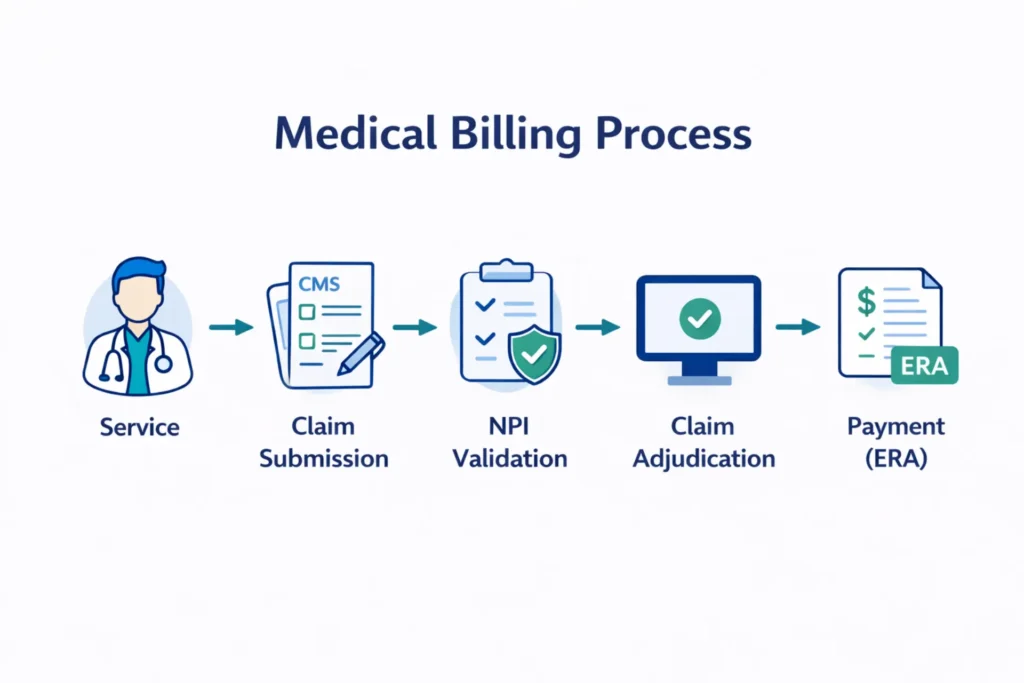
Your NPI number isn’t just an ID you get and forget — it’s the foundation of Medicaid billing for NEMT providers. It shows up on every single claim you file, and if the numbers don’t match what payers have on file, your claims get rejected. Period.
NPI on the CMS-1500 Claim Form
Most NEMT providers bill using the CMS-1500 form (or its electronic equivalent, the 837P). Here’s where your NPI appears:
Box 17b — Referring provider’s NPI. If a physician ordered the transportation, their NPI goes here.
Box 24J — Rendering provider’s NPI. This identifies who actually provided the service. For NEMT, this is usually your company NPI (Type 2) unless the state requires individual driver NPIs.
Box 33a — Billing provider’s NPI. This is the NPI of the entity submitting the claim and receiving payment. For most NEMT operations, this is your company’s Type 2 NPI.
Here’s what trips up new NEMT providers: the NPI in Box 33a must exactly match your enrollment with the payer. If your NPI record in NPPES says “ABC Transport LLC” but your Medicaid enrollment says “ABC Transportation LLC,” you’ll get denials. That one word difference is enough.
Common NPI-Related Claim Denials
The three most frequent NPI-related denial scenarios in NEMT billing are:
NPI not on file with the payer. You applied for your NPI but never completed state Medicaid enrollment or broker credentialing. The payer doesn’t recognize your NPI, so the claim bounces.
NPI/taxonomy mismatch. Your NPPES record shows taxonomy code 343900000X, but the payer’s system has you listed under a different code — or no code at all. This happens when providers update NPPES but forget to notify the payer.
Inactive or deactivated NPI. If you let your NPPES record go inactive (usually by not responding to revalidation notices), your claims will deny until you reactivate.
Understanding how NEMT denial codes work can save you thousands in lost revenue. Most NPI number-related denials are preventable with proper Medicaid billing setup.
NPI and Electronic Data Interchange (EDI)
Beyond paper claims, your NPI is embedded in every electronic transaction between your billing system and the payer. HIPAA requires the NPI in all electronic health transactions — that includes eligibility checks, claim submissions, remittance advice, and referral authorizations.
If you’re using NEMT dispatch and billing software, your NPI is stored in the system configuration. Make sure it matches what’s in NPPES exactly. Even a typo can cascade into weeks of denied claims. Our NEMT software comparison covers which platforms handle NPI configuration most reliably.
Confused About NEMT Billing and NPI Requirements?
Our CPC-certified billing team handles NPI enrollment, CMS-1500 claim submission, denial management, and payer follow-up — so you focus on transporting patients, not chasing payments. Zero setup fees. Zero hidden costs.
Type 1 NPI vs Type 2 NPI — Quick Summary
This is one of the most common questions we get from new NEMT providers, so let’s clear it up.
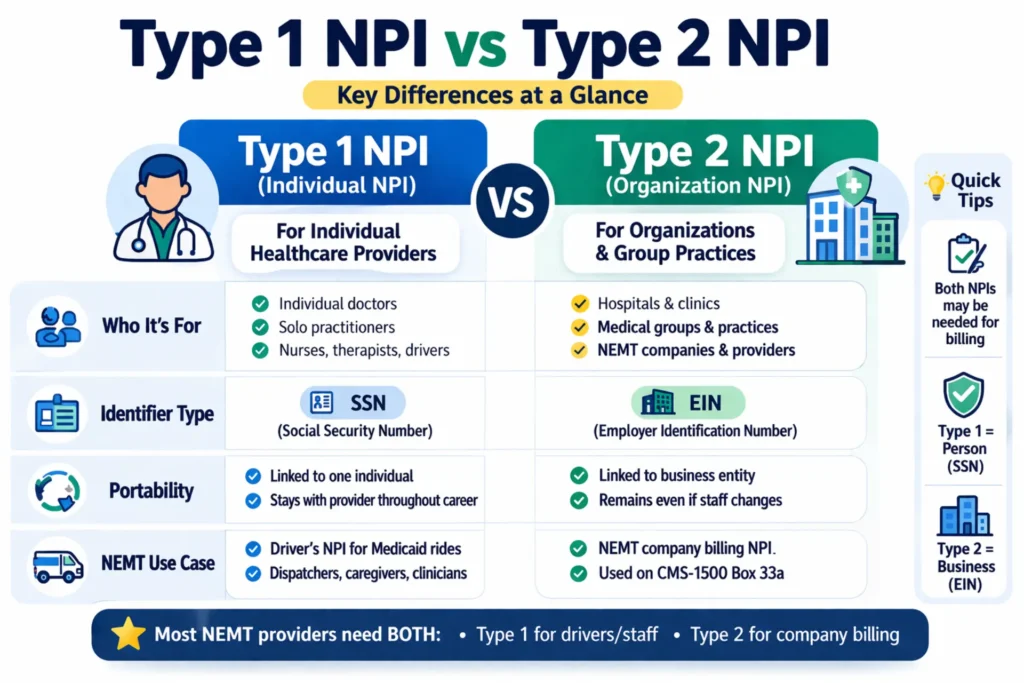
Type 1 NPI — Individual
A Type 1 NPI number is assigned to individual healthcare providers. That means a specific human being — a physician, a nurse practitioner, a therapist, or in some cases, an individual NEMT driver.
Key characteristics: it’s tied to the individual person, it follows them regardless of where they work, and it uses the person’s Social Security Number as part of the application. If a driver leaves your company and goes to work for a competitor, their Type 1 NPI goes with them.
Type 2 NPI — Organization
A Type 2 NPI is assigned to organizations — your LLC, your corporation, your partnership. This is the NPI your NEMT company operates under.
Key characteristics: it’s tied to the business entity, it uses the company’s EIN (Employer Identification Number), and it stays with the company even if ownership changes.
Which One Does Your NEMT Business Need?
Almost every NEMT company needs a Type 2 NPI. That’s the baseline. Your company is the entity billing Medicaid, contracting with brokers, and submitting claims.
Whether you also need Type 1 NPIs for individual drivers depends on your state and your payer contracts. Here’s a practical decision framework:
Get a Type 2 NPI only if: you operate in a state where the organizational NPI covers all billing, your broker contracts don’t require individual driver NPIs, and you’re the sole operator billing under your company.
Get both Type 1 and Type 2 if: your state Medicaid program requires rendering provider NPIs at the individual level, broker networks ask for individual driver credentials, or you’re a sole proprietor who also operates as the company (some states treat this differently). <!–[DIAGRAM PLACEHOLDER: Type 1 vs Type 2 NPI side-by-side comparison table showing: who it’s for, ID used for application (SSN vs EIN), portability, typical NEMT use case]–>
Not sure which combination your state requires? It varies. We’ve mapped the credentialing requirements for every state Medicaid program and major broker network. Check our NEMT compliance guide for state-specific details, or reach out and we’ll tell you exactly what you need.
For NEMT Startups
Need a Professional NEMT Website That Converts?
Your website is the first thing brokers, Medicaid agencies, and patients see. We build HIPAA-aware, mobile-first NEMT websites with online booking, trip request forms, and credentialing-ready contact pages — designed to turn visitors into paying clients.
How to Look Up an NPI Number
Whether you need to verify your own NPI, check a competitor’s enrollment status, or look up a referring provider’s number for a claim, the process is straightforward.
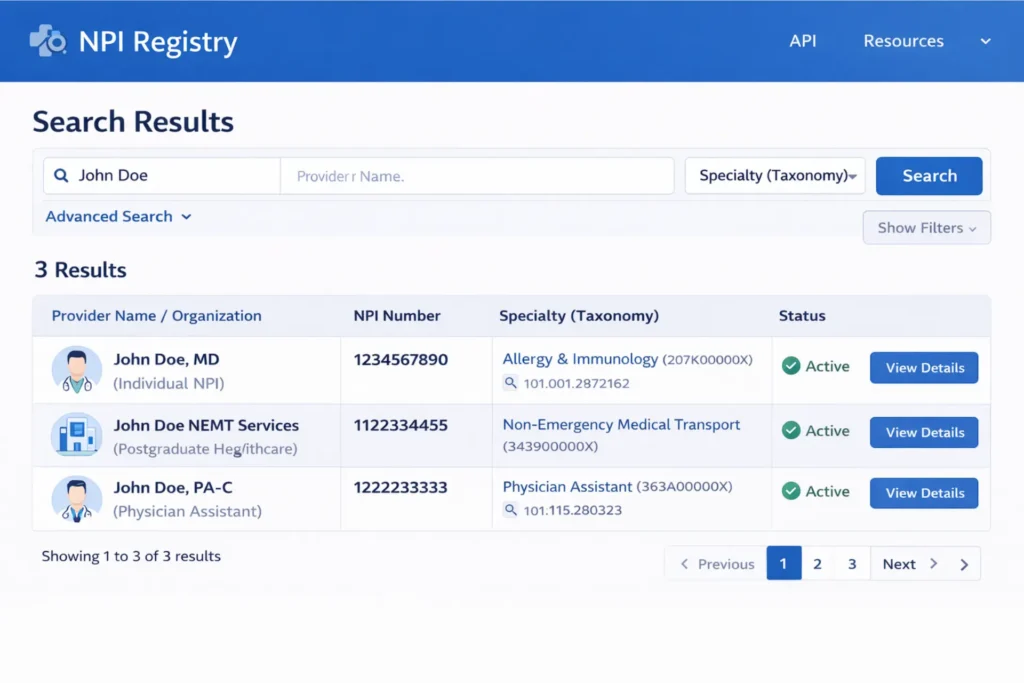
The NPPES NPI Registry
CMS maintains a free, public NPI lookup tool at npiregistry.cms.hhs.gov. You can search by provider name, NPI number, organization name, taxonomy code, city, or state. The database updates daily.
Here’s how to use it in practice:
To verify your own NPI: Enter your legal business name exactly as registered. If your search returns no results, try variations — “LLC” vs “L.L.C.,” or your DBA name vs your legal entity name. If nothing comes up, your NPI may not be active, which means claims won’t process.
To look up a broker or partner: If you’re coordinating with a hospital system, managed care organization, or referring physician, you can verify their NPI to ensure accurate claim submission.
To check enrollment status: The registry shows whether an NPI is active or deactivated. If you’re acquiring another NEMT company, checking their NPI status is basic due diligence.
Third-Party NPI Lookup Tools
Several websites offer NPI lookup services that pull from the same CMS data but add easier search interfaces and additional information. Sites like NPI Profile (npiprofile.com) let you browse by taxonomy code and see things like how many NEMT providers are registered in a given state.
As of early 2026, there are over 34,000 providers registered under taxonomy code 343900000X (Non-Emergency Medical Transport – Van) in the NPPES system. That number has grown steadily over the past five years, reflecting the expansion of the NEMT industry as a whole. <!–[SCREENSHOT PLACEHOLDER: NPPES NPI Registry search results page showing a sample NEMT provider lookup]–>
Protecting Your NPI
Treat your NPI like a business credential. While the number itself is public information (it’s in the NPPES registry, after all), you should still be careful about who has access to your NPPES login credentials. Someone with your login can change your address, your taxonomy, or your authorized official — and any of those changes can disrupt your billing.
Best practice: assign one trusted person as the Authorized Official on your NPPES account, use a dedicated business email for the account, and review your NPPES record quarterly. This is part of basic NEMT compliance that every provider should follow.
NPI Number and NEMT Credentialing
Getting your NPI is step one. But here’s what a lot of new NEMT owners don’t realize: the NPI alone doesn’t let you bill anyone. You need credentialing.
Think of it this way. Your NPI is your healthcare identity. Credentialing is the process of getting payers to recognize and accept that identity.
The NEMT Credentialing Sequence
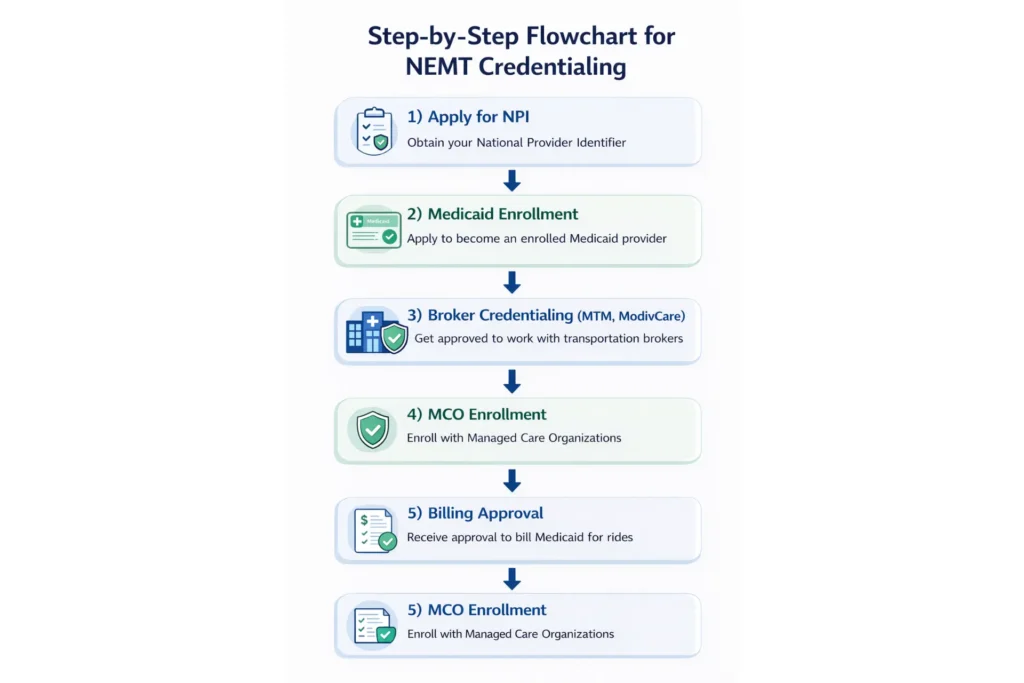
Here’s the order of operations that actually works. Skip a step, and you’ll be stuck waiting months to start earning:
Step 1: Apply for your NPI. This takes 1-10 business days through NPPES. It’s free. Do this before anything else.
Step 2: Enroll with your state Medicaid program. Every state has its own enrollment portal. Texas uses TMHP. New York uses eMedNY. California uses Medi-Cal’s PAVE system. You’ll submit your NPI, EIN, business license, insurance certificates, and vehicle documentation. Processing time varies — anywhere from 30 to 90 days depending on the state and completeness of your application. If you’re still sorting out NEMT insurance requirements, handle those before submitting your Medicaid enrollment.
Step 3: Credential with broker networks. MTM, ModivCare (formerly LogistiCare), MAS, Alivi, and SafeRide each have their own provider application process. All of them require your NPI. Most also require your Medicaid Provider ID from Step 2, plus insurance certificates naming them as additional insured, vehicle inspection documentation, and driver qualification files.
Step 4: Managed care organization enrollment (if applicable). Many states have moved NEMT services into managed care. That means you may need to enroll separately with MCOs like UnitedHealthcare, Anthem, or Centene — each of which will verify your NPI against NPPES. <!–[FLOWCHART PLACEHOLDER: NEMT credentialing process with NPI application as Step 1, followed by state Medicaid enrollment, broker credentialing, and MCO enrollment]–>
Real Timelines — Not Marketing Fluff
Let me be direct about how long this actually takes. When we handle NEMT credentialing at EliteMed Financials, start to finish:
NPI application: 1-10 business days. State Medicaid enrollment: 30-90 days (varies heavily by state — Michigan and Florida tend to be faster; New York and California take longer). Broker credentialing: 4-8 weeks per broker network. Full credentialing from zero to billing-ready: 60-120 days total.
The biggest delays we see aren’t from the agencies themselves — they’re from incomplete applications. A missing insurance certificate, an expired vehicle inspection, a driver without a current background check. Each missing document adds 2-4 weeks to the timeline. That’s why proper NEMT documentation upfront saves enormous time downstream.
For a deeper look at the full process from business formation to billing your first trip, our complete NEMT billing guide walks through every step.
Get Credentialed in 30–60 Days. Zero Errors.
EliteMed Financials handles your complete NEMT credentialing from start to finish — NPI application, state Medicaid enrollment, broker network credentialing (MTM, ModivCare, MAS, Alivi), and ongoing compliance monitoring. You focus on building your fleet. We get you billing-ready.
Frequently Asked Questions
What does NPI stand for in healthcare?
NPI stands for National Provider Identifier. It’s a unique 10-digit number assigned to every healthcare provider in the United States — including NEMT companies — through the NPPES system managed by CMS. The NPI replaced all previous provider identification numbers when it became the HIPAA standard identifier on May 23, 2007.
Every NEMT provider who bills Medicaid, Medicare, or private insurance needs an NPI. The number is permanent, free to obtain, and doesn’t change even if your business name, location, or ownership structure changes. For more on how NPI fits into overall healthcare billing, see our medical billing services overview.
What is an NPI number used for?
An NPI number is used to identify healthcare providers in every HIPAA-covered electronic transaction — including claims submission, eligibility verification, prior authorization requests, and remittance processing. For NEMT providers, the NPI appears on CMS-1500 claim forms in Boxes 24J and 33a, and is required for Medicaid enrollment and broker network credentialing.
Without an active NPI linked to your payer enrollments, no claims will process. It’s the foundational identifier that connects your business to every dollar of reimbursement flowing through the healthcare system.
Do NEMT drivers need their own individual NPI number?
It depends on your state and payer requirements. In most states, the NEMT company’s Type 2 (organizational) NPI is sufficient for billing. Drivers operate under the company’s enrollment and don’t need individual NPIs.
However, some state Medicaid programs and managed care plans require a rendering provider NPI at the individual level. When that’s the case, each driver needs a Type 1 (individual) NPI. Check your state’s Medicaid provider manual and your broker contracts to confirm. Our guide on NEMT driver requirements covers what’s needed state by state.
How long is an NPI number valid?
Your NPI number is valid for life. It never expires. Once CMS assigns you an NPI through the NPPES system, that number stays with you permanently — whether you’re an individual provider or a business entity.
That said, you must keep your NPPES record updated. CMS requires you to report any changes (address, phone, authorized official, taxonomy) within 30 days. Neglecting updates won’t deactivate your NPI automatically, but outdated information will cause claim denials and enrollment issues. Some states also require periodic Medicaid revalidation, which is separate from your NPI status. Review our NEMT audit preparation guide for compliance best practices.
Can I look up a provider’s NPI number online?
Yes. The CMS NPI Registry at npiregistry.cms.hhs.gov is a free, public database that lets anyone search for NPI numbers. You can search by provider name, organization name, NPI number, taxonomy code, location, or state. The database updates daily.
For NEMT providers, this tool is useful for verifying your own NPI status, checking the enrollment of partner organizations, and confirming referring provider NPIs for claim forms. Third-party sites like NPI Profile also pull from the same NPPES data with additional browsing features.
How do I get an NPI number for my NEMT business?
Go to nppes.cms.hhs.gov and create an account through the CMS Identity and Access system. Select “Organization” for a Type 2 NPI, enter your legal business name, EIN, and taxonomy code 343900000X for non-emergency medical transport. The application is free, and most NPIs are issued within 1 to 10 business days.
Is an NPI number the same as a Medicaid provider number?
No. Your NPI is a national identifier issued by CMS that identifies you across all payers. Your Medicaid provider number is state-specific and issued by your state’s Medicaid agency after you complete provider enrollment. You need the NPI first, then use it to apply for Medicaid enrollment. They’re two separate numbers that work together.
How much does it cost to get an NPI number?
Getting an NPI is completely free. There is no application fee, no annual maintenance cost, and no renewal charge. CMS issues NPI numbers through the NPPES system at no cost to the provider. Be cautious of any third-party website that charges a fee to “obtain” your NPI — the official process through nppes.cms.hhs.gov costs nothing.
What happens if I don’t have an NPI for my NEMT company?
Without an NPI, you cannot enroll as a Medicaid provider, credential with transportation broker networks like MTM or ModivCare, or submit claims for reimbursement. Every electronic healthcare transaction under HIPAA requires an NPI. Operating without one effectively locks you out of the NEMT billing process entirely.
What is taxonomy code 343900000X?
Taxonomy code 343900000X is the healthcare provider taxonomy classification for Non-Emergency Medical Transport (Van). You select this code when applying for your NPI through NPPES. It tells payers and the healthcare system that your organization provides NEMT services. As of 2026, over 34,000 providers are registered under this taxonomy code nationwide.
Getting Your NPI Right the First Time
Here’s the reality: your NPI number is the single most foundational credential your NEMT business needs. Without it, nothing moves forward — not Medicaid enrollment, not broker credentialing, not claims, not payments.
The good news? Getting an NPI is free and relatively quick. The process at NPPES takes minutes, and approval comes within days.
The harder part is what comes after. Connecting that NPI to your state Medicaid enrollment, aligning it with broker network requirements, making sure your NPPES record stays current, and ensuring every claim you file references the right NPI in the right box — that’s where most NEMT providers need help.
Here’s your action plan:
First, apply for your NPI at nppes.cms.hhs.gov if you haven’t already. Select Type 2 for your business entity, use taxonomy code 343900000X, and make sure your legal business name matches your IRS documents exactly.
Second, start your state Medicaid enrollment. Use the NPI you just received. Our step-by-step guide to becoming a NEMT provider covers the state-by-state process.
Third, begin broker credentialing with MTM, ModivCare, and any other networks operating in your service area. They’ll all need your NPI, Medicaid Provider ID, insurance documentation, and driver qualification files.
If the credentialing process feels overwhelming — and for most new NEMT owners, it does — that’s exactly what our team handles every day. EliteMed Financials walks NEMT providers from NPI application to first paid claim, covering credentialing, enrollment, and ongoing billing support.
Ready to Start Your NEMT Business the Right Way?
EliteMed Financials handles end-to-end NEMT credentialing and billing:
✅ NPI Application & Setup
✅ State Medicaid Enrollment
✅ Broker Network Credentialing
✅ Claims Submission & Follow-Up
✅ Denial Management & Appeals
✅ Ongoing Compliance Monitoring
Credentialed in 30–60 days. Zero setup fees. Zero errors.